
Verwandte Artikel zu Common Sense and Related Writings (The Bedford Series...
Common Sense and Related Writings (The Bedford Series in History and Culture) - Softcover
Buch 23 von 46: Bedford Series in History and Culture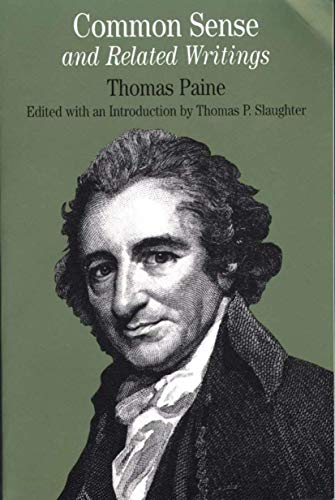
Inhaltsangabe
Thomas Paine's Common Sense is one of the most important primary documents of the Revolutionary era. This edition of the pamphlet is unique in its inclusion of selections from Paine's other writings from 1775 and 1776 - additional essays that contextualize Common Sense provide unusual insight on both the writer and the cause for which he wrote. The volume introduction focuses on Paine's childhood and early adult years in England, arguing for the significance of personal experience, environment, career, and religion in understanding Paine's influential political writings. The volume also includes a glossary, a chronology, illustrations, a selected bibliography, and questions for consideration.
Die Inhaltsangabe kann sich auf eine andere Ausgabe dieses Titels beziehen.
Über die Autorin bzw. den Autor
THOMAS P. SLAUGHTER is Professor of History at Rutgers University. He has written three prize-winning books and his books have won the National Historical Society Prize, the American Revolution Round Table Award, the Society of the Cincinnati Award, and the New Jersey Council for the Humanities Distinguished Author Award. He is a former fellow of the National Endowment for the Humanities, the Center for Advanced Study in the Behavioural Sciences, the John Simon Guggenheim Memorial Foundation and the Shelby Cullom Davis Center
Auszug. © Genehmigter Nachdruck. Alle Rechte vorbehalten.
Common Sense
And Related WritingsBy Thomas PaineBedford Books
Copyright © 2000 Thomas PaineAll right reserved.
ISBN: 9780312201487
Introduction
Perhaps the sentiments contained in the following pages, are not yetsufficiently fashionable to procure them general favor; a long habitof not thinking a thing wrong, gives it a superficial appearance ofbeing right, and raises at first a formidable outcry in defence ofcustom. But the tumult soon subsides. Time makes more converts thanreason.As a long and violent abuse of power, is generally the Means ofcalling the right of it in question (and in Matters too which mightnever have been thought of, had not the Sufferers been aggravatedinto the inquiry) and as the King of England hath undertaken in hisown Right, to support the Parliament in what he calls Theirs, and asthe good people of this country are grievously oppressed by thecombination, they have an undoubted privilege to inquire into thepretensions of both, and equally to reject the usurpation of either.
In the following sheets, the author hath studiously avoided everything which is personal among ourselves. Compliments as well ascensure to individuals make no part thereof. The wise, and theworthy, need not the triumph of a pamphlet; and those whosesentiments are injudicious, or unfriendly, will cease of themselvesunless too much pains are bestowed upon their conversion.
The cause of America is in a great measure the cause of all mankind.Many circumstances hath, and will arise, which are not local, butuniversal, and through which the principles of all Lovers of Mankindare affected, and in the Event of which, their Affections areinterested. The laying a Country desolate with Fire and Sword,declaring War against the natural rights of all Mankind, andextirpating the Defenders thereof from the Face of the Earth, is theConcern of every Man to whom Nature hath given the Power of feeling;of which Class, regardless of Party Censure, is the
author.
P. S. The Publication of this new Edition hath been delayed, with aView of taking notice (had it been necessary) of any Attempt torefute the Doctrine of Independance: As no Answer hath yet appeared,it is now presumed that none will, the Time needful for getting sucha Performance ready for the Public being considerably past.
Who the Author of this Production is, is wholly unnecessary to thePublic, as the Object for Attention is the Doctrine itself, not theMan. Yet it may not be unnecessary to say, That he is unconnectedwith any Party, and under no sort of Influence public or private,but the influence of reason and principle.
Philadelphia, February 14, 1776
Of the origin and design of government in general. With conciseremarks on the English constitution.
Some writers have so confounded society with government, as to leavelittle or no distinction between them; whereas they are not onlydifferent, but have different origins. Society is produced by ourwants, and government by our wickedness; the former promotes ourhappiness positively by uniting our affections, the latternegatively by restraining our vices. The one encourages intercourse,the other creates distinctions. The first is a patron, the last apunisher.
Society in every state is a blessing, but government even in itsbest state is but a necessary evil; in its worst state anintolerable one; for when we suffer, or are exposed to the samemiseries by a government, which we might expect in a country withoutgovernment, our calamity is heightened by reflecting that we furnishthe means by which we suffer. Government, like dress, is the badgeof lost innocence; the palaces of kings are built on the ruins ofthe bowers of paradise. For were the impulses of conscience clear,uniform, and irresistably obeyed, man would need no other lawgiver;but that not being the case, he finds it necessary to surrender up apart of his property to furnish means for the protection of therest; and this he is induced to do by the same prudence which inevery other case advises him out of two evils to choose the least.Wherefore, security being the true design and end of government, itunanswerably follows that whatever form thereof appears most likelyto ensure it to us, with the least expence and greatest benefit, ispreferable to all others.
In order to gain a clear and just idea of the design and end ofgovernment, let us suppose a small number of persons settled in somesequestered part of the earth, unconnected with the rest, they willthen represent the first peopling of any country, or of the world.In this state of natural liberty, society will be their firstthought. A thousand motives will excite them thereto, the strengthof one man is so unequal to his wants, and his mind so unfitted forperpetual solitude, that he is soon obliged to seek assistance andrelief of another, who in his turn requires the same. Four or fiveunited would be able to raise a tolerable dwelling in the midst of awilderness, but one man might labour out the common period of lifewithout accomplishing any thing; when he had felled his timber hecould not remove it, nor erect it after it was removed; hunger inthe mean time would urge him from his work, and every different wantcall him a different way. Disease, nay even misfortune would bedeath, for though neither might be mortal, yet either would disablehim from living, and reduce him to a state in which he might ratherbe said to perish than to die.
Thus necessity, like a gravitating power, would soon form our newlyarrived emigrants into society, the reciprocal blessings of which,would supersede, and render the obligations of law and governmentunnecessary while they remained perfectly just to each other; but asnothing but heaven is impregnable to vice, it will unavoidablyhappen, that in proportion as they surmount the first difficultiesof emigration, which bound them together in a common cause, theywill begin to relax in their duty and attachment to each other; andthis remissness, will point out the necessity, of establishing someform of government to supply the defect of moral virtue.
Some convenient tree will afford them a State-House, under thebranches of which, the whole colony may assemble to deliberate onpublic matters. It is more than probable that their first laws willhave the title only of Regulations, and be enforced by no otherpenalty than public disesteem. In this first parliament every man,by natural right, will have a seat.
But as the colony increases, the public concerns will increaselikewise, and the distance at which the members may be separated,will render it too inconvenient for all of them to meet on everyoccasion as at first, when their number was small, their habitationsnear, and the public concerns few and trifling. This will point outthe convenience of their consenting to leave the legislative part tobe managed by a select number chosen from the whole body, who aresupposed to have the same concerns at stake which those have whoappointed them, and who will act in the same manner as the wholebody would act were they present. If the colony continue increasing,it will become necessary to augment the number of therepresentatives, and that the interest of every part of the colonymay be attended to, it will be found best to divide the whole intoconvenient parts, each part sending its proper number; and that theelected might never form to themselves an interest separate from theelectors, prudence will point out the propriety of having electionsoften; because as the elected might by that means return and mixagain with the general body of the electors in a few months, theirfidelity to the public will be secured by the prudent reflexion ofnot...
„Über diesen Titel“ kann sich auf eine andere Ausgabe dieses Titels beziehen.
Suchergebnisse für Common Sense and Related Writings (The Bedford Series...

Foto des Verkäufers
Common Sense: and Related Writings (The Bedford Series in History and Culture)
Anbieter: Dream Books Co., Denver, CO, USA
Verkäuferbewertung 5 von 5 Sternen

Zustand: good. Gently used with minimal wear on the corners and cover. A few pages may contain light highlighting or writing, but the text remains fully legible. Dust jacket may be missing, and supplemental materials like CDs or codes may not be included. May be ex-library with library markings. Ships promptly! Bestandsnummer des Verkäufers DBV.0312201486.G
Gebraucht kaufen
EUR 7,27
Versand gratis
Versand innerhalb von USA
Versand innerhalb von USA
Anzahl: 1 verfügbar
Foto des Verkäufers
Common Sense: and Related Writings (The Bedford Series in History and Culture)
Anbieter: Bay State Book Company, North Smithfield, RI, USA
Verkäuferbewertung 5 von 5 Sternen
Zustand: good. The book is in good condition with all pages and cover intact, including the dust jacket if originally issued. The spine may show light wear. Pages may contain some notes or highlighting, and there might be a "From the library of" label. Boxed set packaging, shrink wrap, or included media like CDs may be missing. Bestandsnummer des Verkäufers BSM.1EQUX
Gebraucht kaufen
EUR 7,27
Versand gratis
Versand innerhalb von USA
Versand innerhalb von USA
Anzahl: 1 verfügbar
Beispielbild für diese ISBN
Common Sense and Related Writings
Verlag:
Bloomsbury Publishing PLC, 2001
ISBN 10: 0312201486
ISBN 13: 9780312201487
Gebraucht
Paperback
Anbieter: World of Books (was SecondSale), Montgomery, IL, USA
Verkäuferbewertung 5 von 5 Sternen
Paperback. Zustand: Good. The volume introduction focuses on Paine's childhood and early adult years in England, arguing for the significance of personal experience, environment, career, and religion in understanding Paine's influential political writings. Bestandsnummer des Verkäufers CIN0312201486G
Gebraucht kaufen
EUR 7,38
Versand gratis
Versand innerhalb von USA
Versand innerhalb von USA
Anzahl: 2 verfügbar
Beispielbild für diese ISBN
Common Sense: And Related Writings
Anbieter: ThriftBooks-Atlanta, AUSTELL, GA, USA
Verkäuferbewertung 5 von 5 Sternen
Paperback. Zustand: Fair. No Jacket. Readable copy. Pages may have considerable notes/highlighting. ~ ThriftBooks: Read More, Spend Less. Bestandsnummer des Verkäufers G0312201486I5N00
Gebraucht kaufen
EUR 8,85
Versand gratis
Versand innerhalb von USA
Versand innerhalb von USA
Anzahl: 1 verfügbar
Beispielbild für diese ISBN
Common Sense: And Related Writings
Anbieter: ThriftBooks-Dallas, Dallas, TX, USA
Verkäuferbewertung 5 von 5 Sternen
Paperback. Zustand: Very Good. No Jacket. May have limited writing in cover pages. Pages are unmarked. ~ ThriftBooks: Read More, Spend Less. Bestandsnummer des Verkäufers G0312201486I4N00
Gebraucht kaufen
EUR 8,85
Versand gratis
Versand innerhalb von USA
Versand innerhalb von USA
Anzahl: 1 verfügbar
Beispielbild für diese ISBN
Common Sense: And Related Writings
Anbieter: ThriftBooks-Atlanta, AUSTELL, GA, USA
Verkäuferbewertung 5 von 5 Sternen
Paperback. Zustand: Good. No Jacket. Pages can have notes/highlighting. Spine may show signs of wear. ~ ThriftBooks: Read More, Spend Less. Bestandsnummer des Verkäufers G0312201486I3N00
Gebraucht kaufen
EUR 8,85
Versand gratis
Versand innerhalb von USA
Versand innerhalb von USA
Anzahl: 1 verfügbar
Beispielbild für diese ISBN
Common Sense: And Related Writings
Anbieter: ThriftBooks-Atlanta, AUSTELL, GA, USA
Verkäuferbewertung 5 von 5 Sternen
Paperback. Zustand: As New. No Jacket. Pages are clean and are not marred by notes or folds of any kind. ~ ThriftBooks: Read More, Spend Less. Bestandsnummer des Verkäufers G0312201486I2N00
Gebraucht kaufen
EUR 8,85
Versand gratis
Versand innerhalb von USA
Versand innerhalb von USA
Anzahl: 1 verfügbar
Beispielbild für diese ISBN
Common Sense and Related Writings
Verlag:
Bloomsbury Publishing PLC, 2001
ISBN 10: 0312201486
ISBN 13: 9780312201487
Gebraucht
Paperback
Anbieter: World of Books Inc, Montgomery, IL, USA
Verkäuferbewertung 4 von 5 Sternen

Paperback. Zustand: Good. The volume introduction focuses on Paine's childhood and early adult years in England, arguing for the significance of personal experience, environment, career, and religion in understanding Paine's influential political writings. Bestandsnummer des Verkäufers CIN0312201486G
Gebraucht kaufen
EUR 9,22
Versand gratis
Versand innerhalb von USA
Versand innerhalb von USA
Anzahl: 2 verfügbar
Foto des Verkäufers
Common Sense: and Related Writings (The Bedford Series in History and Culture)
Anbieter: Big River Books, Powder Springs, GA, USA
Verkäuferbewertung 5 von 5 Sternen
Zustand: good. This book is in good condition. The cover has minor creases or bends. The binding is tight and pages are intact. Some pages may have writing or highlighting. Bestandsnummer des Verkäufers BRV.0312201486.G
Gebraucht kaufen
EUR 8,92
EUR 3,56 Versand
Versand innerhalb von USA
Versand innerhalb von USA
Anzahl: 1 verfügbar