
Verwandte Artikel zu The Animation Business Handbook
Inhaltsangabe
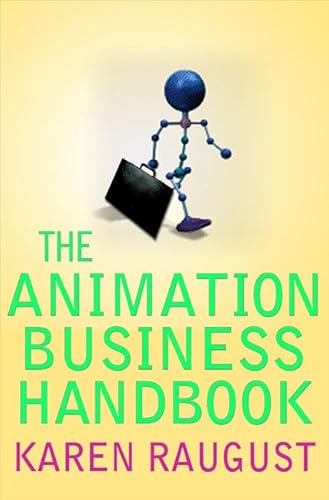
Today, animation is more prevalent than ever in television, films, videogames, and the Internet. Karen Raugust created a much needed, comprehensive look at the entire business. She shows in detail how a successful animation studio or entrepreneur operates, describes the process of developing an animation property from the concept stage through the finished product, and outlines business methods used to create and sell animated media. Topics covered include: Distribution, sales, and marketing methods; Financing, budgeting, costs, and revenue opportunities; The creation of ancillary entertainment and merchandise; Animation in international markets. The Animation Business Handbook is the essential reference for anyone in or considering entering the animation industry.
Die Inhaltsangabe kann sich auf eine andere Ausgabe dieses Titels beziehen.
Über die Autorin bzw. den Autor
Karen Raugust is a freelance licensing consultant and frequent contributor to Animation Magazine, in which she also publishes a monthly column. She has written for approximately thirty other magazines, including Publishers Weekly, Billboard, and Variety Jr. She has authored and contributed to a number of trade books on marketing, entertainment, and business. She lives in Minneapolis, MN.
Auszug. © Genehmigter Nachdruck. Alle Rechte vorbehalten.
ANIMATION BUSINESS HDBK
PART I
PROPRIETARY PROPERTIES
1
Overview of Proprietary Animation Projects
Proprietary animation properties are those in which the creator or a production company, such as an animation studio, owns or maintains an interest. Given the complicated negotiations and deal structures required to get an animated property made and distributed in the 2000s, many proprietary properties have more than one owner. Meanwhile, sole owners often must share the revenues from their properties with several other parties.
Most proprietary animation projects fall into the realm of entertainment, but otherwise vary significantly. They can range in length from less than one minute to ninety minutes or more, encompass one-off projects and ongoing series, and extend into all entertainment media.
FILM
Film producers released 482 films (both animated and live-action) in 2001. Together these features generated a U.S. gross box office take of $8.4 billion, according to the Motion Picture Association of America (MPAA). The box office total was up 9.8 percent from 2000, when 478 films hit theaters.
During the 1990s the number of animated films released each year grew consistently. Of the films released in 2001, twelve were animated, compared to three in 1991, seven in 1999, and ten in 2000. The twelve released in 2001 accounted for about $790 million in ticket sales, or 10 percent of the total box office take for U.S. films that year. Since they represented only 3 percent of films released, their box office totals were, on average, higher than those for live-action films. (These numbers include only fully animated films and not those that were special-effects-heavy, live-action productions, such as Warner Brothers' Cats and Dogs in 2001.)
Many animated films, of course, do very well theatrically, generating among the top ticket sales in any given year. According to Exhibitor Relations, which tracks U.S. box office, the top animated film of 2001 was Shrek, which racked up $267.6 million in U.S. ticket revenues, followed by Monsters, Inc., with $244.6 million. These two films ranked third and fourth respectively in the total box office rankings of all films that year.
Most animated feature films are funded and distributed by the major Hollywood studios such as Disney or Dream Works, or television networks with feature film arms, such as Nickelodeon, which partners with its sister company Paramount on film distribution. A few are produced apart from the studio system and sold to exhibitors through independent distributors, but these are rare.
The big studios released ten of the animated movies that came out in 2001; the top "independent" release (Waking Life, released by 20th Century Fox's art-house subsidiary, Searchlight) ranked number 164 in total box office for that year, selling $2.9 million worth of tickets.
Overall, animated films' ability to bring in significant revenues varies widely. In addition to Shrek and Monsters, Inc., other animated features released in 2001 included Atlantis: The Lost Empire (generating $84 million at the box office), Jimmy Neutron: Boy Genius ($62.3 million), Recess: School's Out ($36.6 million), Final Fantasy ($32.1 million), Pokémon 3 ($17 million), Osmosis Jones ($13.5 million), Waking Life ($2.5 million), and The Trumpet of the Swan ($152,525). Of course, even a low-revenue film can be profitable if its budget is small. Jonah: A Veegie Tales Movie (Big Idea/Artisan Entertainment, 2002) generated a U.S. box office gross of over $25.5 million. The production budget was $14 million and the print and advertising budget $7 million.
In 2001 75 percent of the films that held the number-one box office ranking in their opening weekend saw revenues drop by at least half the next week. The first weekend, therefore, is critical to a picture's success, and studios spend significant marketing dollars to drive audiences to the film during its first few days. The focus on marketing a film's premiere probably contributes to the quick drop-off in attendance for most movies. At the same time, if a release fails to make a mark immediately it will be pulled from theaters; most are no longer given the chance to succeed over time.
Another reason behind the large drop-off in attendance after the opening weekend is that films are able to screen on a huge number of theaters upon their debut, enabling virtually everyone who wants to see a film to see it on the first weekend. Some films open on as many as five thousand screens.
The need to generate moviegoer interest in a film prior to its release is one reason many films--especially those intended to be blockbusters--arebased on recognized franchises such as television shows, comic books, or books. Of the top ten films of 2001, as ranked by U.S. box office totals, seven were based on well-known "brands." The top three were based on books, two were sequels, and two were remakes.
In addition to relying on franchise pictures, many studios are reducing risk by decreasing the overall number of films they release each year. Uni-- versal's output fell from thirty-five to less than twenty and Disney's from thirty to less than twenty from 1998 to 2001.
One area of the feature film business that represents a small but growing opportunity for animated movies is large-format distribution. IMAX is the best-known name in this segment, operating two hundred theaters as of 2001 and planning an ambitious expansion. IMAX showed its first all-animated release, Cyberworld, in 2000. The 45-minute project included eight short films from DreamWorks, 20th Century Fox, Sony, and other entertainment companies.
Walt Disney became the first studio to release a film simultaneously in traditional 35-millimeter theaters and on IMAX screens in 2002 with Treasure Planet, after having had successful IMAX runs with previous movies, including Beauty and the Beast and Fantasia. The IMAX version of Fantasia 2000 brought in about $50 million at fifty-four large-format theaters.
Other studios large and small have released films in large-format theaters, or are looking at large-format distribution as a potential avenue for their films, either on an exclusive basis or along with traditional theatrical outlets. Meanwhile, IMAX invested over $10 million in the CGI animation house Mainframe Entertainment in 1999. The two companies set up a joint venture to produce films for the IMAX format.
Many of the so-called "live-action" movies on the market today are actually composed of a significant amount of animated footage in the form of computer-generated (CG) special effects. Sometimes entire characters--such as Jar Jar Binks in Star Wars: Episode I--The Phantom Menace (1999), Dobby in Harry Potter and the Chamber of Secrets (2002), or Gollum in the Lord of the Rings trilogy (2001--2003)--are CG creations.
Often these effects-filled films are at the top of the box office rankings in a given year. In fact, about a quarter of the $8 billion in domestic box office in 2001 was attributable to films with CG animation. That includes Shrek, Monsters, Inc., and several other CG-animated releases, as well as Harry Potter and the Sorcerer's Stone (bringing in $317.5 million at the domestic box office), The Lord of the Rings: The Fellowship of the Ring ($311.7 million), The Mummy Returns ($202 million), Pearl Harbor ($198.5 million), and Jurassic Park III ($181.1 million).
In 2002 seven of the top ten films were dependent on effects. They included Spider-Man (with a domestic...
„Über diesen Titel“ kann sich auf eine andere Ausgabe dieses Titels beziehen.
Suchergebnisse für The Animation Business Handbook

Foto des Verkäufers
The Animation Business Handbook
Anbieter: Goodwill Books, Hillsboro, OR, USA
Verkäuferbewertung 5 von 5 Sternen

Zustand: good. Signs of wear and consistent use. Bestandsnummer des Verkäufers GICWV.0312284284.G
Gebraucht kaufen
EUR 22,30
EUR 3,56 Versand
Versand innerhalb von USA
Versand innerhalb von USA
Anzahl: 1 verfügbar
Beispielbild für diese ISBN
The Animation Business Handbook
Anbieter: Revaluation Books, Exeter, Vereinigtes Königreich
Verkäuferbewertung 5 von 5 Sternen
Hardcover. Zustand: Brand New. new title edition. 384 pages. 9.50x6.25x1.25 inches. In Stock. Bestandsnummer des Verkäufers 0312284284
Neu kaufen
EUR 80,85
EUR 14,91 Versand
Versand von Vereinigtes Königreich nach USA
Versand von Vereinigtes Königreich nach USA
Anzahl: 1 verfügbar