
Verwandte Artikel zu The Devil's Guide to Hollywood: The Screenwriter...
Inhaltsangabe
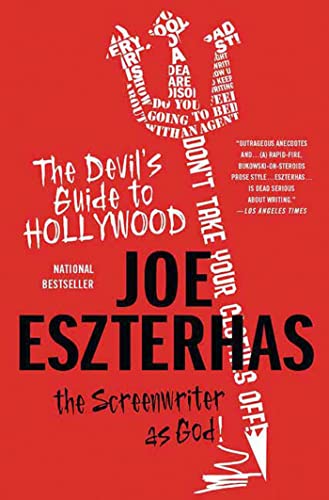
In The Devil's Guide to Hollywood, bestselling author and legendary bad-boy screenwriter Joe Eszterhas tells everything he knows about the industry, its players and screenwriting itself-from the first blank sheet of paper in the Olivetti to the size of the credit on the one-sheet.
"There's just one hunk of funny anecdote after another, quotes from everyone who ever mattered in the movie biz, and the thing is jam-packed with screenwriterly advice. Plus it's hilariously funny, ribald, sexy and brilliant."-Liz Smith
Often practical and always entertaining, The Devil's Guide to Hollywood distills everything one of Hollywood's most accomplished screenwriters knows about the business, from writing advice to negotiation tricks, from the wisdom of past players to the feuds of current ones. Eszterhas has selected his personal pantheon of the most loved and loathed players in the business and treats the reader to a treasure trove of stories, quotes and wisdom from those luminaries, who include William Goldman (loathes) and Zsa Zsa Gabor (loves).
The Devil's Guide to Hollywood could only have been written by someone who loves the business as much as Eszterhas does-but who also has its number.
"Eszterhas delivers a dishy, catty mix of reminiscences and Hollywood trivia...his forte is skewering sycophants and phonies in this opinionated showcase of the underside of Hollywood life."-Publishers Weekly
Die Inhaltsangabe kann sich auf eine andere Ausgabe dieses Titels beziehen.
Über die Autorin bzw. den Autor
Joe Eszterhas has written fifteen films which have made more than a billion dollars at the box office. Among them are Basic Instinct, Jagged Edge, Flashdance, Showgirls, Betrayed, Music Box and F.I.S.T. He is the author of the recent New York Times bestsellers AMERICAN RHAPSODY and HOLLYWOOD ANIMAL. In 1975, his second book, CHARLIE SIMPSON'S APOCALYPSE, was nominated for the National Book Award. He was a senior editor at Rolling Stone from 1971 to 1975. He lives with his wife, Naomi, and their four sons in Bainbridge Township, Ohio.
Von der hinteren Coverseite
In "The Devil's Guide to Hollywood," bestselling author and legendary bad-boy screenwriter Joe Eszterhas tells everything he knows about the industry, its players, and screenwriting itself--from the first blank sheet of paper in the Olivetti to the size of the credit on the one-sheet.
"The Devil's Guide to Hollywood" distills everything one of Hollywood's most accomplished screenwriters knows about the business: from writing advice to negotiation tricks, from the wisdom of past players to the feuds of current ones. Eszterhas dispenses advice as only he can: with his tongue firmly in cheek and a certain finger extended good-naturedly toward the sky. His tips on how to survive in Hollywood are based on his own rugged and real-life experiences: they are not just useful but vastly entertaining. He reveals what he's seen in Hollywood and what he's learned about writing and selling scripts there for record amounts. He also recounts bite-sized takes from personalities he either admires or loathes, sharing the richest, best industry lore that has inspired, amused or enraged him over the years.
"The Devil's Guide to Hollywood" is hilarious, ornery, colorful and wise. It could only have been written by someone who loves the business as much as Eszterhas does--but who also has its number.
Auszug. © Genehmigter Nachdruck. Alle Rechte vorbehalten.
The Devil's Guide to Hollywood
The Screenwriter as God!
By Joe EszterhasSt. Martin's Press
Copyright © 2006 Joe Eszterhas
All rights reserved.
ISBN: 978-0-312-37384-9All rights reserved.
Contents
Title Page,
Copyright Notice,
Dedication,
Epigraph,
Acknowledgments,
Preface,
PART ONE: Pursuing Your Dream,
PART TWO: Learning the Business,
PART THREE: Getting Ready to Write the Script,
PART FOUR: Writing the Script,
PART FIVE: Selling the Script,
PART SIX: Filming the Script,
PART SEVEN: Working with the Director,
PART EIGHT: Working with the Producer,
PART NINE: Dealing with the Studio,
PART TEN: Inspiring the Actors,
PART ELEVEN: Surviving the Critics,
PART TWELVE: The Happy Ending,
Epilogue,
Index,
Praise for Joe Eszterhas's Nonfiction,
Copyright,
CHAPTER 1
LESSON 1
They Can Snort You Here!
Why do you want to be a screenwriter?
The answer I get from most young wannabe screenwriters is, "Cuz I want to be rich."
I tell them what Madonna says: "Money makes you beautiful."
And I tell them that I've made a lot of money but that I'll never be beautiful.
Why do you want to write a screenplay?
Screenwriter/novelist Raymond Chandler (The Blue Dahlia): "Where the money is, so will the jackals gather."
You, too, can be a star.
My biggest year was 1994. I wrote five scripts in one year. I made almost $10 million. I had houses in Tiburon and Malibu, California, and in Kapalua, Maui.
I made half a million dollars for writing a thirty-second television commercial for Chanel No. 5 perfume.
I fell in love. I got divorced. I married my second wife. Our first child was born.
I had the best tables at Spago and the Ivy and at Granita, Postrio, and Roy's. I had limos in northern California, in Malibu, and on Maui.
I ate more, I drank more, I made love more, and I spent more time in the sun than I ever had. The world was my oyster.
I became the screenwriter as star.
"Ben Hecht," his friend Budd Schulberg wrote many years ago, "seemed the personification of the writer at the top of his game, the top of his world, not gnawing at and doubting himself as great writers were said to do, but with every word and every gesture indicating the animal pleasure he took in writing well."
Robert McKee makes money, doesn't he?
When a student interrupted a McKee seminar with a question, McKee roared, "Do not interrupt me!"
A few minutes later, McKee shouted to the student, "If you think that this course is about making money, there's the door!"
I'll say this right up front: This book is about making money.
Money is not the best thing about screenwriting.
The best thing about screenwriting is this: I sit in a little room making things up and put my conjurings down on paper. A year and a half later, if I'm lucky, my conjurings will be playing all over the world on movie screens, giving enjoyment to hundreds of millions of people.
For two hours, the lives of hundreds of millions of people will have been made better by something that I conjured up in a little room out of my own heart, gut, and brain.
By then, my conjurings will have become a megacorporation employing thousands of people — from gaffers to makeup people to ticket sellers.
And it will all have begun with me, with my imagination and my creativity, literally communicating with the whole world.
That's the best part of screenwriting.
The money (almost) doesn't matter.
Screenwriter Jack Epps (Top Gun, Legal Eagles): "You do it because you love the movies. The money gets in the way. I think that if you're a good writer, the money will follow. But if you're writing for money, I don't think it's going to work. I think that very few people can make that happen." I'll say this right up front: This book is about making money. Without losing your soul.
Ben Hecht is no role model.
Wrote Ben: "The fact that the movie magnate is going to make an enormous pile of money out of my story and that I am therefore entitled to a creditable share of it seldom, if ever, occurs to me. I am, to the contrary, convinced that my contribution is nil. The story I will provide will be a piece of hack work, containing in it a reshuffling of familiar plot turns and characterizations."
REELSPEAK
Getting to the Tit
An old Hollywood expression for making some big money.
If you sell a script, you'll be part of a fun and glamorous business.
When he got back to London after the Lawrence of Arabia shoot, screenwriter Robert Bolt told the London Sunday Times that the shoot had been "a continuous clash of egomaniacal monsters wasting more energy than dinosaurs and pouring rivers of money into the sand."
REELSPEAK
Dream Street
Hollywood legend: If you walk down Dream Street and somebody notices you (or buys your script), you can be a star overnight.
We have no role models.
When asked by reporters why he was a screenwriter, Ben Hecht, the most successful screenwriter in the history of Hollywood, said, "Because I was born in a toilet."
Screenwriter William Goldman (Butch Cassidy and the Sundance Kid, All The President's Men) described himself in the twilight of his career this way in his book Hype and Glory: "Couldn't walk, couldn't read, couldn't do a goddamn thing but stare the night away and block out the past."
His big brother, screenwriter James Goldman (The Lion in Winter), wrote this to director Joe Mankiewicz: "I need your help to write this thing. If this letter sounds prosy and dull, it's because I've been reading my script."
Screenwriter Charlie Kaufman, in Adaptation: "Do I have an original thought in my head? Maybe if I were happier my hair wouldn't be falling out. ... I'm a walking cliché. Why should I be made to feel that I have to apologize for my existence?"
In the movie Tales of Ordinary Madness, written by Charles Bukowski about himself, a prostitute was trying to get Ben Gazzara (playing Bukowski) to stop writing and make love to her.
Watching the movie in the back of a Hollywood theater, the real Bukowski yelled, "If that were me, I would have stopped typing long ago."
Somebody in the audience told him to shut up.
"Hey," Bukowski said. "I'm the guy they made the movie about. I can say anything I want to say!"
Somebody yelled, "Oh yeah? Then shut the fuck up!"
Bukowski yelled, "Oh yeah? Fuck you!"
Cops were called. They handcuffed Charlie Bukowski and dragged him out of his own movie and locked him in jail.
You're certainly in good literary company.
William Faulkner, F. Scott Fitzgerald, Truman Capote, Alberto Moravia, Carson McCullers, John Steinbeck, John O'Hara, Dorothy Parker, Jim Harrison, Joan Didion, Ken Kesey, William Kennedy, Norman Mailer, Ayn Rand, Jay McInerney, and Hunter S. Thompson were all screenwriters at one point or another.
Faulkner even took a meeting with Sammy Glick.
After he won the Nobel Prize for Literature, William Faulkner did rewrites of these scripts: The Left Hand of God and Land of the Pharaohs. He took meetings with actress Julie Harris and producer Jerry Wald, Budd...
„Über diesen Titel“ kann sich auf eine andere Ausgabe dieses Titels beziehen.
Suchergebnisse für The Devil's Guide to Hollywood: The Screenwriter...

Beispielbild für diese ISBN
The Devil's Guide to Hollywood: The Screenwriter as God!
Anbieter: Gulf Coast Books, Cypress, TX, USA
Verkäuferbewertung 5 von 5 Sternen

paperback. Zustand: Fair. Bestandsnummer des Verkäufers 0312373848-4-35731483
Gebraucht kaufen
EUR 5,53
Versand gratis
Versand innerhalb von USA
Versand innerhalb von USA
Anzahl: 1 verfügbar
Beispielbild für diese ISBN
The Devil's Guide to Hollywood: The Screenwriter as God!
Verlag:
St. Martin's Griffin (edition Reprint), 2007
ISBN 10: 0312373848
ISBN 13: 9780312373849
Gebraucht
Paperback
Anbieter: BooksRun, Philadelphia, PA, USA
Verkäuferbewertung 5 von 5 Sternen
Paperback. Zustand: Very Good. Reprint. It's a well-cared-for item that has seen limited use. The item may show minor signs of wear. All the text is legible, with all pages included. It may have slight markings and/or highlighting. Bestandsnummer des Verkäufers 0312373848-11-1
Gebraucht kaufen
EUR 5,54
Versand gratis
Versand innerhalb von USA
Versand innerhalb von USA
Anzahl: 2 verfügbar
Beispielbild für diese ISBN
The Devil's Guide to Hollywood: The Screenwriter as God!
Anbieter: The Maryland Book Bank, Baltimore, MD, USA
Verkäuferbewertung 5 von 5 Sternen
paperback. Zustand: Good. Reprint. Corners are slightly bent. Used - Good. Bestandsnummer des Verkäufers 1-o-5-1552
Gebraucht kaufen
EUR 2,18
EUR 4,19 Versand
Versand innerhalb von USA
Versand innerhalb von USA
Anzahl: 1 verfügbar
Beispielbild für diese ISBN
The Devil's Guide to Hollywood: The Screenwriter as God!
Anbieter: ThriftBooks-Reno, Reno, NV, USA
Verkäuferbewertung 5 von 5 Sternen
Paperback. Zustand: Good. No Jacket. Pages can have notes/highlighting. Spine may show signs of wear. ~ ThriftBooks: Read More, Spend Less. Bestandsnummer des Verkäufers G0312373848I3N00
Gebraucht kaufen
EUR 6,57
Versand gratis
Versand innerhalb von USA
Versand innerhalb von USA
Anzahl: 1 verfügbar
Beispielbild für diese ISBN
The Devil's Guide to Hollywood: The Screenwriter as God!
Anbieter: ThriftBooks-Dallas, Dallas, TX, USA
Verkäuferbewertung 5 von 5 Sternen
Paperback. Zustand: Good. No Jacket. Pages can have notes/highlighting. Spine may show signs of wear. ~ ThriftBooks: Read More, Spend Less. Bestandsnummer des Verkäufers G0312373848I3N00
Gebraucht kaufen
EUR 6,57
Versand gratis
Versand innerhalb von USA
Versand innerhalb von USA
Anzahl: 1 verfügbar
Beispielbild für diese ISBN
The Devil's Guide to Hollywood: The Screenwriter as God!
Anbieter: ThriftBooks-Phoenix, Phoenix, AZ, USA
Verkäuferbewertung 5 von 5 Sternen
Paperback. Zustand: Good. No Jacket. Pages can have notes/highlighting. Spine may show signs of wear. ~ ThriftBooks: Read More, Spend Less. Bestandsnummer des Verkäufers G0312373848I3N00
Gebraucht kaufen
EUR 6,57
Versand gratis
Versand innerhalb von USA
Versand innerhalb von USA
Anzahl: 1 verfügbar
Beispielbild für diese ISBN
The Devil's Guide to Hollywood: The Screenwriter as God!
Anbieter: ThriftBooks-Atlanta, AUSTELL, GA, USA
Verkäuferbewertung 5 von 5 Sternen
Paperback. Zustand: Good. No Jacket. Pages can have notes/highlighting. Spine may show signs of wear. ~ ThriftBooks: Read More, Spend Less. Bestandsnummer des Verkäufers G0312373848I3N00
Gebraucht kaufen
EUR 6,57
Versand gratis
Versand innerhalb von USA
Versand innerhalb von USA
Anzahl: 1 verfügbar
Beispielbild für diese ISBN
The Devil's Guide to Hollywood: The Screenwriter as God!
Anbieter: ThriftBooks-Atlanta, AUSTELL, GA, USA
Verkäuferbewertung 5 von 5 Sternen
Paperback. Zustand: Very Good. No Jacket. May have limited writing in cover pages. Pages are unmarked. ~ ThriftBooks: Read More, Spend Less. Bestandsnummer des Verkäufers G0312373848I4N00
Gebraucht kaufen
EUR 6,57
Versand gratis
Versand innerhalb von USA
Versand innerhalb von USA
Anzahl: 1 verfügbar
Beispielbild für diese ISBN
The Devil's Guide to Hollywood : The Screenwriter As God!
Anbieter: Better World Books, Mishawaka, IN, USA
Verkäuferbewertung 5 von 5 Sternen
Zustand: Good. Reprint. Pages intact with minimal writing/highlighting. The binding may be loose and creased. Dust jackets/supplements are not included. Stock photo provided. Product includes identifying sticker. Better World Books: Buy Books. Do Good. Bestandsnummer des Verkäufers 9270607-6
Gebraucht kaufen
EUR 6,75
Versand gratis
Versand innerhalb von USA
Versand innerhalb von USA
Anzahl: 1 verfügbar
Beispielbild für diese ISBN
The Devil's Guide to Hollywood: The Screenwriter as God!
Anbieter: HPB-Diamond, Dallas, TX, USA
Verkäuferbewertung 5 von 5 Sternen
paperback. Zustand: Very Good. Connecting readers with great books since 1972! Used books may not include companion materials, and may have some shelf wear or limited writing. We ship orders daily and Customer Service is our top priority! Bestandsnummer des Verkäufers S_484562637
Gebraucht kaufen
EUR 5,51
EUR 3,35 Versand
Versand innerhalb von USA
Versand innerhalb von USA
Anzahl: 1 verfügbar