
Verwandte Artikel zu Down to the Wire
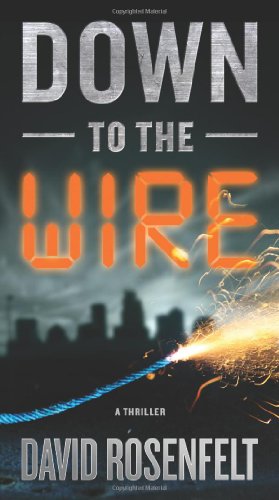
Inhaltsangabe
A reporter for the Bergen News, Chris Turley could never measure up to his father. Edward Turley, a combination of Bob Woodward and Ernie Pyle, was one of the last great investigative reporters and a difficult man to impress. While stuck covering press conferences and town hall meetings, Chris, his father’s legend in mind, has always dreamed of his own Pulitzer, however unlikely it seems.
Then one day while he’s waiting to meet a source, a giant explosion takes out half of an office building next door. Shocked into action, Chris saves five people from the burning building. His firsthand account in the next day’s paper makes him a hero and a celebrity.
And that’s not all. The source’s next tip delivers a second headline-grabber of a story for Chris, and suddenly his career is looking a lot more like his dad’s. But then it seems this anonymous source has had a plan for Chris all along, and his luck for being in the right place at the right time is not a coincidence at all. What seemed like a reporter’s dream quickly becomes an inescapable nightmare.
Down to the Wire, David Rosenfelt’s shocking new thriller about an ordinary man who gets exactly what he’s always wanted at a price he can never pay, is an intense thrill ride that will have readers racing through the pages right up to the end.
Die Inhaltsangabe kann sich auf eine andere Ausgabe dieses Titels beziehen.
Über die Autorin bzw. den Autor
David Rosenfelt is the Edgar and Shamus Award--nominated author of seven Andy Carpenter novels and a stand-alone, Don’t Tell a Soul. He and his wife live in California with their twenty-seven golden retrievers.
Auszug. © Genehmigter Nachdruck. Alle Rechte vorbehalten.
One Reporter’S Eyewitness Account Of A Nightmare
by Chris Turley
I am not a hero. I’m just not the type. I have lived thirty-two years without displaying any physical courage at all. So let’s get that straight going in.
But I was across the street from the medical center this afternoon when it exploded. The force of it, even from a distance of a hundred feet, was unlike anything I have ever experienced. And very much unlike anything I want to experience again.
Because I was so close, even as I write this I know very few particulars of what happened and why. I reacted in the moment, with no real understanding of what was going on.
The left side of the building, as I faced it, crumpled to the ground within seconds. The right side, perhaps even sixty percent of the building as a whole, remained, stubbornly refusing to give in.
It was from that area that I thought I heard screams, though because the explosion had dulled my hearing, I couldn’t be sure that the voices were not from people with me on the street.
Never having been in war, and war is the only comparison I can make, I was not prepared for the chaos around me. But I had to do something, even though every instinct told me to run away.
I went to the building and confirmed that the terrified screams were coming from inside. I ventured in, going through a front door and façade that remained perfectly intact, as if it had not gotten the memo that the rest of the building was . . .
IT’S RARE THAT A story comes out just right the first time; usually it’s a process of rewriting and editing. But Chris’s story was approved almost without any changes at all, such was the vivid power of his words. Of course, stories are almost always written to match up with available space, but that was not a consideration this time. For a first-person account of such an enormous event, Chris would have all the space he needed.
Eleven people died in that building and another seventeen were injured. Chris wrote about five of them in his story, the five he rescued, but ironically didn’t even know their names. In a way, their anonymity was appropriate for the story; Chris’s rescue efforts were a human reaction to other humans in trouble. Personal knowledge of who they were, or a personal connection to them, was not necessary in any way.
When the story was put to bed, Lawrence called Chris into his office, where he poured him a drink. To Lawrence, a drink was scotch, and the only choice offered was for it to either be on the rocks or with water.
Chris hated scotch, but saying no to Lawrence was not a consideration, so it presented him with a dilemma. If he took it with water, it diluted the taste, which was a good thing. However, it increased the size of the drink and made it last longer, which was quite a bad thing.
On this particular occasion, he opted for the scotch on the rocks, mainly because he needed something to calm his nerves quickly. He had acted instinctively after the explosion, but the enormity of what had happened was finally starting to hit him hard. As he drank from the glass, his hand shook.
“You sure you’re okay?” Lawrence asked.
“I’m fine. Why?”
“You look like you’re enjoying that scotch. Usually you drink it like it was medicine.”
Chris laughed. “So why do you always give it to me?”
“Because when I die, I don’t want your father coming up to me and saying, ‘Why the hell did you give my son a fucking Kahlua and cream?’ ”
“I like Kahlua and cream.”
“Quiet,” Lawrence said, looking skyward. “He can hear you.” Then, “But I’ll bet he’s proud of you today.”
Talk of his father often made Chris uncomfortable, especially when it was Lawrence doing the talking. Lawrence had an uncompromisingly positive view of Edward, a view which much of the rest of the world did not fully share. Edward had taken a scorched earth approach to journalism, and his unwillingness to take his foot off the throat of his “victims” often provoked fear and hatred, albeit with a healthy dose of grudging admiration.
“I was in the right place at the right time.”
“That’s what good reporters do,” Lawrence said. “They make sure they’re in the right place at the right time. That’s what your father did with Hansbrough. You did good, but your life will never be the same again.”
“Why?” Chris asked.
“Because the world is about to know your name. It’s not going to be easy to handle.”
“Then can I have another scotch?”
Lawrence laughed. “That’s a good start.” He got up to pour the drink when his phone rang, and he answered it. “Terry.”
He listened for a moment, frowned, and held the phone out for Chris. “Shit. Here it goes,” he said.
“Who is it?” Chris asked.
“The Today show.”
FOR THE MAN WHO would soon be known as “P.T.,” things were going perfectly.
He had arrived at Simmons Crystal and Glass, a large factory in Edison, New Jersey, an hour before closing time. He had pretended to be a vendor, hyping a new type of glass-making machine that produced a more durable product than the kind they were using.
It was the fourth time he had been in the building; the first three amounted to crucial scouting missions. Nobody paid him much attention, since vendors wandered in and out of there all the time. But none had ever been there for a reason anywhere close to this important.
Of course, all he knew about glass he had learned in the last two months, through the magic of Google. And the wondrous machine he bragged about did not even exist. But it got him in the door, and though his halfhearted efforts were brushed off by the purchasing manager, he couldn’t have cared less.
P.T. hid in a storage room until a full hour after closing, then carefully made his way onto the factory floor. He knew from his research that there would be no one around, and that the security guard made his rounds every half hour. That would give him twenty-five minutes to do what he had to do, which was more than enough time.
The first thing he did was disable the security cameras, which for P.T. was the easiest part of the operation. He did it in such a way that they would restart when he left and no one would ever know they had been off .
P.T. then quickly went to the enormous crystal ball being assembled in its own room near the back of the factory. It was an extraordinarily impressive piece, twelve feet tall and six hundred pounds of fine crystal. He detached four of the panels, then opened his briefcase and took out four clear, odorless packets, each weighing more than three pounds. They were connected by remarkably thin, clear fiber-optic wires to a device no larger than a small computer chip.
The difficult part was in attaching the packets to the inside of the detached crystals without damaging the elaborate laser lighting mechanisms inside. He had to be incredibly careful; he was placing them where they could virtually never be detected, yet if he made the slightest mistake it would be immediately noticeable to everyone.
P.T. knew that even with all that was to follow, with all the precision maneuvers he would conduct, this would be the most difficult. In fact, it was the only thing that had the slightest risk of failure. If he erred, he would still be able to compensate, but it would be a setback. And he hated setbacks.
But things went off without a hitch, and twenty-five minutes later, P.T. was driving home. Alone in the safety of his car, he spoke the first words he had spoken in hours.
“Happy New Year.”
THE VISITS WERE MORE for him than for her.
Logically, there was no getting around that. Harriet Turley had been in the Eddings Nursing Home for Women in Teaneck for three years, which meant that she had literally outlasted more than seventy-five percent of the people who were living there when she arrived. Of course, that would depend on one’s definition of “living.”
Chris had always known his mother to be a forceful, independent woman with a razor-sharp mind, one of the few people who could hold her own in a conversation with Chris’s father. The probing, badgering style of questioning that Edward Turley used in his interviews often carried over into his private life, but Harriet could stand toe to toe with him.
Most memorable for Chris was the time he sat unnoticed, at the top of the stairs in their house, as Edward and Harriet argued in the kitchen below. The subject was not memorable, something about the way Harriet had dealt with Chris’s fourth-grade teacher about some difficulty he was having. But Edward was criticizing Harriet’s handling of it, and she was giving better than she got, letting him know in no uncertain terms that as long as he was going to be a relatively absentee father, she was going to call the shots.
“You’re entitled to your opinion,” she had said in a calm voice. “But I am making the decisions.”
Chris often thought that if his interview subjects could have watched her in action, they wouldn’t have been nearly as intimidated by Edward and his typewriter, and in later years his camera and microphone, as they always seemed to be.
But Harriet’s mind had gradually been erased, over a three-year process that Chris watched with horror and Harriet initially cloaked in denial. For at least the past two years, she had displayed a decreasing recognition of Chris when he arrived for a visit, and by this time the frequency of her awareness of him as her son had dipped to less than five percent.
But even though Harriet had no recollections of his visits five minutes after he left, it was still far more than obligation that brought him there three times a week. He loved her deeply; she was the only person he could count on every day of his life. And even though her own life might be coming to an end, he wanted to hold on to her as long as he could.
She was also a link to his father. Sometimes, in her more lucid moments, she would talk about Edward as if he were still there, as if they still shared a life together. A few months before, she had even referenced a rare vacation that they took as a family, talking about it as if it were yesterday, although it was twenty years ago. They had gone to Hersheypark, the amusement park in the Pennsylvania town famous for its chocolate factory.
“Remember how your father took us to a restaurant at the corner of Chocolate Avenue and Cocoa Street?” She laughed at her own recollection, and Chris was stunned by it.
“And then we toured the chocolate factory, and I ate all those free samples,” he said. “I was sick for a week, but it was still the best time I ever had.”
But she didn’t answer. As fast as her lucidity had appeared, just as quickly it was gone, and her blank stare returned.
The few times that Harriet was in touch with her memories, she always talked about times when they were together as a family, when Edward’s presence made her feel safe and happy. The irony, of course, is that her relationship with him was always distant and sporadic; it was on Edward’s terms when Edward’s work permitted.
But Chris would never correct her and would just let her ramble, hoping she would hit upon a memory that they could savor together.
Most of the time Chris just talked to her, talked as if she could process and understand what he was saying. So that day he talked about the building explosion and the rescue of the people. She seemed to listen intently, but had no response.
“And tomorrow morning I’m going to be on the Today show,” he said. “They’re putting me up in a hotel tonight in the city and sending a car for me in the morning.”
She seemed to smile slightly at that, so he continued. “I don’t think Dad was ever on the Today show, was he? I’ll ask the people here to bring you over to the television so you can watch me.”
He looked at her and saw that her eyes were closing. She did that more frequently every week; she just fell asleep in the middle of a visit. He thought that was a good thing and hoped she could have coherent, pleasant dreams.
“I wish Dad were here to see me on the show,” he said, basically to himself. “I think he would have been proud of what I did.”
And then he kissed her on the cheek, and thought he saw her smile.
And then he left.
“P.T.” PICKED PARAMUS PARK out of a hat.
Excerpted from DOWN TO THE WIRE by .
Copyright © 2010 by Tara Productions, Inc..
Published in March 2010 by Minotaur Books.
All rights reserved. This work is protected under copyright laws and reproduction is strictly prohibited. Permission to reproduce the material in any manner or medium must be secured from the Publisher.
by Chris Turley
I am not a hero. I’m just not the type. I have lived thirty-two years without displaying any physical courage at all. So let’s get that straight going in.
But I was across the street from the medical center this afternoon when it exploded. The force of it, even from a distance of a hundred feet, was unlike anything I have ever experienced. And very much unlike anything I want to experience again.
Because I was so close, even as I write this I know very few particulars of what happened and why. I reacted in the moment, with no real understanding of what was going on.
The left side of the building, as I faced it, crumpled to the ground within seconds. The right side, perhaps even sixty percent of the building as a whole, remained, stubbornly refusing to give in.
It was from that area that I thought I heard screams, though because the explosion had dulled my hearing, I couldn’t be sure that the voices were not from people with me on the street.
Never having been in war, and war is the only comparison I can make, I was not prepared for the chaos around me. But I had to do something, even though every instinct told me to run away.
I went to the building and confirmed that the terrified screams were coming from inside. I ventured in, going through a front door and façade that remained perfectly intact, as if it had not gotten the memo that the rest of the building was . . .
IT’S RARE THAT A story comes out just right the first time; usually it’s a process of rewriting and editing. But Chris’s story was approved almost without any changes at all, such was the vivid power of his words. Of course, stories are almost always written to match up with available space, but that was not a consideration this time. For a first-person account of such an enormous event, Chris would have all the space he needed.
Eleven people died in that building and another seventeen were injured. Chris wrote about five of them in his story, the five he rescued, but ironically didn’t even know their names. In a way, their anonymity was appropriate for the story; Chris’s rescue efforts were a human reaction to other humans in trouble. Personal knowledge of who they were, or a personal connection to them, was not necessary in any way.
When the story was put to bed, Lawrence called Chris into his office, where he poured him a drink. To Lawrence, a drink was scotch, and the only choice offered was for it to either be on the rocks or with water.
Chris hated scotch, but saying no to Lawrence was not a consideration, so it presented him with a dilemma. If he took it with water, it diluted the taste, which was a good thing. However, it increased the size of the drink and made it last longer, which was quite a bad thing.
On this particular occasion, he opted for the scotch on the rocks, mainly because he needed something to calm his nerves quickly. He had acted instinctively after the explosion, but the enormity of what had happened was finally starting to hit him hard. As he drank from the glass, his hand shook.
“You sure you’re okay?” Lawrence asked.
“I’m fine. Why?”
“You look like you’re enjoying that scotch. Usually you drink it like it was medicine.”
Chris laughed. “So why do you always give it to me?”
“Because when I die, I don’t want your father coming up to me and saying, ‘Why the hell did you give my son a fucking Kahlua and cream?’ ”
“I like Kahlua and cream.”
“Quiet,” Lawrence said, looking skyward. “He can hear you.” Then, “But I’ll bet he’s proud of you today.”
Talk of his father often made Chris uncomfortable, especially when it was Lawrence doing the talking. Lawrence had an uncompromisingly positive view of Edward, a view which much of the rest of the world did not fully share. Edward had taken a scorched earth approach to journalism, and his unwillingness to take his foot off the throat of his “victims” often provoked fear and hatred, albeit with a healthy dose of grudging admiration.
“I was in the right place at the right time.”
“That’s what good reporters do,” Lawrence said. “They make sure they’re in the right place at the right time. That’s what your father did with Hansbrough. You did good, but your life will never be the same again.”
“Why?” Chris asked.
“Because the world is about to know your name. It’s not going to be easy to handle.”
“Then can I have another scotch?”
Lawrence laughed. “That’s a good start.” He got up to pour the drink when his phone rang, and he answered it. “Terry.”
He listened for a moment, frowned, and held the phone out for Chris. “Shit. Here it goes,” he said.
“Who is it?” Chris asked.
“The Today show.”
FOR THE MAN WHO would soon be known as “P.T.,” things were going perfectly.
He had arrived at Simmons Crystal and Glass, a large factory in Edison, New Jersey, an hour before closing time. He had pretended to be a vendor, hyping a new type of glass-making machine that produced a more durable product than the kind they were using.
It was the fourth time he had been in the building; the first three amounted to crucial scouting missions. Nobody paid him much attention, since vendors wandered in and out of there all the time. But none had ever been there for a reason anywhere close to this important.
Of course, all he knew about glass he had learned in the last two months, through the magic of Google. And the wondrous machine he bragged about did not even exist. But it got him in the door, and though his halfhearted efforts were brushed off by the purchasing manager, he couldn’t have cared less.
P.T. hid in a storage room until a full hour after closing, then carefully made his way onto the factory floor. He knew from his research that there would be no one around, and that the security guard made his rounds every half hour. That would give him twenty-five minutes to do what he had to do, which was more than enough time.
The first thing he did was disable the security cameras, which for P.T. was the easiest part of the operation. He did it in such a way that they would restart when he left and no one would ever know they had been off .
P.T. then quickly went to the enormous crystal ball being assembled in its own room near the back of the factory. It was an extraordinarily impressive piece, twelve feet tall and six hundred pounds of fine crystal. He detached four of the panels, then opened his briefcase and took out four clear, odorless packets, each weighing more than three pounds. They were connected by remarkably thin, clear fiber-optic wires to a device no larger than a small computer chip.
The difficult part was in attaching the packets to the inside of the detached crystals without damaging the elaborate laser lighting mechanisms inside. He had to be incredibly careful; he was placing them where they could virtually never be detected, yet if he made the slightest mistake it would be immediately noticeable to everyone.
P.T. knew that even with all that was to follow, with all the precision maneuvers he would conduct, this would be the most difficult. In fact, it was the only thing that had the slightest risk of failure. If he erred, he would still be able to compensate, but it would be a setback. And he hated setbacks.
But things went off without a hitch, and twenty-five minutes later, P.T. was driving home. Alone in the safety of his car, he spoke the first words he had spoken in hours.
“Happy New Year.”
THE VISITS WERE MORE for him than for her.
Logically, there was no getting around that. Harriet Turley had been in the Eddings Nursing Home for Women in Teaneck for three years, which meant that she had literally outlasted more than seventy-five percent of the people who were living there when she arrived. Of course, that would depend on one’s definition of “living.”
Chris had always known his mother to be a forceful, independent woman with a razor-sharp mind, one of the few people who could hold her own in a conversation with Chris’s father. The probing, badgering style of questioning that Edward Turley used in his interviews often carried over into his private life, but Harriet could stand toe to toe with him.
Most memorable for Chris was the time he sat unnoticed, at the top of the stairs in their house, as Edward and Harriet argued in the kitchen below. The subject was not memorable, something about the way Harriet had dealt with Chris’s fourth-grade teacher about some difficulty he was having. But Edward was criticizing Harriet’s handling of it, and she was giving better than she got, letting him know in no uncertain terms that as long as he was going to be a relatively absentee father, she was going to call the shots.
“You’re entitled to your opinion,” she had said in a calm voice. “But I am making the decisions.”
Chris often thought that if his interview subjects could have watched her in action, they wouldn’t have been nearly as intimidated by Edward and his typewriter, and in later years his camera and microphone, as they always seemed to be.
But Harriet’s mind had gradually been erased, over a three-year process that Chris watched with horror and Harriet initially cloaked in denial. For at least the past two years, she had displayed a decreasing recognition of Chris when he arrived for a visit, and by this time the frequency of her awareness of him as her son had dipped to less than five percent.
But even though Harriet had no recollections of his visits five minutes after he left, it was still far more than obligation that brought him there three times a week. He loved her deeply; she was the only person he could count on every day of his life. And even though her own life might be coming to an end, he wanted to hold on to her as long as he could.
She was also a link to his father. Sometimes, in her more lucid moments, she would talk about Edward as if he were still there, as if they still shared a life together. A few months before, she had even referenced a rare vacation that they took as a family, talking about it as if it were yesterday, although it was twenty years ago. They had gone to Hersheypark, the amusement park in the Pennsylvania town famous for its chocolate factory.
“Remember how your father took us to a restaurant at the corner of Chocolate Avenue and Cocoa Street?” She laughed at her own recollection, and Chris was stunned by it.
“And then we toured the chocolate factory, and I ate all those free samples,” he said. “I was sick for a week, but it was still the best time I ever had.”
But she didn’t answer. As fast as her lucidity had appeared, just as quickly it was gone, and her blank stare returned.
The few times that Harriet was in touch with her memories, she always talked about times when they were together as a family, when Edward’s presence made her feel safe and happy. The irony, of course, is that her relationship with him was always distant and sporadic; it was on Edward’s terms when Edward’s work permitted.
But Chris would never correct her and would just let her ramble, hoping she would hit upon a memory that they could savor together.
Most of the time Chris just talked to her, talked as if she could process and understand what he was saying. So that day he talked about the building explosion and the rescue of the people. She seemed to listen intently, but had no response.
“And tomorrow morning I’m going to be on the Today show,” he said. “They’re putting me up in a hotel tonight in the city and sending a car for me in the morning.”
She seemed to smile slightly at that, so he continued. “I don’t think Dad was ever on the Today show, was he? I’ll ask the people here to bring you over to the television so you can watch me.”
He looked at her and saw that her eyes were closing. She did that more frequently every week; she just fell asleep in the middle of a visit. He thought that was a good thing and hoped she could have coherent, pleasant dreams.
“I wish Dad were here to see me on the show,” he said, basically to himself. “I think he would have been proud of what I did.”
And then he kissed her on the cheek, and thought he saw her smile.
And then he left.
“P.T.” PICKED PARAMUS PARK out of a hat.
Excerpted from DOWN TO THE WIRE by .
Copyright © 2010 by Tara Productions, Inc..
Published in March 2010 by Minotaur Books.
All rights reserved. This work is protected under copyright laws and reproduction is strictly prohibited. Permission to reproduce the material in any manner or medium must be secured from the Publisher.
„Über diesen Titel“ kann sich auf eine andere Ausgabe dieses Titels beziehen.
Suchergebnisse für Down to the Wire

Beispielbild für diese ISBN
Down to the Wire
Anbieter: Gulf Coast Books, Cypress, TX, USA
Verkäuferbewertung 5 von 5 Sternen

hardcover. Zustand: Fair. Bestandsnummer des Verkäufers 0312373945-4-32382730
Gebraucht kaufen
EUR 3,70
Versand gratis
Versand innerhalb von USA
Versand innerhalb von USA
Anzahl: 1 verfügbar
Beispielbild für diese ISBN
Down to the Wire
Anbieter: World of Books (was SecondSale), Montgomery, IL, USA
Verkäuferbewertung 5 von 5 Sternen
Zustand: Good. Item in good condition. Textbooks may not include supplemental items i.e. CDs, access codes etc. Bestandsnummer des Verkäufers 00103562528
Gebraucht kaufen
EUR 3,75
Versand gratis
Versand innerhalb von USA
Versand innerhalb von USA
Anzahl: 1 verfügbar
Beispielbild für diese ISBN
Down to the Wire
Verlag:
Minotaur Books (edition Reprint), 2010
ISBN 10: 0312373945
ISBN 13: 9780312373948
Gebraucht
Hardcover
Anbieter: BooksRun, Philadelphia, PA, USA
Verkäuferbewertung 5 von 5 Sternen
Hardcover. Zustand: Very Good. Reprint. With dust jacket. It's a well-cared-for item that has seen limited use. The item may show minor signs of wear. All the text is legible, with all pages included. It may have slight markings and/or highlighting. Bestandsnummer des Verkäufers 0312373945-11-1-29
Gebraucht kaufen
EUR 4,91
Versand gratis
Versand innerhalb von USA
Versand innerhalb von USA
Anzahl: 1 verfügbar
Beispielbild für diese ISBN
Down to the Wire
Anbieter: World of Books (was SecondSale), Montgomery, IL, USA
Verkäuferbewertung 5 von 5 Sternen
Zustand: Very Good. Item in very good condition! Textbooks may not include supplemental items i.e. CDs, access codes etc. Bestandsnummer des Verkäufers 00109440814
Gebraucht kaufen
EUR 5,31
Versand gratis
Versand innerhalb von USA
Versand innerhalb von USA
Anzahl: 1 verfügbar
Beispielbild für diese ISBN
Down to the Wire
Anbieter: World of Books (was SecondSale), Montgomery, IL, USA
Verkäuferbewertung 5 von 5 Sternen
Zustand: Good. Good condition ex-library book with usual library markings and stickers. Bestandsnummer des Verkäufers 00109034023
Gebraucht kaufen
EUR 5,31
Versand gratis
Versand innerhalb von USA
Versand innerhalb von USA
Anzahl: 1 verfügbar
Beispielbild für diese ISBN
Down to the Wire
Anbieter: ThriftBooks-Atlanta, AUSTELL, GA, USA
Verkäuferbewertung 5 von 5 Sternen
Hardcover. Zustand: Good. No Jacket. Pages can have notes/highlighting. Spine may show signs of wear. ~ ThriftBooks: Read More, Spend Less. Bestandsnummer des Verkäufers G0312373945I3N00
Gebraucht kaufen
EUR 5,92
Versand gratis
Versand innerhalb von USA
Versand innerhalb von USA
Anzahl: 1 verfügbar
Beispielbild für diese ISBN
Down to the Wire
Anbieter: ThriftBooks-Reno, Reno, NV, USA
Verkäuferbewertung 5 von 5 Sternen
Hardcover. Zustand: Good. No Jacket. Pages can have notes/highlighting. Spine may show signs of wear. ~ ThriftBooks: Read More, Spend Less. Bestandsnummer des Verkäufers G0312373945I3N00
Gebraucht kaufen
EUR 5,92
Versand gratis
Versand innerhalb von USA
Versand innerhalb von USA
Anzahl: 1 verfügbar
Beispielbild für diese ISBN
Down to the Wire
Anbieter: ThriftBooks-Reno, Reno, NV, USA
Verkäuferbewertung 5 von 5 Sternen
Hardcover. Zustand: Good. No Jacket. Former library book; Pages can have notes/highlighting. Spine may show signs of wear. ~ ThriftBooks: Read More, Spend Less. Bestandsnummer des Verkäufers G0312373945I3N10
Gebraucht kaufen
EUR 5,92
Versand gratis
Versand innerhalb von USA
Versand innerhalb von USA
Anzahl: 3 verfügbar
Beispielbild für diese ISBN
Down to the Wire
Anbieter: ThriftBooks-Atlanta, AUSTELL, GA, USA
Verkäuferbewertung 5 von 5 Sternen
Hardcover. Zustand: Good. No Jacket. Former library book; Pages can have notes/highlighting. Spine may show signs of wear. ~ ThriftBooks: Read More, Spend Less. Bestandsnummer des Verkäufers G0312373945I3N10
Gebraucht kaufen
EUR 5,92
Versand gratis
Versand innerhalb von USA
Versand innerhalb von USA
Anzahl: 3 verfügbar
Beispielbild für diese ISBN
Down to the Wire
Anbieter: ThriftBooks-Dallas, Dallas, TX, USA
Verkäuferbewertung 5 von 5 Sternen
Hardcover. Zustand: Good. No Jacket. Pages can have notes/highlighting. Spine may show signs of wear. ~ ThriftBooks: Read More, Spend Less. Bestandsnummer des Verkäufers G0312373945I3N00
Gebraucht kaufen
EUR 5,92
Versand gratis
Versand innerhalb von USA
Versand innerhalb von USA
Anzahl: 1 verfügbar