
Verwandte Artikel zu Why You Should Read Kafka Before You Waste Your Life
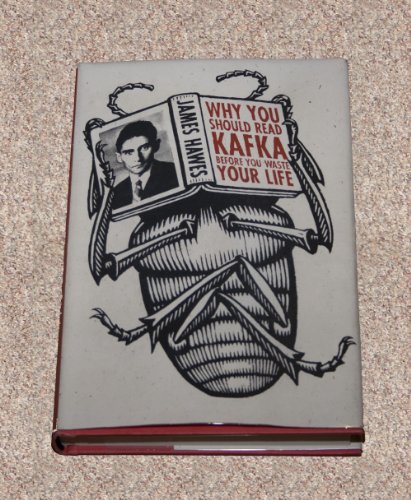
Inhaltsangabe
Whimsically debunks popular myths attributed to the persona and work of Franz Kafka, in a portrait that describes the real-world circumstances surrounding his relationship with his father, his sexuality, and his writing career. 20,000 first printing.
Die Inhaltsangabe kann sich auf eine andere Ausgabe dieses Titels beziehen.
Über die Autorin bzw. den Autor
James Hawes is a novelist and Kafka scholar with a Ph.D. in German literature. He is the author of A White Merc with Fins, White Powder, Green Light, and Speak for England. As an undergraduate at Oxford, Hawes was allowed---uniquely---to handle the original manuscript of Kafka's The Castle. He lives in Cardiff, Wales.
Auszug. © Genehmigter Nachdruck. Alle Rechte vorbehalten.
INTRODUCTION THE FACE, THE FACTS AND THE PORN, OR WHY WE MUST STOP CONDESCENDING TO THE PAST The Face of Kafka You know the face I mean, of course. Everyone does. There are many photos of Dr. Franz Kafka (1883–1924) but, as far as Prague souvenirs and English-language biographies go, this might as well be the only one. Now, this is very unusual for a writer. Who would bet on being able to finger Flaubert, Stendhal, Dostoyevsky, James, Conrad, and Proust in an identification parade of random upper-middle-class men of the past? And why should anyone care to? They are remembered for their books, not their looks. Dickens has a memorable hairstyle, true, and a couple of other modern author photos have become local tourist icons for the cities they fled (Dublin makes a fine old effort with James Joyce, and Swansea tries with Dylan Thomas), but Kafka is in a different international league. Apart from Shakespeare, there’s simply no writer whose image is so well known to so many people who have never read a word he wrote. The face of Kafka has become virtually a brand. Not that Kafka doesn’t deserve his fame. If ever mankind gets to the stars, people commuting between planets will know of his work. I spent ten years of my life studying that work, teaching it at universities, publishing articles on it in weighty journals—and I can’t think of many better ways to spend ten years.* But Kafka’s fame is strange. Dante, Shakespeare, Goethe, Keats, Flaubert, Dickens, Chekhov, Proust, Joyce are all quoted. It’s their words that count, which, since words were all they left behind them, seems pretty logical. Kafka’s words are probably quoted less often than those of any other writer of his rank: he is world famous for his visions. You can see why: A man wakes up and finds that he’s a beetle. A man who has done nothing wrong fights for his life against a bizarre court that sits in almost every attic in the world. A machine quite literally writes condemned people to death. A man tries forever to get into a mysterious castle. A man waits in vain all his life by the Door to the Law, only to be told as he dies that this door was only ever meant for him. These visions haunt the world like those of no other self-conscious, modern author. They have the cthonic power of mysterious fragments from a lost scroll of the Pentateuch or a tantalizingly half-preserved Greek myth. Yet no image becomes immortal just because it’s a great High Concept. The dustbin of literary history is filled with the wrecks of ideas that looked great on the backs of envelopes. Every half-cultured Westerner has at least vaguely heard of Don Quixote and his windmills, but no one would know of this vision today if Cervantes had just sent it out as a witty one-liner. It lives only because it’s part of a larger whole that worked for the people who first read it—and was therefore transmitted down to the next generation, who agreed, and so on. *See (if you insist), J. M. Hawes, Nietzsche and the End of Freedom, the neo-Romantic Dilemma in Kafka, the Brothers Mann, Rilke and Musil, Frankfurt (Lang) 1993; ‘Blind Resistance? A reply to Elizabeth Boa’s reading of Kafka’s Auf der Galerie’ in Deutsche Vierteljahrsschrift für Literaturwissenschaft und Geistesgeschichte, 69. Jahrgang, Heft 2/June 1995, pp.324–36; The Psychology of Power in Kafka’s Der Process and Heinrich Mann’s Der Untertan, in Oxford German Studies 17/18 (1990), pp.119–31; Faust and Nietzsche in Kafka’s Der Process, in New German Studies 15/2, 1989. What counts, in other words, is not only the tale but also the telling. This is where the K.-myth comes in—or, rather, gets in the way. It continually pushes the idea of a mysterious genius, a lonely Middle European Nostradamus, who, almost ignored by his contemporaries, somehow plumbed the depths of his mysterious, quasi-saintly psyche to predict the Holocaust and the Gu-lags. The brooding face of Kafka has become the icon of that K.-myth and his name, typographically irresistible to anyone from west of the Rhine (my dear, that mysterious Z, that oh-so-non-Western double K!) has entered the languages of the world in the term kafkaesque, used wherever guiltless people are trapped in some nightmarish bureaucratic catch-22. In the very simplest of ways, we can see that it’s only a myth. That photo, overwhelmingly the most famous image of him, the international trademark of Prague (which Kafka longed for years to escape), was actually taken in a department store in Berlin (which he longed for years to get to). It’s also the last picture of him ever taken. This is loading the dice somewhat. What we now know as the face of Kafka was created about eight months before his death, when he knew logically that he was doomed (he compared his move to Berlin to Napoleon’s invasion of Russia) but had not quite given up on the irrational hope of still finding real, human life and love. This state of mind is (a) typical of his writing and (b) liable to make anyone look profound. But still not profound enough. The legendary Kafka collector and publisher Klaus Wagenbach recalls watching in the early fifties as the S. Fischer Co. artists retouched this picture to give Kafka’s eyes the desired gleam. And it worked. Prophetic Kafka is now as famous and vague an icon as Saintly Che Guevara—and with about as much historical accuracy. Faces are not just faces; they carry stories. Evolution has minutely tuned our attention to what they say. The whole modern visually driven circus of media stardom depends on our ancient hominid instincts to note and judge incredibly precise facial details. So even if you’ve never read a word of Kafka, you’ll feel— you won’t be able to help feeling—that, since you know his icon, you know something about him. As far as I can tell, most English-speakers seem to pick up Kafka’s writings vaguely expecting something like a mixture of Edgar Allan Poe, The Fly, Philip K. Dick, and 1984. No other writer’s work suffers from this kind of prejudgment. It means that readers come to Kafka already beholding the (alleged) man, forgetting that in the beginning were his words. But there are biographies, guidebooks, and essay-writing aids aplenty, never mind the practically infinite mass of academic interpretation that has gathered around this physically modest corpus of work (never in the history of literary scholarship have so many written so much about so little). So surely, it’s easy to get to know more about Kafka before taking the supposedly heavy plunge into his actual works. Probably, you already know some of these "facts" yourself: • Kafka’s will ordered that all his works should be destroyed. • Kafka was virtually unknown in his lifetime, partly because he was shy about publishing. • Kafka was terrified of his brutal father. • Kafka was crushed by a dead-end bureaucratic job. • Kafka was crippled for years by the TB that he knew must inevitably kill him. • Kafka was incredibly honest about his failings with the women in his life—too honest. • Kafka was imprisoned, as a German-speaking Jew in Prague, in a double ghetto: a minority-within-a-minority amid an absurd and collapsing operetta-like empire. • Kafka’s works are based on his experiences as a Jew. • Kafka’s works uncannily predict Auschwitz. • Kafka’s works were burned by the Nazis. These are the building blocks of the K.-myth....
„Über diesen Titel“ kann sich auf eine andere Ausgabe dieses Titels beziehen.
Suchergebnisse für Why You Should Read Kafka Before You Waste Your Life

Beispielbild für diese ISBN
Why You Should Read Kafka Before You Waste Your Life
Verlag:
St. Martin's Press (edition First Edition), 2008
ISBN 10: 0312376510
ISBN 13: 9780312376512
Gebraucht
Hardcover
Erstausgabe
Anbieter: BooksRun, Philadelphia, PA, USA
Verkäuferbewertung 5 von 5 Sternen

Hardcover. Zustand: Very Good. First Edition. With dust jacket. It's a well-cared-for item that has seen limited use. The item may show minor signs of wear. All the text is legible, with all pages included. It may have slight markings and/or highlighting. Bestandsnummer des Verkäufers 0312376510-11-1-29
Gebraucht kaufen
EUR 4,99
Versand gratis
Versand innerhalb von USA
Versand innerhalb von USA
Anzahl: 1 verfügbar
Beispielbild für diese ISBN
Why You Should Read Kafka Before You Waste Your Life
Anbieter: ThriftBooks-Atlanta, AUSTELL, GA, USA
Verkäuferbewertung 5 von 5 Sternen
Hardcover. Zustand: Good. No Jacket. Former library book; Pages can have notes/highlighting. Spine may show signs of wear. ~ ThriftBooks: Read More, Spend Less. Bestandsnummer des Verkäufers G0312376510I3N10
Gebraucht kaufen
EUR 6,20
Versand gratis
Versand innerhalb von USA
Versand innerhalb von USA
Anzahl: 1 verfügbar
Beispielbild für diese ISBN
Why You Should Read Kafka Before You Waste Your Life
Anbieter: ThriftBooks-Dallas, Dallas, TX, USA
Verkäuferbewertung 5 von 5 Sternen
Hardcover. Zustand: Very Good. No Jacket. May have limited writing in cover pages. Pages are unmarked. ~ ThriftBooks: Read More, Spend Less. Bestandsnummer des Verkäufers G0312376510I4N00
Gebraucht kaufen
EUR 6,20
Versand gratis
Versand innerhalb von USA
Versand innerhalb von USA
Anzahl: 1 verfügbar
Beispielbild für diese ISBN
Why You Should Read Kafka Before You Waste Your Life
Anbieter: HPB-Diamond, Dallas, TX, USA
Verkäuferbewertung 5 von 5 Sternen
hardcover. Zustand: Very Good. Connecting readers with great books since 1972! Used books may not include companion materials, and may have some shelf wear or limited writing. We ship orders daily and Customer Service is our top priority! Bestandsnummer des Verkäufers S_474889954
Gebraucht kaufen
EUR 3,62
EUR 3,29 Versand
Versand innerhalb von USA
Versand innerhalb von USA
Anzahl: 1 verfügbar
Beispielbild für diese ISBN
Why You Should Read Kafka Before You Waste Your Life
Anbieter: Half Price Books Inc., Dallas, TX, USA
Verkäuferbewertung 5 von 5 Sternen
hardcover. Zustand: Very Good. Connecting readers with great books since 1972! Used books may not include companion materials, and may have some shelf wear or limited writing. We ship orders daily and Customer Service is our top priority! Bestandsnummer des Verkäufers S_462996192
Gebraucht kaufen
EUR 4,70
EUR 3,29 Versand
Versand innerhalb von USA
Versand innerhalb von USA
Anzahl: 1 verfügbar
Beispielbild für diese ISBN
Why You Should Read Kafka Before You Waste Your Life
Anbieter: Roundabout Books, Greenfield, MA, USA
Verkäuferbewertung 4 von 5 Sternen

hardcover. Zustand: Near Fine. Condition Notes: Excellent, unmarked copy with little wear and tight binding. We ship in recyclable American-made mailers. 100% money-back guarantee on all orders. Bestandsnummer des Verkäufers 1774673
Gebraucht kaufen
EUR 9,46
Versand gratis
Versand innerhalb von USA
Versand innerhalb von USA
Anzahl: 1 verfügbar
Beispielbild für diese ISBN
Why You Should Read Kafka Before You Waste Your Life
Verlag:
St. Martin's Press, 2008
ISBN 10: 0312376510
ISBN 13: 9780312376512
Gebraucht
Hardcover
Erstausgabe
Anbieter: Better World Books, Mishawaka, IN, USA
Verkäuferbewertung 5 von 5 Sternen
Zustand: Good. First Edition. Former library copy. Pages intact with minimal writing/highlighting. The binding may be loose and creased. Dust jackets/supplements are not included. Includes library markings. Stock photo provided. Product includes identifying sticker. Better World Books: Buy Books. Do Good. Bestandsnummer des Verkäufers 8556521-6
Gebraucht kaufen
EUR 9,95
Versand gratis
Versand innerhalb von USA
Versand innerhalb von USA
Anzahl: 1 verfügbar
Beispielbild für diese ISBN
Why You Should Read Kafka Before You Waste Your Life
Verlag:
St. Martin's Press, 2008
ISBN 10: 0312376510
ISBN 13: 9780312376512
Gebraucht
Hardcover
Erstausgabe
Anbieter: Better World Books, Mishawaka, IN, USA
Verkäuferbewertung 5 von 5 Sternen
Zustand: Good. First Edition. Pages intact with minimal writing/highlighting. The binding may be loose and creased. Dust jackets/supplements are not included. Stock photo provided. Product includes identifying sticker. Better World Books: Buy Books. Do Good. Bestandsnummer des Verkäufers 2010155-6
Gebraucht kaufen
EUR 9,95
Versand gratis
Versand innerhalb von USA
Versand innerhalb von USA
Anzahl: 2 verfügbar
Beispielbild für diese ISBN
Why You Should Read Kafka Before You Waste Your Life
Anbieter: HPB Inc., Dallas, TX, USA
Verkäuferbewertung 5 von 5 Sternen
hardcover. Zustand: Very Good. Connecting readers with great books since 1972! Used books may not include companion materials, and may have some shelf wear or limited writing. We ship orders daily and Customer Service is our top priority! Bestandsnummer des Verkäufers S_475318308
Gebraucht kaufen
EUR 7,23
EUR 3,29 Versand
Versand innerhalb von USA
Versand innerhalb von USA
Anzahl: 1 verfügbar
Beispielbild für diese ISBN
Why You Should Read Kafka Before You Waste Your Life
Anbieter: Books From California, Simi Valley, CA, USA
Verkäuferbewertung 4 von 5 Sternen
hardcover. Zustand: Very Good. Bestandsnummer des Verkäufers mon0003743483
Gebraucht kaufen
EUR 6,81
EUR 4,38 Versand
Versand innerhalb von USA
Versand innerhalb von USA
Anzahl: 1 verfügbar