
Verwandte Artikel zu My Name Is Number 4: A True Story from the Cultural...
Inhaltsangabe
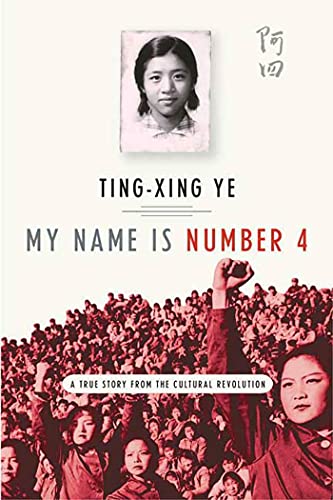
A powerful and passionate memoir, My Name Is Number 4 is the gripping tale of one girl's life growing up during China's Cultural Revolution.
Number Four will have a difficult life. These are the words that were uttered upon Ting-xing Ye's birth. Soon this prophecy would prove only too true. . . . Here is the real-life story about the fourth child in a family torn apart by China's Cultural Revolution. After the death of both of her parents, Ting-xing and her siblings endured brutal Red Guard attacks on their schools and even in their home. At the age of sixteen, Ting-xing is exiled to a prison farm far from the world she knows. How she struggled through years of constant terror while keeping her spirit intact is at the heart of My Name Is Number 4. Haunting and inspiring, Ting-xing Ye's personal account of this horrific period in history is one that no reader will soon forget.Die Inhaltsangabe kann sich auf eine andere Ausgabe dieses Titels beziehen.
Über die Autorin bzw. den Autor
Ting-xing Ye is the author of the international bestseller A Leaf in the Bitter Wind. Once an English interpreter for the Chinese government, she now lives in Canada.
Auszug. © Genehmigter Nachdruck. Alle Rechte vorbehalten.
My Name Is Number 4
A True Story from the Cultural RevolutionBy Ye, Ting-xingSt. Martin's Griffin
Copyright © 2008 Ye, Ting-xingAll right reserved.
ISBN: 9780312379872
Chapter One — I was born in Shanghai, late on a hot June afternoon in 1952, the fourth child in my family. So I was called Ah Si, Number 4. My father decided four kids were enough, but rather than rely on birth control, which was officially discouraged at that time, he put his faith in the power of words. Choosing a formal name for a child was no small matter: it required the weighing of tradition and precedent. My surname, Ye, means Leaf. My generation name, Xing—Capable—had been decreed by my paternal grandfather after casting bamboo fortune telling sticks in the family ancestral hall, so all Father’s children were called Xing. My three older siblings Father had named after characteristics he admired; my brothers were Upright and Steadfast, my sister Diligent. For me he chose Ting, a homonym that means Graceful in writing but sounds like Stop when heard. The word magic didn’t work. A year and a half later my sister Maple was born, Mother’s fifth and last child. Normally, June was the beginning of the rainy season, a time of year hated by most people in the lower reaches of the Yangtze River. There was usually a solid month of drizzle and extreme humidity. Green mould grew on walls and floors; dampness seeped into people’s bones. On the rare days when the sun appeared, courtyards and sidewalks were festooned with clothing, bedding and furniture. Everyone dreamt of living in a "zipper-roofed building." As Great-Aunt never tired of telling anyone who would listen, my coming into the world was unlucky, a girl born in the year of the dragon.1 She also said I was destined to lead a hard and unpredictable life, since June 1952 was uncharacteristically hot and dry, a sure sign of the King Dragon’s disapproval, for he was the God of Rain. King Dragon, she said, dwelt in a crystal palace at the bottom of the Eastern Sea, where he was surrounded by crab generals and an army of shrimps, all of them male. I was often tempted to ask who did the household chores if there were no females like Grandmother, Mother 1.Although we called her Great-Aunt, she was not a blood relation. She had been taken into my grandfather Ye’s household as an unpaid live-in maid when in her twenties, after being twice widowed. When my father set up his home in Shanghai, Great-Aunt was sent along to keep house for him. — A week after my birth, Mother brought me home from the Red House Hospital, so named because red paint covered its brick walls, wooden window-frames and doors, to my family’s three-room apartment in the centre of the city. Shaded by plane trees, Wuding (Valiant Tranquillity) Road ran east and west through the former International Settlement and many long-tang —lanes, some as wide as two cars side by side, some only shoulder width—connected with it, forming a densely populated yet quiet neighbourhood. Shanghai itself, only ten miles wide and ten miles long, was inhabited by about six million people. We lived in Zi Yang Li—Purple Sunshine Lane. Our two-story brick building was a traditional Shanghai-style house, built in a square U-shape around a courtyard or "sky-well" that served as the front entrance. Two black-lacquer doors, heavy and tall, with brass door-knockers shaped like dragon heads with rings through their noses, guarded the courtyard. Residents used the back door, however, reserving the front for occasions such as weddings and funerals. In all, eight families lived in six apartments, three at each level. Two water taps in the tiny corridor at the back served all the families, and their use was strictly regulated and policed by our neighbour, Granny Ningbo. The upper tap, with its brick sink, could be used only to wash food, clothing and dishes. The lower one was for cleaning chamber pots and rinsing mops. On each floor, one small kitchen served four families. From the roof terrace I could see the chimney of the Zheng Tai Rubber Shoe Factory, which my father owned. Where Purple Sunshine Lane intersected with Wuding Road was the cai chang —food market. Its rough plank stalls stretched about thirty yards along both sides of the shady street. The centre of our neighbourhood, it opened at six o’clock in the morning, but lineups for popular food like pork bones and fat, which were cheaper and required fewer ration coupons, began to form hours earlier. Some residents would get out of bed early, take up spots near the front of the line, then sell them for a few cents. By early afternoon the market was closed, and the residents used the empty stalls to make quilts on or to air their bedding. For several years the sky-well, the lane and the busy market were my world. — One day when I was four years old, my father came home from the factory with a big red silk flower pinned to the lapel of his Western-style jacket. Even at that age I knew that wearing a red flower, real or not, meant praise and honour. But Father didn’t look happy about his prize. He limped past me, tossing the flower on the dinner table, and closed the bedroom door behind him. I stared longingly at the red blossom. From inside the bedroom, I heard Father and Mother talking. Only then did I realize that Father had come home early. All my older siblings were still in school and two-year-old Number 5 was having a nap. Mother came out of the room and saw me eyeing the flower. She said I could have it so long as I kept quiet. She helped me pin it to my jacket and I rushed joyfully downstairs to the sky-well, sporting my colourful reward. I didn’t know that Father had been given the flower for surrendering his factory—the enterprise his grandfather had established and he had operated for almost twenty years—to the government. In return, he was to receive a ridiculously meagre compensation of cash and bonds, paid in installments over seven years.2 Father was kept on as "private representative" to run the factory he used to own. But when he insisted on claiming his compensation, he was labelled a "hard-minded capitalist" who, the government said, could be reformed only through hard physical labour. Thus, before I turned five, my father had fallen from a respected and prosperous business owner to a labourer. 2.In 1956 the government began its nationalization program: the forced confiscation of all private businesses. Even though I was too young to understand the momentous changes that worried Mother, Father and Great-Aunt, I was old enough to notice certain changes. Father no longer wore his Western-style jacket and tie. Instead he put on a dark blue or black worker’s jacket buttoned up to the neck. Despite his physical disability—a childhood attack of meningitis had crippled him in one leg and he had to walk with a cane—he was assigned to one of the most menial jobs in the factory, pushing a heavy wooden cart loaded with rubber shoe uppers between workshops. It was the humiliation and deep wound to his pride that led him to make a decision that turned to tragedy. One morning in April 1959, Father left home to go to work as usual. It was the last time I saw him walk. Later that day, Mother was called to a district hospital, where she learned that without telling anyone in the family Father had undergone surgery to cure his limp. The operation had been botched...
„Über diesen Titel“ kann sich auf eine andere Ausgabe dieses Titels beziehen.
Suchergebnisse für My Name Is Number 4: A True Story from the Cultural...

Foto des Verkäufers
My Name Is Number 4: A True Story from the Cultural Revolution
Anbieter: Greenworld Books, Arlington, TX, USA
Verkäuferbewertung 5 von 5 Sternen

Zustand: very_good. Fast Free Shipping â" Very Good condition book with a firm cover and clean pages. Shows normal use and some light wear or limited notes markings. A solid, nice copy to enjoy. Bestandsnummer des Verkäufers GWV.0312379870.VG
Gebraucht kaufen
EUR 5,33
Versand gratis
Versand innerhalb von USA
Versand innerhalb von USA
Anzahl: 1 verfügbar
Foto des Verkäufers
My Name Is Number 4: A True Story from the Cultural Revolution
Anbieter: Greenworld Books, Arlington, TX, USA
Verkäuferbewertung 5 von 5 Sternen
Zustand: good. Fast Free Shipping â" Good condition. It may show normal signs of use, such as light writing, highlighting, or library markings, but all pages are intact and the book is fully readable. A solid, complete copy that's ready to enjoy. Bestandsnummer des Verkäufers GWV.0312379870.G
Gebraucht kaufen
EUR 5,33
Versand gratis
Versand innerhalb von USA
Versand innerhalb von USA
Anzahl: 1 verfügbar
Beispielbild für diese ISBN
My Name Is Number 4: A True Story from the Cultural Revolution
Anbieter: World of Books (was SecondSale), Montgomery, IL, USA
Verkäuferbewertung 5 von 5 Sternen
Zustand: Good. Good condition ex-library book with usual library markings and stickers. Bestandsnummer des Verkäufers 00104172132
Gebraucht kaufen
EUR 5,51
Versand gratis
Versand innerhalb von USA
Versand innerhalb von USA
Anzahl: 1 verfügbar
Beispielbild für diese ISBN
My Name Is Number 4: A True Story from the Cultural Revolution
Anbieter: ThriftBooks-Dallas, Dallas, TX, USA
Verkäuferbewertung 5 von 5 Sternen
Paperback. Zustand: Fair. No Jacket. Readable copy. Pages may have considerable notes/highlighting. ~ ThriftBooks: Read More, Spend Less. Bestandsnummer des Verkäufers G0312379870I5N00
Gebraucht kaufen
EUR 6,03
Versand gratis
Versand innerhalb von USA
Versand innerhalb von USA
Anzahl: 1 verfügbar
Beispielbild für diese ISBN
My Name Is Number 4: A True Story from the Cultural Revolution
Anbieter: ThriftBooks-Atlanta, AUSTELL, GA, USA
Verkäuferbewertung 5 von 5 Sternen
Paperback. Zustand: Fair. No Jacket. Former library book; Readable copy. Pages may have considerable notes/highlighting. ~ ThriftBooks: Read More, Spend Less. Bestandsnummer des Verkäufers G0312379870I5N10
Gebraucht kaufen
EUR 6,03
Versand gratis
Versand innerhalb von USA
Versand innerhalb von USA
Anzahl: 1 verfügbar
Beispielbild für diese ISBN
My Name Is Number 4: A True Story from the Cultural Revolution
Anbieter: ThriftBooks-Dallas, Dallas, TX, USA
Verkäuferbewertung 5 von 5 Sternen
Paperback. Zustand: Good. No Jacket. Pages can have notes/highlighting. Spine may show signs of wear. ~ ThriftBooks: Read More, Spend Less. Bestandsnummer des Verkäufers G0312379870I3N00
Gebraucht kaufen
EUR 6,03
Versand gratis
Versand innerhalb von USA
Versand innerhalb von USA
Anzahl: 1 verfügbar
Beispielbild für diese ISBN
My Name Is Number 4: A True Story from the Cultural Revolution
Anbieter: ThriftBooks-Atlanta, AUSTELL, GA, USA
Verkäuferbewertung 5 von 5 Sternen
Paperback. Zustand: Very Good. No Jacket. Former library book; May have limited writing in cover pages. Pages are unmarked. ~ ThriftBooks: Read More, Spend Less. Bestandsnummer des Verkäufers G0312379870I4N10
Gebraucht kaufen
EUR 6,03
Versand gratis
Versand innerhalb von USA
Versand innerhalb von USA
Anzahl: 1 verfügbar
Beispielbild für diese ISBN
My Name Is Number 4: A True Story from the Cultural Revolution
Anbieter: ThriftBooks-Atlanta, AUSTELL, GA, USA
Verkäuferbewertung 5 von 5 Sternen
Paperback. Zustand: Good. No Jacket. Pages can have notes/highlighting. Spine may show signs of wear. ~ ThriftBooks: Read More, Spend Less. Bestandsnummer des Verkäufers G0312379870I3N00
Gebraucht kaufen
EUR 6,03
Versand gratis
Versand innerhalb von USA
Versand innerhalb von USA
Anzahl: 1 verfügbar
Beispielbild für diese ISBN
My Name Is Number 4: A True Story from the Cultural Revolution
Anbieter: ThriftBooks-Dallas, Dallas, TX, USA
Verkäuferbewertung 5 von 5 Sternen
Paperback. Zustand: Very Good. No Jacket. May have limited writing in cover pages. Pages are unmarked. ~ ThriftBooks: Read More, Spend Less. Bestandsnummer des Verkäufers G0312379870I4N00
Gebraucht kaufen
EUR 6,03
Versand gratis
Versand innerhalb von USA
Versand innerhalb von USA
Anzahl: 1 verfügbar
Beispielbild für diese ISBN
My Name Is Number 4: A True Story from the Cultural Revolution
Anbieter: ThriftBooks-Phoenix, Phoenix, AZ, USA
Verkäuferbewertung 5 von 5 Sternen
Paperback. Zustand: Good. No Jacket. Pages can have notes/highlighting. Spine may show signs of wear. ~ ThriftBooks: Read More, Spend Less. Bestandsnummer des Verkäufers G0312379870I3N00
Gebraucht kaufen
EUR 6,03
Versand gratis
Versand innerhalb von USA
Versand innerhalb von USA
Anzahl: 1 verfügbar