
Verwandte Artikel zu Busy Body (Agatha Raisin)
Inhaltsangabe
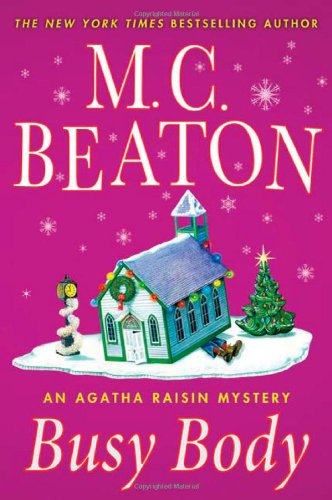
Agatha Raisin has always been ambivalent about holiday cheer, but her cozy little village of Carsely has long prided itself on its Christmas festivities. But this year Mr. John Sunday, a selfimportant officer with the Health and Safety Board, has ruled that the traditional tree on top of the church is a public menace; that lampposts are unsafe for hanging illuminations; that May Dimwoody’s homemade toys are dangerous for children… Things have reached such a desperate pass that the Carsely Ladies’ Society joins forces with the ladies in the neighboring village of Odley Cruesis to try to put a stop to Mr. Sunday’s meddling—only to find that someone has literally put a stop to him with a kitchen knife. Agatha’s detective agency is on the case, but when a man has made as many enemies as John Sunday, it’s hard to know where to start…
Die Inhaltsangabe kann sich auf eine andere Ausgabe dieses Titels beziehen.
Über die Autorin bzw. den Autor
M. C. Beaton has been hailed as “the new Queen of Crime.” She is the New York Times bestselling author of the Agatha Raisin mysteries, including A Spoonful of Poison and As the Pig Turns. She has also written more than 100 historical romance novels under the name Marion Chesney. Before writing her first novels, Beaton worked as a bookseller, a newspaper reporter and fashion critic, and a waitress in a greasy spoon. Born in Scotland, she currently divides her time between Paris and a village in the English Cotswolds. She was selected the British Guest of Honor for the Bouchercon World Mystery Convention in 2006.
Auszug. © Genehmigter Nachdruck. Alle Rechte vorbehalten.
image
Chapter One
Chapter One
Having found that her love for her ex-husband, James Lacey, had more or less disappeared, Agatha Raisin, middle-aged owner of a detective agency in the English Cotswolds, decided to hit another obsession on the head.
For the past two years she had been determined to create the perfect Christmas, the full Dickensian dream, with disappointing results. So she decided to flee Christmas by taking a long holiday in Corsica. Her second in command, young Toni Gilmour, was more than capable of dealing with the usual run of dreary divorce cases and missing pets, the bread and butter of the agency.
Agatha had booked a room in a hotel in the town of Porto Vecchio at the south of the Mediterranean island. She had Googled the information and found that it was an old Genoese town with a winter temperature in the low sixties Fahrenheit.
She arrived at the hotel late because it took her more than an hour to find a taxi at Figari Airport. Agatha looked forward to celebrating Christmas with a lobster dinner. No more turkey.
The receptionist at the hotel greeted her with, “I see you’ve booked in with us for three weeks. Why?”
Agatha blinked. “Why? I’m on holiday.”
“But what are you going to do?” asked the receptionist. “Most of the shops and restaurants are closed. You don’t have a car. There aren’t that many taxis, and the ones that there are don’t like short trips.”
“I’ll think about it,” said Agatha wearily. “I’m hungry. Do you have a restaurant?”
“No, but if you go out of the hotel and turn right and then next left it will take you up to the citadel and there are a few restaurants there.”
Agatha left her luggage and set off on the steep climb up to the citadel. The Christmas decorations were the most beautiful she had ever seen, but the streets were deserted. She reached the square in the centre of the old citadel. There were two restaurants open and, in the middle of the square, an empty skating rink where men were pouring water on the surface of the ice so that it would freeze overnight. Agatha’s spirits sank even lower. She had not imagined Corsica ever getting cold enough for ice to freeze.
There was a heated area for smokers facing one restaurant. She sat down and ordered a meal which turned out to be nothing special and came to forty-two euros, which, thanks to the falling sterling, meant it cost her the equivalent of forty-two pounds.
She sat and puffed on a cigarette and debated whether to hire a car or not. The trouble was Agatha could not parallel park. In fact, she felt happy only when there was an empty parking space that could take the size of a truck. The cars she had seen parked were all tight together. How on earth did they manage to get out without damaging the cars parked up against them, front and back?
Agatha did not want to admit failure. She did not want to return home and say she had made a mistake. A good night’s sleep was all she needed. She trudged back to the hotel through the deserted streets under the sparkling golden halo of Christmas decorations around every street lamp.
The next day was sunny. After a good breakfast, Agatha asked directions to the port, where she was sure there must be delicious seafood. “There’s a quick way down from the citadel,” said the receptionist, “but it’s terribly steep.” Agatha’s arthritic hip gave a nasty twinge. “What about round by the road?” she asked. “How long would that take?”
“About half an hour.”
So Agatha set out. And walked and walked and walked until an hour and a half later, she found herself at the port. There was a restaurant open, but no lobster. She ordered a salmon steak, the special of the day, reflecting that she could easily have got the same thing back home in England. At the end of the meal, she hopefully asked the waitress to phone for a taxi. But the result was no taxi would take her. “They only like long trips from town to town,” said the waitress.
So Agatha decided to try the shortcut up to the citadel. It was incredibly steep. At one point, she could have sworn the pavement was staring her in the face. The pain in her hip was severe and she panted for breath the whole way up. When she reached the square in the citadel, she sank down into a chair in a restaurant and ordered a beer. She took out a packet of cigarettes and then put them away again. She was still gasping from the climb up.
I have to get out of here, she thought. Bonifacio is supposed to be beautiful. Dammit. I’ll hire a car and go there. There’s bound to be lobster there.
Back at the hotel, she checked Bonifacio on her laptop. She read that the harbour was exclusive and sophisticated with many good restaurants. There was an old medieval town on the cliff above the harbour. There did not seem to be many hotels open but she found one that looked promising and booked a room, saying cautiously she did not know how long she would be staying.
As she drove off at dawn the following morning in her rented car, she was glad of the deserted roads and the fact that the route to Bonifacio was well signposted. As the sun rose on another perfect day and her car climbed up into the mountains, Agatha felt happy. It was all going to be all right.
The hotel turned out to be outside the town. She was given a small house in the grounds of the hotel, like a fairy house, made of old stone with a red tiled roof. There was a large living room, bedroom and a bathroom with an enormous bath. The hotel served only dinner, so once unpacked, Agatha drove down to the port.
Practically all the restaurants were closed. In the short time since her arrival, the sky had darkened and a freezing wind was bending the palm trees in the port and singing in the shrouds of the yachts moored alongside the quay. Agatha had lunch in one of the few restaurants. The food was good—but no lobster. Determined to visit the old town, after lunch Agatha drove up into it and found herself in a terrifying maze of very narrow streets. Several times she nearly scraped the car. Several times she nearly lost her way before, with a sigh of relief, finally finding the route to the port again. Rain was slashing against the windscreen.
“Sod this for a game of soldiers,” Agatha howled to the uncaring elements. “I’m going home.”
By the time she got to Charles de Gaulle, she had a sore throat and was cursing that she now had to leave by terminal E2 instead of the former 2F. The terminal is huge and bewildering and the check-in, chaotic. The only bright spot was when the man checking her bags through security asked to see her passport. He studied her photograph. “This, madame,” he said, “is the photograph of a beautiful woman, and you are even more beautiful today.”
Agatha, accustomed to the French ability to flirt, answered, “Monsieur, such a compliment coming from a handsome man like yourself makes me feel beautiful.” He smiled, everyone in security smiled, and Agatha felt a glow. Aren’t the French marvellous when it comes to flirting, she thought. It’s a technique we lost in Britain as soon as the birth control pill arrived on the scene. Flirt with a man back home and all you get is, Enough of this nonsense, drop your drawers.
The gate for the flight to Birmingham was down in the basement. Then all the passengers were put on a bus that took so long to reach the plane that Agatha wondered whether they were going all the way to Calais.
image
As she drove down the road leading to Carsely, towards her cottage, she thought, I can ignore Christmas here just as well as I could in Corsica. But Agatha automatically looked for the Christmas tree on top of the church tower. No Christmas tree. She blinked in surprise. Every year, the lights of the Carsely Christmas tree on top of the square church tower had shone out over the surrounding landscape. She circled the village green. Even the Christmas tree, which usually stood there in December, was missing, as were the fairy lights, usually strung across the main street of the village.
Agatha mentally shrugged. They had probably come to their senses and were all fed up with all the commercial hoo-ha of Christmas. Still, the church could hardly be accused of being commercial. She did not know then that there was only one man behind the darkness, one man who was going to bring death and fear into the Cotswolds.
It had all started the day after she had left for Corsica. The vicar, Alf Bloxby, with two sturdy helpers, was mounting the steep stairs to the church roof, carrying a Christmas tree. Once up on the top of the tower, they were just looking for the cables kept in a chest on the tower roof to anchor the tree, when a voice from the doorway to the tower cried, “Stop!”
Alf turned round in surprise. Standing in the doorway was Mr. John Sunday, an officer with the Health and Safety Board based in Mircester.
“You can’t put that tree up,” he said. “It’s a danger to the public. It could fall off the tower and kill someone.”
Mr. Sunday was a small, barrel-chested man with a pugnacious face and thick pepper-and-salt hair. “I am within my rights as an officer of the Mircester Health and Safety Board,” he said. “If you persist in erecting that tree, I will have you taken to court. Furthermore I am putting red tape round the gravestones in the churchyard.”
“Why on earth?” exclaimed Alf.
“Because they might fall over.”
“Look here, you stupid man, those gravestones have been standing for hundreds of years without falling over.”
“A gravestone fell over in a cemetery in Yorkshire and injured someone. It is my job to ensure safety.”
“Oh, go away,” said Alf wearily. “Come on, men. Let’s get this tree up.”
But two days later the vicar received an official letter from the Health and Safety Board telling him he must take down the tree or face court proceedings.
The Carsely parish council was then informed that if they wished to put up fairy lights along the main street, they were not to use ladders. A cherry picker had to be used instead by two trained workers, which would have cost the village one thousand two hundred pounds in training fees, plus their wages and the cost of the equipment. Every light fitting must undergo a “pull test” using expensive special equipment to make sure it was strong enough. Lamp posts were deemed unsafe for hanging illuminations.
John Sunday earned the nickname of Grudge Sunday as his unpopularity grew. The village shop was told it could no longer have wooden shelves which had been there since the time of Queen Victoria “in case someone ran their hands along the shelves and got a splinter.” The village school was ordered to leave lights on at night “in case unauthorised intruders tripped over in the dark.”
And children were warned not to play with “counterfeit banknotes” after playing with toy money that did not show a picture of the queen.
Grudge Sunday swelled in importance after each report. He thought the hatred directed towards him by the villagers of Carsely was prompted by envy.
All this Agatha learned when she called on her friend, Mrs. Bloxby, the vicar’s wife, a day after she had arrived home. But to Mrs. Bloxby’s surprise, Agatha did not seem particularly interested in the iniquities of Grudge Sunday. In fact Agatha did not seem to be interested in anything. When asked when she was going back to work, Agatha said listlessly, “Probably sometime in the New Year.”
Mrs. Bloxby had often wished that her friend would grow out of her silly obsessions, but, she thought, Agatha without an obsession seemed gutted somehow.
Agatha Raisin still presented a smart appearance. She had thick, glossy brown hair, good skin, excellent legs, but a rather thick waist and small brown bearlike eyes. She was wearing a tailored dark blue cashmere trouser suit over a gold silk blouse. But her generous mouth was turned down at the corners and her eyes were dull.
“Our Ladies Society is having a meeting with the Odley Cruesis society tonight. Do come along. They come under the rule of Mr. Sunday, and they wish us to join forces to see if there is something we can do. You haven’t been to the society for ages.”
“I won’t know anyone,” said Agatha. “People keep selling up and the incomers get older and older.”
“Apart from myself and Miss Simms,” said Mrs. Bloxby, “you never cared much for the last lot. Oh, do come along.” Her usually mild and pleasant voice took on an edge. “What else are you going to do? Sit at home and brood?”
Agatha gave her friend a startled look. In the tradition of the society they addressed each other by their second names, dating from some now long-forgotten time when the use of first names had been considered vulgar.
“I just can’t seem to get interested in anything or anyone,” sighed Agatha. “All right, I’ll drive you over. I’ve never been to Odley Cruesis.”
„Über diesen Titel“ kann sich auf eine andere Ausgabe dieses Titels beziehen.
Suchergebnisse für Busy Body (Agatha Raisin)

Beispielbild für diese ISBN
Busy Body
Anbieter: World of Books (was SecondSale), Montgomery, IL, USA
Verkäuferbewertung 5 von 5 Sternen

Hardback. Zustand: Good. This Christmas, be careful what you wish for. Cranky yet lovable Agatha Raisin has always been ambivalent about holiday cheer, though her cozy village of Carsely has long prided itself on its Christmas festivities. Until now. This year, local Health and Safety Board officer John Sunday is threatening to undo some of Carsley's most time-honored traditions. The tree on top of the church? A public menace. The decorations hanging on the lampposts? Hazardous. Even May Dimwoody's homemade toys are deemed unsafe for the children. Bah humbug! The Carsely Ladies Society is in an uproar and will do anything to put a stop to this Scrooge--only to find that someone else has done it for them.with a kitchen knife. Soon Agatha's detective agency is on the case. But when a man has made as many enemies as Mr. John Sunday, it's hard to know where to start--or how to stop the killer from striking again. Beaton does a brilliant job.Agatha's struggles.continue to tantalize.--Publishers Weekly (starred review)Agatha scores again with a cunning mix of satire and mystery.--Kirkus Reviews. Bestandsnummer des Verkäufers 00106746700
Gebraucht kaufen
EUR 3,91
Versand gratis
Versand innerhalb von USA
Versand innerhalb von USA
Anzahl: 9 verfügbar
Foto des Verkäufers
Busy Body: An Agatha Raisin Mystery
Anbieter: 3Brothers Bookstore, Egg harbor township, NJ, USA
Verkäuferbewertung 5 von 5 Sternen
Zustand: good. Books may contain some notes and highlighting. Supplements such as Access Codes, Cd's Dust Jackets, etc. are not guaranteed with used book purchases. Bestandsnummer des Verkäufers EVV.0312387016.G
Gebraucht kaufen
EUR 3,92
Versand gratis
Versand innerhalb von USA
Versand innerhalb von USA
Anzahl: 1 verfügbar
Foto des Verkäufers
Busy Body: An Agatha Raisin Mystery
Anbieter: Reliant Bookstore, El Dorado, KS, USA
Verkäuferbewertung 5 von 5 Sternen
Zustand: very_good. This book is in excellent condition. There may be minimal writing on the inside cover or cover page. Cover image on the book may vary from photo. Ships out quickly in a secure plastic mailer. Bestandsnummer des Verkäufers RDV.0312387016.VG
Gebraucht kaufen
EUR 4,51
Versand gratis
Versand innerhalb von USA
Versand innerhalb von USA
Anzahl: 1 verfügbar
Foto des Verkäufers
Busy Body: An Agatha Raisin Mystery
Anbieter: 2nd Life Books, Burlington, NJ, USA
Verkäuferbewertung 5 von 5 Sternen
Zustand: very_good. Used book in very good condition. May have some minor wear. May NOT include discs, or access code or other supplemental material. Ships directly from Amazon and is eligible for Prime or super saver FREE shipping. We ship Monday-Saturday and respond to inquiries within 24 hours. Bestandsnummer des Verkäufers BXM.BUHW
Gebraucht kaufen
EUR 1,18
EUR 3,57 Versand
Versand innerhalb von USA
Versand innerhalb von USA
Anzahl: 1 verfügbar
Foto des Verkäufers
Busy Body: An Agatha Raisin Mystery
Anbieter: Greenworld Books, Arlington, TX, USA
Verkäuferbewertung 5 von 5 Sternen
Zustand: good. Fast Free Shipping â" Good condition. It may show normal signs of use, such as light writing, highlighting, or library markings, but all pages are intact and the book is fully readable. A solid, complete copy that's ready to enjoy. Bestandsnummer des Verkäufers GWV.0312387016.G
Gebraucht kaufen
EUR 4,81
Versand gratis
Versand innerhalb von USA
Versand innerhalb von USA
Anzahl: 1 verfügbar
Beispielbild für diese ISBN
Busy Body: An Agatha Raisin Mystery
Verlag:
Minotaur Books (edition First Edition), 2010
ISBN 10: 0312387016
ISBN 13: 9780312387013
Gebraucht
Hardcover
Erstausgabe
Anbieter: BooksRun, Philadelphia, PA, USA
Verkäuferbewertung 5 von 5 Sternen
Hardcover. Zustand: Fair. First Edition. With dust jacket. The item might be beaten up but readable. May contain markings or highlighting, as well as stains, bent corners, or any other major defect, but the text is not obscured in any way. Bestandsnummer des Verkäufers 0312387016-7-1-13_29
Gebraucht kaufen
EUR 5,13
Versand gratis
Versand innerhalb von USA
Versand innerhalb von USA
Anzahl: 1 verfügbar
Beispielbild für diese ISBN
Busy Body
Anbieter: World of Books Inc, Montgomery, IL, USA
Verkäuferbewertung 4 von 5 Sternen

Hardback. Zustand: Good. This Christmas, be careful what you wish for. Cranky yet lovable Agatha Raisin has always been ambivalent about holiday cheer, though her cozy village of Carsely has long prided itself on its Christmas festivities. Until now. This year, local Health and Safety Board officer John Sunday is threatening to undo some of Carsley's most time-honored traditions. The tree on top of the church? A public menace. The decorations hanging on the lampposts? Hazardous. Even May Dimwoody's homemade toys are deemed unsafe for the children. Bah humbug! The Carsely Ladies Society is in an uproar and will do anything to put a stop to this Scrooge--only to find that someone else has done it for them.with a kitchen knife. Soon Agatha's detective agency is on the case. But when a man has made as many enemies as Mr. John Sunday, it's hard to know where to start--or how to stop the killer from striking again. Beaton does a brilliant job.Agatha's struggles.continue to tantalize.--Publishers Weekly (starred review)Agatha scores again with a cunning mix of satire and mystery.--Kirkus Reviews. Bestandsnummer des Verkäufers CIN0312387016G
Gebraucht kaufen
EUR 5,75
Versand gratis
Versand innerhalb von USA
Versand innerhalb von USA
Anzahl: 9 verfügbar
Beispielbild für diese ISBN
Busy Body: An Agatha Raisin Mystery
Anbieter: ThriftBooks-Reno, Reno, NV, USA
Verkäuferbewertung 5 von 5 Sternen
Hardcover. Zustand: Good. No Jacket. Pages can have notes/highlighting. Spine may show signs of wear. ~ ThriftBooks: Read More, Spend Less. Bestandsnummer des Verkäufers G0312387016I3N00
Gebraucht kaufen
EUR 5,96
Versand gratis
Versand innerhalb von USA
Versand innerhalb von USA
Anzahl: 1 verfügbar
Beispielbild für diese ISBN
Busy Body: An Agatha Raisin Mystery
Anbieter: ThriftBooks-Atlanta, AUSTELL, GA, USA
Verkäuferbewertung 5 von 5 Sternen
Hardcover. Zustand: Good. No Jacket. Former library book; Pages can have notes/highlighting. Spine may show signs of wear. ~ ThriftBooks: Read More, Spend Less. Bestandsnummer des Verkäufers G0312387016I3N10
Gebraucht kaufen
EUR 5,96
Versand gratis
Versand innerhalb von USA
Versand innerhalb von USA
Anzahl: 1 verfügbar
Beispielbild für diese ISBN
Busy Body: An Agatha Raisin Mystery
Anbieter: ThriftBooks-Dallas, Dallas, TX, USA
Verkäuferbewertung 5 von 5 Sternen
Hardcover. Zustand: Good. No Jacket. Pages can have notes/highlighting. Spine may show signs of wear. ~ ThriftBooks: Read More, Spend Less. Bestandsnummer des Verkäufers G0312387016I3N00
Gebraucht kaufen
EUR 5,96
Versand gratis
Versand innerhalb von USA
Versand innerhalb von USA
Anzahl: 1 verfügbar