
Verwandte Artikel zu Letters to a Young Novelist
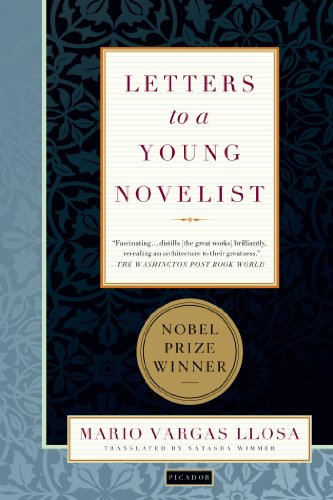
Inhaltsangabe
WINNER OF THE NOBEL PRIZE IN LITERATURE
Mario Vargas Llosa condenses a lifetime of writing, reading, and thought into an essential manual for aspiring writers. Drawing on the stories and novels of writers from around the globe-Borges, Bierce, Céline, Cortázar, Faulkner, Kafka, Robbe-Grillet-he lays bare the inner workings of fiction, all the while urging young novelists not to lose touch with the elemental urge to create. Conversational, eloquent, and effortlessly erudite, this little book is destined to be read and re-read by young writers, old writers, would-be writers, and all those with a stake in the world of letters.
Die Inhaltsangabe kann sich auf eine andere Ausgabe dieses Titels beziehen.
Über die Autorin bzw. den Autor
Mario Vargas Llosa; Translated by Natasha Wimmer
Auszug. © Genehmigter Nachdruck. Alle Rechte vorbehalten.
Letters to a Young Novelist
By Mario Vargas Llosa, Natasha WimmerPicador
Copyright © 1997 Mario Vargas Llosa
All rights reserved.
ISBN: 978-0-312-42172-4All rights reserved.
Contents
The Parable of the Tapeworm,
The Catoblepas,
The Power of Persuasion,
Style,
The Narrator and Narrative Space,
Time,
Levels of Reality,
Shifts and Qualitative Leaps,
Chinese Boxes,
The Hidden Fact,
Communicating Vessels,
By Way of a P.S.,
Index of Names and Works,
CHAPTER 1
The Parable of the Tapeworm
Dear Friend,
I was moved by your letter because in it I saw myself at fourteen or fifteen, in gray Lima under the dictatorship of General Odría, aflame with the desire to one day become a writer yet disheartened because I didn't know what steps to take, how to begin channeling my ambition, which I experienced as an urgent prompting, into the creation of real works; how to write stories that would dazzle my readers as I had been dazzled by the writers I was beginning to install in my personal pantheon: Faulkner, Hemingway, Malraux, Dos Passos, Camus, Sartre.
Many times it occurred to me to write to one of them (they were all still alive) and ask for their advice on how to be a writer. I never dared, out of shyness or out of the kind of defeatism — why write, if I know no one will deign to respond? — that so often thwarts the ambitions of young people in countries where literature means little to most and survives on the margins of society as an almost underground activity.
You do not suffer from that kind of paralysis, since you've written to me. That's a fine beginning to the adventure you wish to set out on and from which you expect — as I'm sure you do, though you don't tell me so in your letter — many marvelous things. I venture to suggest that you not expect quite so much and that you not count too much on success. There's no reason why you shouldn't be successful, of course, but if you persevere in writing and publishing, you'll soon discover that prizes, public acclaim, book sales, the social standing of a writer all have a sui generis appeal; they are extraordinarily arbitrary, sometimes stubbornly evading those who most deserve them while besieging and overwhelming those who merit them least. Which means that those who see success as their main goal will probably never realize their dreams; they are confusing literary ambition with a hunger for glory and for the financial gains that literature affords certain writers (very few of them). There is a difference.
The defining characteristic of the literary vocation may be that those who possess it experience the exercise of their craft as its own best reward, much superior to anything they might gain from the fruits of their labors. That is one thing I am sure of amid my many uncertainties regarding the literary vocation: deep inside, a writer feels that writing is the best thing that ever happened to him, or could ever happen to him, because as far as he is concerned, writing is the best possible way of life, never mind the social, political, or financial rewards of what he might achieve through it.
Vocation seems to me the inevitable starting point for our talk about what is exciting and troubling you: namely, how to become a writer. It's a mysterious business, of course, veiled in doubt and subjectivity. But that doesn't stop us from trying to explain it rationally, rejecting the religious fervor and pride of the self-important myths the romantics spun around it, according to which the writer was the chosen one of the gods, a being singled out by a transcendent superhuman entity to write divine words that, once breathed, would effect the sublimation of the human soul and allow the writer, thanks to his brush with Beauty (capitalized, of course), to achieve immortality.
Today nobody talks that way about literary or artistic vocation, but even though the definition offered in our times is less grandiose, less steeped in fatefulness, it is still fairly elusive: a predisposition of murky origin that causes certain men and women to dedicate their lives to an activity that one day they feel called, almost obliged, to pursue, because they sense that only in pursuing this vocation — writing stories, for example — will they feel complete, at peace with themselves, able to give the best of themselves without the nagging fear that they are wasting their lives.
I don't believe that the destinies of human beings are programmed in the womb by fate or by a mischievous divinity that distributes aptitudes, ineptitudes, likes, and dislikes among brand-new souls. But neither do I believe, as once I did under the influence of the French existentialists — especially Sartre — that vocation is a choice, a free expression of individual will that decides a person's future. Indeed, in spite of my conviction that literary vocation is not governed by fate or inscribed in the genes of future writers, and despite my belief that discipline and perseverance may sometimes produce genius, I've come to be convinced that it cannot be explained solely in terms of free choice. Free choice is essential, in my opinion, but only at a second stage, following an initial subjective inclination, innate or forged in childhood or earliest adolescence, that rational choice serves to strengthen but is unable to manufacture from scratch.
If I'm not mistaken in my supposition (though I very well may be), a man or a woman develops precociously in childhood or early in his or her teenage years a penchant for dreaming up people, situations, anecdotes, worlds different from the world in which he or she lives, and that inclination is the first sign of what may later be termed literary vocation. Naturally, there is an abyss that the vast majority of human beings never cross between the propensity to retreat from the real world and real life into the imagination and the actual practice of literature. Those who do cross and who become creators of worlds with the written word are writers, the minority who have reinforced their penchant or tendency with an exertion of the will Sartre called choice. At a given moment, they decided to become writers. That's what they chose to be. They arranged their lives to make the written word the focus of the drive that at first they contented themselves with harnessing for the elaboration, in the misty realms of the mind, of other lives and worlds. This is where you are now: at the difficult and thrilling moment when you must decide whether you will go beyond amusing yourself with the creation of fictional realities, whether you will set them down in writing. If that's what you choose, you will certainly have taken a very important step, though your future as a writer will still be far from assured. But the decision to commit yourself, to orient your life toward the achievement of your purposes, is already a way — the only possible way — of beginning to be a writer.
What is the origin of this early inclination, the source of the literary vocation, for inventing beings and stories? The answer, I think, is rebellion. I'm convinced that those who immerse themselves in the lucubration of lives different from their own demonstrate indirectly their rejection and criticism of life as it is, of the real world, and manifest their desire to substitute for it the creations of their imagination and dreams. Why would anyone who is deeply satisfied with reality, with real life as it is lived, dedicate himself to something as insubstantial and fanciful as the creation of...
„Über diesen Titel“ kann sich auf eine andere Ausgabe dieses Titels beziehen.
Suchergebnisse für Letters to a Young Novelist

Beispielbild für diese ISBN
Letters to a Young Novelist
Anbieter: ThriftBooks-Atlanta, AUSTELL, GA, USA
Verkäuferbewertung 5 von 5 Sternen

Paperback. Zustand: As New. No Jacket. Pages are clean and are not marred by notes or folds of any kind. ~ ThriftBooks: Read More, Spend Less. Bestandsnummer des Verkäufers G0312421729I2N00
Gebraucht kaufen
EUR 5,97
Versand gratis
Versand innerhalb von USA
Versand innerhalb von USA
Anzahl: 1 verfügbar
Beispielbild für diese ISBN
Letters to a Young Novelist
Anbieter: ThriftBooks-Atlanta, AUSTELL, GA, USA
Verkäuferbewertung 5 von 5 Sternen
Paperback. Zustand: Good. No Jacket. Pages can have notes/highlighting. Spine may show signs of wear. ~ ThriftBooks: Read More, Spend Less. Bestandsnummer des Verkäufers G0312421729I3N00
Gebraucht kaufen
EUR 5,97
Versand gratis
Versand innerhalb von USA
Versand innerhalb von USA
Anzahl: 1 verfügbar
Beispielbild für diese ISBN
Letters to a Young Novelist
Anbieter: ThriftBooks-Dallas, Dallas, TX, USA
Verkäuferbewertung 5 von 5 Sternen
Paperback. Zustand: Good. No Jacket. Pages can have notes/highlighting. Spine may show signs of wear. ~ ThriftBooks: Read More, Spend Less. Bestandsnummer des Verkäufers G0312421729I3N00
Gebraucht kaufen
EUR 5,97
Versand gratis
Versand innerhalb von USA
Versand innerhalb von USA
Anzahl: 1 verfügbar
Beispielbild für diese ISBN
Letters to a Young Novelist
Anbieter: ThriftBooks-Phoenix, Phoenix, AZ, USA
Verkäuferbewertung 5 von 5 Sternen
Paperback. Zustand: Good. No Jacket. Pages can have notes/highlighting. Spine may show signs of wear. ~ ThriftBooks: Read More, Spend Less. Bestandsnummer des Verkäufers G0312421729I3N00
Gebraucht kaufen
EUR 5,97
Versand gratis
Versand innerhalb von USA
Versand innerhalb von USA
Anzahl: 1 verfügbar
Beispielbild für diese ISBN
Letters to a Young Novelist
Anbieter: ThriftBooks-Reno, Reno, NV, USA
Verkäuferbewertung 5 von 5 Sternen
Paperback. Zustand: Good. No Jacket. Pages can have notes/highlighting. Spine may show signs of wear. ~ ThriftBooks: Read More, Spend Less. Bestandsnummer des Verkäufers G0312421729I3N00
Gebraucht kaufen
EUR 5,97
Versand gratis
Versand innerhalb von USA
Versand innerhalb von USA
Anzahl: 1 verfügbar
Foto des Verkäufers
Letters to a Young Novelist
Anbieter: Windflower Bookstore, Rockford, IL, USA
Verkäuferbewertung 4 von 5 Sternen

Zustand: like_new. Bestandsnummer des Verkäufers WFBV.0312421729.LN
Gebraucht kaufen
EUR 2,47
EUR 3,55 Versand
Versand innerhalb von USA
Versand innerhalb von USA
Anzahl: 1 verfügbar
Beispielbild für diese ISBN
Letters to a Young Novelist
Anbieter: World of Books (was SecondSale), Montgomery, IL, USA
Verkäuferbewertung 5 von 5 Sternen
Paperback. Zustand: Fair. WINNER OF THE NOBEL PRIZE IN LITERATURE Mario Vargas Llosa condenses a lifetime of writing, reading, and thought into an essential manual for aspiring writers. Drawing on the stories and novels of writers from around the globe-Borges, Bierce, Céline, Cortázar, Faulkner, Kafka, Robbe-Grillet-he lays bare the inner workings of fiction, all the while urging young novelists not to lose touch with the elemental urge to create. Conversational, eloquent, and effortlessly erudite, this little book is destined to be read and re-read by young writers, old writers, would-be writers, and all those with a stake in the world of letters. Bestandsnummer des Verkäufers 00103286153
Gebraucht kaufen
EUR 6,02
Versand gratis
Versand innerhalb von USA
Versand innerhalb von USA
Anzahl: 1 verfügbar
Foto des Verkäufers
Letters to a Young Novelist
Anbieter: Blue Vase Books, Interlochen, MI, USA
Verkäuferbewertung 5 von 5 Sternen
Zustand: acceptable. The item is very worn but is perfectly usable. Signs of wear can include aesthetic issues such as scratches, dents, worn and creased covers, folded page corners and minor liquid stains. All pages and the cover are intact, but the dust cover may be missing. Pages may include moderate to heavy amount of notes and highlighting, but the text is not obscured or unreadable. Page edges may have foxing age related spots and browning . May NOT include discs, access code or other supplemental materials. Bestandsnummer des Verkäufers BVV.0312421729.A
Gebraucht kaufen
EUR 6,03
Versand gratis
Versand innerhalb von USA
Versand innerhalb von USA
Anzahl: 1 verfügbar
Beispielbild für diese ISBN
Letters to a Young Novelist
Anbieter: Half Price Books Inc., Dallas, TX, USA
Verkäuferbewertung 5 von 5 Sternen
Paperback. Zustand: Very Good. Connecting readers with great books since 1972! Used books may not include companion materials, and may have some shelf wear or limited writing. We ship orders daily and Customer Service is our top priority! Bestandsnummer des Verkäufers S_473128050
Gebraucht kaufen
EUR 2,75
EUR 3,33 Versand
Versand innerhalb von USA
Versand innerhalb von USA
Anzahl: 1 verfügbar
Beispielbild für diese ISBN
Letters to a Young Novelist
Anbieter: Better World Books, Mishawaka, IN, USA
Verkäuferbewertung 5 von 5 Sternen
Zustand: Good. 1 Edition. Former library copy. Pages intact with minimal writing/highlighting. The binding may be loose and creased. Dust jackets/supplements are not included. Includes library markings. Stock photo provided. Product includes identifying sticker. Better World Books: Buy Books. Do Good. Bestandsnummer des Verkäufers 403740-6
Gebraucht kaufen
EUR 6,54
Versand gratis
Versand innerhalb von USA
Versand innerhalb von USA
Anzahl: 1 verfügbar