
Verwandte Artikel zu The Evolution of Calpurnia Tate: (Newbery Honor Book)
Inhaltsangabe
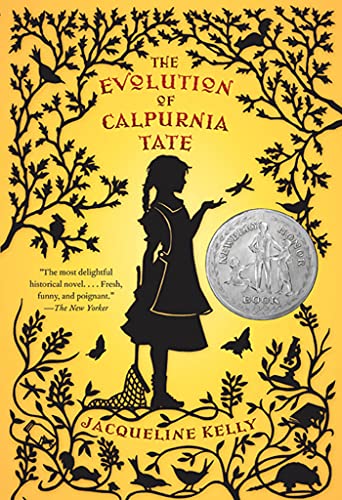
In this witty historical fiction middle grade novel set at the turn of the century, an 11-year-old girl explores the natural world, learns about science and animals, and grows up. A Newbery Honor Book.
"The most delightful historical novel for tweens in many, many years. . . . Callie's struggles to find a place in the world where she'll be encouraged in the gawky joys of intellectual curiosity are fresh, funny, and poignant today." -The New Yorker
Calpurnia Virginia Tate is eleven years old in 1899 when she wonders why the yellow grasshoppers in her Texas backyard are so much bigger than the green ones. With a little help from her notoriously cantankerous grandfather, an avid naturalist, she figures out that the green grasshoppers are easier to see against the yellow grass, so they are eaten before they can get any larger. As Callie explores the natural world around her, she develops a close relationship with her grandfather, navigates the dangers of living with six brothers, and comes up against just what it means to be a girl at the turn of the century.
Author Jacqueline Kelly deftly brings Callie and her family to life, capturing a year of growing up with unique sensitivity and a wry wit.
The Evolution of Calpurnia Tate by Jacqueline Kelly was a 2010 Newbery Honor Book and the winner of the 2010 Bank Street - Josette Frank Award. This title has Common Core connections. This is perfect for young readers who like historical fiction, STEM topics, animal stories, and feminist middle grade novels.
Don't miss the sequel!
The Curious World of Calpurnia Tate
To follow Calpurnia Tate on more adventures, read the Calpurnia Tate, Girl Vet chapter book series:
Skunked!
Counting Sheep
Who Gives a Hoot?
A Prickly Problem
Die Inhaltsangabe kann sich auf eine andere Ausgabe dieses Titels beziehen.
Über die Autorin bzw. den Autor
Jacqueline Kelly
Auszug. © Genehmigter Nachdruck. Alle Rechte vorbehalten.
The Evolution of Calpurnia Tate
By Jacqueline KellySquare Fish
Copyright © 2011 Jacqueline KellyAll right reserved.
ISBN: 9780312659301
Chapter 1
The Origin of Species
When a young naturalist commences the study of a group of organisms quite unknown to him, he is at first much perplexed to determine what differences to consider . . . for he knows nothing of the amount and kind of variation to which the group is subject. . . .
By 1899, we had learned to tame the darkness but not the Texas heat. We arose in the dark, hours before sunrise, when there was barely a smudge of indigo along the eastern sky and the rest of the horizon was still pure pitch. We lit our kerosene lamps and carried them before us in the dark like our own tiny wavering suns. There was a full day’s work to be done before noon, when the deadly heat drove everyone back into our big shuttered house and we lay down in the dim high-ceilinged rooms like sweating victims. Mother’s usual summer remedy of sprinkling the sheets with refreshing cologne lasted only a minute. At three o’clock in the afternoon, when it was time to get up again, the temperature was still killing.
The heat was a misery for all of us in Fentress, but it was the women who suffered the most in their corsets and petticoats. (I was still a few years too young for this uniquely feminine form of torture.) They loosened their stays and sighed the hours away and cursed the heat and their husbands, too, for dragging them to Caldwell County to plant cotton and acres of pecan trees. Mother temporarily gave up her hairpieces, a crimped false fringe and a rolled horsehair rat, platforms on which she daily constructed an elaborate mountain of her own hair. On those days when we had no company, she even took to sticking her head under the kitchen pump and letting Viola, our quadroon cook, pump away until she was soaked through. We were forbidden by sharp orders to laugh at this astounding entertainment. As Mother gradually surrendered her dignity to the heat, we discovered (as did Father) that it was best to keep out of her way.
My name is Calpurnia Virginia Tate, but back then everybody called me Callie Vee. That summer, I was eleven years old and the only girl out of seven children. Can you imagine a worse situation? I was spliced midway between three older brothers—Harry, Sam Houston, and Lamar—and three younger brothers—Travis, Sul Ross, and the baby, Jim Bowie, whom we called J.B. The little boys actually managed to sleep at midday, sometimes even piled atop one another like damp, steaming puppies. The men who came in from the fields and my father, back from his office at the cotton gin, slept too, first dousing themselves with tin buckets of tepid well water on the sleeping porch before falling down on their rope beds as if poleaxed.
Yes, the heat was a misery, but it also brought me my freedom. While the rest of the family tossed and dozed, I secretly made my way to the San Marcos River bank and enjoyed a daily interlude of no school, no pestiferous brothers, and no Mother. I didn’t have permission to do this, exactly, but no one said I couldn’t. I got away with it because I had my own room at the far end of the hall, whereas my brothers all had to share, and they would have tattled in a red-hot second. As far as I could tell, this was the sole decent thing about being the only girl.
Our house was separated from the river by a crescentshaped parcel of five acres of wild, uncleared growth. It would have been an ordeal to push my way through it except that the regular river patrons—dogs, deer, brothers—kept a narrow path beaten down through the treacherous sticker burrs that rose as high as my head and snatched at my hair and pinafore as I folded myself narrow to slide by. When I reached the river, I stripped down to my chemise, floating on my back with my shimmy gently billowing around me in the mild currents, luxuriating in the coolness of the water flowing around me. I was a river cloud, turning gently in the eddies. I looked up at the filmy bags of webworms high above me in the lush canopy of oaks bending over the river. The webworms seemed to mirror me, floating in their own balloons of gauze in the pale turquoise sky.
That summer, all the men except for my grandfather Walter Tate cut their hair close and shaved off their thick beards and mustaches. They looked as naked as blind salamanders for the few days it took to get over the shock of their pale, weak chins. Strangely, Grandfather felt no distress from the heat, even with his full white beard tumbling down his chest. He claimed it was because he was a man of regular and moderate habits who never took whiskey before noon. His smelly old swallowtail coat was hopelessly outdated by then, but he wouldn’t hear of parting with it. Despite regular spongings with benzene at the hands of our maid SanJuanna, the coat always kept its musty smell and strange color, which was neither black nor green.
Grandfather lived under the same roof with us but was something of a shadowy figure. He had long since turned over the running of the family business to his only son, my father, Alfred Tate, and spent his days engaged in “experiments” in his “laboratory” out back. The laboratory was just an old shed that had once been part of the slave quarters. When he wasn’t in the laboratory, he was either out hunting specimens or holed up with his moldering books in a dim corner of the library, where no one dared disturb him.
I asked Mother if I could cut off my hair, which hung in a dense swelter all the way down my back. She said no, she wouldn’t have me running about like a shorn savage. I found this manifestly unfair, to say nothing of hot. So I devised a plan: Every week I would cut off an inch of hair—just one stealthy inch—so that Mother wouldn’t notice. She wouldn’t notice because I would camouflage myself with good manners. When I took on the disguise of a polite young lady, I could often escape her closer scrutiny. She was usually swamped by the constant demands of the household and the ceaseless uproar of my brothers. You wouldn’t believe the amount of chaos and commotion six brothers could create. Plus, the heat aggravated her crippling sick headaches, and she had to resort to a big spoonful of Lydia Pinkham’s Vegetable Compound, known to be the Best Blood Purifier for Women.
That night I took a pair of embroidery scissors and, with great exhilaration and a pounding heart, cut off the first inch. I looked at the soft haystack of hair cupped in my palm. I was striding forth to greet my future in the shiny New Century, a few short months away. It seemed to me a great moment indeed. I slept poorly that night in fear of the morning.
The next day I held my breath coming down the stairs to breakfast. The pecan flapjacks tasted like cardboard. And do you know what happened? Absolutely nothing. No one noticed in the slightest. I was mightily relieved but also thought, Well, isn’t that just like this family. In fact, no one noticed anything until four weeks and four inches went by and our cook, Viola, gave me a hard look one morning. But she didn’t say a word.
It was so hot...
„Über diesen Titel“ kann sich auf eine andere Ausgabe dieses Titels beziehen.
Suchergebnisse für The Evolution of Calpurnia Tate: (Newbery Honor Book)

Beispielbild für diese ISBN
The Evolution of Calpurnia Tat
Anbieter: World of Books (was SecondSale), Montgomery, IL, USA
Verkäuferbewertung 5 von 5 Sternen

Zustand: Acceptable. Item in acceptable condition! Textbooks may not include supplemental items i.e. CDs, access codes etc. Bestandsnummer des Verkäufers 00090547232
Gebraucht kaufen
EUR 3,63
Versand gratis
Versand innerhalb von USA
Versand innerhalb von USA
Anzahl: 12 verfügbar
Beispielbild für diese ISBN
The Evolution of Calpurnia Tat
Anbieter: World of Books (was SecondSale), Montgomery, IL, USA
Verkäuferbewertung 5 von 5 Sternen
Zustand: Very Good. Item in very good condition! Textbooks may not include supplemental items i.e. CDs, access codes etc. Bestandsnummer des Verkäufers 00109449807
Gebraucht kaufen
EUR 3,63
Versand gratis
Versand innerhalb von USA
Versand innerhalb von USA
Anzahl: 9 verfügbar
Beispielbild für diese ISBN
The Evolution of Calpurnia Tat
Anbieter: World of Books (was SecondSale), Montgomery, IL, USA
Verkäuferbewertung 5 von 5 Sternen
Zustand: Good. Item in good condition. Textbooks may not include supplemental items i.e. CDs, access codes etc. Bestandsnummer des Verkäufers 00090113246
Gebraucht kaufen
EUR 3,63
Versand gratis
Versand innerhalb von USA
Versand innerhalb von USA
Anzahl: Mehr als 20 verfügbar
Beispielbild für diese ISBN
The Evolution of Calpurnia Tate (Calpurnia Tate, 1)
Anbieter: Gulf Coast Books, Cypress, TX, USA
Verkäuferbewertung 5 von 5 Sternen
Paperback. Zustand: Fair. Bestandsnummer des Verkäufers 031265930X-4-26335222
Gebraucht kaufen
EUR 3,64
Versand gratis
Versand innerhalb von USA
Versand innerhalb von USA
Anzahl: 1 verfügbar
Beispielbild für diese ISBN
The Evolution of Calpurnia Tate (Calpurnia Tate, 1)
Anbieter: Gulf Coast Books, Cypress, TX, USA
Verkäuferbewertung 5 von 5 Sternen
Paperback. Zustand: Good. Bestandsnummer des Verkäufers 031265930X-3-22474789
Gebraucht kaufen
EUR 3,64
Versand gratis
Versand innerhalb von USA
Versand innerhalb von USA
Anzahl: 1 verfügbar
Beispielbild für diese ISBN
The Evolution of Calpurnia Tate (Calpurnia Tate, 1)
Anbieter: Your Online Bookstore, Houston, TX, USA
Verkäuferbewertung 5 von 5 Sternen
paperback. Zustand: Fair. Bestandsnummer des Verkäufers 031265930X-4-31147691
Gebraucht kaufen
EUR 3,64
Versand gratis
Versand innerhalb von USA
Versand innerhalb von USA
Anzahl: 1 verfügbar
Beispielbild für diese ISBN
The Evolution of Calpurnia Tate: (Newbery Honor Book) (Calpurnia Tate, 1)
Anbieter: Orion Tech, Kingwood, TX, USA
Verkäuferbewertung 5 von 5 Sternen
paperback. Zustand: Fair. Bestandsnummer des Verkäufers 031265930X-4-32116166
Gebraucht kaufen
EUR 3,64
Versand gratis
Versand innerhalb von USA
Versand innerhalb von USA
Anzahl: 2 verfügbar
Foto des Verkäufers
The Evolution of Calpurnia Tate: (Newbery Honor Book)
Anbieter: 3Brothers Bookstore, Egg harbor township, NJ, USA
Verkäuferbewertung 5 von 5 Sternen
Zustand: very_good. Cover may have light wear, pages in very good condition and binding is sturdy; may have other light shelf wear or creases. May have notes or highlighting. Bestandsnummer des Verkäufers EVV.031265930X.VG
Gebraucht kaufen
EUR 3,93
Versand gratis
Versand innerhalb von USA
Versand innerhalb von USA
Anzahl: 1 verfügbar
Foto des Verkäufers
The Evolution of Calpurnia Tate: (Newbery Honor Book)
Anbieter: 3Brothers Bookstore, Egg harbor township, NJ, USA
Verkäuferbewertung 5 von 5 Sternen
Zustand: good. Books may contain some notes and highlighting. Supplements such as Access Codes, Cd's Dust Jackets, etc. are not guaranteed with used book purchases. Bestandsnummer des Verkäufers EVV.031265930X.G
Gebraucht kaufen
EUR 3,93
Versand gratis
Versand innerhalb von USA
Versand innerhalb von USA
Anzahl: 3 verfügbar
Foto des Verkäufers
The Evolution of Calpurnia Tate: (Newbery Honor Book)
Anbieter: 3Brothers Bookstore, Egg harbor township, NJ, USA
Verkäuferbewertung 5 von 5 Sternen
Zustand: like_new. Book is in like new condition with only potential shelf wear. No marking or highlighting. Bestandsnummer des Verkäufers EVV.031265930X.LN
Gebraucht kaufen
EUR 3,93
Versand gratis
Versand innerhalb von USA
Versand innerhalb von USA
Anzahl: 1 verfügbar