
Verwandte Artikel zu Blackhorse Riders: A Desperate Last Stand, An Extraordinary...
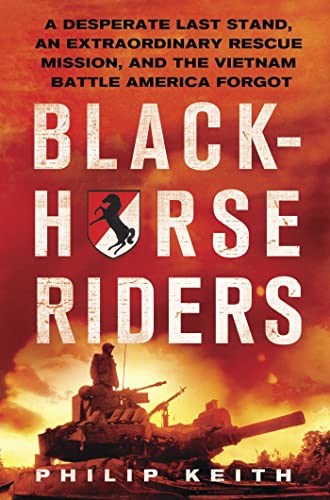
Blackhorse Riders: A Desperate Last Stand, An Extraordinary Rescue Mission, and the Vietnam Battle America Forgot - Hardcover
Inhaltsangabe
Winner of the 2013 Silver Medal in History from the Military Writer's Society of America
Finalist, 2013 Colby Award
Winner of the 2012 USA Best Book Award for Military History
Philip Keith's Blackhorse Riders is the incredible true story of a brave military unit in Vietnam that risked everything to rescue an outnumbered troop under heavy fire—and the thirty-nine-year odyssey to recognize their bravery.
Deep in the jungles of Vietnam, Alpha Troop, 1st Squadron, 11th Armored Cavalry, the famed Blackhorse Regiment, was a specialized cavalry outfit equipped with tanks and armored assault vehicles. On the morning of March 26, 1970, they began hearing radio calls from an infantry unit four kilometers away that had stumbled into a hidden North Vietnamese Army stronghold. Outnumbered at least six to one, the ninety-man American company was quickly surrounded, pinned down, and fighting for its existence. Helicopters could not penetrate the dense jungle, and artillery and air support could not be targeted effectively. The company was fated to be worn down and eventually all killed or captured.
Overhearing the calls for help on his radio, Captain John Poindexter, Alpha Troop's twenty-five-year-old commander, realized that his outfit was the only hope for the trapped company. It just might be possible that they could "bust" enough jungle by nightfall to reach them. Not making the attempt was deemed unacceptable, so he ordered his men to "saddle up." With the courage and determination that makes legends out of ordinary men, they effected a daring rescue and fought a pitched battle—at considerable cost. Many brave deeds were done that day and Captain Poindexter tried to make sure his men were recognized for their actions.
Thirty years later Poindexter was made aware that his award recommendations and even the records of the battle had somehow gone missing. Thus began the second phase of this remarkable story: a "battle" to ensure that his brave men's accomplishments would never be forgotten again.
The full circle was completed when President Obama stepped to the podium on October 20, 2009, to award the Alpha Troop with the Presidential Unit Citation: the highest combat award that can be given to a military unit.
Die Inhaltsangabe kann sich auf eine andere Ausgabe dieses Titels beziehen.
Über die Autorin bzw. den Autor
PHILIP KEITH became a naval aviator after graduating from Harvard. During three tours in Vietnam he was awarded, among other decorations, the Presidential Unit Citation, the Air Medal for Gallantry, the Purple Heart, and the Navy Commendation Medal. Keith is also a columnist for the Southampton Press and a feature writer for magazines. He lives in Southampton, Long Island.
Auszug. © Genehmigter Nachdruck. Alle Rechte vorbehalten.
Blackhorse Riders
A Desperate Last Stand, an Extraordinary Rescue Mission, and the Vietnam Battle America ForgotBy Philip KeithSt. Martin's Press
Copyright © 2012 Philip KeithAll right reserved.
ISBN: 9780312681920
1
ALPHA TROOP: MEN OF IRON, STEEDS OF STEEL
1200, MARCH 26, 1970, ALPHA TROOP’S NDP, WAR ZONE C, REPUBLIC OF VIETNAM
Somebody’s in serious trouble, Capt. John Poindexter told himself as he sat, sweltering, in the stifling heat. The long, tall Texan, twenty-five, was trying to steal a few minutes of downtime after a horrible night of pain, terror, and numbing death among the members of his cavalry troop.
It was well over a hundred degrees, even under the cover of the canvas tent-top that extended from the rear of Poindexter’s M-577 (a specialized ACAV, or armored cavalry assault vehicle). Seconds before, the battalion radio inside the baking command vehicle behind him had crackled to life. Racer Two-Nine was calling Stone Mountain Two-Nine and insistently asking for help.
Poindexter perked up and cocked an ear to listen. He knew Stone Mountain Two-Nine was his current boss, Lt. Col. Mike Conrad, battalion commander of the 2nd Battalion, 8th Cavalry. It took him a few more seconds to recall that Racer Two-Nine was that fellow Hobson, the commander of Charlie Company, also part of Conrad’s battalion. Poindexter had worked with Hobson’s company, but that was before Hobson had taken over a couple of weeks back. Poindexter’s men were soldiering with Alpha Company, a brother company to Charlie, currently under the command of Capt. Ray Armer. Armer was, in fact, sitting just a few feet away from Poindexter, suffering in the same heat and also intently interested in what the radio was pumping out.
From the semigarbled back-and-forth it eventually became clear that Hobson was in a real shit sandwich (a very bad tactical situation). His company of infantry, about eighty men, had inadvertently walked into the middle of a large, concealed, heavily fortified North Vietnamese Army (NVA) supply base. Worse, the complex seemed to be populated by frontline regular soldiers, possibly as many as a battalion. If the NVA were even at moderate strength, Hobson was outnumbered at least seven or eight to one, maybe more. Even worse news: The NVA were entrenched in bunkers. This meant they were safely behind stout dirt-and-log barricades and Hobson and his men were out in the open, or at best ducking down behind much less substantial jungle foliage, fallen timbers, or whatever cover they could find. They had already taken boo-koo (bastardization of the French beaucoup, many) casualties and were getting dangerously low on ammunition.
Poindexter got up wearily and stepped into the back of the M-577. He found a map of the local operations area. He didn’t know exactly where Hobson was, but by the sound of the gunfire that was growing in volume he guessed he and his men had to be somewhere off to the northwest about four klicks away (approximately two and a half miles). He tossed the chart down on the table and went back outside, sinking into his grime-and-grease-stained canvas chair once more.
Four Cobra gunships and two U.S. Air Force F-4 Phantom jets streaked overhead, racing to where Poindexter figured Hobson was bogged down. Artillery rounds, from Fire Support Base Illingworth, a few klicks behind them, arced overhead, trying to reach out to the NVA and cover the stranded Americans. The distant crash and boom ratcheted up and up, the crescendo building, indicating an all-out firefight was under way.
Ray Armer stared at Poindexter and quietly said, “Sounds like they need help.”
Both officers knew that their small command of approximately two hundred soldiers, Sheridan tanks, and ACAVs were the only ground forces within miles that could come to Charlie Company’s aid. They were way out in the boonies, far in advance of the main force, but Charlie was out even farther, probably very close to the Cambodian border.
Both men also knew that the jungle nearby was virtually impenetrable from the air. Unless Charlie had somehow located or manufactured an LZ (landing zone) before they were jumped (not very likely) it would be impossible to send in a rescue force by air or attempt any kind of vertical extraction. If Charlie Company couldn’t fight their way out, and the radio traffic clearly indicated they were surrounded, their only hope was a rescue column of some sort. The only conceivable “column” was hunkered down in the middle of a dry lake bed, licking its own wounds, and separated from Charlie by a couple of miles of dense, choking jungle.
The choices were few and ugly: Do nothing until ordered, in which case the men of Charlie Company would continue to suffer and die without hope; or mount up and charge off into the jungle with every prospect of either getting ambushed along the way or being chopped up in the same meat grinder that was chewing through the ranks of Charlie.
The sweat rolled off Poindexter’s brow, but it was no longer only because of the heat of the day.
* * *
The subsequent decisions made by John Poindexter and the resultant actions of the men of Team Alpha are the main focus of this book. Before we learn more about what happened to this redoubtable band, it is important to describe their organization, their capabilities, and how they came to be sitting in that dust-choked depression in the middle of War Zone C, deep in enemy territory.
ALPHA TROOP, THE MECHANIZED COMPONENT The 11th Armored Cavalry Regiment (see appendix 2) traces its roots back to the 11th Cavalry, a much-decorated unit that began operations in 1901 at Fort Myer, Virginia. It was all about the horses at first, but the real provenance of the 11th begins after the flesh-and-blood mounts were traded in for steeds of steel. Reorganized first as a tank battalion at the beginning of World War II, and then converted into a true armored cavalry regiment, the 11th served steadfastly in France and Germany, including the D-day landings and the Battle of the Bulge. After the end of World War II, the 11th, like many similar units, was caught up in a rapid and extensive demobilization effort intended to take the army back to much smaller and more traditional peacetime levels. The 11th was ultimately deactivated completely on November 30, 1948.
No one knew the Korean War was coming, of course, so when that conflict erupted in 1950, the army planners reversed course and reactivated the proud old unit, this time as the 11th Armored Cavalry Regiment, and stationed it at Camp Carson, Colorado. The regiment had to be rebuilt from scratch, except for its motto, which remained, “Allons” (“Let’s go,” in French) and its “Blackhorse” logo.
Once the 11th was back on line, it was moved again, to Fort Knox, Kentucky, and the unit was given the task of training reservists. They relocated yet again in 1957 to Germany, where the men took up duties of guarding the German-Czechoslovakian border. The regiment’s overseas duties ended in 1964 and the entire command, now supporting an aviation company, was shipped back to Fort Meade, Maryland. The 11th would remain at Fort Meade until its deployment to Vietnam in September 1966.
The 11th would stay in Vietnam almost six years. The last men out would not return until March of 1972. In that long stretch of time, the regiment would engage in many actions, such as the one that is the subject...
ALPHA TROOP: MEN OF IRON, STEEDS OF STEEL
1200, MARCH 26, 1970, ALPHA TROOP’S NDP, WAR ZONE C, REPUBLIC OF VIETNAM
Somebody’s in serious trouble, Capt. John Poindexter told himself as he sat, sweltering, in the stifling heat. The long, tall Texan, twenty-five, was trying to steal a few minutes of downtime after a horrible night of pain, terror, and numbing death among the members of his cavalry troop.
It was well over a hundred degrees, even under the cover of the canvas tent-top that extended from the rear of Poindexter’s M-577 (a specialized ACAV, or armored cavalry assault vehicle). Seconds before, the battalion radio inside the baking command vehicle behind him had crackled to life. Racer Two-Nine was calling Stone Mountain Two-Nine and insistently asking for help.
Poindexter perked up and cocked an ear to listen. He knew Stone Mountain Two-Nine was his current boss, Lt. Col. Mike Conrad, battalion commander of the 2nd Battalion, 8th Cavalry. It took him a few more seconds to recall that Racer Two-Nine was that fellow Hobson, the commander of Charlie Company, also part of Conrad’s battalion. Poindexter had worked with Hobson’s company, but that was before Hobson had taken over a couple of weeks back. Poindexter’s men were soldiering with Alpha Company, a brother company to Charlie, currently under the command of Capt. Ray Armer. Armer was, in fact, sitting just a few feet away from Poindexter, suffering in the same heat and also intently interested in what the radio was pumping out.
From the semigarbled back-and-forth it eventually became clear that Hobson was in a real shit sandwich (a very bad tactical situation). His company of infantry, about eighty men, had inadvertently walked into the middle of a large, concealed, heavily fortified North Vietnamese Army (NVA) supply base. Worse, the complex seemed to be populated by frontline regular soldiers, possibly as many as a battalion. If the NVA were even at moderate strength, Hobson was outnumbered at least seven or eight to one, maybe more. Even worse news: The NVA were entrenched in bunkers. This meant they were safely behind stout dirt-and-log barricades and Hobson and his men were out in the open, or at best ducking down behind much less substantial jungle foliage, fallen timbers, or whatever cover they could find. They had already taken boo-koo (bastardization of the French beaucoup, many) casualties and were getting dangerously low on ammunition.
Poindexter got up wearily and stepped into the back of the M-577. He found a map of the local operations area. He didn’t know exactly where Hobson was, but by the sound of the gunfire that was growing in volume he guessed he and his men had to be somewhere off to the northwest about four klicks away (approximately two and a half miles). He tossed the chart down on the table and went back outside, sinking into his grime-and-grease-stained canvas chair once more.
Four Cobra gunships and two U.S. Air Force F-4 Phantom jets streaked overhead, racing to where Poindexter figured Hobson was bogged down. Artillery rounds, from Fire Support Base Illingworth, a few klicks behind them, arced overhead, trying to reach out to the NVA and cover the stranded Americans. The distant crash and boom ratcheted up and up, the crescendo building, indicating an all-out firefight was under way.
Ray Armer stared at Poindexter and quietly said, “Sounds like they need help.”
Both officers knew that their small command of approximately two hundred soldiers, Sheridan tanks, and ACAVs were the only ground forces within miles that could come to Charlie Company’s aid. They were way out in the boonies, far in advance of the main force, but Charlie was out even farther, probably very close to the Cambodian border.
Both men also knew that the jungle nearby was virtually impenetrable from the air. Unless Charlie had somehow located or manufactured an LZ (landing zone) before they were jumped (not very likely) it would be impossible to send in a rescue force by air or attempt any kind of vertical extraction. If Charlie Company couldn’t fight their way out, and the radio traffic clearly indicated they were surrounded, their only hope was a rescue column of some sort. The only conceivable “column” was hunkered down in the middle of a dry lake bed, licking its own wounds, and separated from Charlie by a couple of miles of dense, choking jungle.
The choices were few and ugly: Do nothing until ordered, in which case the men of Charlie Company would continue to suffer and die without hope; or mount up and charge off into the jungle with every prospect of either getting ambushed along the way or being chopped up in the same meat grinder that was chewing through the ranks of Charlie.
The sweat rolled off Poindexter’s brow, but it was no longer only because of the heat of the day.
* * *
The subsequent decisions made by John Poindexter and the resultant actions of the men of Team Alpha are the main focus of this book. Before we learn more about what happened to this redoubtable band, it is important to describe their organization, their capabilities, and how they came to be sitting in that dust-choked depression in the middle of War Zone C, deep in enemy territory.
ALPHA TROOP, THE MECHANIZED COMPONENT The 11th Armored Cavalry Regiment (see appendix 2) traces its roots back to the 11th Cavalry, a much-decorated unit that began operations in 1901 at Fort Myer, Virginia. It was all about the horses at first, but the real provenance of the 11th begins after the flesh-and-blood mounts were traded in for steeds of steel. Reorganized first as a tank battalion at the beginning of World War II, and then converted into a true armored cavalry regiment, the 11th served steadfastly in France and Germany, including the D-day landings and the Battle of the Bulge. After the end of World War II, the 11th, like many similar units, was caught up in a rapid and extensive demobilization effort intended to take the army back to much smaller and more traditional peacetime levels. The 11th was ultimately deactivated completely on November 30, 1948.
No one knew the Korean War was coming, of course, so when that conflict erupted in 1950, the army planners reversed course and reactivated the proud old unit, this time as the 11th Armored Cavalry Regiment, and stationed it at Camp Carson, Colorado. The regiment had to be rebuilt from scratch, except for its motto, which remained, “Allons” (“Let’s go,” in French) and its “Blackhorse” logo.
Once the 11th was back on line, it was moved again, to Fort Knox, Kentucky, and the unit was given the task of training reservists. They relocated yet again in 1957 to Germany, where the men took up duties of guarding the German-Czechoslovakian border. The regiment’s overseas duties ended in 1964 and the entire command, now supporting an aviation company, was shipped back to Fort Meade, Maryland. The 11th would remain at Fort Meade until its deployment to Vietnam in September 1966.
The 11th would stay in Vietnam almost six years. The last men out would not return until March of 1972. In that long stretch of time, the regiment would engage in many actions, such as the one that is the subject...
„Über diesen Titel“ kann sich auf eine andere Ausgabe dieses Titels beziehen.
Suchergebnisse für Blackhorse Riders: A Desperate Last Stand, An Extraordinary...

Beispielbild für diese ISBN
Blackhorse Riders: A Desperate Last Stand, an Extraordinary Rescue Mission, and the Vietnam Battle America Forgot
Verlag:
St. Martin's Press (edition First Edition), 2012
ISBN 10: 0312681925
ISBN 13: 9780312681920
Gebraucht
Hardcover
Erstausgabe
Anbieter: BooksRun, Philadelphia, PA, USA
Verkäuferbewertung 5 von 5 Sternen

Hardcover. Zustand: Very Good. First Edition. It's a well-cared-for item that has seen limited use. The item may show minor signs of wear. All the text is legible, with all pages included. It may have slight markings and/or highlighting. Bestandsnummer des Verkäufers 0312681925-11-1
Gebraucht kaufen
EUR 5,62
Versand gratis
Versand innerhalb von USA
Versand innerhalb von USA
Anzahl: 1 verfügbar
Foto des Verkäufers
Blackhorse Riders: A Desperate Last Stand, an Extraordinary Rescue Mission, and the Vietnam Battle America Forgot
Anbieter: Greenworld Books, Arlington, TX, USA
Verkäuferbewertung 5 von 5 Sternen
Zustand: good. Fast Free Shipping â" Good condition. It may show normal signs of use, such as light writing, highlighting, or library markings, but all pages are intact and the book is fully readable. A solid, complete copy that's ready to enjoy. Bestandsnummer des Verkäufers GWV.0312681925.G
Gebraucht kaufen
EUR 5,69
Versand gratis
Versand innerhalb von USA
Versand innerhalb von USA
Anzahl: 1 verfügbar
Beispielbild für diese ISBN
Blackhorse Riders: A Desperate Last Stand, an Extraordinary Rescue Mission, and the Vietnam Battle America Forgot
Anbieter: World of Books (was SecondSale), Montgomery, IL, USA
Verkäuferbewertung 5 von 5 Sternen
Hardback. Zustand: Good. Deep in the jungles of Vietnam, Alpha Troop, 1st Squadron, 11th Armoured Cavalry, the famed Blackhorse Regiment began hearing radio calls from an infantry unit four kilometres away. Overhearing the calls for help, it became apparent to Alpha Troop's commander, Captain John Poindexter, that his outfit was the only hope for the trapped company. Bestandsnummer des Verkäufers 00102782793
Gebraucht kaufen
EUR 6,14
Versand gratis
Versand innerhalb von USA
Versand innerhalb von USA
Anzahl: 2 verfügbar
Foto des Verkäufers
Blackhorse Riders: A Desperate Last Stand, an Extraordinary Rescue Mission, and the Vietnam Battle America Forgot
Anbieter: Goodwill Books, Hillsboro, OR, USA
Verkäuferbewertung 5 von 5 Sternen
Zustand: acceptable. Fairly worn, but readable and intact. If applicable: Dust jacket, disc or access code may not be included. Bestandsnummer des Verkäufers GICWV.0312681925.A
Gebraucht kaufen
EUR 2,69
EUR 3,56 Versand
Versand innerhalb von USA
Versand innerhalb von USA
Anzahl: 1 verfügbar
Beispielbild für diese ISBN
Blackhorse Riders : A Desperate Last Stand, an Extraordinary Rescue Mission, and the Vietnam Battle America Forgot
Verlag:
St. Martin's Press, 2012
ISBN 10: 0312681925
ISBN 13: 9780312681920
Gebraucht
Hardcover
Erstausgabe
Anbieter: Better World Books, Mishawaka, IN, USA
Verkäuferbewertung 5 von 5 Sternen
Zustand: Very Good. 1St Edition. Former library copy. Pages intact with possible writing/highlighting. Binding strong with minor wear. Dust jackets/supplements may not be included. Includes library markings. Stock photo provided. Product includes identifying sticker. Better World Books: Buy Books. Do Good. Bestandsnummer des Verkäufers 10314992-6
Gebraucht kaufen
EUR 6,35
Versand gratis
Versand innerhalb von USA
Versand innerhalb von USA
Anzahl: 1 verfügbar
Beispielbild für diese ISBN
Blackhorse Riders : A Desperate Last Stand, an Extraordinary Rescue Mission, and the Vietnam Battle America Forgot
Verlag:
St. Martin's Press, 2012
ISBN 10: 0312681925
ISBN 13: 9780312681920
Gebraucht
Hardcover
Erstausgabe
Anbieter: Better World Books, Mishawaka, IN, USA
Verkäuferbewertung 5 von 5 Sternen
Zustand: Good. 1St Edition. Former library copy. Pages intact with minimal writing/highlighting. The binding may be loose and creased. Dust jackets/supplements are not included. Includes library markings. Stock photo provided. Product includes identifying sticker. Better World Books: Buy Books. Do Good. Bestandsnummer des Verkäufers 4262379-6
Gebraucht kaufen
EUR 6,35
Versand gratis
Versand innerhalb von USA
Versand innerhalb von USA
Anzahl: 3 verfügbar
Foto des Verkäufers
Blackhorse Riders: A Desperate Last Stand, an Extraordinary Rescue Mission, and the Vietnam Battle America Forgot
Anbieter: Austin Goodwill 1101, Austin, TX, USA
Verkäuferbewertung 5 von 5 Sternen
Zustand: good. Book shows general signs of use and handling. May have light wear on the cover or edges and minimal writing or highlighting. Binding remains tight, and pages are clean and readable. Bestandsnummer des Verkäufers CTXV.0312681925.G
Gebraucht kaufen
EUR 3,97
EUR 2,94 Versand
Versand innerhalb von USA
Versand innerhalb von USA
Anzahl: 1 verfügbar
Beispielbild für diese ISBN
Blackhorse Riders: A Desperate Last Stand, an Extraordinary Rescue Mission, and the Vietnam Battle America Forgot
Anbieter: HPB-Ruby, Dallas, TX, USA
Verkäuferbewertung 5 von 5 Sternen
Hardcover. Zustand: Very Good. Connecting readers with great books since 1972! Used books may not include companion materials, and may have some shelf wear or limited writing. We ship orders daily and Customer Service is our top priority! Bestandsnummer des Verkäufers S_473565626
Gebraucht kaufen
EUR 4,36
EUR 3,34 Versand
Versand innerhalb von USA
Versand innerhalb von USA
Anzahl: 1 verfügbar
Beispielbild für diese ISBN
Blackhorse Riders: A Desperate Last Stand, an Extraordinary Rescue Mission, and the Vietnam Battle America Forgot
Anbieter: HPB-Red, Dallas, TX, USA
Verkäuferbewertung 5 von 5 Sternen
hardcover. Zustand: Good. Connecting readers with great books since 1972! Used textbooks may not include companion materials such as access codes, etc. May have some wear or writing/highlighting. We ship orders daily and Customer Service is our top priority! Bestandsnummer des Verkäufers S_440933741
Gebraucht kaufen
EUR 4,59
EUR 3,34 Versand
Versand innerhalb von USA
Versand innerhalb von USA
Anzahl: 1 verfügbar
Beispielbild für diese ISBN
Blackhorse Riders: A Desperate Last Stand, an Extraordinary Rescue Mission, and the Vietnam Battle America Forgot
Anbieter: World of Books Inc, Montgomery, IL, USA
Verkäuferbewertung 4 von 5 Sternen

Hardback. Zustand: Good. Deep in the jungles of Vietnam, Alpha Troop, 1st Squadron, 11th Armoured Cavalry, the famed Blackhorse Regiment began hearing radio calls from an infantry unit four kilometres away. Overhearing the calls for help, it became apparent to Alpha Troop's commander, Captain John Poindexter, that his outfit was the only hope for the trapped company. Bestandsnummer des Verkäufers CIN0312681925G
Gebraucht kaufen
EUR 7,98
Versand gratis
Versand innerhalb von USA
Versand innerhalb von USA
Anzahl: 2 verfügbar