
Verwandte Artikel zu Icebound
Inhaltsangabe
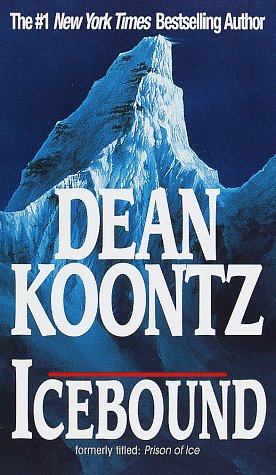
A secret Arctic experiment turns into a frozen nightmare when a team of scientists, stranded on a drifting iceberg with a massive explosive charge, battle the elements for survival, only to discover that one of them is a murderer. Original.
Die Inhaltsangabe kann sich auf eine andere Ausgabe dieses Titels beziehen.
Über die Autorin bzw. den Autor
When he was a senior in college, Dean Koontz won an Atlantic Monthly fiction competition. He has been writing ever since. His books are published in 38 languages; worldwide sales are over 300 million copies.
Ten of his novels have risen to number one on the New York Times hardcover best-seller list (The Husband, One Door Away From Heaven, From The Corner Of His Eye, Midnight, Cold Fire, Hideaway, Dragon Tears, The Bad Place, Intensity, and Sole Survivor). Thirteen of his books have risen to the number one position in paperback.
Several of his books have been adapted into feature films and TV miniseries, including the highly rated “Intensity” on the Fox Network. The Husband is currently in development as a major motion picture by Focus Features/Random House Films.
The New York Times has called his writing "psychologically complex, masterly and satisfying." The New Orleans Times-Picayune said Koontz is "lyrical without ever being naive or romantic. [He creates] a grotesque world, much like that of Flannery O'Connor or Walker Percy ... scary, worthwhile reading." The London Times called him "a literary juggler," and Publishers Weekly recently stated in a starred review that Koontz "gives readers bright hope in a dark world. He is a true original."
Dean Koontz was born and raised in Pennsylvania. He graduated from Shippensburg State College (now Shippensburg University), and his first job after graduation was with the Appalachian Poverty Program, where he was expected to counsel and tutor underprivileged children on a one-to-one basis. His first day on the job, he discovered that the previous occupier of his position had been beaten up by the very kids he had been trying to help and had landed in the hospital for several weeks. The following year was filled with challenge but also tension, and Koontz was more highly motivated than ever to build a career as a writer. He wrote nights and weekends, which he continued to do after leaving the poverty program and going to work as an English teacher in a suburban school district outside Harrisburg. After he had been a year and a half in that position, his wife, Gerda, made him an offer he couldn't refuse: "I'll support you for five years," she said, "and if you can't make it as a writer in that time, you'll never make it." By the end of those five years, Gerda had quit her job to run the business end of her husband's writing career. Dean and Gerda Koontz live in southern California with their golden retriever, Trixie, who herself has written two successful books—Life Is Good and Christmas Is Good.
Aus dem Klappentext
adventure of science gone wrong and psychopathic terror in the polar icecaps by a modern master of horror and suspense.
Auszug. © Genehmigter Nachdruck. Alle Rechte vorbehalten.
Chapter One
Snare
Noon
Detonation in twelve hours
With a crystal-shattering shriek, the bit of the power drill bored deep into the Arctic ice. Gray-white slush churned out of the hole, sluiced across the crusted snow, and refroze in seconds. The flared auger was out of sight, and most of the long steel shank also had disappeared into the four-inch-diameter shaft.
Watching the drill, Harry Carpenter had a curious premonition of imminent disaster. A faint flicker of alarm. Like a bird shadow fluttering across a bright landscape. Even inside his heavily insulated clothing, he shivered.
As a scientist, Harry respected the tools of logic, method, and reason, but he had learned never to discount a hunch–especially on the ice, where strange things could happen. He was unable to identify the source of his sudden uneasiness, though occasional dark forebodings were to be expected on a job involving high explosives. The chance of one of the charges detonating prematurely, killing them all, was slim to nil. Nevertheless . .
Peter Johnson, the electronics engineer who doubled as the team's demolitions expert, switched off the drill and stepped back from it. In his white Gore-Tex/Thermolite storm suit, fur-lined parka, and fur-lined hood, Pete resembled a polar bear–except for his dark brown face.
Claude Jobert shut down the portable generator that supplied power to the drill. The resultant hush had an eerie quality of expectancy so intense that Harry glanced behind himself and then up into the sky, half convinced that something was rushing or falling toward him.
If Death kissed anyone today, it was more likely to rise up from below than to descend upon them. As the bleak afternoon began, the three men were preparing to lower the last hundred-pound explosive charge deep into the ice. It was the sixtieth demolitions package that they had handled since the previous morning, and they were all uneasily conscious of standing upon enough high-yield plastic explosives to destroy them in an apocalyptic flash.
No fertile imagination was required to picture themselves dying in these hostile climes: The icecap was a perfect graveyard, utterly lifeless, and it encouraged thoughts of mortality. Ghostly bluish-white plains led off in all directions, somber and moody during that long season of nearly constant darkness, brief twilight, and perpetual overcast. At the moment, visibility was fair because the day had drawn down to that time when a vague, cloud-filtered crescent of sunlight painted the horizon. However, the sun had little to illuminate in the stark landscape. The only points of elevation were the jagged pressure ridges and hundreds of slabs of ice–some only as large as a man, others bigger than houses–that had popped from the field and stood on end like gigantic tombstones.
Pete Johnson, joining Harry and Claude at a pair of snowmobiles that had been specially rebuilt for the rigors of the pole, told them, "The shaft's twenty-eight yards deep. One more extension for the bit, and the job's done."
"Thank God!" Claude Jobert shivered as if his thermal suit provided no protection whatsoever. In spite of the transparent film of petroleum jelly that protected the exposed portions of his face from frostbite, he was pale and drawn. "We'll make it back to base camp tonight. Think of that! I haven't been warm one minute since we left."
Ordinarily, Claude didn't complain. He was a jovial, energetic little man. At a glance, he seemed fragile, but that was not the case. At five seven and a hundred thirty pounds, he was lean, wiry, hard. He had a mane of white hair now tucked under his hood, a face weathered and made leathery by a lifetime in extreme climates, and bring blue eyes as clear as those of a child. Harry had never seen hatred or anger in those eyes. Until yesterday, he had never seen self-pity in them, either, not even three years ago, when Claude lost his wife, Colette, in a sudden, senseless act of violence; he had been consumed by grief but had never wallowed in self-pity.
Since they had left the comfort of Edgeway Station, however, Claude had been neither jovial nor energetic, and he had complained frequently about the cold. At fifty-nine, he was the oldest member of the expedition, eighteen years older than Harry Carpenter, which was the outer limit for anyone working in those brutal latitudes.
Although he was a fine arctic geologist specializing in the dynamics of ice formation and movement, the current expedition would be his last trip to either pole. Henceforth, his research would be done in laboratories and at computers, for from the severe conditions of the icecap.
Harry wondered if Jobert was bothered less by the bitter cold than by the knowledge that the work he loved had grown too demanding for him. One day Harry would have to face the same truth, and he wasn't sure that he would be able to exit with grace. The great chaste spaces of the Arctic and Antarctic enthralled him: the power of the extreme weather, the mystery that cloaked the white geometric landscapes and pooled in the purple shadows of every seemingly unplumbable crevasse, the spectacle on clear night when the aurora borealis splashed the sky with shimmering streamers of light in jewellike colors, and the vast fields of stars when the curtains of the aurora drew back to reveal them.
In some ways he was still the kid who had grown up on a quiet farm in Indiana, without brothers or sisters or playmates: the lonely boy who'd felt stifled by the life into which he'd been born, who'd daydreamed of traveling to far places and seeing all the exotic marvels of the world, who'd wanted never to be tied down to one plot of earth, and who'd yearned for adventure. He was a grown man now, and he knew that adventure was hard work. Yet, from time to time, the boy within him was abruptly overcome by wonder, stopped whatever he was doing, slowly turned in a circle to look at the dazzlingly white world around him, and thought: Holy jumping catfish, I'm really here, all the way from Indiana to the end of the earth, the top of the world!
Pete Johnson said, "It's snowing."
Even as Pete spoke, Harry saw the lazily spiraling flakes descending in a silent ballet. The day was windless, though the calm might not endure much longer.
Claude Jobert frowned. "We weren't due for this storm until this evening."
The trip out from Edgeway Station–which lay four air miles to the northeast of their temporary camp, six miles by snowmobile past ridges and deep chasms–had not been difficult. Nevertheless, a bad storm might make the return journey impossible. Visibility could quickly deteriorate to zero, and they could easily get lost because of compass distortion. And if their snowmobiles ran out of fuel, they would freeze to death, for even their thermal suits would be insufficient protection against prolonged exposure to the more murderous cold that would ride in on the back of a blizzard.
Deep snows were not as common on the Greenland cap as might have been expected, in part because of the extreme lows to which the air temperature could sink.. At some point in virtually every blizzard, the snowflakes metamorphosed into spicules of ice, but even then visibility was poor.
Studying the sky, Harry said, "Maybe it's a local squall."
"Yes, that's just what Online Weather said last week about that storm," Claude reminded him. "We were to have only local squalls on the periphery of the main event. Then we had so much snow and ice it would've kept Père Noël home on Christmas Eve."
"So we'd better finish this job quickly."
"Yesterday would be good."
As if to confirm the need...
„Über diesen Titel“ kann sich auf eine andere Ausgabe dieses Titels beziehen.
Suchergebnisse für Icebound

Beispielbild für diese ISBN
Icebound
Anbieter: World of Books (was SecondSale), Montgomery, IL, USA
Verkäuferbewertung 5 von 5 Sternen

Zustand: Acceptable. Item in acceptable condition! Textbooks may not include supplemental items i.e. CDs, access codes etc. Bestandsnummer des Verkäufers 00072742169
Gebraucht kaufen
EUR 3,67
Versand gratis
Versand innerhalb von USA
Versand innerhalb von USA
Anzahl: 9 verfügbar
Beispielbild für diese ISBN
Icebound
Anbieter: Gulf Coast Books, Cypress, TX, USA
Verkäuferbewertung 5 von 5 Sternen
paperback. Zustand: Fair. Bestandsnummer des Verkäufers 0345384350-4-27832716
Gebraucht kaufen
EUR 3,68
Versand gratis
Versand innerhalb von USA
Versand innerhalb von USA
Anzahl: 1 verfügbar
Foto des Verkäufers
Icebound
Anbieter: Zoom Books Company, Lynden, WA, USA
Verkäuferbewertung 5 von 5 Sternen
Zustand: very_good. Book is in very good condition and may include minimal underlining highlighting. The book can also include "From the library of" labels. May not contain miscellaneous items toys, dvds, etc. . We offer 100% money back guarantee and 24 7 customer service. Bestandsnummer des Verkäufers ZBV.0345384350.VG
Gebraucht kaufen
EUR 4,00
Versand gratis
Versand innerhalb von USA
Versand innerhalb von USA
Anzahl: 1 verfügbar
Foto des Verkäufers
Icebound
Anbieter: Greenworld Books, Arlington, TX, USA
Verkäuferbewertung 5 von 5 Sternen
Zustand: good. Fast Free Shipping â" Good condition. It may show normal signs of use, such as light writing, highlighting, or library markings, but all pages are intact and the book is fully readable. A solid, complete copy that's ready to enjoy. Bestandsnummer des Verkäufers GWV.0345384350.G
Gebraucht kaufen
EUR 4,74
Versand gratis
Versand innerhalb von USA
Versand innerhalb von USA
Anzahl: Mehr als 20 verfügbar
Foto des Verkäufers
Icebound
Anbieter: Greenworld Books, Arlington, TX, USA
Verkäuferbewertung 5 von 5 Sternen
Zustand: acceptable. Fast Free Shipping â" A well-loved copy with text fully readable and cover pages intact. May display wear such as writing, highlighting, bends, folds or library marks. Still a complete and usable book. Bestandsnummer des Verkäufers GWV.0345384350.A
Gebraucht kaufen
EUR 4,74
Versand gratis
Versand innerhalb von USA
Versand innerhalb von USA
Anzahl: 1 verfügbar
Foto des Verkäufers
Icebound
Anbieter: Greenworld Books, Arlington, TX, USA
Verkäuferbewertung 5 von 5 Sternen
Zustand: very_good. Fast Free Shipping â" Very Good condition book with a firm cover and clean pages. Shows normal use and some light wear or limited notes markings. A solid, nice copy to enjoy. Bestandsnummer des Verkäufers GWV.0345384350.VG
Gebraucht kaufen
EUR 4,74
Versand gratis
Versand innerhalb von USA
Versand innerhalb von USA
Anzahl: 9 verfügbar
Foto des Verkäufers
Icebound
Anbieter: Preferred Books, Claremont, CA, USA
Verkäuferbewertung 4 von 5 Sternen

Soft cover. Zustand: Near Fine+. Light wear. Bestandsnummer des Verkäufers 003075
Gebraucht kaufen
EUR 0,91
EUR 3,96 Versand
Versand innerhalb von USA
Versand innerhalb von USA
Anzahl: 1 verfügbar
Beispielbild für diese ISBN
Icebound
Verlag:
Ballantine Books (edition First Edition), 1994
ISBN 10: 0345384350
ISBN 13: 9780345384355
Gebraucht
Mass Market Paperback
Erstausgabe
Anbieter: BooksRun, Philadelphia, PA, USA
Verkäuferbewertung 5 von 5 Sternen
Mass Market Paperback. Zustand: Fair. First Edition. The item might be beaten up but readable. May contain markings or highlighting, as well as stains, bent corners, or any other major defect, but the text is not obscured in any way. Bestandsnummer des Verkäufers 0345384350-7-18-13
Gebraucht kaufen
EUR 5,17
Versand gratis
Versand innerhalb von USA
Versand innerhalb von USA
Anzahl: 1 verfügbar
Beispielbild für diese ISBN
Icebound
Anbieter: HPB-Ruby, Dallas, TX, USA
Verkäuferbewertung 5 von 5 Sternen
Paperback. Zustand: Very Good. Connecting readers with great books since 1972! Used books may not include companion materials, and may have some shelf wear or limited writing. We ship orders daily and Customer Service is our top priority! Bestandsnummer des Verkäufers S_436057496
Gebraucht kaufen
EUR 2,25
EUR 3,30 Versand
Versand innerhalb von USA
Versand innerhalb von USA
Anzahl: 1 verfügbar
Beispielbild für diese ISBN
Icebound
Anbieter: HPB Inc., Dallas, TX, USA
Verkäuferbewertung 5 von 5 Sternen
Paperback. Zustand: Very Good. Connecting readers with great books since 1972! Used books may not include companion materials, and may have some shelf wear or limited writing. We ship orders daily and Customer Service is our top priority! Bestandsnummer des Verkäufers S_407044007
Gebraucht kaufen
EUR 2,25
EUR 3,30 Versand
Versand innerhalb von USA
Versand innerhalb von USA
Anzahl: 1 verfügbar