
Verwandte Artikel zu Reading People: How to Understand People and Predict...
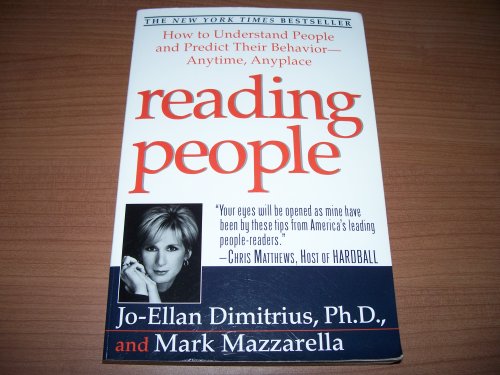
Inhaltsangabe
America's top jury consultant, Jo-Ellan Dimitrius, can literally read a person like a book. By decoding the hidden messages in appearance, tone of voice, facial expression, and personal habit, she has accurately predicted the behavior of jurors, witnesses, lawyers, and judges in some of the most celebrated trials of the past two decades. Now in this phenomenal new book, she applies the secrets of her extraordinary success to the everyday situations we all face at work, at home, and in relationships.
How can you "hear between the lines" to detect a lie? When is intuition the best guide to making important decisions? What are the tell-tale signs of romantic attraction? How do other people "read" us? The answers lie closer than we might think. Hair style, clothing, grooming, hand gestures, the neatness of office or living room, the steadiness of the gaze, behavior around subordinates: all of these provide critical clues to a person's integrity, work habits, and sexual interests. Through vivid anecdotes and proven techniques, Dimitrius teaches us how to interpret these signs with accuracy and precision.
Whether your focus is friendship or marriage, career or family, romance or professional success, Reading People gives you the skills you need to make sound, swift decisions and reap the benefits from a lifetime of razor-sharp insight.
Die Inhaltsangabe kann sich auf eine andere Ausgabe dieses Titels beziehen.
Über die Autorin bzw. den Autor
Jo-Ellan Dimitrius, Ph.D., has consulted in over six hundred jury trials, including the Rodney King, Reginald Denny, John DuPont, McMartin Preschool, and O. J. Simpson cases. She has appeared on Oprah, Good Morning America, the Today show, Larry King Live, Face the Nation, and 60 Minutes, and she has consulted with many Fortune 100 companies.
Mark Mazzarella has been a practicing trial lawyer in San Diego for twenty years. He is a past chairman of the twelve-thousand-member litigation section of the California State Bar, and he writes and lectures extensively.
From the Hardcover edition.
Auszug. © Genehmigter Nachdruck. Alle Rechte vorbehalten.
ONE
Reading Readiness
Preparing for the Challenge of
Reading People
“I can’t believe I didn’t see the signs. They were right there
in front of me! How could I have been so blind?”
We’ve all said something very much like this, probably more times than we care to admit. After we’ve misjudged our boss’s intentions, a friend’s loyalty, or a babysitter’s common sense, we carefully replay the past—and usually see the mistakes we made with 20/20 hindsight. Why, then, after living and reliving our mistakes, don’t we learn more from them? If reading people were like driving a car or hitting a tennis ball, we’d be able to recognize our weak points and improve our performance with every try. That rarely happens with relationships. Instead, we interact with our friends, colleagues, and spouses in the same old ways, doggedly hoping for the best.
In theory, thanks to the people-reading skills I acquired over the years, it should have been easy for me to make better decisions in my personal life—whom to let into it and what to expect from them once I did. Yet for many years I failed to apply my courtroom abilities to my off-duty life. Perhaps I had to reach a saturation point of pain and disappointment in some of my personal relationships before I was willing to analyze my mistakes and put my professional experience to work for me.
When I finally resolved to bring that focus and clarity to my personal life, it made sense to start by comparing the courthouse with the world outside. I was determined to figure out what I was doing in the courtroom that enabled me to read people in that setting with such consistent accuracy. I thought I should be able to distill that information into a set of people-reading basics that would work anywhere.
When I told my colleagues about the great difference between my people-reading successes on and off the job, I found I wasn’t alone. Many of the best attorneys I knew confessed that, while they enjoyed great success reading people in court, the rest of the time they didn’t do much better than anyone else. Why?
The conclusions I eventually reached led me to the keys of “reading readiness”—the foundation of understanding people and predicting their behavior. The first thing I discovered was that attitude is critical. In a courtroom, I was ready to focus fully on the people I encountered, to listen to them closely, to observe the way they looked and acted, and to carefully think about what I was hearing and seeing. I had a very different attitude in my private life. I rarely did any of those things. The fact is, you have to be ready to read people, or all the clues in the world won’t do you any good.
In this chapter, you’ll learn how to bring a courtroom state of mind—clear-eyed, observant, careful, and objective—into the emotional, subjective drama that is everyday life. Master the following skills, and you’ll be ready to read people.
1.Spend more time with people. That’s the best way to learn to understand them.
2.Stop, look, and listen. There’s no substitute for patience and attentiveness.
3.Learn to reveal something of yourself. To get others to open up, you must first open up to them.
4.Know what you’re looking for. Unless you know what you want in another person, there’s a good chance you’ll be disappointed.
5.Train yourself to be objective. Objectivity is essential to reading people, but it’s the hardest of these seven skills for most of us to master.
6.Start from scratch, without biases and prejudices.
7.Make a decision, then act on it.
Discovering the Lost Art of Reading People
Unless you’ve been stranded on a desert island for the past fifty years, you’ve noticed that the world has changed. Understanding people has always been one of life’s biggest challenges, but the social changes and technological explosion of recent decades have made it even more difficult. Today, many of us don’t enjoy close bonds or daily contact even with the most important people in our lives. We’re out of touch and out of practice.
Unless you practice the skills you’ll learn in this book, you won’t retain them. But that’s difficult today because we live in a global society. We’re in contact with people across town, across the country, or even on the other side of the world. But our contact usually isn’t personal. The same technological advances that allow us such extraordinary access to others have exacted a toll—they have made face-to-face conversation relatively rare. Why meet with a client in person if you can phone him? Why have an actual conversation with Mom if you can leave a message on her answering machine? Why phone a friend if you can send an e-mail or an instant message? As long as the message gets through, what’s the difference? Most of us have even phoned someone, hoping to leave a message, only to be disappointed when she’s actually there to answer the call. Some of us even bow out altogether, relying on our assistants, kids, spouses, or friends to do our communicating for us. Or we settle into cyberspace, meeting, doing business, sometimes even becoming engaged—all on the basis of the sterile, electronically generated word, without the benefit of seeing someone or even talking to him.
All forms of communication are not equal. If I want to ask a favor of my colleague Alan, I have several choices. I can walk down the hall and speak with him in person; in that case, I’ll be able to gauge his response accurately. Maybe he’ll gladly say yes. Then again, maybe he’ll say yes while wincing. Or perhaps he’ll say no, but will clearly show his reservations. There’s an almost infinite number of reactions I might see if I’m there in the room with him. Now, if I phone Alan instead, I’ll be able to sense some of his feelings from his voice—but I may miss the more subtle undertones and I won’t get any visual cues. If we e-mail each other, effectively squelching almost all human contact, I’ll get just the facts. And what if I simply send someone else to ask?
Making matters worse, most of us purposely avoid meaningful conversation with all but our closest friends and family. When we do get together, we may be more comfortable saying what is expected or “politically correct” than what we really believe. Self-revelation comes hard to most people; those who confess their innermost secrets on afternoon talk shows are the exception, not the rule.
The reasons we don’t like to expose ourselves could fill a book, but undoubtedly the edgy, distrustful tenor of urban life is among them. From childhood on, those of us who live in or near big cities are urged to be wary of strangers; the concept is reinforced nightly on the local news. We urbanites often return from a visit to a small town marveling at how we were treated. Instead of the averted gazes we’ve grown accustomed to, we’re met with a friendly “Hello, how are you?” from people who really seem to mean it! That level of spontaneous, trusting communication is hard to come by in the cities where most Americans live.
Most of us did not grow up in a community where our high school classmates became our dentists, our barbers, and our children’s schoolteachers. Sure, we have friends and families, but the majority of people we see each day are strangers and therefore suspect. Because we fear them, we often avoid contact, and as a result we don’t use our social skills as often as we could. Our people-reading muscles have...
„Über diesen Titel“ kann sich auf eine andere Ausgabe dieses Titels beziehen.
Suchergebnisse für Reading People: How to Understand People and Predict...

Beispielbild für diese ISBN
Reading People: How to Understand People and Predict Their Behavior- -Anytime, Anyplace
Anbieter: World of Books (was SecondSale), Montgomery, IL, USA
Verkäuferbewertung 5 von 5 Sternen

Zustand: Good. Item in good condition. Textbooks may not include supplemental items i.e. CDs, access codes etc. Bestandsnummer des Verkäufers 00083714341
Gebraucht kaufen
EUR 3,94
Versand gratis
Versand innerhalb von USA
Versand innerhalb von USA
Anzahl: 19 verfügbar
Beispielbild für diese ISBN
Reading People: How to Understand People and Predict Their Behavior- -Anytime, Anyplace
Anbieter: World of Books (was SecondSale), Montgomery, IL, USA
Verkäuferbewertung 5 von 5 Sternen
Zustand: Acceptable. Item in acceptable condition! Textbooks may not include supplemental items i.e. CDs, access codes etc. Bestandsnummer des Verkäufers 00108161951
Gebraucht kaufen
EUR 3,94
Versand gratis
Versand innerhalb von USA
Versand innerhalb von USA
Anzahl: 1 verfügbar
Beispielbild für diese ISBN
Reading People: How to Understand People and Predict Their Behavior- -Anytime, Anyplace
Anbieter: More Than Words, Waltham, MA, USA
Verkäuferbewertung 5 von 5 Sternen
Zustand: Good. A sound copy with only light wear. Overall a solid copy at a great price! Bestandsnummer des Verkäufers BOS-E-12b-01627
Gebraucht kaufen
EUR 0,89
EUR 3,44 Versand
Versand innerhalb von USA
Versand innerhalb von USA
Anzahl: 2 verfügbar
Foto des Verkäufers
Reading People: How to Understand People and Predict Their Behavior- -Anytime, Anyplace
Anbieter: Greenworld Books, Arlington, TX, USA
Verkäuferbewertung 5 von 5 Sternen
Zustand: very_good. Fast Free Shipping â" Very Good condition book with a firm cover and clean pages. Shows normal use and some light wear or limited notes markings. A solid, nice copy to enjoy. Bestandsnummer des Verkäufers GWV.0345425871.VG
Gebraucht kaufen
EUR 4,37
Versand gratis
Versand innerhalb von USA
Versand innerhalb von USA
Anzahl: 1 verfügbar
Beispielbild für diese ISBN
Reading People: How to Understand People and Predict Their Behavior- -Anytime, Anyplace
Anbieter: Evergreen Goodwill, Seattle, WA, USA
Verkäuferbewertung 5 von 5 Sternen
paperback. Zustand: Acceptable. Bestandsnummer des Verkäufers mon0000722414
Gebraucht kaufen
EUR 1,12
EUR 3,44 Versand
Versand innerhalb von USA
Versand innerhalb von USA
Anzahl: 1 verfügbar
Beispielbild für diese ISBN
Reading People: How to Understand People and Predict Their Behavior- -Anytime, Anyplace
Anbieter: Evergreen Goodwill, Seattle, WA, USA
Verkäuferbewertung 5 von 5 Sternen
paperback. Zustand: Good. Bestandsnummer des Verkäufers mon0000494888
Gebraucht kaufen
EUR 1,12
EUR 3,44 Versand
Versand innerhalb von USA
Versand innerhalb von USA
Anzahl: 1 verfügbar
Beispielbild für diese ISBN
Reading People: How to Understand People and Predict Their Behavior- -Anytime, Anyplace
Verlag:
Ballantine Books (edition 1), 1999
ISBN 10: 0345425871
ISBN 13: 9780345425874
Gebraucht
Paperback
Anbieter: BooksRun, Philadelphia, PA, USA
Verkäuferbewertung 5 von 5 Sternen
Paperback. Zustand: Very Good. 1. It's a well-cared-for item that has seen limited use. The item may show minor signs of wear. All the text is legible, with all pages included. It may have slight markings and/or highlighting. Bestandsnummer des Verkäufers 0345425871-11-6
Gebraucht kaufen
EUR 4,88
Versand gratis
Versand innerhalb von USA
Versand innerhalb von USA
Anzahl: 1 verfügbar
Beispielbild für diese ISBN
Reading People: How to Understand People and Predict Their Behavior- -Anytime, Anyplace
Anbieter: Once Upon A Time Books, Siloam Springs, AR, USA
Verkäuferbewertung 4 von 5 Sternen

Paperback. Zustand: Good. This is a used book in good condition and may show some signs of use or wear . This is a used book in good condition and may show some signs of use or wear . Bestandsnummer des Verkäufers mon0003372644
Gebraucht kaufen
EUR 1,88
EUR 3,40 Versand
Versand innerhalb von USA
Versand innerhalb von USA
Anzahl: 1 verfügbar
Beispielbild für diese ISBN
Reading People: How to Understand People and Predict Their Behavior- -Anytime, Anyplace
Anbieter: SustainableBooks.com, Amherst, NY, USA
Verkäuferbewertung 5 von 5 Sternen
Zustand: Poor. Book is Poor condition. Good for reading, not pretty to look at! The pages and cover are soiled and/or yellowed, worn throughout. Bestandsnummer des Verkäufers 0345425871-2-6
Gebraucht kaufen
EUR 5,49
Versand gratis
Versand innerhalb von USA
Versand innerhalb von USA
Anzahl: 1 verfügbar
Beispielbild für diese ISBN
Reading People : How to Understand People and Predict Their Behavior - Anytime, Anyplace
Verlag:
Random House Publishing Group, 1999
ISBN 10: 0345425871
ISBN 13: 9780345425874
Gebraucht
Softcover
Erstausgabe
Anbieter: Better World Books, Mishawaka, IN, USA
Verkäuferbewertung 5 von 5 Sternen
Zustand: Good. 1st. Pages intact with minimal writing/highlighting. The binding may be loose and creased. Dust jackets/supplements are not included. Stock photo provided. Product includes identifying sticker. Better World Books: Buy Books. Do Good. Bestandsnummer des Verkäufers 3208234-6
Gebraucht kaufen
EUR 5,97
Versand gratis
Versand innerhalb von USA
Versand innerhalb von USA
Anzahl: 1 verfügbar