
Verwandte Artikel zu The Last Theorem: A Novel
Inhaltsangabe
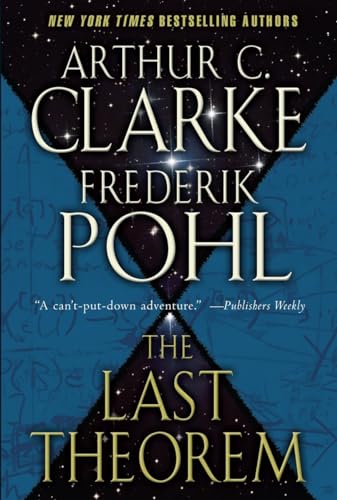
When Ranjit Subramanian, a Sri Lankan with a special gift for numbers, writes a three-page proof of the coveted “Last Theorem,” which French mathematician Pierre de Fermat claimed to have discovered (but never recorded) in 1637, Ranjit’s achievement is hailed as a work of genius, bringing him fame and fortune. But it also brings him to the attention of the National Security Agency and a shadowy United Nations outfit called Pax per Fidem–or Peace Through Transparency–whose secretive workings belie its name. Suddenly Ranjit–along with his family–finds himself swept up in world-shaking events, his genius for abstract mathematical thought put to uses that are both concrete and potentially deadly.
Die Inhaltsangabe kann sich auf eine andere Ausgabe dieses Titels beziehen.
Über die Autorin bzw. den Autor
Arthur C. Clarke is considered to be the greatest science fiction writer of all time. He is an international treasure in many other ways: An article written by him in 1945 led to the invention of satellite technology. Books by Mr. Clarke—both fiction and nonfiction—have more than one hundred million copies in print worldwide. Mr. Clarke passed away March 19th, 2008.
Frederik Pohl is the author of many novels, including The Boy Who Would Live Forever; Gateway, part of his acclaimed Heechee saga; and Jem, for which he won the National Book Award. With Isaac Asimov, he was a founding member of the New York-based science fiction group known as the Futurians. In the sixties, Pohl edited Galaxy magazine and its sister magazine, if, which won the Hugo Award three years in a row. In 1993, he became a Science Fiction Writers of America Grand Master. He lives in Palatine, Illinois.
Auszug. © Genehmigter Nachdruck. Alle Rechte vorbehalten.
Chapter One
ON SWAMI ROCK
And so now, at last, we meet this Ranjit Subramanian, the one whose long and remarkable life this book is all about.
At this time Ranjit was sixteen years old, a freshman at Sri Lanka’s principal university, in the city of Colombo, and more full of himself than even your average sixteen- year- old. He wasn’t at the university now, though. At his father’s bidding he had made the long trip from Colombo slantwise across the island of Sri Lanka to the district of Trincomalee, where his father had the distinction of being chief priest at the Hindu temple called Tiru Koneswaram. Ranjit actually loved his father very much.
He was almost always glad to see him. This time, however, he was a bit less so, because this time Ranjit had a pretty good idea of what the revered Ganesh Subramanian wanted to talk to him about.
Ranjit was an intelligent boy, in fact one who was quite close to being as smart as he thought he was. He was a good- looking one, too. He wasn’t terribly tall, but most Sri Lankans aren’t. Ethnically he was a Tamil, and his skin color was the rich dark brown of a spoonful of cocoa powder, just before it went into the hot milk. The skin color wasn’t because he was a Tamil, though. Sri Lankans have a rich palette of complexions from near- Scandinavian white to a black so dark it seems almost purple. Ranjit’s best friend, Gamini Bandara, was pure Sinhalese for as many generations back as anyone had bothered to count, but the boys were the same in skin hue. The boys had been friends for a long time—since that scary night when Gamini’s school had burned to the ground, probably put to the torch by a couple of upperclassmen smoking forbidden cigarettes in a storage room.
Like every other nearby human being capable of picking up a splintered piece of plywood and throwing it on the back of a truck, Ranjit had been drafted for emergency relief work. So had all the rest of the student body of his own school. It had been a dirty job, a lot harder than a youngster’s developing muscles were used to, not to mention the splinters and the scrapes and the endless cuts from the broken glass that was everywhere. Those were the bad parts, and there were plenty of them. But there were good parts, too. Like the time when Ranjit and some other boy around his own age finally got down to the source of some plaintive sounds that were coming from a debris pile, and released the headmaster’s terrified, but intact, elderly Siamese cat.
When a teacher had carried the cat off to its owner, the two boys had stood grinning at each other. Ranjit had stuck his hand out, English fashion. “I’m Ranjit Subramanian,” he’d said.
“And I’m Gamini Bandara,” the other boy had said, pumping his hand gleefully, “and, hey, we did a pretty good job here, didn’t we?”
They agreed that they had. When at last they had been allowed to quit work for the day, they had lined up together for the sort of porridge that was their evening meal, and plopped their sleeping bags next to each other that night, and they had been best friends ever since. Helped out, to be sure, by the fact that Gamini’s school had been made uninhabitable by the fire and so its students had to double up at Ranjit’s. Gamini turned out to be pretty much everything a best friend could be, including the fact that the one great obsession in Ranjit’s life, the one for which there was no room for another person to share, didn’t interest Gamini at all.
And, of course, there was one other thing that Gamini was. That was the part of Ranjit’s impending talk with his father that Ranjit least wanted to have.
Ranjit grimaced to himself. As instructed, Ranjit went straight to one of the temple’s side doors, but it wasn’t his father who met him there. It was an elderly monk named Surash who told Ranjit—rather officiously, Ranjit thought—only that he would have to wait a bit. So Ranjit waited, for what he considered quite a long time, with nothing to do but listen to the bustle that came from within his father’s temple, about which Ranjit had mixed emotions.
The temple had given his father purpose, position, and a rewarding career, all of which was good. However, it had also encouraged the old man in the vain hope that his son would follow in his footsteps. That was not going to happen. Even as a boy, Ranjit had not been able to believe in the complex Hindu pantheon of gods and goddesses, some with their various animal heads and unusual number of arms, whose sculptured figures encrusted the temple walls. Ranjit had been able to name every one of them, and to list its special powers and principal fast days as well, by the time he was six. It hadn’t been out of religious fervor. It had been simply because he had wanted to please the father he loved.
Ranjit remembered waking early in the morning when he was a small child, still living at home, and his father getting up at sunrise to bathe in the temple pool. He would see his father, naked to the waist as he faced the rising sun, and hear his long, reverberating Om. When he was a little older, Ranjit himself learned to say the mantra, and the location of the six parts of the body that he touched, and to offer water to the statues in the puja room. But then he went away to school. His religious observances were not required, and therefore ended. By the time he was ten, he knew he would never follow in his father’s faith.
Not that his father’s was not a fine profession. True, Ganesh Subramanian’s temple was neither as ancient nor as vast as the one it had attempted to replace. Although it had been bravely given the same name as the original—Tiru Koneswaram—even its chief priest rarely called it anything but “the new temple.” It hadn’t been completed until 1983, and in size it was not a patch on the original Tiru Koneswaram, the famous “temple with a thousand columns,” whose beginnings had been shrouded by two thousand years of history.
And then, when at last Ranjit was met, it was not by his father but by old Surash. He was apologetic. “It is these pilgrims,” he said. “So many of them! More than one hundred, and your father, the chief priest, is determined to greet each one. Go, Ranjit. Sit on Swami Rock and watch the sea. In an hour, perhaps, your father will join you there, but just now—” He sighed, and shook his head, and turned away to the task of helping his boss cope with the flood of pilgrims. Leaving Ranjit to his own resources. Which, as a matter of fact, was just fine, because for Ranjit an hour or so to himself on Swami Rock was a welcome gift.
An hour or so earlier Swami Rock would have been crowded with couples and whole families picnicking, sightseeing, or simply enjoying the cooling breeze that came off the Bay of Bengal. Now, with the sun lowering behind the hills to the west, it was almost deserted.
That was the way Ranjit preferred it. He loved Swami Rock. Had loved it all his life, in fact—or no, he amended the thought, at six or seven he hadn’t actually loved the rock itself nearly as much as he had the...
„Über diesen Titel“ kann sich auf eine andere Ausgabe dieses Titels beziehen.
Suchergebnisse für The Last Theorem: A Novel

Foto des Verkäufers
The Last Theorem: A Novel
Anbieter: Zoom Books East, Glendale Heights, IL, USA
Verkäuferbewertung 5 von 5 Sternen

Zustand: very_good. Book is in very good condition and may include minimal underlining highlighting. The book can also include "From the library of" labels. May not contain miscellaneous items toys, dvds, etc. . We offer 100% money back guarantee and 24 7 customer service. Bestandsnummer des Verkäufers ZEV.0345470230.VG
Gebraucht kaufen
EUR 3,93
Versand gratis
Versand innerhalb von USA
Versand innerhalb von USA
Anzahl: 1 verfügbar
Beispielbild für diese ISBN
The Last Theorem A Novel
Anbieter: World of Books (was SecondSale), Montgomery, IL, USA
Verkäuferbewertung 5 von 5 Sternen
Zustand: Good. Item in good condition. Textbooks may not include supplemental items i.e. CDs, access codes etc. Bestandsnummer des Verkäufers 00105417469
Gebraucht kaufen
EUR 3,96
Versand gratis
Versand innerhalb von USA
Versand innerhalb von USA
Anzahl: 2 verfügbar
Foto des Verkäufers
The Last Theorem: A Novel
Anbieter: Zoom Books East, Glendale Heights, IL, USA
Verkäuferbewertung 5 von 5 Sternen
Zustand: good. Book is in good condition and may include underlining highlighting and minimal wear. The book can also include "From the library of" labels. May not contain miscellaneous items toys, dvds, etc. . We offer 100% money back guarantee and 24 7 customer service. Bestandsnummer des Verkäufers ZEV.0345470230.G
Gebraucht kaufen
EUR 4,14
Versand gratis
Versand innerhalb von USA
Versand innerhalb von USA
Anzahl: 1 verfügbar
Foto des Verkäufers
The Last Theorem: A Novel
Anbieter: Greenworld Books, Arlington, TX, USA
Verkäuferbewertung 5 von 5 Sternen
Zustand: very_good. Fast Free Shipping â" Very Good condition book with a firm cover and clean pages. Shows normal use and some light wear or limited notes markings. A solid, nice copy to enjoy. Bestandsnummer des Verkäufers GWV.0345470230.VG
Gebraucht kaufen
EUR 4,84
Versand gratis
Versand innerhalb von USA
Versand innerhalb von USA
Anzahl: 2 verfügbar
Beispielbild für diese ISBN
The Last Theorem: A Novel
Anbieter: Read&Dream, SAINT LOUIS, MO, USA
Verkäuferbewertung 4 von 5 Sternen

Zustand: Good. The book may have minor cosmetic wear like creased spine, cover, scratches, curled corners, folded pages, minor sunburn, minor water damage, minor bent. The book may have some highlights, notes, underlined pages. Accessories such as CD, codes, toys, may not be included . Safe and Secure Mailer. No Hassle Return. Bestandsnummer des Verkäufers 1.6M_MG_H0004RTC
Gebraucht kaufen
EUR 5,52
Versand gratis
Versand innerhalb von USA
Versand innerhalb von USA
Anzahl: 1 verfügbar
Beispielbild für diese ISBN
The Last Theorem: A Novel
Anbieter: Wonder Book, Frederick, MD, USA
Verkäuferbewertung 5 von 5 Sternen
Zustand: Very Good. Very Good condition. With remainder mark. A copy that may have a few cosmetic defects. May also contain light spine creasing or a few markings such as an owner's name, short gifter's inscription or light stamp. Bestandsnummer des Verkäufers L15D-01471
Gebraucht kaufen
EUR 6,22
Versand gratis
Versand innerhalb von USA
Versand innerhalb von USA
Anzahl: 1 verfügbar
Beispielbild für diese ISBN
The Last Theorem
Anbieter: ThriftBooks-Dallas, Dallas, TX, USA
Verkäuferbewertung 5 von 5 Sternen
Paperback. Zustand: Fair. No Jacket. Readable copy. Pages may have considerable notes/highlighting. ~ ThriftBooks: Read More, Spend Less. Bestandsnummer des Verkäufers G0345470230I5N00
Gebraucht kaufen
EUR 6,88
Versand gratis
Versand innerhalb von USA
Versand innerhalb von USA
Anzahl: 1 verfügbar
Beispielbild für diese ISBN
The Last Theorem
Anbieter: ThriftBooks-Phoenix, Phoenix, AZ, USA
Verkäuferbewertung 5 von 5 Sternen
Paperback. Zustand: Good. No Jacket. Pages can have notes/highlighting. Spine may show signs of wear. ~ ThriftBooks: Read More, Spend Less. Bestandsnummer des Verkäufers G0345470230I3N00
Gebraucht kaufen
EUR 6,88
Versand gratis
Versand innerhalb von USA
Versand innerhalb von USA
Anzahl: 1 verfügbar
Beispielbild für diese ISBN
The Last Theorem
Anbieter: ThriftBooks-Dallas, Dallas, TX, USA
Verkäuferbewertung 5 von 5 Sternen
Paperback. Zustand: Very Good. No Jacket. May have limited writing in cover pages. Pages are unmarked. ~ ThriftBooks: Read More, Spend Less. Bestandsnummer des Verkäufers G0345470230I4N00
Gebraucht kaufen
EUR 6,88
Versand gratis
Versand innerhalb von USA
Versand innerhalb von USA
Anzahl: 1 verfügbar
Beispielbild für diese ISBN
The Last Theorem
Anbieter: ThriftBooks-Atlanta, AUSTELL, GA, USA
Verkäuferbewertung 5 von 5 Sternen
Paperback. Zustand: Good. No Jacket. Pages can have notes/highlighting. Spine may show signs of wear. ~ ThriftBooks: Read More, Spend Less. Bestandsnummer des Verkäufers G0345470230I3N00
Gebraucht kaufen
EUR 6,88
Versand gratis
Versand innerhalb von USA
Versand innerhalb von USA
Anzahl: 1 verfügbar