
Verwandte Artikel zu Shadow Divers: The True Adventure of Two Americans...
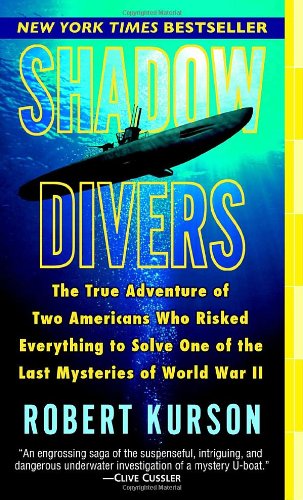
Shadow Divers: The True Adventure of Two Americans Who Risked Everything to Solve One of the Last Mysteries of World War II - Softcover
Inhaltsangabe
Recounts the 1991 discovery of a sunken German U-boat by two recreational scuba divers, tracing how they devoted the following six years to researching the identities of the submarine and its crew, correcting historical texts and breaking new grounds in the world of diving along the way. Reprint.
Die Inhaltsangabe kann sich auf eine andere Ausgabe dieses Titels beziehen.
Über die Autorin bzw. den Autor
ROBERT KURSON earned a bachelor’s degree in philosophy from the University of Wisconsin, then a law degree from Harvard Law School. After working as a features reporter for the Chicago Sun-Times and Chicago magazine, he moved to Esquire as as a contributing editor. His award-winning stories have also appeared in Rolling Stone, The New York Times Magazine, and other publications. He lives in the Chicago suburbs and can be reached via the Internet at www.robertkurson.com.
From the Hardcover edition.
Auszug. © Genehmigter Nachdruck. Alle Rechte vorbehalten.
CHAPTER ONE
THE BOOK OF NUMBERS
Brielle, New Jersey, September 1991
Bill Nagle's life changed the day a fisherman sat beside him in a ramshackle bar and told him about a mystery he had found lying at the bottom of the Atlantic Ocean. Against his better judgment, that fisherman promised to tell Nagle how to find it. The men agreed to meet the next day on the rickety wooden pier that led to Nagle's boat, the Seeker, a vessel Nagle had built to chase possibility. But when the appointed time came, the fisherman was not there. Nagle paced back and forth, careful not to plunge through the pier where its wooden planks had rotted away. He had lived much of his life on the Atlantic, and he knew when worlds were about to shift. Usually, that happened before a storm or when a man's boat broke. Today, however, he knew it was going to happen when the fisherman handed him a scrap of paper, a hand-scrawled set of numbers that would lead to the sunken mystery. Nagle looked into the distance for the fisherman. He saw no one. The salt air blew against the small seashore town of Brielle, tilting the dockside boats and spraying the Atlantic into Nagle's eyes. When the mist died down he looked again. This time, he saw the fisherman approaching, a small square of paper crumpled in his hands. The fisherman looked worried. Like Nagle, he had lived on the ocean, and he also knew when a man's life was about to change.
In the whispers of approaching autumn, Brielle's rouge is blown away and what remains is the real Brielle, the locals' Brielle. This small seashore town on the central New Jersey coast is the place where the boat captains and fishermen live, where convenience store owners stay open to serve neighbors, where fifth graders can repair scallop dredges. This is where the hangers-on and wannabes and also-rans and once-greats keep believing in the sea. In Brielle, when the customers leave, the town's lines show, and they are the kind grooved by the thin difference between making a living on the water and washing out.
The Seeker towers above the other boats tied to this Brielle dock, and it's not just the vessel's sixty-five-foot length that grabs one's attention, it's the feeling-from her battered wooden hull and nicked propellers-that she's been places. Conceived in Nagle's imagination, the Seeker was built for a single purpose: to take scuba divers to the most dangerous shipwrecks in the Atlantic Ocean.
Nagle was forty years old then, a thin, deeply tanned former Snap-On Tools Salesman of the Year. To see him here, waiting for this fisherman in his tattered T-shirt and thrift-shop sandals, the Jim Beam he kept as best friend slurring his motions, no one would guess that he had been an artist, that in his day Nagle had been great.
In his twenties, Nagle was already legend in shipwreck diving, a boy wonder in a sport that regularly kills its young. In those days, deep-wreck diving was still the province of the adventurer. Countless shipwrecks, even famous ones, lay undiscovered at the bottom of the Atlantic, and the hunt for those wrecks-with their bent metal and arrested history-was the motion that primed Nagle's imagination.
Treasure never figured into the equation for Atlantic shipwreck divers in the Northeast. Spanish galleons overflowing with gold doubloons and silver pieces of eight did not sink in this part of the ocean, and even if they had, Nagle wouldn't have been interested. His neighborhood was the New York and New Jersey shipping lanes, waters that conducted freighters, ocean liners, passenger vessels, and warships about the business and survival of America. These wrecks occasionally surrendered a rare piece of china or jewelry, but Nagle and his kind were looking for something different. They saw stories in the Modiglianied faces of broken ships, frozen moments in a nation's hopes or a captain's dying instinct or a child's potential, and they experienced these scenes unbuffered by curators or commentators or historians, shoulder to shoulder with life as it existed at the moment it had most mattered.
And they did it to explore. Many of the deep wrecks hadn't been seen since their victims last looked at them, and would remain lost while nature pawed at them until they simply didn't exist anymore. In a world where even the moon had been traveled, the floor of the Atlantic remained uncharted wilderness, its shipwrecks beacons for men compelled to look.
You had to have steel balls to do what Nagle did in his heyday. In the 1970s and 1980s, scuba equipment was still rudimentary, not much advanced past 1943, when Jacques Cousteau helped invent the system of tanks and regulators that allowed men to breathe underwater. Even at 130 feet, the recreational limit suggested by most scuba training organizations, a minor equipment failure could kill the most skilled practitioner. In searching for the most interesting wrecks, Nagle and the sport's other kings might descend to 200 feet or deeper, virtually begging the forces of nature to flick them into the afterlife, practically demanding their biology to abandon them. Men died-often-diving the shipwrecks that called to Nagle.
Even if Nagle's equipment and body could survive the deep Atlantic, he faced a smorgasbord of other perils, each capable of killing him à la carte. For starters, the sport was still new; there was no ancient wisdom to be passed from father to son, the kind of collective experience that routinely keeps today's divers alive. The sport's cautionary tales, those lifelines learned over beers with buddies and by reading magazines and attending classes, were beaten into Nagle underwater at antihuman depths. If Nagle found himself in some crazy, terrible circumstance-and there were countless of them on these deep wrecks-odds were that he would be the one who would tell the first tale. When he and his ilk survived, the magazines wrote articles about them.
Nagle pushed deeper. Diving below 200 feet, he began doing things scientists didn't fully understand, going places recreational divers had never been. When he penetrated a shipwreck at these depths, he was often among the first to see the vessel since it had gone down, the first to open the purser's safe since it had been closed, the first to look at these men since they had been lost at sea. But this also meant that Nagle was on his own. He had no maps drawn by earlier divers. Had someone visited these wrecks before, he might have told Nagle, "Don't brush against that outboard beam in the galley-the thing moved when I swam by, and the whole room might cave in and bury you if you do." Nagle had to discover all this by himself. It is one thing, wreck divers will tell you, to slither in near-total darkness through a shipwreck's twisted, broken mazes, each room a potential trap of swirling silt and collapsing structure. It is another to do so without knowing that someone did it before you and lived.
The Atlantic floor was still a wilderness in Nagle's prime, and it demanded of its explorers the same grit that the American West did of its pioneers. A single bad experience on a shipwreck could reroute all but the hardiest souls to more sensible pursuits. Early divers like Nagle had bad experiences every day. The sport eagerly shook out its dabblers and sightseers; those who remained seemed of a different species. They were physical in their world orientation and sudden in their appetites. They thought nothing of whipping out a sledgehammer and beating a porthole from the side of a ship, even as their heavy breath hastened nitrogen narcosis, the potentially deadly buildup of that otherwise benign gas in their brains. Underwater, rules of possession bent with the light; some divers cut prizes from the mesh goody bags of other divers, following the motto "He who floats it owns it." Fistfights-aboard boats and even underwater-often settled...
„Über diesen Titel“ kann sich auf eine andere Ausgabe dieses Titels beziehen.
Suchergebnisse für Shadow Divers: The True Adventure of Two Americans...

Beispielbild für diese ISBN
Shadow Divers: The True Adventure of Two Americans Who Risked Everything to Solve One of the Last Mysteries of World War II
Anbieter: World of Books (was SecondSale), Montgomery, IL, USA
Verkäuferbewertung 5 von 5 Sternen

Zustand: Good. New York Times Bestseller In the tradition of Jon Krakauer's Into Thin Air and Sebastian Junger's The Perfect Storm comes a true tale of riveting adventure in which two weekend scuba divers risk everything to solve a great historical mystery-and make history themselves. For John Chatterton and Richie Kohler, deep wreck diving was more than a sport. Testing themselves against treacherous currents, braving depths that induced hallucinatory effects, navigating through wreckage as perilous as a minefield, they pushed themselves to their limits and beyond, brushing against death more than once in the rusting hulks of sunken ships. But in the fall of 1991, not even these courageous divers were prepared for what they found 230 feet below the surface, in the frigid Atlantic waters sixty miles off the coast of New Jersey: a World War I German U-boat, its ruined interior a macabre wasteland of twisted metal, tangled wires, and human bones-all buried under decades of accumulated sediment. No identifying marks were visible on the submarine or the few artifacts brought to the surface. No historian, expert, or government had a clue as to which U-boat the men had found. In fact, the official records all agreed that there simply could not be a sunken U-boat and crew at that location. Over the next six years, an elite team of divers embarked on a quest to solve the mystery. Some of them would not live to see its end. Chatterton and Kohler, at first bitter rivals, would be drawn into a friendship that deepened to an almost mystical sense of brotherhood with each other and with the drowned U-boat sailors-former enemies of their country. As the men's marriages frayed under the pressure of a shared obsession, their dives grew more daring, and each realized that he was hunting more than the identities of a lost U-boat and its nameless crew. Author Robert Kurson's account of this quest is at once thrilling and emotionally complex, and it is written with a vivid sense of what divers actually experience when they meet the dangers of the ocean's underworld. The story of Shadow Divers often seems too amazing to be true, but it all happened, two hundred thirty feet down, in the deep blue sea. Bestandsnummer des Verkäufers 00108425906
Gebraucht kaufen
EUR 4,53
Versand gratis
Versand innerhalb von USA
Versand innerhalb von USA
Anzahl: 4 verfügbar
Beispielbild für diese ISBN
Shadow Divers: The True Adventure of Two Americans Who Risked Everything to Solve One of the Last Mysteries of World War II
Anbieter: World of Books (was SecondSale), Montgomery, IL, USA
Verkäuferbewertung 5 von 5 Sternen
Zustand: Fair. New York Times Bestseller In the tradition of Jon Krakauer's Into Thin Air and Sebastian Junger's The Perfect Storm comes a true tale of riveting adventure in which two weekend scuba divers risk everything to solve a great historical mystery-and make history themselves. For John Chatterton and Richie Kohler, deep wreck diving was more than a sport. Testing themselves against treacherous currents, braving depths that induced hallucinatory effects, navigating through wreckage as perilous as a minefield, they pushed themselves to their limits and beyond, brushing against death more than once in the rusting hulks of sunken ships. But in the fall of 1991, not even these courageous divers were prepared for what they found 230 feet below the surface, in the frigid Atlantic waters sixty miles off the coast of New Jersey: a World War I German U-boat, its ruined interior a macabre wasteland of twisted metal, tangled wires, and human bones-all buried under decades of accumulated sediment. No identifying marks were visible on the submarine or the few artifacts brought to the surface. No historian, expert, or government had a clue as to which U-boat the men had found. In fact, the official records all agreed that there simply could not be a sunken U-boat and crew at that location. Over the next six years, an elite team of divers embarked on a quest to solve the mystery. Some of them would not live to see its end. Chatterton and Kohler, at first bitter rivals, would be drawn into a friendship that deepened to an almost mystical sense of brotherhood with each other and with the drowned U-boat sailors-former enemies of their country. As the men's marriages frayed under the pressure of a shared obsession, their dives grew more daring, and each realized that he was hunting more than the identities of a lost U-boat and its nameless crew. Author Robert Kurson's account of this quest is at once thrilling and emotionally complex, and it is written with a vivid sense of what divers actually experience when they meet the dangers of the ocean's underworld. The story of Shadow Divers often seems too amazing to be true, but it all happened, two hundred thirty feet down, in the deep blue sea. Bestandsnummer des Verkäufers 00100212567
Gebraucht kaufen
EUR 4,53
Versand gratis
Versand innerhalb von USA
Versand innerhalb von USA
Anzahl: 3 verfügbar
Foto des Verkäufers
Shadow Divers: The True Adventure of Two Americans Who Risked Everything to Solve One of the Last Mysteries of World War II
Anbieter: Dream Books Co., Denver, CO, USA
Verkäuferbewertung 5 von 5 Sternen
Zustand: acceptable. This copy has clearly been enjoyedâ"expect noticeable shelf wear and some minor creases to the cover. Binding is strong, and all pages are legible. May contain previous library markings or stamps. Bestandsnummer des Verkäufers DBV.0345482476.A
Gebraucht kaufen
EUR 4,53
Versand gratis
Versand innerhalb von USA
Versand innerhalb von USA
Anzahl: 1 verfügbar
Beispielbild für diese ISBN
Shadow Divers: The True Adventure of Two Americans Who Risked Everything to Solve One of the Last Mysteries of World War II
Verlag:
Ballantine Books (edition Reprint), 2005
ISBN 10: 0345482476
ISBN 13: 9780345482471
Gebraucht
Mass Market Paperback
Anbieter: BooksRun, Philadelphia, PA, USA
Verkäuferbewertung 5 von 5 Sternen
Mass Market Paperback. Zustand: Fair. Reprint. The item might be beaten up but readable. May contain markings or highlighting, as well as stains, bent corners, or any other major defect, but the text is not obscured in any way. Bestandsnummer des Verkäufers 0345482476-7-1-13
Gebraucht kaufen
EUR 4,61
Versand gratis
Versand innerhalb von USA
Versand innerhalb von USA
Anzahl: 1 verfügbar
Foto des Verkäufers
Shadow Divers: The True Adventure of Two Americans Who Risked Everything to Solve One of the Last Mysteries of World War II
Anbieter: Zoom Books Company, Lynden, WA, USA
Verkäuferbewertung 5 von 5 Sternen
Zustand: very_good. Book is in very good condition and may include minimal underlining highlighting. The book can also include "From the library of" labels. May not contain miscellaneous items toys, dvds, etc. . We offer 100% money back guarantee and 24 7 customer service. Bestandsnummer des Verkäufers ZBV.0345482476.VG
Gebraucht kaufen
EUR 5,67
Versand gratis
Versand innerhalb von USA
Versand innerhalb von USA
Anzahl: 1 verfügbar
Beispielbild für diese ISBN
Shadow Divers: The True Adventure of Two Americans Who Risked Everything to Solve One of the Last Mysteries of World War II
Verlag:
Ballantine Books, 2005
ISBN 10: 0345482476
ISBN 13: 9780345482471
Gebraucht
Mass Market Paperback
Anbieter: HPB-Ruby, Dallas, TX, USA
Verkäuferbewertung 5 von 5 Sternen
Mass Market Paperback. Zustand: Very Good. Connecting readers with great books since 1972! Used books may not include companion materials, and may have some shelf wear or limited writing. We ship orders daily and Customer Service is our top priority! Bestandsnummer des Verkäufers S_483831497
Gebraucht kaufen
EUR 2,60
EUR 3,36 Versand
Versand innerhalb von USA
Versand innerhalb von USA
Anzahl: 1 verfügbar
Beispielbild für diese ISBN
Shadow Divers The True Adventure of Two Americans Who Risked Everything to Solve One of the Last Mysteries of World War II by Kurson, Robert [Random,2005] (Paperback)
Anbieter: ThriftBooks-Atlanta, AUSTELL, GA, USA
Verkäuferbewertung 5 von 5 Sternen
Paperback. Zustand: Fair. No Jacket. Former library book; Readable copy. Pages may have considerable notes/highlighting. ~ ThriftBooks: Read More, Spend Less. Bestandsnummer des Verkäufers G0345482476I5N10
Gebraucht kaufen
EUR 6,17
Versand gratis
Versand innerhalb von USA
Versand innerhalb von USA
Anzahl: 1 verfügbar
Beispielbild für diese ISBN
Shadow Divers The True Adventure of Two Americans Who Risked Everything to Solve One of the Last Mysteries of World War II by Kurson, Robert [Random,2005] (Paperback)
Anbieter: ThriftBooks-Dallas, Dallas, TX, USA
Verkäuferbewertung 5 von 5 Sternen
Paperback. Zustand: Fair. No Jacket. Readable copy. Pages may have considerable notes/highlighting. ~ ThriftBooks: Read More, Spend Less. Bestandsnummer des Verkäufers G0345482476I5N00
Gebraucht kaufen
EUR 6,17
Versand gratis
Versand innerhalb von USA
Versand innerhalb von USA
Anzahl: 1 verfügbar
Beispielbild für diese ISBN
Shadow Divers The True Adventure of Two Americans Who Risked Everything to Solve One of the Last Mysteries of World War II by Kurson, Robert [Random,2005] (Paperback)
Anbieter: ThriftBooks-Atlanta, AUSTELL, GA, USA
Verkäuferbewertung 5 von 5 Sternen
Paperback. Zustand: Good. No Jacket. Pages can have notes/highlighting. Spine may show signs of wear. ~ ThriftBooks: Read More, Spend Less. Bestandsnummer des Verkäufers G0345482476I3N00
Gebraucht kaufen
EUR 6,17
Versand gratis
Versand innerhalb von USA
Versand innerhalb von USA
Anzahl: 1 verfügbar
Beispielbild für diese ISBN
Shadow Divers : The True Adventure of Two Americans Who Risked Everything to Solve One of the Last Mysteries of World War II
Verlag:
Random House Publishing Group, 2005
ISBN 10: 0345482476
ISBN 13: 9780345482471
Gebraucht
Softcover
Anbieter: Better World Books, Mishawaka, IN, USA
Verkäuferbewertung 5 von 5 Sternen
Zustand: Good. Reprint. Pages intact with minimal writing/highlighting. The binding may be loose and creased. Dust jackets/supplements are not included. Stock photo provided. Product includes identifying sticker. Better World Books: Buy Books. Do Good. Bestandsnummer des Verkäufers 446770-6
Gebraucht kaufen
EUR 6,21
Versand gratis
Versand innerhalb von USA
Versand innerhalb von USA
Anzahl: 3 verfügbar