
Verwandte Artikel zu It's a Boy!: Understanding Your Son's Development...
Inhaltsangabe
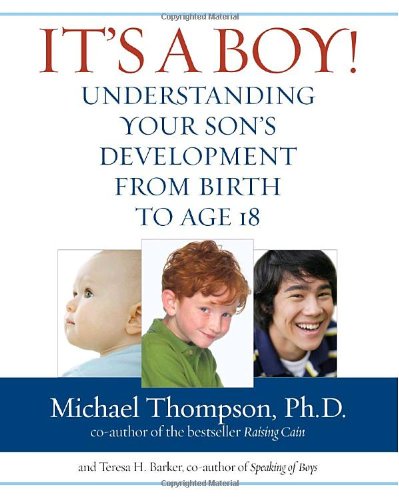
The authors of Raising Cain present a definitive handbook for parents on raising boys, from birth to age eighteen, furnishing specific, practical information and advice on how to deal with the day-to-day challenges of each stage of development and offering helpful sidebars, tips, and case studies that cover boys' emotional, psychological, social, and academic life. 50,000 first printing.
Die Inhaltsangabe kann sich auf eine andere Ausgabe dieses Titels beziehen.
Über die Autorin bzw. den Autor
Michael Thompson, Ph.D., is a clinical psychologist, lecturer, consultant, and former seventh-grade teacher. He conducts workshops across the United States and internationally on social cruelty, children’s friendships, and boys’ development. With Dan Kindlon, Ph.D., he co-authored the New York Times bestseller Raising Cain: Protecting the Emotional Life of Boys, which was adapted into an acclaimed documentary shown on PBS. With Teresa H. Barker he co-authored The Pressured Child: Helping Your Child Find Success in School and Life and Speaking of Boys: Answers to the Most-Asked Questions About Raising Sons. With Catherine O’Neill Grace and Lawrence J. Cohen, Ph.D., he co-authored Best Friends, Worst Enemies: Understanding the Social Lives of Children and Mom, They’re Teasing Me: Helping Your Child Solve Social Problems. Dr. Thompson is married and the father of two. He lives in Arlington, Massachusetts, and can be reached at www.michaelthompson-phd.com.
Teresa Barker, who collaborated with Michael Thompson on Raising Cain, Speaking of Boys, and The Pressured Child, is a journalist whose other book collaborations include Girls Will Be Girls, The Soul of Money, and In the Moment. Barker is married and the mother of a son and two daughters. She lives in Portland, Oregon.
Auszug. © Genehmigter Nachdruck. Alle Rechte vorbehalten.
CHAPTER ONE
IMAGINING A BOY
What Were You Thinking?
ANDREW’S PARENTS ARE GRAPPLING WITH THE ISSUES that occupy the mind of every loving parent. They aren’t sure how to strike a healthy balance in their son’s life between sports and academics, music and video games, friends and family time. Should they let him watch TV before he cleans up his room? When should they stand firm and when should they let their son decide for himself? They agree it’s too early to think about college. But while they don’t want to pressure him about eventual career choices, the family business does have his name on it. “We’ll just take a wait-and-see approach,” his mother says gamely as she pats her very pregnant belly. It is two weeks before Andrew’s due date. As for Andrew, he mostly busies himself making wide turns in utero, the bulge of his tiny foot tracing an impressive arc across his mother’s midriff.
Perhaps you, too, are expecting a boy. And if he is your first child or the first boy in your growing family, your curiosity and concerns about a boy’s life fill your thoughts and conversations. You have heard other mothers say, “They really are different!” And, of course, they are. If they weren’t, there would be no point at all in my writing this book. “Boys are easier than girls,” you hear. “Boys are an open book.” “Boys love their mothers.” But then what do you make of all those stories about boys being uncommunicative, behaving badly or struggling through school, stifling their inner life or losing themselves on the way to becoming men?
If this is your first foray into the intimate life of boys, you may be excited or nervous at the prospect. If you already have a son, or you had brothers, or you are a dad and remember your own boyhood, then your outlook on parenting a boy may have you feeling all the more confident and encouraged—or wary, bracing for the worst.
Perhaps you are the mother of a five-year-old boy and you are feeling a bit edgy about his interests. “My son really likes to play with guns,” one mother told me. “I don’t like them and I won’t allow them in the house, so one day at breakfast he made a gun with his finger and his thumb and he ‘shot’ his brother with it! Why does he keep doing that?”
If you are that mother, you may be worried that, despite your great love for your son and the good home in which he is being raised, his interest in guns is a sign that he’s going to grow up to be violent and dangerous. That’s an uncomfortable feeling.
Perhaps you are the mother of a two-year-old and your little boy is suddenly beginning to seem different to you. He is starting to disobey you, to look right at you when he breaks a rule or touches something he’s not supposed to touch. He laughs gleefully when you scold him. He seems so willful and defiant. Is that normal?
Or perhaps you are the mother of an older boy who has begun to pull away from you into a boys-only world that is clearly off-limits to moms. The goodnight chats are getting shorter and details of his day less forthcoming. You’ve heard that happens with boys, but you and your son have been so close—surely not him, not yet!
If you are a dad, perhaps you are not too proud to admit that you are a bit nervous about raising a boy, even though you were a boy yourself and you should, theoretically, know all about it. Maybe you had a hard time as a boy or have mixed feelings about your father, and you want it to be different for your son. Or perhaps you were a lucky boy and a lucky man, an enthusiastic dad who wants to get it right for your son. If you are a dad or father-to-be and you are making this effort to deepen your understanding about the life of boys, then your son is already a lucky boy, too.
Once you accept the miracle of a child coming into your life, once you embrace the humbling journey that parenting is for all of us, the question that drives nearly every conversation about boys, whether you are expecting your first or you have a houseful of them, is: What makes boys tick?
Development is the fundamental engine of a child’s growth, the ongoing process in which nature, nurture, and sheer luck come together and a unique human being emerges. The biological story of growth and advice about prenatal health and the day-to-day care and feeding of infants and children are well covered in general parenting literature and medical checkups. We’re here to focus on the psychological development of boys, the inside story of how a boy’s inner life takes shape and progresses through infancy, childhood, and adolescence. It’s a process that isn’t always easy to see or understand, not because boys intentionally hide it (though they attempt to do so at times) but because they show it in ways that adults don’t always recognize. But it’s all there. In everyday life with boys they are always onstage, showing us what’s new. Against that developmental backdrop, in the chapters ahead we’ll examine the key issues of psychological development that dominate each stage because that is, for you and your son, where the greatest challenges and drama of childhood—and parenting—play out.
If pregnancy and parenthood have left you much time to think, you are full of expectations and wonderings about your boy. You are imagining your son as he will be in six months or two years or twenty years. You may be reading a lot of parenting literature and hearing advice from family, friends, and total strangers. And every day in the news there is another research finding about child or adolescent brain science and gender differences, but very little on their actual relevance to raising your son. How do you turn all that into intelligent, intuitive parenting for raising a boy? How do you begin to answer the two most important questions for the next eighteen years: What do boys need? What is my son going to need from me?
Those are questions we’ll address in the pages ahead, but before we do that, let’s look back to the time when your thoughts about boys first took shape long ago.
You may feel newly called to this deep exploration of the inner life of boys, but I want to suggest the surprising idea that you have been thinking about what makes boys tick all of your life, or almost all of it. Thinking about having a baby someday—and imagining that baby as a boy or a girl—is one of the most basic of all human thoughts. It starts early in life. As soon as they can talk and engage in imaginary play, children—boys as well as girls—begin to enact the role of parent, first by themselves and then alongside other children, imitating the actions of the mothers and fathers they love and watch intently every day.
Most of us don’t remember what we played when we were three or four years old. That is why I want to remind you that you almost certainly did engage in some version of this domestic role-playing game, taking the role of a mom or dad, rocking a baby doll (or, if you were a boy, perhaps dismantling it or making it fly like a superhero or roll in the mud), and holding forth on what boys like and girls prefer. You “played doctor,” asking bold, uncensored questions about body parts, making mental notes. You continued as a child to school yourself in a child’s everyday version of gender studies, offering your expertise to any parent, teacher, or other child whom you felt was short on insight. From the age of five, when her younger brother arrived, my daughter, Joanna, objected to anything we did for our son, Will, that didn’t seem properly masculine to her. “Mom, that’s...
„Über diesen Titel“ kann sich auf eine andere Ausgabe dieses Titels beziehen.
Suchergebnisse für It's a Boy!: Understanding Your Son's Development...

Beispielbild für diese ISBN
It's a Boy!: Understanding You
Anbieter: World of Books (was SecondSale), Montgomery, IL, USA
Verkäuferbewertung 5 von 5 Sternen

Zustand: Good. Item in good condition. Textbooks may not include supplemental items i.e. CDs, access codes etc. Bestandsnummer des Verkäufers 00103604831
Gebraucht kaufen
EUR 4,01
Versand gratis
Versand innerhalb von USA
Versand innerhalb von USA
Anzahl: 1 verfügbar
Foto des Verkäufers
It's a Boy!: Understanding Your Son's Development from Birth to Age 18
Anbieter: Zoom Books East, Glendale Heights, IL, USA
Verkäuferbewertung 5 von 5 Sternen
Zustand: good. Book is in good condition and may include underlining highlighting and minimal wear. The book can also include "From the library of" labels. May not contain miscellaneous items toys, dvds, etc. . We offer 100% money back guarantee and 24 7 customer service. Bestandsnummer des Verkäufers ZEV.0345493958.G
Gebraucht kaufen
EUR 4,02
Versand gratis
Versand innerhalb von USA
Versand innerhalb von USA
Anzahl: 1 verfügbar
Foto des Verkäufers
It's a Boy!: Understanding Your Son's Development from Birth to Age 18
Anbieter: Greenworld Books, Arlington, TX, USA
Verkäuferbewertung 5 von 5 Sternen
Zustand: good. Fast Free Shipping â" Good condition. It may show normal signs of use, such as light writing, highlighting, or library markings, but all pages are intact and the book is fully readable. A solid, complete copy that's ready to enjoy. Bestandsnummer des Verkäufers GWV.0345493958.G
Gebraucht kaufen
EUR 5,13
Versand gratis
Versand innerhalb von USA
Versand innerhalb von USA
Anzahl: 2 verfügbar
Beispielbild für diese ISBN
It's a Boy!: Understanding Your Son's Development from Birth to Age 18
Anbieter: Evergreen Goodwill, Seattle, WA, USA
Verkäuferbewertung 5 von 5 Sternen
hardcover. Zustand: Good. Bestandsnummer des Verkäufers mon0000772655
Gebraucht kaufen
EUR 1,62
EUR 3,52 Versand
Versand innerhalb von USA
Versand innerhalb von USA
Anzahl: 1 verfügbar
Beispielbild für diese ISBN
It's a Boy!: Understanding Your Son's Development from Birth to Age 18
Verlag:
Ballantine Books (edition 1), 2008
ISBN 10: 0345493958
ISBN 13: 9780345493958
Gebraucht
Hardcover
Anbieter: BooksRun, Philadelphia, PA, USA
Verkäuferbewertung 5 von 5 Sternen
Hardcover. Zustand: Very Good. 1. With dust jacket. It's a well-cared-for item that has seen limited use. The item may show minor signs of wear. All the text is legible, with all pages included. It may have slight markings and/or highlighting. Bestandsnummer des Verkäufers 0345493958-11-1-29
Gebraucht kaufen
EUR 5,56
Versand gratis
Versand innerhalb von USA
Versand innerhalb von USA
Anzahl: 1 verfügbar
Beispielbild für diese ISBN
It's a Boy!: Understanding Your Son's Development from Birth to Age 18
Anbieter: More Than Words, Waltham, MA, USA
Verkäuferbewertung 5 von 5 Sternen
Zustand: Good. A sound copy with only light wear. Overall a solid copy at a great price! Bestandsnummer des Verkäufers BOS-M-10d-01991
Gebraucht kaufen
EUR 2,06
EUR 3,52 Versand
Versand innerhalb von USA
Versand innerhalb von USA
Anzahl: 1 verfügbar
Beispielbild für diese ISBN
It's a Boy!: Understanding Your Son's Development from Birth to Age 18
Anbieter: World of Books Inc, Montgomery, IL, USA
Verkäuferbewertung 4 von 5 Sternen

Hardback. Zustand: Good. Bestandsnummer des Verkäufers CIN0345493958G
Gebraucht kaufen
EUR 5,83
Versand gratis
Versand innerhalb von USA
Versand innerhalb von USA
Anzahl: 2 verfügbar
Beispielbild für diese ISBN
It's a Boy!: Understanding Your Son's Development from Birth to Age 18
Anbieter: ThriftBooks-Dallas, Dallas, TX, USA
Verkäuferbewertung 5 von 5 Sternen
Hardcover. Zustand: Good. No Jacket. Missing dust jacket; Pages can have notes/highlighting. Spine may show signs of wear. ~ ThriftBooks: Read More, Spend Less. Bestandsnummer des Verkäufers G0345493958I3N01
Gebraucht kaufen
EUR 6,39
Versand gratis
Versand innerhalb von USA
Versand innerhalb von USA
Anzahl: 1 verfügbar
Beispielbild für diese ISBN
It's a Boy!: Understanding Your Son's Development from Birth to Age 18
Anbieter: ThriftBooks-Dallas, Dallas, TX, USA
Verkäuferbewertung 5 von 5 Sternen
Hardcover. Zustand: As New. No Jacket. Pages are clean and are not marred by notes or folds of any kind. ~ ThriftBooks: Read More, Spend Less. Bestandsnummer des Verkäufers G0345493958I2N00
Gebraucht kaufen
EUR 6,39
Versand gratis
Versand innerhalb von USA
Versand innerhalb von USA
Anzahl: 1 verfügbar
Beispielbild für diese ISBN
It's a Boy!: Understanding Your Son's Development from Birth to Age 18
Anbieter: ThriftBooks-Dallas, Dallas, TX, USA
Verkäuferbewertung 5 von 5 Sternen
Hardcover. Zustand: Very Good. No Jacket. May have limited writing in cover pages. Pages are unmarked. ~ ThriftBooks: Read More, Spend Less. Bestandsnummer des Verkäufers G0345493958I4N00
Gebraucht kaufen
EUR 6,39
Versand gratis
Versand innerhalb von USA
Versand innerhalb von USA
Anzahl: 1 verfügbar