
Verwandte Artikel zu Faust 2
Inhaltsangabe
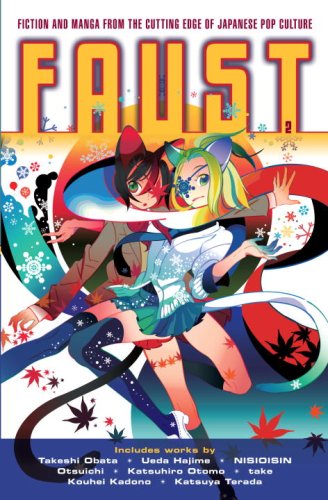
Collects fiction, essays, and manga from prominent authors in Japan today.
Die Inhaltsangabe kann sich auf eine andere Ausgabe dieses Titels beziehen.
Auszug. © Genehmigter Nachdruck. Alle Rechte vorbehalten.
Magical Girl Risuka
Nisioisin
Illustrations by Kinu Nishimura
Translated by Andrew Cunningham
Magical Girl Risuka is a typical NISIOISIN fantasia-if anything could be said to be "typical" about NISIOISIN's work. NISIOISIN is without parallel in the light novel world as an inventor of strange universes and fantastic characters, and the strange and gorgeously complicated world of Risuka is no exception. While much of Risuka's fictional universe is of NISIOISIN's own wild imagining, the story contains some references to another world-forger, H. P. Lovecraft. Some of the books that Risuka is studying refer to the Cthulu mythos. (Also interesting to note: The Book of Thoth is a real book by Aleister Crowley.) Nyarlathotep is one of Cthulu's elder gods, the only one to take human forms and use human language. A reference to Japanese folklore and the kamaitachi (a demon that takes the form of a sudden whirlwind, capable of cutting through anything) completes NISIOISIN's rich web of references. The translator has also made an attempt at rendering Risuka's distinctive style of speech, which NISIOISIN rendered in rather idiosyncratic Japanese.
Born in 1981, the prolific NISIOISIN has already revolutionized the Japanese literary world with his fast-paced, pop culture-fueled novels. He debuted with The Kubikiri Cycle in 2002, beginning his seminal Zaregoto series, and Bakemonogatari was published under Kodansha's popular Kodansha BOX imprint. In 2007 came the magnificent conclusion to his twelve-month consecutive serial novel, Katanagatari-for which NISIOSIN wrote one novel a month for an entire year-also for Kodansha BOX. In addition to xxxHOLiC, NISIOISIN tackled another major manga franchise with Death Note Another Note: The Los Angeles BB Murder Cases, based on Tsugumi Ohba and Takeshi Obata's blockbuster series. Zaregoto, Book One: The Kubikiri Cycle was published in the United States by Del Rey Manga in 2008. Kinu Nishimura is an illustrator who has also worked as a graphic designer for Capcom on such projects as the Street Fighter game series.
I happened to witness what might have been an incident, or might have been an accident, but either way was clearly a truth, exactly one week ago, Sunday last week. Events had brought me far from my place of residence in the city of Kawano, in Saga Prefecture, taking me across prefectural lines into Fukuoka Prefecture, the city of Hakata, the town of Kizuna. There are a number of ways in which I could describe the business that brought me there, but they all boil down to "meeting someone," and looked at from a different perspective, you could even claim I had come with no clear purpose at all. Either way it was not inevitable that I should arrive at the spot where I witnessed this truth; I believe my being there was pure coincidence. Because of things like this, I cannot bring myself to hate coincidence. Events occurred while I was standing on subway platform number 1 in the New Kizuna Station, waiting for the train that would take me back into Hakata proper. The time was definitely 6:32 p.m. I can say so with confidence because that was the moment at which the train I had intended to board was pulling into the station. All Japanese trains, private or government-operated, are invariably punctual. Which means it was 6:32. The customary announcement, "Train approaching platform 1. Please remain behind the yellow lines," echoed through the station, and it happened a few seconds later. Four people lined up in front of me, preparing to board the train. I did not know any of them, but I know their names now: Kagawa Sakiro, Yana Harusame, Manabe Saki, and Tainaka Umi. With perfect timing, just as the front of the train was about to pass us, they all flung themselves out in front of it. I remember that moment happening in slow motion-whether the result of chemicals in my brain or simply a trick of the mind. I saw them seemingly sucked toward it, struggling against one another to be the first to fall. I saw the train's driver gaping as if he were witnessing the destruction of earth and heaven-but only for an instant, a mere instant.
A moment later, the speed of my vision returned to normal-and what happened afterward need not be explained to anyone, assuming blood still flows to their brain. They were pulped, their bits flung together till it was impossible to tell which belonged to which. Trains have been designed for the simple function of moving quickly along tracks, and what might occur if they happened to strike a human being has never really been on their designers' minds. The four victims and I were lined up near the front end of the platform, but it made little difference. We were facing a massive chunk of iron, a veritable symbol of destructive force. Even if we had been at the far end of the platform, near the front doors of the train, the best they could have hoped for was that their bodies might have remained recognizably human. At present, this is the extent of the truth as I know it; and if that is all there is to it, then I do not see a problem. Certainly, because of this truth the train was delayed a wasteful thirty minutes, but I am not so petty as to be infuriated by such trivialities. Anger is a waste of energy, and I make use of it only if there is something to be gained in the process. But there were a number of factors to this truth that suggest it would not remain a simple truth, and I viewed this as problematic. The first problem is an obvious one-the fact that four people chose to jump simultaneously. If one person had chosen to dive in front of a train, I would understand. If a single person had tripped and fallen onto the tracks, that would have been even easier. Suicide or accident, such incidents have become a ceaseless ritual, occurring constantly in all parts of the country, on every day of the year. But for four people to engage in that ritual together-that was different. It was unthinkable that they had chosen to do so together by chance, coincidentally-and the idea of it being a planned suicide was also dubious. If they had been family members or close friends, group suicide might have been an option, but from what I had observed standing behind them, there was no connection among the four: Each of them was a complete stranger to the other three.
I am rather confident of my ability to observe human behavior. (Bring anyone you like to me, and no matter who they are, I will provide you with an itemized list of a hundred facts about them-obviously, not including any details of their appearance, just facts about their inner nature.) And the newspapers after the incident verified that there was no connection among them, so that can now be put down as an objective fact. In other words, if the first problem was the simultaneous nature of it, the second was the lack of connection among them. I doubt there are many so foolish as to have not worked out the third problem-namely, that it was absolutely impossible. For four strangers to fall onto the tracks simultaneously-to make that situation occur, the only reasonable method would be for the person standing immediately behind them to push them off the platform. Indeed, the police and the news media are actively looking for the "culprit" behind this "case"-sadly, a futile effort. For the simple reason that the person standing behind the four victims was me; and I had not pushed them. I would never do anything like push four complete strangers onto the train tracks, never do anything that failed to provide some future benefit. But no matter what I say, without your even needing to bring up the Cretan paradox, mere words on my part are hardly convincing. More convincing than any exhortation on my part is the simple fact that it was physically impossible...
„Über diesen Titel“ kann sich auf eine andere Ausgabe dieses Titels beziehen.
Suchergebnisse für Faust 2

Beispielbild für diese ISBN
Faust 2
Anbieter: WorldofBooks, Goring-By-Sea, WS, Vereinigtes Königreich
Verkäuferbewertung 4 von 5 Sternen

Paperback. Zustand: Very Good. D. K.; Ueda Hajime; Takeshi Obata; Kinu Nishimura (illustrator). The book has been read, but is in excellent condition. Pages are intact and not marred by notes or highlighting. The spine remains undamaged. Bestandsnummer des Verkäufers GOR011844807
Gebraucht kaufen
EUR 24,77
EUR 6,73 Versand
Versand von Vereinigtes Königreich nach USA
Versand von Vereinigtes Königreich nach USA
Anzahl: 1 verfügbar
Foto des Verkäufers
Faust 2
Anbieter: Bay State Book Company, North Smithfield, RI, USA
Verkäuferbewertung 5 von 5 Sternen

Zustand: good. D. K.; Ueda Hajime; Takeshi Obata; Kinu Nishimura (illustrator). The book is in good condition with all pages and cover intact, including the dust jacket if originally issued. The spine may show light wear. Pages may contain some notes or highlighting, and there might be a "From the library of" label. Boxed set packaging, shrink wrap, or included media like CDs may be missing. Bestandsnummer des Verkäufers BSM.1H4Q6
Gebraucht kaufen
EUR 41,41
Versand gratis
Versand innerhalb von USA
Versand innerhalb von USA
Anzahl: 1 verfügbar
Foto des Verkäufers
Faust 2
Anbieter: ThriftBooksVintage, Tukwila, WA, USA
Verkäuferbewertung 5 von 5 Sternen
Paperback. Zustand: Very Good. No Jacket. D. K.; Ueda Hajime; Takeshi Obata; Kinu Nishimura (illustrator). First edition THUS. Minor shelf and handling wear, overall a clean solid copy with minimal signs of use. Secure packaging for safe delivery. Bestandsnummer des Verkäufers 1580710592
Gebraucht kaufen
EUR 190,20
Versand gratis
Versand innerhalb von USA
Versand innerhalb von USA
Anzahl: 1 verfügbar
Beispielbild für diese ISBN
Faust 2
Anbieter: Foggypaws, Sonoma, CA, USA
Verkäuferbewertung 4 von 5 Sternen
paperback. Zustand: New. D. K.; Ueda Hajime; Takeshi Obata; Kinu Nishimura (illustrator). Paperback. Bestandsnummer des Verkäufers mon0000084280
Neu kaufen
EUR 187,38
EUR 7,27 Versand
Versand innerhalb von USA
Versand innerhalb von USA
Anzahl: 1 verfügbar