
Verwandte Artikel zu The New Tsar: The Rise and Reign of Vladimir Putin
Inhaltsangabe
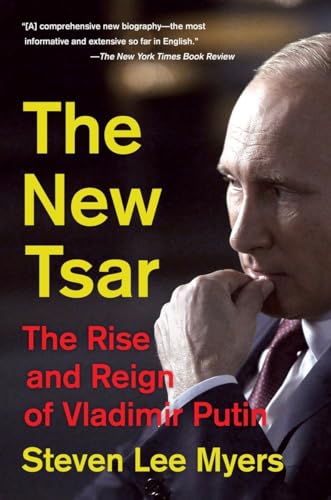
As the world struggles to confront a bolder Russia, the importance of understanding the formidable and ambitious Vladimir Putin has never been greater. This gripping narrative of Putin's rise to power recounts Putin's origins—from his childhood of abject poverty in Leningrad to his ascent through the ranks of the KGB, and his eventual consolidation of rule in the Kremlin.
On the one hand, Putin's many domestic reforms—from tax cuts to an expansion of property rights—have helped reshape the potential of millions of Russians whose only experience of democracy had been crime, poverty, and instability after the fall of the Soviet Union. On the other, Putin has ushered in a new authoritarianism—unyielding in its brutal repression of dissent and newly assertive politically and militarily in regions like Crimea and the Middle East.
The New Tsar is a staggering achievement, a deeply researched and essential biography of one of the most important and destabilizing world leaders in recent history, a man whose merciless rule has become inextricably bound to Russia's forseeable future.
Die Inhaltsangabe kann sich auf eine andere Ausgabe dieses Titels beziehen.
Über die Autorin bzw. den Autor
STEVEN LEE MYERS has worked at The New York Times for twenty-six years, seven of them in Russia during the period when Putin consolidated his power. He spent two years as bureau chief in Baghdad, covering the winding down of the American war in Iraq, and now covers national security issues. He lives in Washington, D.C. This is his first book.
Auszug. © Genehmigter Nachdruck. Alle Rechte vorbehalten.
CHAPTER 1
Homo Sovieticus
Vladimir Spiridonovich Putin edged forward through the cratered battlefield beside the Neva River, roughly thirty miles from Leningrad. His orders seemed suicidal. He was to reconnoiter the German positions and, if possible, capture a “tongue,” slang for a soldier to interrogate. It was November 17, 1941,1 already bitterly cold, and the Soviet Union’s humiliated army was now desperately fighting to avoid its complete destruction at the hands of Nazi Germany. The last tanks in reserve in the city had crossed the Neva a week before, and Putin’s commanders now had orders to break through heavily reinforced positions defended by 54,000 German infantrymen. There was no choice but to obey. He and another soldier approached a foxhole along a dug-in front, carved with trenches, pocked with shell craters, stained with blood. A German suddenly rose, surprising all three of them. For a frozen moment, nothing happened. The German reacted first, unpinned a grenade and tossed it. It landed near Putin, killing his comrade and riddling his own legs with shrapnel. The German soldier escaped, leaving Putin for dead. “Life is such a simple thing, really,” a man who retold the story decades later would say, with a characteristic fatalism.
Putin, then thirty years old, lay wounded on a bridgehead on the east bank of the Neva. The Red Army’s commanders had poured troops across the river in hopes of breaking the encirclement of Leningrad that had begun two months earlier when the Germans captured Shlisselburg, an ancient fortress at the mouth of the Neva, but the effort failed. The Germans laid a siege that would last 872 days and kill a million civilians by bombardment, starvation, or disease. “The Führer has decided to wipe the city of Petersburg from the face of the earth,” a secret German order declared on September 29. Surrender would not be accepted. Air and artillery bombardment would be the instrument of the city’s destruction, and hunger would be its accomplice, since “feeding the population cannot and should not be solved by us.” Never before had a modern city endured a siege like it.
“Is this the end of your losses?” Joseph Stalin furiously cabled the city’s defenders the day after the siege began. “Perhaps you have already decided to give up Leningrad?” The telegram was signed by the entire Soviet leadership, including Vyacheslav Molotov, who in 1939 had signed the notorious nonaggression pact with his Nazi counterpart, Joachim von Ribbentrop, which was now betrayed. It was by no means the end of the losses. The fall of Shlisselburg coincided with ferocious air raids in Leningrad itself, including one that ignited the city’s main food warehouse. The Soviet forces defending the city were in disarray, as they were everywhere in the Soviet Union. Operation Barbarossa, the Nazi invasion that began on June 22, 1941, had crushed Soviet defenses along a thousand-mile front, from the Baltic Sea to the Black Sea. Even Moscow seemed in danger of falling.
Stalin never considered surrendering Leningrad, and he dispatched the chief of the general staff, Georgy Zhukov, to shore up the city’s defenses, which he did with great brutality. On the night of September 19, on Zhukov’s orders, Soviet forces mounted the first assault 600 meters across the Neva to break the siege, but it was repulsed by overwhelming German firepower. In October, they tried again, hurling forth the 86th Division, which included Putin’s unit, the 330th Rifle Regiment. The bridgehead those troops managed to create on the eastern bank of the Neva became known, because of its size, as the Nevsky Pyatachok, from the word for a five-kopek coin or a small patch. At its greatest expanse the battlefield was barely a mile wide, less than half a mile deep. For the soldiers fated to fight there, it was a brutal, senseless death trap.
Putin was an uneducated laborer, one of four sons of Spiridon Putin, a chef who once worked in the city’s famed pre-revolutionary Astoria Hotel. Spiridon, though a supporter of the Bolsheviks, fled the imperial capital during the civil war and famine that followed the October Revolution in 1917. He settled in his ancestral village, Pominovo, in the rolling hills west of Moscow, and later moved to the city itself, where he cooked for Vladimir Lenin’s widow, Nadezhda Krupskaya, at her official Soviet dacha in the Gorky district on the edge of Moscow. After her death in 1939, he worked in the retreat of Moscow’s Communist Party Committee. He was said to have cooked once for Grigory Rasputin at the Astoria and on occasion for Stalin when he visited Lenin’s widow, beginning a family tradition of servitude to the political elite. Proximity to power did nothing to protect his sons from the Nazis; the entire nation was fighting for survival.
Vladimir Putin was already a veteran when the Nazis invaded the Soviet Union in June 1941. He had served as a submariner in the 1930s before settling down not far from Leningrad, in the village of Petrodvorets, where Peter the Great had built his palace on the Gulf of Finland. In the chaotic days that followed the invasion, he, like many citizens, had rushed to volunteer to defend the nation and was initially assigned to a special demolitions detachment of the People’s Commissariat for Internal Affairs, or NKVD, the dreaded secret police agency that would later become the KGB. The NKVD created 2,222 of these detachments to harass the Nazis behind the front, which was then rapidly advancing. One of Putin’s first missions in the war was a disaster. He and twenty-seven other partisan fighters parachuted behind the Germans advancing on Leningrad, near the town of Kingisepp. It was close to the border with Estonia, which the Soviet Union had occupied the year before, along with Latvia and Lithuania, as part of the notorious prewar pact with Hitler. Putin’s detachment managed to blow up one arms depot, as the story went, but quickly ran out of ammunition and rations. Local residents, Estonians, brought them food but also betrayed them to the Germans, whom many in the Baltic nations welcomed, at least at first, as liberators from Soviet occupation. German troops closed in on the unit, firing on them as they raced along a road back to the Soviet lines. Putin split off, chased by Germans with dogs, and hid in a marsh, submerging himself and breathing through a reed until the patrol moved on.8 How exactly he made it back is lost to the fog of history, but only he and three others of the detachment survived the raid. The NKVD interrogated him after his escape, but he managed to avoid suspicion of desertion or cowardice and was soon sent back to the front. It might have been courage alone that drove Putin, or it might have been fear. Stalin’s Order No. 270, issued on August 16, had threatened soldiers who deserted with execution and their family members with arrest.
Inside Leningrad conditions deteriorated rapidly, despite efforts by the authorities to maintain a sense of normality. Schools opened, as always, on September 1, but three days later the first German shells landed inside the city. With the blockade completed and the city now under regular assault from above, the authorities intensified the rationing of food.
Rations would gradually decline, leading to desperation, despair, and finally death. As Vladimir Putin fought outside the city, his wife, Maria, and their infant son were trapped inside. Vladimir and Maria, both born in 1911, were children of Russia’s turbulent twentieth century, buffeted by World War I, the Bolshevik revolution, and the civil war that followed....
„Über diesen Titel“ kann sich auf eine andere Ausgabe dieses Titels beziehen.
Suchergebnisse für The New Tsar: The Rise and Reign of Vladimir Putin

Beispielbild für diese ISBN
The New Tsar: The Rise and Reign of Vladimir Putin
Anbieter: World of Books (was SecondSale), Montgomery, IL, USA
Verkäuferbewertung 5 von 5 Sternen

Zustand: Good. Item in good condition. Textbooks may not include supplemental items i.e. CDs, access codes etc. Bestandsnummer des Verkäufers 00095523595
Gebraucht kaufen
EUR 4,05
Versand gratis
Versand innerhalb von USA
Versand innerhalb von USA
Anzahl: 5 verfügbar
Foto des Verkäufers
The New Tsar: The Rise and Reign of Vladimir Putin
Anbieter: Zoom Books East, Glendale Heights, IL, USA
Verkäuferbewertung 5 von 5 Sternen
Zustand: good. Book is in good condition and may include underlining highlighting and minimal wear. The book can also include "From the library of" labels. May not contain miscellaneous items toys, dvds, etc. . We offer 100% money back guarantee and 24 7 customer service. Bestandsnummer des Verkäufers ZEV.0345802799.G
Gebraucht kaufen
EUR 4,06
Versand gratis
Versand innerhalb von USA
Versand innerhalb von USA
Anzahl: 1 verfügbar
Foto des Verkäufers
The New Tsar: The Rise and Reign of Vladimir Putin
Anbieter: Greenworld Books, Arlington, TX, USA
Verkäuferbewertung 5 von 5 Sternen
Zustand: like_new. Fast Free Shipping â" Excellent condition book with clean cover and pages. Barely handled, with minimal wear. An outstanding copy, close to enjoy! Bestandsnummer des Verkäufers GWV.0345802799.LN
Gebraucht kaufen
EUR 4,89
Versand gratis
Versand innerhalb von USA
Versand innerhalb von USA
Anzahl: 1 verfügbar
Beispielbild für diese ISBN
The New Tsar: The Rise and Reign of Vladimir Putin
Anbieter: Gulf Coast Books, Cypress, TX, USA
Verkäuferbewertung 5 von 5 Sternen
paperback. Zustand: Good. Bestandsnummer des Verkäufers 0345802799-3-37941867
Gebraucht kaufen
EUR 5,29
Versand gratis
Versand innerhalb von USA
Versand innerhalb von USA
Anzahl: 1 verfügbar
Beispielbild für diese ISBN
The New Tsar: The Rise and Reign of Vladimir Putin
Anbieter: Once Upon A Time Books, Siloam Springs, AR, USA
Verkäuferbewertung 4 von 5 Sternen

paperback. Zustand: Good. This is a used book in good condition and may show some signs of use or wear . This is a used book in good condition and may show some signs of use or wear . Bestandsnummer des Verkäufers mon0003301184
Gebraucht kaufen
EUR 1,94
EUR 3,52 Versand
Versand innerhalb von USA
Versand innerhalb von USA
Anzahl: 1 verfügbar
Beispielbild für diese ISBN
The New Tsar: The Rise and Reign of Vladimir Putin
Anbieter: World of Books Inc, Montgomery, IL, USA
Verkäuferbewertung 4 von 5 Sternen
Paperback. Zustand: Good. In this gripping narrative of Putin's rise to power, Steven Lee Myers recounts Putin's origins--from his childhood of abject poverty in Leningrad to his ascent through the ranks of the KGB, and his eventual consolidation of rule in the Kremlin. As the world struggles to confront a bolder Russia, the importance of understanding the formidable and ambitious Vladimir Putin has never been greater. On the one hand, Putin's many domestic reforms--from tax cuts to an expansion of property rights--have helped reshape the potential of millions of Russians whose only experience of democracy had been crime, poverty, and instability after the fall of the Soviet Union. On the other, Putin has ushered in a new authoritarianism--unyielding in its brutal repression of dissent and newly assertive politically and militarily in regions like Crimea and the Middle East. The New Tsar is a staggering achievement, a deeply researched and essential biography of one of the most important and destabilizing world leaders in recent history, a man whose merciless rule has become inextricably bound to Russia's forseeable future. Bestandsnummer des Verkäufers CIN0345802799G
Gebraucht kaufen
EUR 5,89
Versand gratis
Versand innerhalb von USA
Versand innerhalb von USA
Anzahl: 6 verfügbar
Beispielbild für diese ISBN
The New Tsar: The Rise and Reign of Vladimir Putin
Anbieter: ThriftBooks-Atlanta, AUSTELL, GA, USA
Verkäuferbewertung 5 von 5 Sternen
Paperback. Zustand: Very Good. No Jacket. May have limited writing in cover pages. Pages are unmarked. ~ ThriftBooks: Read More, Spend Less. Bestandsnummer des Verkäufers G0345802799I4N00
Gebraucht kaufen
EUR 5,99
Versand gratis
Versand innerhalb von USA
Versand innerhalb von USA
Anzahl: 1 verfügbar
Beispielbild für diese ISBN
The New Tsar: The Rise and Reign of Vladimir Putin
Anbieter: ThriftBooks-Atlanta, AUSTELL, GA, USA
Verkäuferbewertung 5 von 5 Sternen
Paperback. Zustand: As New. No Jacket. Pages are clean and are not marred by notes or folds of any kind. ~ ThriftBooks: Read More, Spend Less. Bestandsnummer des Verkäufers G0345802799I2N00
Gebraucht kaufen
EUR 5,99
Versand gratis
Versand innerhalb von USA
Versand innerhalb von USA
Anzahl: 1 verfügbar
Beispielbild für diese ISBN
The New Tsar: The Rise and Reign of Vladimir Putin
Anbieter: ThriftBooks-Dallas, Dallas, TX, USA
Verkäuferbewertung 5 von 5 Sternen
Paperback. Zustand: Very Good. No Jacket. May have limited writing in cover pages. Pages are unmarked. ~ ThriftBooks: Read More, Spend Less. Bestandsnummer des Verkäufers G0345802799I4N00
Gebraucht kaufen
EUR 5,99
Versand gratis
Versand innerhalb von USA
Versand innerhalb von USA
Anzahl: 1 verfügbar
Beispielbild für diese ISBN
The New Tsar: The Rise and Reign of Vladimir Putin
Anbieter: ThriftBooks-Reno, Reno, NV, USA
Verkäuferbewertung 5 von 5 Sternen
Paperback. Zustand: Very Good. No Jacket. May have limited writing in cover pages. Pages are unmarked. ~ ThriftBooks: Read More, Spend Less. Bestandsnummer des Verkäufers G0345802799I4N00
Gebraucht kaufen
EUR 5,99
Versand gratis
Versand innerhalb von USA
Versand innerhalb von USA
Anzahl: 1 verfügbar