
Verwandte Artikel zu The Man with the Compound Eyes
Inhaltsangabe
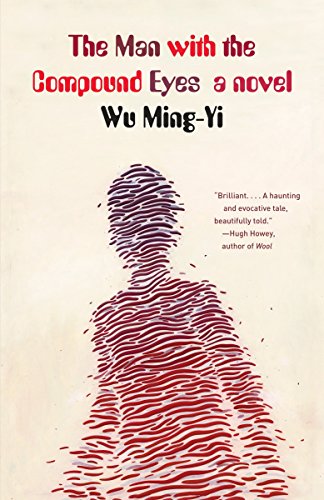
When a tsunami sends a massive island made of trash crashing into the coast of Taiwan, two very different people&;an outcast from a mythical country and a woman on the verge of suicide&;are united in ways they never could have imagined. Intertwined with the story of their burgeoning friendship are the lives of others affected by the tsunami, from environmentalists to Taiwan&;s indigenous peoples&;and, of course, the mysterious man with the compound eyes. A work of lyrical beauty that combines fantasy, reality, and dystopian environmental saga, here is the English-language debut of a new and exciting award-winning voice from Taiwan. 
Die Inhaltsangabe kann sich auf eine andere Ausgabe dieses Titels beziehen.
Über die Autorin bzw. den Autor
Wu Ming-Yi was born in 1971 in Taiwan, where he still lives. A writer, artist, professor, and environmental activist, he has been teaching literature and creative writing at National Dong Hwa University since 2000 and is now a professor in the Department of Chinese. Wu is the author of two books of nature writing, the second of which, The Way of Butterflies, was awarded the China Times Open Book Award in 2003. His debut novel, Routes in the Dream, was named one of the ten best Chinese-language novels of the year by Asian Weekly magazine. The Man with the Compound Eyes is his first book to be translated into English.
Auszug. © Genehmigter Nachdruck. Alle Rechte vorbehalten.
2. Atile’i’s Last Night
The people of Wayo Wayo thought the whole world was but a single island.
The island was situated in the midst of an immense ocean, far from any continent. As far as island memory reached, the white man had once visited the island, but nobody had ever left and brought back news of another land. In the beginning, people believed, there was nothing but a shoreless sea, until Kabang (the word for “God” in the Wayo Wayoan language) created the island for them to live on, as if placing a small, hollow clamshell in a tub of water. The island followed the tides, floating around in the ocean, which was a source of sustenance for the people. But some of the ocean’s spawn were the avatars of Kabang. The asamu, for instance, was a black-and-white fish sent to spy on people, and to test them. For this reason, it was counted among the creatures that could not be eaten.
“If you are so careless as to eat an asamu, you will grow a ring of scales around your navel, a ring of scales that you could never finish peeling off your whole life long.” Leaning on a whalerib staff, the Sea Sage hobbled over and sat under a tree every day at dusk to tell the little ones all the stories of the sea. He talked until the sun dipped below the waves. He talked until the boys became youths, and until the youths endured the rite of passage and became men. His speech carried the smell of the sea, and there was salt on his every breath.
“So what if we grow scales?” one boy asked. The children here all had enormous eyes, like the eyes of a nocturnal animal.
“Oh my child, people can’t grow scales, just like a sea turtle can’t sleep with its belly to the sky.”
Another day, the Earth Sage took the children to the field in the hollow, to the place where the akaba grew. One of the only starchy plants on the island, the luxuriant akaba, a word that meant “shaped like the palm of a hand,” seemed to raise innumerable hands in supplication to the sky. The island was small and the people lacked farming tools, so pebbles were piled around the plots, to keep the soil moist and to serve as a windbreak. “You must love the land, my children, and ring it in with your love. For the land is the most precious thing on this island. It is like rain, like the heart of a woman.” The Earth Sage showed the children how to arrange the rocks. His skin was dry like cracked mud, and his back was arched like an earthen mound. “In all the world, the only things worth trusting in are the land, the sea and Kabang, my children.”
At the southeast corner of the island was a coral lagoon, a good place to catch fish with thrownets or to collect clams. To the northeast, at a distance of ten husks (ten throws of a coconut husk) there was a cay, a coral reef that was fully exposed at ebb tide. This was where the seabirds flocked. The Wayo Wayoans hunted the birds with gawana. To make a gawana, they tied branches into a tool that had the virtues of club and spear, with one end blunt and the other end sharpened to a point; then they passed a rope of saltgrass through a hole in the blunt end and tied one end into a noose. Armed with a gawana, a fisherman would row his talawaka near the cay and let the ocean current carry him along, pretending to ignore the birds as he prayed to Kabang. When he drifted within range he would hurl his gawana. Blessed by Kabang, the noose would slip, just so, over a seabird’s neck, and a deft flick of the wrist would impale the bird on the pointy end. Blood would trickle down from the point, as if the gawana itself had suffered a mortal wound. The only resistance the albatross, the booby, the pelican, the petrel and the seagull could put up was prolifer-ation. When the birds stopped in spring to build nests, people would feast on eggs, wearing cruel and satisfied smiles on their faces.
As on any island, there was never enough fresh water on Wayo Wayo. The only sources were rain and a lake at the center of the island. Consisting mainly of fish and fowl, the diet was salty, giving the people a thin and dark appearance and often leaving them constipated. At dawn they would squat over pit latrines, facing away from the sea, often getting teary-eyed from the strain.
The island was so small that most people could set out after breakfast, walk all the way around and return not long after lunch. For the same reason, people were accustomed to a rough parlance of “facing the sea” or “facing away” to orient themselves, and the only way to face away was to face the hillock at the center of the island. People talked facing the sea and ate facing away. They conducted rituals facing the sea, and made love facing away, so as not to offend Kabang. There were no chiefs among the people, only “elders,” the wisest of whom were called “old men of the sea.” The front door of the home of a family in which an old man of the sea had lived faced the shore. Adorned with shells and carvings, Wayo Wayoan houses looked like capsized canoes. They stuck fish skin to the walls, and the whole community would gather round and build a coral fence out in front to block the wind. The islanders could neither walk to a place where the sea could not be heard nor have a conversation in which the sea was not mentioned. In the morning, they greeted each other, “Are you going to sea?” At noon they asked, “Shall we test our luck at sea?” And at night, even if the weather had been too rough to go fishing today, they exhorted one another, “You must remember me a story of the sea.” As a rule, the Wayo Wayo went fishing every day. Fishermen who met on shore would yell, “Don’t let the mona’e steal your name!” Mona’e meant wave. When people bumped into one another, one would ask, “So how’s the weather at sea?” Even if a gale was blowing, the other had to reply, “Very fair.” The tonality of the Wayo Wayoan language was sharp and sonorous, like birdsong, with each utterance ending in a light trill and a plop, like a hungry seabird that swiftly dives and breaks the waves in search of prey.
Occasionally, the people went hungry, the weather was too rough, or two of the villages would come into conflict; but no matter how he spent his days, everyone was skilled at telling diverse stories of the sea. People told tales at meals, when they met, at rituals, and when making love. They even told them in their sleep. A complete record had never been made, but many years later anthropologists might know that the islanders had the greatest number of sea sagas of any people on Earth. “Let me tell you a story of the sea” was on the tip of everyone’s tongue. They did not ask how old people were, but simply grew tall like trees and stuck out their organs of increase like flowers. Like the obstinate clam they just passed the time. Like a sea turtle each islander died with the curl of a smile at the corner of his mouth. They were all old souls, older than they appeared, and because they spent their lives staring at the sea they all had melancholy miens and tended to get cataracts and go blind in old age. When they were ready to go, old folks would ask the youngsters by the bed, “What’s the weather out at sea like now?” People believed that dying while gazing at the sea was the grace of Kabang. Their lifelong dream was to arrive at the moment of death with an image of the ocean in the ocean of the mind.
When a boy was born, his father would select a tree for him and carve a notch for each resurrection of the...
„Über diesen Titel“ kann sich auf eine andere Ausgabe dieses Titels beziehen.
Suchergebnisse für The Man with the Compound Eyes

Foto des Verkäufers
The Man with the Compound Eyes: A Novel
Anbieter: Austin Goodwill 1101, Austin, TX, USA
Verkäuferbewertung 5 von 5 Sternen

Zustand: good. Book shows general signs of use and handling. May have light wear on the cover or edges and minimal writing or highlighting. Binding remains tight, and pages are clean and readable. Bestandsnummer des Verkäufers CTXV.0345802888.G
Gebraucht kaufen
EUR 4,77
EUR 2,83 Versand
Versand innerhalb von USA
Versand innerhalb von USA
Anzahl: 1 verfügbar
Beispielbild für diese ISBN
The Man with the Compound Eyes: A Novel
Anbieter: Half Price Books Inc., Dallas, TX, USA
Verkäuferbewertung 5 von 5 Sternen
Paperback. Zustand: Very Good. Connecting readers with great books since 1972! Used books may not include companion materials, and may have some shelf wear or limited writing. We ship orders daily and Customer Service is our top priority! Bestandsnummer des Verkäufers S_479050963
Gebraucht kaufen
EUR 5,64
EUR 3,21 Versand
Versand innerhalb von USA
Versand innerhalb von USA
Anzahl: 1 verfügbar
Beispielbild für diese ISBN
The Man with the Compound Eyes: A Novel
Anbieter: Books From California, Simi Valley, CA, USA
Verkäuferbewertung 4 von 5 Sternen

Paperback. Zustand: Good. Bestandsnummer des Verkäufers mon0003903104
Gebraucht kaufen
EUR 4,64
EUR 4,28 Versand
Versand innerhalb von USA
Versand innerhalb von USA
Anzahl: 1 verfügbar
Foto des Verkäufers
Man With the Compound Eyes
Anbieter: GreatBookPrices, Columbia, MD, USA
Verkäuferbewertung 5 von 5 Sternen
Zustand: good. May show signs of wear, highlighting, writing, and previous use. This item may be a former library book with typical markings. No guarantee on products that contain supplements Your satisfaction is 100% guaranteed. Twenty-five year bookseller with shipments to over fifty million happy customers. Bestandsnummer des Verkäufers 22169532-5
Gebraucht kaufen
EUR 6,70
EUR 2,26 Versand
Versand innerhalb von USA
Versand innerhalb von USA
Anzahl: 5 verfügbar
Beispielbild für diese ISBN
The Man with the Compound Eyes : A Novel
Verlag:
Knopf Doubleday Publishing Group, 2015
ISBN 10: 0345802888
ISBN 13: 9780345802880
Gebraucht
Softcover
Anbieter: Better World Books: West, Reno, NV, USA
Verkäuferbewertung 5 von 5 Sternen
Zustand: Good. Pages intact with minimal writing/highlighting. The binding may be loose and creased. Dust jackets/supplements are not included. Stock photo provided. Product includes identifying sticker. Better World Books: Buy Books. Do Good. Bestandsnummer des Verkäufers 14397405-6
Gebraucht kaufen
EUR 9,71
Versand gratis
Versand innerhalb von USA
Versand innerhalb von USA
Anzahl: 1 verfügbar
Beispielbild für diese ISBN
The Man with the Compound Eyes : A Novel
Verlag:
Knopf Doubleday Publishing Group, 2015
ISBN 10: 0345802888
ISBN 13: 9780345802880
Gebraucht
Softcover
Anbieter: Better World Books, Mishawaka, IN, USA
Verkäuferbewertung 5 von 5 Sternen
Zustand: Good. Former library copy. Pages intact with minimal writing/highlighting. The binding may be loose and creased. Dust jackets/supplements are not included. Includes library markings. Stock photo provided. Product includes identifying sticker. Better World Books: Buy Books. Do Good. Bestandsnummer des Verkäufers 14935561-6
Gebraucht kaufen
EUR 9,71
Versand gratis
Versand innerhalb von USA
Versand innerhalb von USA
Anzahl: 2 verfügbar
Beispielbild für diese ISBN
The Man with the Compound Eyes: A Novel
Anbieter: HPB Inc., Dallas, TX, USA
Verkäuferbewertung 5 von 5 Sternen
Paperback. Zustand: Very Good. Connecting readers with great books since 1972! Used books may not include companion materials, and may have some shelf wear or limited writing. We ship orders daily and Customer Service is our top priority! Bestandsnummer des Verkäufers S_474800697
Gebraucht kaufen
EUR 7,05
EUR 3,21 Versand
Versand innerhalb von USA
Versand innerhalb von USA
Anzahl: 1 verfügbar
Foto des Verkäufers
The Man with the Compound Eyes: A Novel
Anbieter: Goodwill of Greater Milwaukee and Chicago, Racine, WI, USA
Verkäuferbewertung 5 von 5 Sternen
Zustand: acceptable. Book is considered to be in acceptable condition. The actual cover image may not match the stock photo. Book may have one or more of the following defects: noticeable wear on the cover dust jacket or spine; curved, dog eared or creased page s ; writing or highlighting inside or on the edges; sticker s or other adhesive on cover; CD DVD may not be included; and book may be a former library copy. Bestandsnummer des Verkäufers SEWV.0345802888.A
Gebraucht kaufen
EUR 8,29
EUR 2,57 Versand
Versand innerhalb von USA
Versand innerhalb von USA
Anzahl: 1 verfügbar
Beispielbild für diese ISBN
The Man with the Compound Eyes: A Novel
Anbieter: Lakeside Books, Benton Harbor, MI, USA
Verkäuferbewertung 5 von 5 Sternen
Zustand: New. Brand New! Not Overstocks or Low Quality Book Club Editions! Direct From the Publisher! We're not a giant, faceless warehouse organization! We're a small town bookstore that loves books and loves it's customers! Buy from Lakeside Books! Bestandsnummer des Verkäufers OTF-S-9780345802880
Beispielbild für diese ISBN
Man With the Compound Eyes
Anbieter: GreatBookPrices, Columbia, MD, USA
Verkäuferbewertung 5 von 5 Sternen
Zustand: New. Bestandsnummer des Verkäufers 22169532-n
Neu kaufen
EUR 10,76
EUR 2,26 Versand
Versand innerhalb von USA
Versand innerhalb von USA
Anzahl: Mehr als 20 verfügbar