
Verwandte Artikel zu Stringer: A Reporter's Journey in the Congo
Inhaltsangabe
Book of the Year, The Royal African Society (UK)
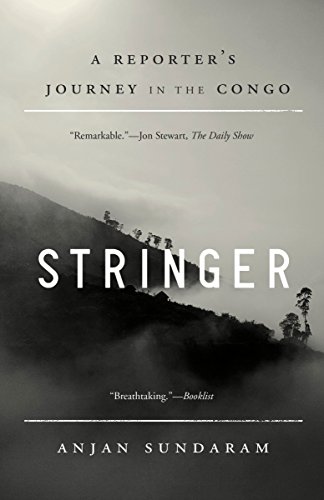
In the powerful travel-writing tradition of Ryszard Kapuœciñski and V.S. Naipaul, a haunting memoir of a dangerous and disorienting year of self-discovery in one of the world’s unhappiest countries.
In August 2005, Anjan Sundaram abandoned his path to a Yale Ph.D. in mathematics to travel to the Democratic Republic of the Congo and refashion himself as a journalist. He found a country that was diseased, corrupt, and poised on the cusp of war. When Sundaram is engaged as a “stringer” for the Associated Press, he becomes a chronicler for a country he’s just beginning to experience. Stringer is his searing portrait of life in this broken, lawless place, an account of the rocky education of a reporter. Sundaram describes the grueling reality of daily existence in the Congo, intimately outlining his own struggle to make sense of life in a world where cab rides can end at gunpoint and rebel generals are only a phone call away. As the city of Kinshasha descends into anarchy after a contested election, Sundaram takes shelter in a factory to file report after report even as other journalists flee. Oscillating between anger and loneliness and between melancholy and exhilaration, Stringer completely transports us not only to the Congo—but to the limits of sanity, reason, and experience.
Die Inhaltsangabe kann sich auf eine andere Ausgabe dieses Titels beziehen.
Über die Autorin bzw. den Autor
Anjan Sundaram is an award-winning journalist who has reported from Africa and the Middle East for The New York Times and the Associated Press. His writing has also appeared in Foreign Policy, Fortune, The Washington Post, the Los Angeles Times, the Chicago Tribune, The Telegraph, The Guardian, the International Herald Tribune, and the Huffington Post. He has been interviewed by the BBC World Service and Radio France Internationale for his analysis of the conflict in Congo. He received a Reuters journalism award in 2006 for his reporting on Pygmy tribes in Congo’s rain forest. He currently lives in Kigali, Rwanda, with his wife.
Auszug. © Genehmigter Nachdruck. Alle Rechte vorbehalten.
Excerpted from the hardcover edition
1
I was already feeling perturbed. There was something perhaps about the bar’s large parasol umbrellas, lit starkly by the hanging naked bulbs. Or it could have been the figures flitting behind them, beyond my view.
I had sensed his presence, his curt movements. But they did not seem malicious. Then he lunged for my table, and I found myself running in the night. I ran with all my force. And I would have said I was faster than him. But I might have imagined my own speed from the people who passed me by like pages in a flip-book: mamas with bananas on their heads, vendors carting cages of birds and monkeys, the crocodile-leather pointy-shoed bureaucrats. They turned to stare at me, the whites of their eyes stabbing the darkness and piercing my face, my side, my back. Who are you looking at? He’s the thief, stop him!
I squinted to keep sight. His form was like an illusion—feet leaping off the earth, driving up plumes of dust. His hands pulled at his falling shorts; and when he looked back to see I was still running he screamed in surprise, showing dull teeth, and turned into a narrow passage.
We regressed from the city. The alleys amplified the darkness and my shallow breaths filled the spaces between the walls that rose on either side—gray walls high and long between which I ran blindly, without thinking—until we came to a field. And for a moment I lost sight of him.
I turned sharply, feeling a panic rise.
“You!” He appeared, empty-handed—and jeering at me, almost as if he wanted to play. A sickly chicken of a boy, with limbs extending like antennae from his belly. “You have my phone!” I yelled. “Té! I refuse!” The ground was wet and yielding, covered in waste, cans, wrappers. The smell was rotten. It was like nothing I had known. A landfill in the middle of the city. Of what was I afraid?
“I’ll give you money.”
“How much?” He wiped his shoulder over his mouth; his face was covered in sweat.
A group of children skipped toward us. I reached into my pocket for my notebook and wallet. The boy turned, and I saw a wound on a hairless part of his scalp.
“Keep the phone”—I pointed into my palm—“I only need the numbers inside.” He smiled, as if smelling a trick. I felt frustrated at my carelessness. I didn’t have money to hand out, and those numbers were precious. I was new in the country and had few friends. Most meetings had been gained by chance, in the street, at the odd conference, in a waiting room or at a bar; they had not been planned, necessary, or even particularly friendly. And yet they had taken on, in my mind, a great importance.
Kinshasa, when I first arrived, had felt giant, overwhelming. The scenes on the roads, the people moving from here to there, the languages, gestures, stares—the smallest rituals had seemed imbued with meaning and purpose, and the city appeared as a collusion of secrets only the locals shared. But these strangers I had met—journalists, businessmen, minor politicians—had become bearings from which I navigated the confusion. With them I constructed a sense of place, and for moments felt part of the mystery. So the phone contained my personal map; and without it I felt lost, as though I had newly arrived for a second time and was again without connection. The bewilderment was now greater. And having exhausted the initial excitement of the new place, I now found the city distant, hostile.
My sigh came out heavy and sharp; it startled the boy. Already he was stepping away. I half tripped forward and yelled, “How do I find you? What’s your name?”
“Guy.”
And, making a cackling noise, he ran behind a mound. I felt suddenly strained.
I could not tell the way by which I had come—so I picked a nearby narrow street and followed it for a mile or two. The walk was not unpleasant. We were in the middle of a brief rainless period, in the summer; and there was a slight breeze. But even in this season the climate was humid and hot, and in such conditions everything grew quickly: the nails, the hair, the plants and insects. All attained giant or copious proportions. I stopped to inspect a falling banana tree. Its top was sappy, and crawling with red ants.
The city also grew daily. It was a center of migration for the region, like São Paulo or Calcutta, and already black Africa’s largest capital—a collapsed metropolis, unable to assure even the survival of its nine million people. But still the dispossessed came in floods from the villages.
I passed some women sitting on their porches, washing down their children from canisters of soapy brown water. They looked up. Bonjour, I said. Slowly they repeated the word, as though they had not expected it.
The main road was unlit and cars streamed past. People stood in packs, frantically waving their hands and rushing to each slowing taxi. I made a circle with my forefinger pointing at the ground and twenty minutes later found space in a minibus going north. My house was to the south, but it was the end of the working day and I was commuting like the masses. This was my way of finding a free seat.
I trembled incessantly—as did the bus’s plywood floor. The metal chassis around me was covered in the dents of countless collisions. The driver took us to the city’s commercial area, cruising along the street edge and gathering passengers. A man hanging on the back of the bus constantly yelled our route. People swelled toward us like a sea. We sat in an old Volkswagen whose twelve cushioned seats had been pulled out and replaced with wooden benches; soon we were more than thirty inside, cramped side by side, hands between our knees. We squeezed more for the woman who brought in her drooling infant. The windows were sealed shut, so there was no breeze, and inside it was suffocating. The human smells engulfed us. But I looked through the glass and saw the movement; and this perception of the wind gave some false relief. We came to the harbor, with its broken heavy machinery. And the two- and three-story buildings stained with long black stripes: algae, rising from within the cement and blooming in the open. One imagined the decomposition that lived hidden within. The city seemed to be falling apart, building by building—structures crumbled so slowly they seemed almost to melt. At a roundabout we circled a brick monument—black, as though burned. The statue of the Belgian king had long been toppled, leaving two pillars framing an empty space. Lining the roads were heaps of garbage, glowing like embers and giving off black smoke.
The collapse, the crisis. It is how the world knows Congo. Death is as widespread in few places. Children born here have the bleakest futures. It is the most diseased, the most corrupt, and the least habitable—the country heads nearly every conceivable blacklist. One survey has it that no nation has more citizens who want to leave.
And now we come to the mouth of the Boulevard, the city’s artery. The bus, shivering, accelerates in the wide lanes. On both sides old trees with majestic green crowns and high-rises pass quickly. They still inspire awe. Not far away is the Congo River, opening into a pool and curling around us. One is reminded that this place, even in Europe, was once called the Beautiful, La Belle.
The Boulevard is soothing in a way—this part of the city, one feels, has a certain vision, and was made with care. Buildings eighty and ninety years old are still intact, with porches and pillars and...
„Über diesen Titel“ kann sich auf eine andere Ausgabe dieses Titels beziehen.
Suchergebnisse für Stringer: A Reporter's Journey in the Congo

Beispielbild für diese ISBN
Stringer: A Reporter's Journey in the Congo
Anbieter: BooksRun, Philadelphia, PA, USA
Verkäuferbewertung 5 von 5 Sternen

Paperback. Zustand: New. Reprint. The item is brand new, never used or read. It's in perfect condition and may include supplements and/or access codes or come shrink-wrapped. Bestandsnummer des Verkäufers 0345806328-10-1
Beispielbild für diese ISBN
Stringer: A Reporter's Journey in the Congo
Anbieter: Wonder Book, Frederick, MD, USA
Verkäuferbewertung 5 von 5 Sternen
Zustand: Good. Good condition. A copy that has been read but remains intact. May contain markings such as bookplates, stamps, limited notes and highlighting, or a few light stains. Bestandsnummer des Verkäufers B09A-03081
Gebraucht kaufen
EUR 6,45
Versand gratis
Versand innerhalb von USA
Versand innerhalb von USA
Anzahl: 1 verfügbar
Beispielbild für diese ISBN
Stringer: A Reporter's Journey in the Congo
Anbieter: Wonder Book, Frederick, MD, USA
Verkäuferbewertung 5 von 5 Sternen
Zustand: Very Good. Very Good condition. A copy that may have a few cosmetic defects. May also contain light spine creasing or a few markings such as an owner's name, short gifter's inscription or light stamp. Bestandsnummer des Verkäufers U10Q-01051
Gebraucht kaufen
EUR 6,45
Versand gratis
Versand innerhalb von USA
Versand innerhalb von USA
Anzahl: 1 verfügbar
Foto des Verkäufers
Stringer: A Reporter's Journey in the Congo
Anbieter: Goodwill Books, Hillsboro, OR, USA
Verkäuferbewertung 5 von 5 Sternen
Zustand: good. Signs of wear and consistent use. Bestandsnummer des Verkäufers GICWV.0345806328.G
Gebraucht kaufen
EUR 3,16
EUR 3,58 Versand
Versand innerhalb von USA
Versand innerhalb von USA
Anzahl: 1 verfügbar
Foto des Verkäufers
Stringer: A Reporter's Journey in the Congo
Anbieter: Goodwill Books, Hillsboro, OR, USA
Verkäuferbewertung 5 von 5 Sternen
Zustand: acceptable. Fairly worn, but readable and intact. If applicable: Dust jacket, disc or access code may not be included. Bestandsnummer des Verkäufers GICWV.0345806328.A
Gebraucht kaufen
EUR 3,16
EUR 3,58 Versand
Versand innerhalb von USA
Versand innerhalb von USA
Anzahl: 1 verfügbar
Beispielbild für diese ISBN
Stringer: A Reporter's Journey in the Congo
Anbieter: ThriftBooks-Atlanta, AUSTELL, GA, USA
Verkäuferbewertung 5 von 5 Sternen
Paperback. Zustand: Very Good. No Jacket. May have limited writing in cover pages. Pages are unmarked. ~ ThriftBooks: Read More, Spend Less. Bestandsnummer des Verkäufers G0345806328I4N00
Gebraucht kaufen
EUR 6,84
Versand gratis
Versand innerhalb von USA
Versand innerhalb von USA
Anzahl: 1 verfügbar
Beispielbild für diese ISBN
Stringer: A Reporter's Journey in the Congo
Anbieter: ThriftBooks-Dallas, Dallas, TX, USA
Verkäuferbewertung 5 von 5 Sternen
Paperback. Zustand: Good. No Jacket. Pages can have notes/highlighting. Spine may show signs of wear. ~ ThriftBooks: Read More, Spend Less. Bestandsnummer des Verkäufers G0345806328I3N00
Gebraucht kaufen
EUR 6,84
Versand gratis
Versand innerhalb von USA
Versand innerhalb von USA
Anzahl: 1 verfügbar
Beispielbild für diese ISBN
Stringer: A Reporter's Journey in the Congo
Anbieter: ThriftBooks-Atlanta, AUSTELL, GA, USA
Verkäuferbewertung 5 von 5 Sternen
Paperback. Zustand: Good. No Jacket. Pages can have notes/highlighting. Spine may show signs of wear. ~ ThriftBooks: Read More, Spend Less. Bestandsnummer des Verkäufers G0345806328I3N00
Gebraucht kaufen
EUR 6,84
Versand gratis
Versand innerhalb von USA
Versand innerhalb von USA
Anzahl: 1 verfügbar
Beispielbild für diese ISBN
Stringer: A Reporter's Journey in the Congo
Anbieter: ThriftBooks-Dallas, Dallas, TX, USA
Verkäuferbewertung 5 von 5 Sternen
Paperback. Zustand: Very Good. No Jacket. May have limited writing in cover pages. Pages are unmarked. ~ ThriftBooks: Read More, Spend Less. Bestandsnummer des Verkäufers G0345806328I4N00
Gebraucht kaufen
EUR 6,84
Versand gratis
Versand innerhalb von USA
Versand innerhalb von USA
Anzahl: 1 verfügbar
Beispielbild für diese ISBN
Stringer: A Reporter's Journey in the Congo
Anbieter: The Maryland Book Bank, Baltimore, MD, USA
Verkäuferbewertung 5 von 5 Sternen
paperback. Zustand: Like New. Reprint. Used - Like New. Bestandsnummer des Verkäufers 3-HH-2-0212
Gebraucht kaufen
EUR 3,17
EUR 4,20 Versand
Versand innerhalb von USA
Versand innerhalb von USA
Anzahl: 1 verfügbar