
Verwandte Artikel zu The Sweet Science
Inhaltsangabe
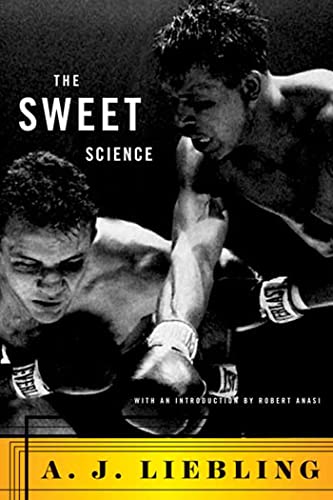
A.J. Liebling's classic New Yorker pieces on the "sweet science of bruising" bring vividly to life the boxing world as it once was.
The Sweet Science depicts the great events of boxing's American heyday: Sugar Ray Robinson's dramatic comeback, Rocky Marciano's rise to prominence, Joe Louis's unfortunate decline. Liebling never fails to find the human story behind the fight, and he evokes the atmosphere in the arena as distinctly as he does the goings-on in the ring--a combination that prompted Sports Illustrated to name The Sweet Science the best American sports book of all time.
Die Inhaltsangabe kann sich auf eine andere Ausgabe dieses Titels beziehen.
Über die Autorin bzw. den Autor
A. J. Liebling, born October 18, 1904, joined the staff of The New Yorker in 1935 and contributed innumerable articles before his death in 1963.
Auszug. © Genehmigter Nachdruck. Alle Rechte vorbehalten.
The Sweet Science
By A. J. LieblingNorth Point Press
Copyright © 2004 A. J. LieblingAll right reserved.
ISBN: 9780374272272
The Sweet Science
The Big Fellows
Boxing with the Naked Eye
Watching a fight on television has always seemed to me a poor substitute for being there. For one thing, you can't tell the fighters what to do. When I watch a fight, I like to study one boxer's problem, solve it, and then communicate my solution vocally. On occasion my advice is disregarded, as when I tell a man to stay away from the other fellow's left and he doesn't, but in such cases I assume that he hasn't heard my counsel, or that his opponent has, and has acted on it. Some fighters hear better and are more suggestible than others--for example, the pre-television Joe Louis. "Let him have it, Joe!" I would yell whenever I saw him fight, and sooner or later he would let the other fellow have it. Another fighter like that was the late Marcel Cerdan, whom I would coach in his own language, to prevent opposition seconds from picking up our signals. "Vas-y, Marcel!" I used to shout, and Marcel always y allait. I get a feeling of participation that way that I don't in front of a television screen. I could yell, of course, but I would know that if my suggestion was adopted, it would be by the merest coincidence.
Besides, when you go to a fight, the boxers aren't the only ones you want to be heard by. You are surrounded by people whose ignorance of the ring is exceeded only by their unwillingness to face facts--the sharpness of your boxer's punching, for instance. Such people may take it upon themselves to disparage theprincipal you are advising. This disparagement is less generally addressed to the man himself (as "Gavilan, you're a bum!") than to his opponent, whom they have wrong-headedly picked to win. ("He's a cream puff, Miceli!" they may typically cry. "He can't hurt you. He can't hurt nobody. Look--slaps! Ha, ha!") They thus get at your man--and, by indirection, at you. To put them in their place, you address neither them nor their man but your man. ("Get the other eye, Gavilan!" you cry.) This throws them off balance, because they haven't noticed anything the matter with either eye. Then, before they can think of anything to say, you thunder, "Look at that eye!" It doesn't much matter whether or not the man has been hit in the eye; he will be. Addressing yourself to the fighter when you want somebody else to hear you is a parliamentary device, like "Mr. Chairman ..." Before television, a prize-fight was to a New Yorker the nearest equivalent to the New England town meeting. It taught a man to think on his seat.
Less malignant than rooters for the wrong man, but almost as disquieting, are those who are on the right side but tactically unsound. At a moment when you have steered your boxer to a safe lead on points but can see the other fellow is still dangerous, one of these maniacs will encourage recklessness. "Finish the jerk, Harry!" he will sing out. "Stop holding him up! Don't lose him!" But you, knowing the enemy is a puncher, protect your client's interests. "Move to your left, Harry!" you call. "Keep moving! Keep moving! Don't let him set!" I sometimes finish a fight like that in a cold sweat.
If you go to a fight with a friend, you can keep up unilateral conversations on two vocal levels--one at the top of your voice, directed at your fighter, and the other a running expertise nominally aimed at your companion but loud enough to reach a modest fifteen feet in each direction. "Reminds me of Panama Al Brown," you may say as a new fighter enters the ring. "He wasfive feet eleven and weighed a hundred and eighteen pounds. This fellow may be about forty pounds heavier and a couple of inches shorter, but he's got the same kind of neck. I saw Brown box a fellow named Mascart in Paris in 1927. Guy stood up in the top gallery and threw an apple and hit Brown right on the top of the head. The whole house started yelling, 'Finish him, Mascart! He's groggy!'" Then, as the bout begins, "Boxes like Al, too, except this fellow's a southpaw." If he wins, you say, "I told you he reminded me of Al Brown," and if he loses, "Well, well, I guess he's no Al Brown. They don't make fighters like Al any more." This identifies you as a man who (a) has been in Paris, (b) has been going to fights for a long time, and (c) therefore enjoys what the fellows who write for quarterlies call a frame of reference.
It may be argued that this doesn't get you anywhere, but it at least constitutes what a man I once met named Thomas S. Matthews called communication. Mr. Matthews, who was the editor of Time, said that the most important thing in journalism is not reporting but communication. "What are you going to communicate?" I asked him. "The most important thing," he said, "is the man on one end of the circuit saying 'My God, I'm alive! You're alive!' and the fellow on the other end, receiving his message, saying 'My God, you're right! We're both alive!'" I still think it is a hell of a way to run a news magazine, but it is a good reason for going to fights in person. Television, if unchecked, may carry us back to a pre-tribal state of social development, when the family was the largest conversational unit.
Fights are also a great place for adding to your repertory of witty sayings. I shall not forget my adolescent delight when I first heard a fight fan yell, "I hope youse bot' gets knocked out!" I thought he had made it up, although I found out later it was a cliche. It is a formula adaptable to an endless variety of situations outside the ring. The only trouble with it is it neverworks out. The place where I first heard the line was Bill Brown's, a fight club in a big shed behind a trolley station in Far Rockaway.
On another night there, the time for the main bout arrived and one of the principals hadn't. The other fighter sat in the ring, a bantamweight with a face like a well-worn coin, and the fans stamped in cadence and whistled and yelled for their money back. It was thirty years before television, but there were only a couple of hundred men on hand. The preliminary fights had been terrible. The little fighter kept looking at his hands, which were resting on his knees in cracked boxing gloves, and every now and then he would spit on the mat and rub the spittle into the canvas with one of his scuffed ring shoes. The longer he waited, the more frequently he spat, and I presumed he was worrying about the money he was supposed to get; it wouldn't be more than fifty dollars with a house that size, even if the other man turned up. He had come there from some remote place like West or East New York, and he may have been thinking about the last train home on the Long Island Railroad, too. Finally, the other bantamweight got there, looking out of breath and flustered. He had lost his way on the railroad--changed to the wrong train at Jamaica and had to go back there and start over. The crowd booed so loud that he looked embarrassed. When the fight began, the fellow who had been waiting walked right into the new boy and knocked him down. He acted impatient. The tardy fellow got up and fought back gamely, but the one who had been waiting nailed him again, and the latecomer just about pulled up to one knee at the count of seven. He had been hit pretty hard, and you could see from his face that he was wondering whether to chuck it. Somebody in the crowd yelled out, "Hey, Hickey! You kept us all waiting! Why don't you stay around awhile?" So the fellow got up and caught for ten rounds...
„Über diesen Titel“ kann sich auf eine andere Ausgabe dieses Titels beziehen.
Suchergebnisse für The Sweet Science

Foto des Verkäufers
The Sweet Science
Anbieter: Zoom Books East, Glendale Heights, IL, USA
Verkäuferbewertung 5 von 5 Sternen

Zustand: good. Book is in good condition and may include underlining highlighting and minimal wear. The book can also include "From the library of" labels. May not contain miscellaneous items toys, dvds, etc. . We offer 100% money back guarantee and 24 7 customer service. Bestandsnummer des Verkäufers ZEV.0374272271.G
Gebraucht kaufen
EUR 4,84
Versand gratis
Versand innerhalb von USA
Versand innerhalb von USA
Anzahl: 1 verfügbar
Beispielbild für diese ISBN
The Sweet Science
Anbieter: World of Books (was SecondSale), Montgomery, IL, USA
Verkäuferbewertung 5 von 5 Sternen
Paperback. Zustand: Very Good. This collection of A. J. Liebling's classic New Yorker pieces on the sweet science of bruising brings vividly to life the boxing world as it once was. It depicts the great events of boxing's American heyday, including Sugar Ray Robinson's dramatic comeback, Rocky Marciano's rise to prominence, and Joe Louis's unfortunate decline. Liebling never fails to find the human story behind the fight, and he evokes the atmosphere in the arena as distinctly as he does the goings-on in the ring--a combination that prompted Sports Illustrated to name The Sweet Science the best American sports book of all time. Bestandsnummer des Verkäufers 00106095021
Gebraucht kaufen
EUR 5,07
Versand gratis
Versand innerhalb von USA
Versand innerhalb von USA
Anzahl: 2 verfügbar
Beispielbild für diese ISBN
The Sweet Science
Anbieter: World of Books (was SecondSale), Montgomery, IL, USA
Verkäuferbewertung 5 von 5 Sternen
Paperback. Zustand: Fair. This collection of A. J. Liebling's classic New Yorker pieces on the sweet science of bruising brings vividly to life the boxing world as it once was. It depicts the great events of boxing's American heyday, including Sugar Ray Robinson's dramatic comeback, Rocky Marciano's rise to prominence, and Joe Louis's unfortunate decline. Liebling never fails to find the human story behind the fight, and he evokes the atmosphere in the arena as distinctly as he does the goings-on in the ring--a combination that prompted Sports Illustrated to name The Sweet Science the best American sports book of all time. Bestandsnummer des Verkäufers 00110900383
Gebraucht kaufen
EUR 5,07
Versand gratis
Versand innerhalb von USA
Versand innerhalb von USA
Anzahl: 1 verfügbar
Foto des Verkäufers
The Sweet Science
Anbieter: Zoom Books Company, Lynden, WA, USA
Verkäuferbewertung 5 von 5 Sternen
Zustand: very_good. Book is in very good condition and may include minimal underlining highlighting. The book can also include "From the library of" labels. May not contain miscellaneous items toys, dvds, etc. . We offer 100% money back guarantee and 24 7 customer service. Bestandsnummer des Verkäufers ZBV.0374272271.VG
Gebraucht kaufen
EUR 5,08
Versand gratis
Versand innerhalb von USA
Versand innerhalb von USA
Anzahl: 1 verfügbar
Beispielbild für diese ISBN
The Sweet Science
Anbieter: Evergreen Goodwill, Seattle, WA, USA
Verkäuferbewertung 5 von 5 Sternen
paperback. Zustand: Good. Bestandsnummer des Verkäufers mon0000178299
Gebraucht kaufen
EUR 2,96
EUR 3,52 Versand
Versand innerhalb von USA
Versand innerhalb von USA
Anzahl: 1 verfügbar
Beispielbild für diese ISBN
The Sweet Science
Verlag:
North Point Press (edition First Edition), 2004
ISBN 10: 0374272271
ISBN 13: 9780374272272
Gebraucht
Paperback
Erstausgabe
Anbieter: BooksRun, Philadelphia, PA, USA
Verkäuferbewertung 5 von 5 Sternen
Paperback. Zustand: Fair. First Edition. The item might be beaten up but readable. May contain markings or highlighting, as well as stains, bent corners, or any other major defect, but the text is not obscured in any way. Bestandsnummer des Verkäufers 0374272271-7-18
Gebraucht kaufen
EUR 6,66
Versand gratis
Versand innerhalb von USA
Versand innerhalb von USA
Anzahl: 1 verfügbar
Beispielbild für diese ISBN
The Sweet Science
Anbieter: ThriftBooks-Dallas, Dallas, TX, USA
Verkäuferbewertung 5 von 5 Sternen
Paperback. Zustand: Fair. No Jacket. Readable copy. Pages may have considerable notes/highlighting. ~ ThriftBooks: Read More, Spend Less. Bestandsnummer des Verkäufers G0374272271I5N00
Gebraucht kaufen
EUR 6,76
Versand gratis
Versand innerhalb von USA
Versand innerhalb von USA
Anzahl: 1 verfügbar
Beispielbild für diese ISBN
The Sweet Science
Anbieter: ThriftBooks-Dallas, Dallas, TX, USA
Verkäuferbewertung 5 von 5 Sternen
Paperback. Zustand: Very Good. No Jacket. May have limited writing in cover pages. Pages are unmarked. ~ ThriftBooks: Read More, Spend Less. Bestandsnummer des Verkäufers G0374272271I4N00
Gebraucht kaufen
EUR 6,76
Versand gratis
Versand innerhalb von USA
Versand innerhalb von USA
Anzahl: 1 verfügbar
Beispielbild für diese ISBN
The Sweet Science
Anbieter: World of Books Inc, Montgomery, IL, USA
Verkäuferbewertung 4 von 5 Sternen

Paperback. Zustand: Good. This collection of A. J. Liebling's classic New Yorker pieces on the sweet science of bruising brings vividly to life the boxing world as it once was. It depicts the great events of boxing's American heyday, including Sugar Ray Robinson's dramatic comeback, Rocky Marciano's rise to prominence, and Joe Louis's unfortunate decline. Liebling never fails to find the human story behind the fight, and he evokes the atmosphere in the arena as distinctly as he does the goings-on in the ring--a combination that prompted Sports Illustrated to name The Sweet Science the best American sports book of all time. Bestandsnummer des Verkäufers CIN0374272271G
Gebraucht kaufen
EUR 6,89
Versand gratis
Versand innerhalb von USA
Versand innerhalb von USA
Anzahl: 5 verfügbar
Beispielbild für diese ISBN
The Sweet Science
Anbieter: World of Books Inc, Montgomery, IL, USA
Verkäuferbewertung 4 von 5 Sternen
Paperback. Zustand: Very Good. This collection of A. J. Liebling's classic New Yorker pieces on the sweet science of bruising brings vividly to life the boxing world as it once was. It depicts the great events of boxing's American heyday, including Sugar Ray Robinson's dramatic comeback, Rocky Marciano's rise to prominence, and Joe Louis's unfortunate decline. Liebling never fails to find the human story behind the fight, and he evokes the atmosphere in the arena as distinctly as he does the goings-on in the ring--a combination that prompted Sports Illustrated to name The Sweet Science the best American sports book of all time. Bestandsnummer des Verkäufers CIN0374272271VG
Gebraucht kaufen
EUR 6,89
Versand gratis
Versand innerhalb von USA
Versand innerhalb von USA
Anzahl: 2 verfügbar