
Verwandte Artikel zu John Kenneth Galbraith: His Life, His Politics, His...
Inhaltsangabe
The life and times of America’s most celebrated economist, assessing his lessons—and warnings—for us today
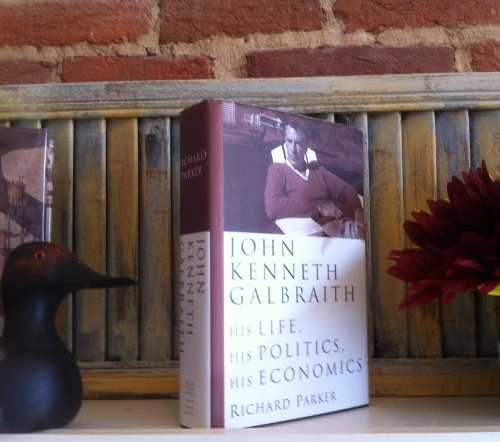
John Kenneth Galbraith’s books—among them The Affluent Society and American Capitalism—are famous for good reason. Written by a scholar renowned for energetic political engagement and irrepressible wit, they are models of provocative good sense that warn prophetically of the dangers of deregulated markets, war in Asia, corporate greed, and stock-market bubbles. Galbraith’s work has also deeply—and controversially—influenced his own profession, and in Richard Parker’s hands his biography becomes a vital reinterpretation of American economics and public policy.
Born and raised on a small Canadian farm, Galbraith began teaching at Harvard during the Depression. He was FDR’s “price czar” during the war and then a senior editor of Fortune before returning to Harvard and to fame as a bestselling writer. Parker shows how, from his early championing of Keynes to his acerbic analysis of America’s “private wealth and public squalor,” Galbraith regularly challenged prevailing theories and policies. And his account of Galbraith’s remarkable friendship with John F. Kennedy, whom he served as a close advisor while ambassador to India, is especially relevant for its analysis of the intense, dynamic debates that economists and politicians can have over how America should manage its wealth and power. This masterful chronicle gives color, depth, and meaning to the record of an extraordinary life.
John Kenneth Galbraith’s books—among them The Affluent Society and American Capitalism—are famous for good reason. Written by a scholar renowned for energetic political engagement and irrepressible wit, they are models of provocative good sense that warn prophetically of the dangers of deregulated markets, war in Asia, corporate greed, and stock-market bubbles. Galbraith’s work has also deeply—and controversially—influenced his own profession, and in Richard Parker’s hands his biography becomes a vital reinterpretation of American economics and public policy.
Born and raised on a small Canadian farm, Galbraith began teaching at Harvard during the Depression. He was FDR’s “price czar” during the war and then a senior editor of Fortune before returning to Harvard and to fame as a bestselling writer. Parker shows how, from his early championing of Keynes to his acerbic analysis of America’s “private wealth and public squalor,” Galbraith regularly challenged prevailing theories and policies. And his account of Galbraith’s remarkable friendship with John F. Kennedy, whom he served as a close advisor while ambassador to India, is especially relevant for its analysis of the intense, dynamic debates that economists and politicians can have over how America should manage its wealth and power. This masterful chronicle gives color, depth, and meaning to the record of an extraordinary life.
Die Inhaltsangabe kann sich auf eine andere Ausgabe dieses Titels beziehen.
Über die Autorin bzw. den Autor
Richard Parker, an Oxford-trained economist and senior fellow of the Shorenstein Center at Harvard’s Kennedy School of Government, writes extensively on economics and public policy. He lives in Cambridge, Massachusetts, with his wife and children.
Rezensionen
Perhaps only an elephant of a book could cover the life and thinking of so influential a figure as John Kenneth Galbraith (b. 1908). But this one goes too far. While Parker, an economist, writes with fluency and expert knowledge, he thinks it essential to write short histories of everything Galbraith was involved in. And that was much, starting with New Deal Washington, then the post-WWII Strategic Bombing Survey, Harvard, JFK's administration and an ambassadorship to India—and, always, liberal Democratic politics. Through it all, Galbraith poured out torrents of never dull writings, of which The Affluent Society best embodies his combination of fresh thought, political acuity and polemical skill. He took on academic and political orthodoxies to transform the way informed people think about the economy, institutions and social justice. Despite its length, Parker's biography is a model of clarity on these matters. The author, who is altogether sympathetic to his subject, never shrinks from offering others' tough, and his own measured, judgments. Galbraith emerges as highly appealing, a man of sparkling wit liked by most of his intellectual opponents and deprecated chiefly by his hard-boiled fellow economists. While they'll long debate his contributions to economics, there's no denying, as this book makes indelibly clear, that Galbraith, has been one of the major American lives of the 20th century. (Feb.)
Copyright © Reed Business Information, a division of Reed Elsevier Inc. All rights reserved.
John Kenneth Galbraith, now in his 97th year, has had an expansive career. Arguably America's best-known economist, as well as a former government official, journalist, public intellectual, presidential confidante, ambassador, antiwar activist and even a successful novelist, the outsized Galbraith surely deserves a biography almost as long as the one Richard Parker has written.
Readers whose patience will be tried by Parker's densely written 820-page tome will nonetheless appreciate the clarity and insight he brings to this portrait of the outsider as insider. For Galbraith's main contribution to politics as well as economics was to be a gadfly in tweed, skeptical of all authority and any system of fixed thought. Anyone too heavily invested in preserving the "conventional wisdom" -- a term he coined in his most famous work, The Affluent Society (1958) -- would feel the sting of his debunking, made more painful by the wit and elegance with which it was delivered. What's surprising in Parker's account is not that Galbraith had so many enemies across the ideological spectrum but that he was tolerated in high places for so long.
Galbraith's outsider stance derived partly from his background. Born into unpromising circumstances in rural Ontario, indifferently educated at a local agricultural school that he described as "not only the cheapest but probably the worst college in the English-speaking world," he escaped a potential future as a hog grader by winning a graduate fellowship in economics at Berkeley and then an instructorship at Harvard. There he collided with rigidly conservative professors whose faith in the market was ultimately theological rather than (as they imagined) scientific, and which not even the trauma of the Depression could shake.
Public service, in the New Deal and then as director of price control during World War II, gave Galbraith an understanding of real-world economic problems beyond that of most academics. Participation in the postwar U.S. Strategic Bombing Survey, in which he determined that neither enemy morale nor production was impeded by Allied bombing of German and Japanese cities, provided an education in the lengths to which powerful figures will go to ensure that their assumptions remain undisturbed by inconvenient truths. Confrontations with red-baiting politicians brought notoriety, while a string of bestsellers (Parker calculates that Galbraith's books have sold more than 7 million copies) propelled him to fame. As a much-interviewed public commentator, he was part of a cultured and cosmopolitan group of action-minded thinkers who briefly made intellect seem glamorous.
Harvard connections and experience as a speechwriter for Adlai Stevenson brought Galbraith into John F. Kennedy's inner circle and led to his appointment as ambassador to India in 1961. Despite his distance from Washington, he retained a direct connection to the president, who relished his spicily written cables; Galbraith once wrote to Kennedy that attempting to communicate through the State Department was "like trying to fornicate through a mattress." Galbraith was an early and prescient critic of U.S. involvement in Vietnam, and Parker argues persuasively that he moved Kennedy toward restraint in the Cold War as well as Keynesian economic policies at home. When Galbraith proved unable to moderate Lyndon B. Johnson's Vietnam adventurism, he metamorphosed into one of the most prominent "establishment" critics of the war.
Much of this story has been told by Galbraith himself in his journals and autobiography -- and in prose like brandy, where Parker's is more like cold water. What makes Parker's biography valuable, however, is his ability to place Galbraith in a sweeping and comprehensive history of the evolution of economic thought, and to keep sight of his subject's continuing relevance to the present day.
Parker, an economist at Harvard's Kennedy School of Government, points out that Galbraith has been looked down upon (figuratively if not literally) by most members of the economics profession for the past half-century. Nobel laureate Paul Samuelson, for example, described him as "America's foremost economist for non-economists." This reaction reflects not only jealousy but also professional pique over Galbraith's skepticism toward the mathematical modeling and equations that have come to define modern economics. But Galbraith knew that reality was messier than the clean and well-lit universe of the theorists. He battled not only with "rational expectations" conservatives but also with guns-and-butter Keynesian liberals, whose policies fostered the public squalor alongside private affluence that persists to this day.
Parker clearly means for Galbraith's example to inspire modern liberals. In 1953, when the energies of the New Deal had faded and Democrats were at nearly as low an ebb as they are today, Galbraith wrote to Stevenson to propose an initiative to "keep the Democratic Party intellectually alert and positive during these years in the wilderness." The subsequent success of Galbraith and his fellow thinkers in providing fresh ideas helped reinvigorate the party and led to a new era of liberal dominance.
Whether today's Democratic Party has the courage to bring independent intellectuals of Galbraith's stripe into positions of power remains to be seen. But the dominant conservatives ought to ponder Galbraith's warning: "The threat to men of great dignity, privilege and pretense is not from the radicals they revile; it is from accepting their own myth."
Reviewed by Geoffrey Kabaservice
Copyright 2005, The Washington Post Co. All Rights Reserved.
Parker is an economist, like his subject, and his biography of one of American liberalism's articulators imbibes most deeply from Galbraith's career. One of the two greatest influences on Galbraith's ideological outlook, Parker declares, was John Maynard Keynes' macroeconomic landmark The General Theory of Employment, Interest, and Money (1936), and the other was Galbraith's father, an agrarian populist in early 1900s Ontario. Galbraith has witnessed nearly a century of change, a span Parker traces in its public and personal dimensions. He departed Canada in 1931, and until his permanent arrival at Harvard in 1948, moved among jobs in academia, the U.S. government, and Fortune magazine. Quoting Galbraith's belief that the latter job turned him into a writer, Parker extensively paraphrases and excerpts from Galbraith's stable of best-sellers, which includes such classics as The Affluent Society (1958). Also covering Galbraith's involvement in Democratic Party politics, Parker's portrait of the urbane, ironic Galbraith and his fortunes as a liberal diagnostician of American economic problems is a stout biography that will be the standard for years. Gilbert Taylor
Copyright © American Library Association. All rights reserved
„Über diesen Titel“ kann sich auf eine andere Ausgabe dieses Titels beziehen.
Suchergebnisse für John Kenneth Galbraith: His Life, His Politics, His...

Beispielbild für diese ISBN
John Kenneth Galbraith: His Life, His Politics, His Economics
Verlag:
Farrar, Straus and Giroux, 2005
ISBN 10: 0374281688
ISBN 13: 9780374281687
Gebraucht
Hardcover
Anbieter: Orion Tech, Kingwood, TX, USA
Verkäuferbewertung 5 von 5 Sternen

hardcover. Zustand: Fair. Bestandsnummer des Verkäufers 0374281688-4-37769763
Gebraucht kaufen
EUR 5,38
Versand gratis
Versand innerhalb von USA
Versand innerhalb von USA
Anzahl: 1 verfügbar
Beispielbild für diese ISBN
John Kenneth Galbraith and the Making of American Economics: His Life, His Politics, His Economics
Anbieter: World of Books (was SecondSale), Montgomery, IL, USA
Verkäuferbewertung 5 von 5 Sternen
Hardback. Zustand: Fair. Bestandsnummer des Verkäufers 00103511295
Gebraucht kaufen
EUR 5,38
Versand gratis
Versand innerhalb von USA
Versand innerhalb von USA
Anzahl: 1 verfügbar
Beispielbild für diese ISBN
John Kenneth Galbraith and the Making of American Economics: His Life, His Politics, His Economics
Anbieter: World of Books (was SecondSale), Montgomery, IL, USA
Verkäuferbewertung 5 von 5 Sternen
Hardback. Zustand: Very Good. Bestandsnummer des Verkäufers 00110578401
Gebraucht kaufen
EUR 5,38
Versand gratis
Versand innerhalb von USA
Versand innerhalb von USA
Anzahl: 1 verfügbar
Beispielbild für diese ISBN
John Kenneth Galbraith: His Life, His Politics, His Economics
Verlag:
Farrar, Straus and Giroux, 2005
ISBN 10: 0374281688
ISBN 13: 9780374281687
Gebraucht
Hardcover
Anbieter: Open Books, Chicago, IL, USA
Verkäuferbewertung 5 von 5 Sternen
Hardcover. Zustand: Good. Open Books is a nonprofit social venture that provides literacy experiences for thousands of readers each year through inspiring programs and creative capitalization of books. Bestandsnummer des Verkäufers mon0000818772
Gebraucht kaufen
EUR 2,12
EUR 3,55 Versand
Versand innerhalb von USA
Versand innerhalb von USA
Anzahl: 1 verfügbar
Beispielbild für diese ISBN
John Kenneth Galbraith: His Life, His Politics, His Economics
Verlag:
Farrar, Straus and Giroux, 2005
ISBN 10: 0374281688
ISBN 13: 9780374281687
Gebraucht
Hardcover
Anbieter: HPB-Movies, Dallas, TX, USA
Verkäuferbewertung 5 von 5 Sternen
hardcover. Zustand: Very Good. Connecting readers with great books since 1972! Used books may not include companion materials, and may have some shelf wear or limited writing. We ship orders daily and Customer Service is our top priority! Bestandsnummer des Verkäufers S_471846151
Gebraucht kaufen
EUR 2,81
EUR 3,33 Versand
Versand innerhalb von USA
Versand innerhalb von USA
Anzahl: 1 verfügbar
Beispielbild für diese ISBN
John Kenneth Galbraith: His Life, His Politics, His Economics
Verlag:
Farrar, Straus and Giroux, 2005
ISBN 10: 0374281688
ISBN 13: 9780374281687
Gebraucht
Hardcover
Anbieter: ThriftBooks-Dallas, Dallas, TX, USA
Verkäuferbewertung 5 von 5 Sternen
Hardcover. Zustand: Very Good. No Jacket. May have limited writing in cover pages. Pages are unmarked. ~ ThriftBooks: Read More, Spend Less. Bestandsnummer des Verkäufers G0374281688I4N00
Gebraucht kaufen
EUR 6,46
Versand gratis
Versand innerhalb von USA
Versand innerhalb von USA
Anzahl: 1 verfügbar
Beispielbild für diese ISBN
John Kenneth Galbraith: His Life, His Politics, His Economics
Verlag:
Farrar, Straus and Giroux, 2005
ISBN 10: 0374281688
ISBN 13: 9780374281687
Gebraucht
Hardcover
Anbieter: ThriftBooks-Dallas, Dallas, TX, USA
Verkäuferbewertung 5 von 5 Sternen
Hardcover. Zustand: Fair. No Jacket. Former library book; Readable copy. Pages may have considerable notes/highlighting. ~ ThriftBooks: Read More, Spend Less. Bestandsnummer des Verkäufers G0374281688I5N10
Gebraucht kaufen
EUR 6,46
Versand gratis
Versand innerhalb von USA
Versand innerhalb von USA
Anzahl: 1 verfügbar
Beispielbild für diese ISBN
John Kenneth Galbraith : His Life, His Politics, His Economics
Verlag:
Farrar, Straus & Giroux, 2005
ISBN 10: 0374281688
ISBN 13: 9780374281687
Gebraucht
Hardcover
Anbieter: Better World Books, Mishawaka, IN, USA
Verkäuferbewertung 5 von 5 Sternen
Zustand: Good. Pages intact with minimal writing/highlighting. The binding may be loose and creased. Dust jackets/supplements are not included. Stock photo provided. Product includes identifying sticker. Better World Books: Buy Books. Do Good. Bestandsnummer des Verkäufers GRP14019543
Gebraucht kaufen
EUR 6,81
Versand gratis
Versand innerhalb von USA
Versand innerhalb von USA
Anzahl: 2 verfügbar
Beispielbild für diese ISBN
John Kenneth Galbraith : His Life, His Politics, His Economics
Verlag:
Farrar, Straus & Giroux, 2005
ISBN 10: 0374281688
ISBN 13: 9780374281687
Gebraucht
Hardcover
Anbieter: Better World Books, Mishawaka, IN, USA
Verkäuferbewertung 5 von 5 Sternen
Zustand: Good. Former library copy. Pages intact with minimal writing/highlighting. The binding may be loose and creased. Dust jackets/supplements are not included. Includes library markings. Stock photo provided. Product includes identifying sticker. Better World Books: Buy Books. Do Good. Bestandsnummer des Verkäufers GRP66318971
Gebraucht kaufen
EUR 6,81
Versand gratis
Versand innerhalb von USA
Versand innerhalb von USA
Anzahl: 1 verfügbar
Beispielbild für diese ISBN
John Kenneth Galbraith: His Life, His Politics, His Economics
Verlag:
Farrar, Straus and Giroux, 2005
ISBN 10: 0374281688
ISBN 13: 9780374281687
Gebraucht
Hardcover
Anbieter: HPB Inc., Dallas, TX, USA
Verkäuferbewertung 5 von 5 Sternen
hardcover. Zustand: Very Good. Connecting readers with great books since 1972! Used books may not include companion materials, and may have some shelf wear or limited writing. We ship orders daily and Customer Service is our top priority! Bestandsnummer des Verkäufers S_478559568
Gebraucht kaufen
EUR 3,56
EUR 3,33 Versand
Versand innerhalb von USA
Versand innerhalb von USA
Anzahl: 1 verfügbar