
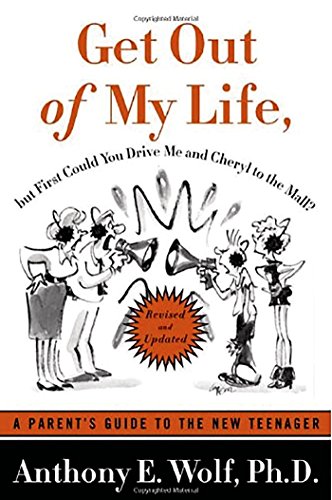
Get Out of My Life, But First Could You Drive Me & Cheryl to the Mall: A Parent's Guide to the New Teenager - Softcover
Inhaltsangabe
Beleaguered parents will breath sighs of relief and gratitude over this bestselling guide to raising teenagers. In this revised edition, Dr. Anthony E. Wolf tackles the changes in recent years with the same wit and compassion as the original edition.
Dr. Wolf points out that while the basic issues of adolescence and the relationships between parents and their children remain much the same, today's teenagers navigate a faster, less clearly anchored world. Wolf's revisions include a new chapter on the Internet, a significantly modified section on drugs and drinking, and an added piece on gay teenagers.
Die Inhaltsangabe kann sich auf eine andere Ausgabe dieses Titels beziehen.
Über die Autorin bzw. den Autor
Anthony E. Wolf, received his Ph.D. in Clinical Psychology from the City University of New York. For more than two decades he has been in private practice seeing children and adolescents in the Springfield, Massachusetts area. Married, Dr. Wolf is the father of two grown children. He has written several books on parenting, including Get Out of My Life, But First Could You Drive Me & Cheryl to the Mall?, and numerous articles, which have appeared in such magazines as Child Magazine, Parents, and Family Circle. He has also written a monthly column for Child Magazine.
Auszug. © Genehmigter Nachdruck. Alle Rechte vorbehalten.
Get Out of My Life, but First Could You Drive Me & Cheryl to the Mall
A Parent's Guide to the New TeenagerBy Anthony E. Wolf, Ph.D.Farrar, Straus and Giroux
Copyright © 2002 Anthony E. Wolf, Ph.D.All right reserved.
ISBN: 9780374528539
Get Out of My Life, But First Could You Drive Me and Cheryl to the Mall?
Part I
Adolescence
1 What Is Adolescence?
"Clarissa was so sweet. She always used to give me these cute little cards with hearts or smiley faces on them. They would say 'I love you, Mommy.' She was a treasure. She really was. I used to call her 'Mommy's little treasure.' And helpful around the house? She would always ask if there was anything she could do. I just don't understand what happened. She changed. And now she abuses me. She's a monster."
"Reuben and I always had a special relationship. We were very close. When he got home from school, he couldn't wait to tell me about his day, and he always wanted to show me his school papers. He was so proud of them. Sometimes he would sit in my lap, he wasn't embarrassed about it, and we would just talk. It was really very wonderful. But then he changed. Now he hates me. He can't stand to be around me. I can't touch him. I've lost him. I feel so awful, so rejected."
Adolescence is unlike any other period in life. Above all, it is a time of transformation. It is not a single event, but a number of major changes coming within a relatively short period. These changes turn nice little children into intimidating adolescents.
There are distinct differences between how boys and girls go through this traumatic period of their lives. Not all adolescent boys and girls behave in the ways described throughout this book, but there is no question that certain patterns of behavior are characteristic of each sex. And there are very real reasons why these patterns exist.
When does the process start? There is no clear beginning. Girls generally mature earlier than boys, both physically and emotionally; often they have most of the characteristics of adolescence by age twelve. Boys, on average, mature about a year later. But whenever the change begins, it will often seem rather sudden: one day a child, the next, something quite different.
With boys, the change may begin that first day when he combs his hair before going to school. With girls, it seems to happen on an otherwise uneventful day--a day that occurs with inexplicable frequency during February of the seventh grade. That's the day when Clarissa comes home from school and is asked to do something that in the past she has done quite willingly, even enthusiastically. But on this day--the first day of her adolescence--she turns to her parents and snaps, "Why are you always asking me to do it? You've got hands, too, you know."
Physical Changes
What are the changes of adolescence? The most obvious ones are physical. The kids get a lot bigger--not gradually, as they have been doing all along, but suddenly. The girls mature before boys, of course, so that an eighth-grade class offers the humorous spectacle of huge women walking side by side with little kids.
The bodies don't simply grow. They change. Girls, for whom the changes are probably more significant, take on a whole new shape. Their hips widen and their breasts develop. Boys develop more muscle, grow hair in new places, and confront a very different-looking set of genitals. When this physical maturation is finished, every child looks at him- or herself and does not see the same person who was there not long before.
Adolescence is the start of true sexuality. Girls menstruate. Boys produce sperm. Most important of all, both sexes begin to have sexual feelings. Prior to adolescence, during the period referred to as "latency," they had such feelings, but for the most part these were underground. Preteens do have some interest in sex and can engage in sexual activity, but it really is a low priority:
"Hey, wanna see the new series of 'Gross-out Cards'? They have a lady with worms coming out of her eye sockets."
"Yeah. Lemme see."
"Hey, kid, wanna see a picture of a naked lady?"
"Yeah, sure. Is it okay if I look at her later?"
With the dawning of adolescence, the naked lady pictures knock the Gross-out Cards into oblivion. The sexual feelings brought on by the biological changes of adolescence are unavoidable. Like it or not, here we are! And these feelings change everything. Suddenly the world has a whole new coloring. Previously a neutral canvas, it is now imbued with sexuality. And the way in which the new adolescent experiences it is changed forever.
Intellectual Changes
"Mom, Aunt Edith and Uncle Ralph are probably going to get a divorce, aren't they?"
"Where'd you hear that?"
"I didn't. I can just tell by the way you and Dad talk about them."
"Dad, Mrs. Williams is very insecure, isn't she?"
"What do you mean?"
"You know, the way she acts so phony all the time."
In addition to changes in sexuality, a less obvious but nonetheless very important change of adolescence is that thinking processes jump to a whole new level. Teenagers understand concepts and abstractions in a way they were not capable of before. They can participate in adult conversations (although they probably won't choose to). They can see the world through adult eyes (although they often refuse to). In short, the world of the adolescent is infinitely more complex than what he or she had known before.
The Major Change: Turning Away from Childhood
All kinds of changes, physical and intellectual, mark adolescence. But the hallmark of adolescence--the transformation that defines this period of life--is a psychological change. It is the adolescent mandate. A new and powerful voice rises inside of children. They must obey this voice and, in doing so, their lives change forever.
Simply put, the mandate tells the adolescent to turn away from childhood and childish feelings. Since childhood ismarked by the domination by parents, it follows that adolescents must turn away from their parents.
Before adolescence children were ... children, and they were free to act and feel as children. They could love their parents openly and depend on them. But with adolescence, a new force within dictates that teenagers must now experience themselves as independent, and able to exist on their own. No more can they feel close to or dependent upon their parents.
This mandate eliminates the wonderful security of childhood. Day-to-day living takes on a quality of desperation. The independent self of childhood, which had been content to develop a basic competence in such matters as tying shoes and riding a bicycle, and always with Mommy and Daddy as a safety net beneath it, now begins to assume for itself the full responsibility for survival. Life is no longer a game. It is for real. Yes, the world has become an exciting place, but in this new world adolescents feel much more exposed and therefore more vulnerable than ever before. Things can get scary, even terrifying, and perhaps overwhelming.
This turn toward independence, toward a...
„Über diesen Titel“ kann sich auf eine andere Ausgabe dieses Titels beziehen.
Weitere beliebte Ausgaben desselben Titels

Suchergebnisse für Get Out of My Life, But First Could You Drive Me &...

Beispielbild für diese ISBN
Get Out of My Life, but First Could You Drive Me & Cheryl to the Mall: A Parent's Guide to the New Teenager, Revised and Updated
Verlag:
Farrar, Straus and Giroux, 2002
ISBN 10: 0374528535
ISBN 13: 9780374528539
Gebraucht
Softcover
Anbieter: World of Books (was SecondSale), Montgomery, IL, USA
Verkäuferbewertung 5 von 5 Sternen

Zustand: Acceptable. Item in acceptable condition! Textbooks may not include supplemental items i.e. CDs, access codes etc. Bestandsnummer des Verkäufers 00106357584
Gebraucht kaufen
EUR 3,44
Versand gratis
Versand innerhalb von USA
Versand innerhalb von USA
Anzahl: 1 verfügbar
Beispielbild für diese ISBN
Get Out of My Life but First C
Verlag:
Farrar, Straus and Giroux, 2002
ISBN 10: 0374528535
ISBN 13: 9780374528539
Gebraucht
Softcover
Anbieter: World of Books (was SecondSale), Montgomery, IL, USA
Verkäuferbewertung 5 von 5 Sternen
Zustand: Good. Item in good condition. Textbooks may not include supplemental items i.e. CDs, access codes etc. Bestandsnummer des Verkäufers 00070372555
Gebraucht kaufen
EUR 3,65
Versand gratis
Versand innerhalb von USA
Versand innerhalb von USA
Anzahl: Mehr als 20 verfügbar
Beispielbild für diese ISBN
Get Out of My Life, but First Could You Drive Me & Cheryl to the Mall: A Parent's Guide to the New Teenager, Revised and Updated
Verlag:
Farrar, Straus and Giroux, 2002
ISBN 10: 0374528535
ISBN 13: 9780374528539
Gebraucht
Softcover
Anbieter: World of Books (was SecondSale), Montgomery, IL, USA
Verkäuferbewertung 5 von 5 Sternen
Zustand: Acceptable. Item in good condition. Textbooks may not include supplemental items i.e. CDs, access codes etc. Bestandsnummer des Verkäufers 00070381469
Gebraucht kaufen
EUR 3,65
Versand gratis
Versand innerhalb von USA
Versand innerhalb von USA
Anzahl: 1 verfügbar
Beispielbild für diese ISBN
Get Out of My Life, but First Could You Drive Me & Cheryl to the Mall: A Parent's Guide to the New Teenager, Revised and Updated
Verlag:
Farrar, Straus and Giroux, 2002
ISBN 10: 0374528535
ISBN 13: 9780374528539
Gebraucht
Softcover
Anbieter: World of Books (was SecondSale), Montgomery, IL, USA
Verkäuferbewertung 5 von 5 Sternen
Zustand: Very Good. Item in very good condition! Textbooks may not include supplemental items i.e. CDs, access codes etc. Bestandsnummer des Verkäufers 00106356033
Gebraucht kaufen
EUR 3,65
Versand gratis
Versand innerhalb von USA
Versand innerhalb von USA
Anzahl: 2 verfügbar
Beispielbild für diese ISBN
Get Out of My Life, but First Could You Drive Me & Cheryl to the Mall: A Parent's Guide to the New Teenager, Revised and Updated
Verlag:
Farrar, Straus and Giroux, 2002
ISBN 10: 0374528535
ISBN 13: 9780374528539
Gebraucht
Paperback
Anbieter: Your Online Bookstore, Houston, TX, USA
Verkäuferbewertung 5 von 5 Sternen
Paperback. Zustand: Good. Bestandsnummer des Verkäufers 0374528535-3-19478934
Gebraucht kaufen
EUR 3,66
Versand gratis
Versand innerhalb von USA
Versand innerhalb von USA
Anzahl: 8 verfügbar
Beispielbild für diese ISBN
Get Out of My Life, but First Could You Drive Me & Cheryl to the Mall: A Parent's Guide to the New Teenager, Revised and Updated
Verlag:
Farrar, Straus and Giroux, 2002
ISBN 10: 0374528535
ISBN 13: 9780374528539
Gebraucht
Paperback
Anbieter: Gulf Coast Books, Cypress, TX, USA
Verkäuferbewertung 5 von 5 Sternen
Paperback. Zustand: Fair. Bestandsnummer des Verkäufers 0374528535-4-20155027
Gebraucht kaufen
EUR 3,66
Versand gratis
Versand innerhalb von USA
Versand innerhalb von USA
Anzahl: 2 verfügbar
Beispielbild für diese ISBN
Get Out of My Life, but First Could You Drive Me & Cheryl to the Mall: A Parent's Guide to the New Teenager, Revised and Updated
Verlag:
Farrar, Straus and Giroux, 2002
ISBN 10: 0374528535
ISBN 13: 9780374528539
Gebraucht
Paperback
Anbieter: Orion Tech, Kingwood, TX, USA
Verkäuferbewertung 5 von 5 Sternen
Paperback. Zustand: Good. Bestandsnummer des Verkäufers 0374528535-3-23405914
Gebraucht kaufen
EUR 3,66
Versand gratis
Versand innerhalb von USA
Versand innerhalb von USA
Anzahl: 8 verfügbar
Beispielbild für diese ISBN
Get Out of My Life, but First Could You Drive Me & Cheryl to the Mall: A Parent's Guide to the New Teenager, Revised and Updated
Verlag:
Farrar, Straus and Giroux, 2002
ISBN 10: 0374528535
ISBN 13: 9780374528539
Gebraucht
Paperback
Anbieter: Orion Tech, Kingwood, TX, USA
Verkäuferbewertung 5 von 5 Sternen
Paperback. Zustand: Fair. Bestandsnummer des Verkäufers 0374528535-4-19708159
Gebraucht kaufen
EUR 3,66
Versand gratis
Versand innerhalb von USA
Versand innerhalb von USA
Anzahl: 1 verfügbar
Beispielbild für diese ISBN
Get Out of My Life, but First Could You Drive Me & Cheryl to the Mall: A Parent's Guide to the New Teenager, Revised and Updated
Verlag:
Farrar, Straus and Giroux, 2002
ISBN 10: 0374528535
ISBN 13: 9780374528539
Gebraucht
Paperback
Anbieter: Gulf Coast Books, Cypress, TX, USA
Verkäuferbewertung 5 von 5 Sternen
Paperback. Zustand: Good. Bestandsnummer des Verkäufers 0374528535-3-20210360
Gebraucht kaufen
EUR 3,66
Versand gratis
Versand innerhalb von USA
Versand innerhalb von USA
Anzahl: 6 verfügbar
Beispielbild für diese ISBN
Get Out of My Life, but First Could You Drive Me & Cheryl to the Mall: A Parent's Guide to the New Teenager, Revised and Updated
Verlag:
Farrar, Straus and Giroux, 2002
ISBN 10: 0374528535
ISBN 13: 9780374528539
Gebraucht
Paperback
Anbieter: Your Online Bookstore, Houston, TX, USA
Verkäuferbewertung 5 von 5 Sternen
Paperback. Zustand: Fair. Bestandsnummer des Verkäufers 0374528535-4-22742904
Gebraucht kaufen
EUR 3,66
Versand gratis
Versand innerhalb von USA
Versand innerhalb von USA
Anzahl: 3 verfügbar