
Verwandte Artikel zu Prodigal: A Poem
Inhaltsangabe
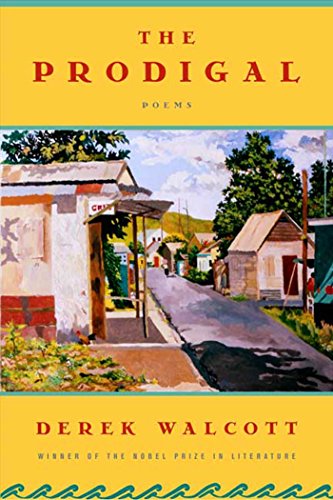
Nobel Laureate Derek Walcott's The Prodigal is a journey through physical and mental landscapes, from Greenwich Village to the Alps, Pescara to Milan, Germany to Cartagena.
But always in "the music of memory, water," abides St. Lucia, the author's birthplace, and the living sea. In this book of poems, Derek Walcott has created a sweeping yet intimate epic of an exhausted Europe studded with church spires and mountains, train stations and statuary, where the New World is an idea, a "wavering map," and where History subsumes the natural history of his "unimportantly beautiful" island home. Here, the wanderer fears that he has been tainted by his exile, that his life has become untranslatable, and that his craft itself is rooted in betrayal of the vivid archipelago to which, like Antaeus, he must return for the very sustenance of life.
Die Inhaltsangabe kann sich auf eine andere Ausgabe dieses Titels beziehen.
Über die Autorin bzw. den Autor
Derek Walcott (1930-2017) was born in St. Lucia, the West Indies, in 1930. His Collected Poems: 1948-1984 was published in 1986, and his subsequent works include a book-length poem, Omeros (1990); a collection of verse, The Bounty (1997); and, in an edition illustrated with his own paintings, the long poem Tiepolo's Hound (2000). His numerous plays include The Haitian Trilogy (2001) and Walker and The Ghost Dance (2002). Walcott received the Queen's Medal for Poetry in 1988 and the Nobel Prize in Literature in 1992.
Auszug. © Genehmigter Nachdruck. Alle Rechte vorbehalten.
The Prodigal
By Derek WalcottFarrar Straus Giroux
Copyright © 2006 Derek WalcottAll right reserved.
ISBN: 9780374530167
Chapter One
I In autumn, on the train to Pennsylvania, he placed his book face-down on the sunlit seat and it began to move. Metre established, carried on calm parallels, he preferred to read the paragraphs, the gliding blocks of stanzas framed by the widening windows-Italian light on the factories, October's motley in Jersey, wild fans of trees, the blue metallic Hudson, and in the turning aureate afternoon, dusk on rose brickwork as if it were Siena. Nothing. Nobody at the small railroad station. The willows fan open. Here we hung our harps, as the river slid past to elegiac banjos and the barge crawled along an ochre canal past the white spires of autumnal towns and racketing freight trains all long whoop and echo. Stations, bridges and tunnels enter their language and the scribble of brown twigs on a blank sky. And now the cars began to fill with pilgrims, while the book slept. With others in the car, he felt as if he had become a tunnel through which they entered the idea of America-familiar mantling through the tunnel's skin. It was still unfamiliar, the staidness of trains. And the thoughtful, the separate, gliding in cars on arrowing rails serenely, each gripped face intent on the puzzle of distance, as stations pass without waving, and sad, approaching cities, announced by the prologue of ramshackle yards and toothless tunnels, and the foliage rusting across an old aqueduct, loomed and then dwindled into their name. There were no stations or receding platforms in the maps of childhood nor blizzards of dogwood, no piercing steeples from buttressed cathedrals, nor statues whose base held dolphins, blunt browed, repeating themselves. Look at that man looking from the stalled window-he contains many absences. He has ridden over infinite bridges, some with roofs below, many where the afternoon glittered like mica on the empty river. There was no time to fall in love with Florence, to completely understand Wilmington or the rusty stanchions that flashed past with their cables or how the screaming gulls knew the names of all the women he had lost. There was sweet meditation on a train even of certain griefs, a gliding time on the levelled surface of elegiac earth more than the immortal motion of a blue bay next to the stone sails of graves, his growing loss. Echoing railway stations drew him to fiction, their web of schedules, incoherent announcements, the terror of missing his train, and because trains (their casual accuracy, the joy in their gliding power) had (there were no trains on the islands of his young manhood) a child's delight in motion, the lines and parallels and smoky arches of unread famous novels would stay the same for yet another fall with its bright counties, he knew, through the gliding window, the trees would lift in lament for all the leaves of the unread books, Anna Karenina, for the long wail of smoke across Alpine meadows, for soldiers leaning out of war-crowded stations, a separate joy more rooted in landscapes than the flare of battles. In the middle of the nineteenth century, somewhere between Balzac and Lautriamont, a little farther on than Baudelaire Station where bead-eyed Verlaine sat, my train broke down, and has been stuck there since. When I got off I found that I had missed the Twentieth Century. I studied those small things which besieged the station, the comical belligerence of dragonflies and the perpetual astonishment of owls. It was another country whose time had passed, with pastoral willows and a belief in drawing. I saw where Courbet lived; I saw the big quarry and the lemon light of Jean-Baptiste Camille Corot. The noise of roaring parliaments, a noise that sounded like the ocean, whorled in my ear-shell, was far, and the one sibilance was of the poplars who once bowed to Hobbema. My joy was stuck. The small station was empty in the afternoon, as it had been on the trip to Philadelphia. I sipped the long delight of a past time where ambition was too late. My craft was stuck. My deep delight lay in being dated like the archaic engine. Peace was immense. But Time passed differently than it did on water. II There is a continent outside my window, in the Hudson's patient narrative. There's some calm. But traffic hurtles up the West Side Highway, and in fall, the embankment blazes, but even in spring sunlight I have rarely sought the glittering consolation of the river, its far-fetched history, the tongues of unknown trees talk to an old man sitting on a bench. Along the smouldering autumnal sidewalks, the secretive coffee-shops, bright flower stalls, wandering the Village in search of another subject other than yourself, it is yourself you meet. An old man remembering white-headed mountains. And subtly the sense insinuates itself that frequent exile turns into treachery, missing the seasons at the table of July on lower Seventh Avenue when young women glide like Nereids in their lissome summer dresses, all those Susannas for a single elder! In spring the leaves sing round a tireless statue who will not sit although invited to. From a fresh- to a salt-water muse. Home to the Hudson. The bells on a bright Sunday from my bed, the squares of sunlight on the buildings opposite the river slate, the sky cloudless, enamelled. Then Sunday brings its summary of the world, with the serene Hudson and its criss-crossing ferries, great clouds and a red barge. Gaze, graze on the numinous greys of the river, its spectral traffic and the ghostly bridges, the bouquet of lamps, along the embankment your name fades into fog. Clouds, the sag of old towels, sodden in grey windows, the far shore scumbled by the fog, ducks bob on the grey river like decoys, not ducks but the submerged pieces of an old pier, lights fade from the water, "Such, such were the joys," muffled remorse in the December air. III Desire and disease commingling, commingling, the white hair and the white page with the fear of white sight, blindness, amputation, a recurring kidney stone, the plague of AIDS, shaken in the mirror by that bewildered look, the truculence, the drooping lip of a spiritual lout. Look at it any way you like, it's an old man's book whenever you write it, whenever it comes out, the age in your armpits in the pleats of your crotch, the faded perfumes of cherished conversations, and the toilet gurgling its eclogues, resurrecting names in its hoarse swivelling into an echo after. This is the music of memory, water. IV On Mondays, Boston classes. Lunch, a Korean corner-my glasses clouded by a tribal broth, a soup that tamed shaggy Mongolian horsemen in steaming tents while their mares stamped the snow. Asia swirls in a blizzard; winter is rising on drifts across the pavements, soon every gutter will be a locked rivulet then it will be time for rose and orange lights to dot the Prudential, and sparrows to bulb along the stricken branches. I missed the fall. It went with a sudden flare and blew its wick in Gloucester, sank in Salem, and bleached the salt grass bending off Cape Ann, flipped seals into the...„Über diesen Titel“ kann sich auf eine andere Ausgabe dieses Titels beziehen.
Suchergebnisse für Prodigal: A Poem

Foto des Verkäufers
The Prodigal: A Poem
Verlag:
Farrar, Straus and Giroux, 2006
ISBN 10: 0374530165
ISBN 13: 9780374530167
Gebraucht
Softcover
Anbieter: Bay State Book Company, North Smithfield, RI, USA
Verkäuferbewertung 5 von 5 Sternen

Zustand: very_good. Bestandsnummer des Verkäufers BSM.17WKV
Gebraucht kaufen
EUR 4,48
Versand gratis
Versand innerhalb von USA
Versand innerhalb von USA
Anzahl: 1 verfügbar
Beispielbild für diese ISBN
The Prodigal: A Poem
Verlag:
Farrar, Straus and Giroux, 2006
ISBN 10: 0374530165
ISBN 13: 9780374530167
Gebraucht
paperback
Anbieter: Evergreen Goodwill, Seattle, WA, USA
Verkäuferbewertung 5 von 5 Sternen
paperback. Zustand: Good. Bestandsnummer des Verkäufers mon0000531992
Gebraucht kaufen
EUR 1,45
EUR 3,51 Versand
Versand innerhalb von USA
Versand innerhalb von USA
Anzahl: 1 verfügbar
Beispielbild für diese ISBN
The Prodigal: A Poem
Verlag:
Farrar, Straus and Giroux, 2006
ISBN 10: 0374530165
ISBN 13: 9780374530167
Gebraucht
Paperback
Anbieter: ThriftBooks-Atlanta, AUSTELL, GA, USA
Verkäuferbewertung 5 von 5 Sternen
Paperback. Zustand: Very Good. No Jacket. Former library book; May have limited writing in cover pages. Pages are unmarked. ~ ThriftBooks: Read More, Spend Less. Bestandsnummer des Verkäufers G0374530165I4N10
Gebraucht kaufen
EUR 6,10
Versand gratis
Versand innerhalb von USA
Versand innerhalb von USA
Anzahl: 1 verfügbar
Beispielbild für diese ISBN
The Prodigal: A Poem
Verlag:
Farrar, Straus and Giroux, 2006
ISBN 10: 0374530165
ISBN 13: 9780374530167
Gebraucht
Paperback
Anbieter: ThriftBooks-Dallas, Dallas, TX, USA
Verkäuferbewertung 5 von 5 Sternen
Paperback. Zustand: Good. No Jacket. Pages can have notes/highlighting. Spine may show signs of wear. ~ ThriftBooks: Read More, Spend Less. Bestandsnummer des Verkäufers G0374530165I3N00
Gebraucht kaufen
EUR 6,10
Versand gratis
Versand innerhalb von USA
Versand innerhalb von USA
Anzahl: 1 verfügbar
Beispielbild für diese ISBN
The Prodigal: A Poem
Verlag:
Farrar, Straus and Giroux, 2006
ISBN 10: 0374530165
ISBN 13: 9780374530167
Gebraucht
paperback
Anbieter: Open Books, Chicago, IL, USA
Verkäuferbewertung 5 von 5 Sternen
paperback. Zustand: Very Good. Open Books is a nonprofit social venture that provides literacy experiences for thousands of readers each year through inspiring programs and creative capitalization of books. Bestandsnummer des Verkäufers mon0000850563
Gebraucht kaufen
EUR 2,66
EUR 3,51 Versand
Versand innerhalb von USA
Versand innerhalb von USA
Anzahl: 1 verfügbar
Beispielbild für diese ISBN
The Prodigal: A Poem
Verlag:
Farrar, Straus and Giroux, 2006
ISBN 10: 0374530165
ISBN 13: 9780374530167
Gebraucht
paperback
Anbieter: HPB Inc., Dallas, TX, USA
Verkäuferbewertung 5 von 5 Sternen
paperback. Zustand: Very Good. Connecting readers with great books since 1972! Used books may not include companion materials, and may have some shelf wear or limited writing. We ship orders daily and Customer Service is our top priority! Bestandsnummer des Verkäufers S_447119614
Gebraucht kaufen
EUR 2,93
EUR 3,29 Versand
Versand innerhalb von USA
Versand innerhalb von USA
Anzahl: 1 verfügbar
Beispielbild für diese ISBN
The Prodigal: A Poem
Verlag:
Farrar, Straus and Giroux, 2006
ISBN 10: 0374530165
ISBN 13: 9780374530167
Gebraucht
paperback
Anbieter: HPB-Emerald, Dallas, TX, USA
Verkäuferbewertung 5 von 5 Sternen
paperback. Zustand: Very Good. Connecting readers with great books since 1972! Used books may not include companion materials, and may have some shelf wear or limited writing. We ship orders daily and Customer Service is our top priority! Bestandsnummer des Verkäufers S_473261249
Gebraucht kaufen
EUR 2,94
EUR 3,29 Versand
Versand innerhalb von USA
Versand innerhalb von USA
Anzahl: 1 verfügbar
Foto des Verkäufers
The Prodigal; A Poem
Verlag:
Farrar, Straus and Giroux, New York, NY, 2006
ISBN 10: 0374530165
ISBN 13: 9780374530167
Gebraucht
Paperback
Erstausgabe
Anbieter: True Oak Books, Highland, NY, USA
Verkäuferbewertung 5 von 5 Sternen
Paperback. Zustand: Good. First Paperback Edition; First Printing. 105 pages; minor pen markings on a few pages. Minor creasing on spine. Few minor, faint stains on the covers and on the fore-edge of textblock. Good condition otherwise. No other noteworthy defects.; - Your satisfaction is our priority. We offer free returns and respond promptly to all inquiries. Your item will be packaged with care and ship on the same or next business day. Buy with confidence. Bestandsnummer des Verkäufers HVD-75880-A-0
Gebraucht kaufen
EUR 12,63
Versand gratis
Versand innerhalb von USA
Versand innerhalb von USA
Anzahl: 1 verfügbar
Foto des Verkäufers
The Prodigal A Poem
Verlag:
Farrar, Straus and Giroux, 2006
ISBN 10: 0374530165
ISBN 13: 9780374530167
Gebraucht
Paperback
Anbieter: True Oak Books, Highland, NY, USA
Verkäuferbewertung 5 von 5 Sternen
Paperback. Zustand: Very Good-. 5.74 X 0.28 X 210.31 inches; 112 pages; Very light foxing to exterior edge of pages only. Great overall condition. Minor cosmetic wear. No noteworthy blemishes. No writing.; - We offer free returns for any reason and respond promptly to all inquiries. Your order will be packaged with care and ship on the same or next business day. Buy with confidence. Bestandsnummer des Verkäufers HVD-29155-A-0
Gebraucht kaufen
EUR 12,63
Versand gratis
Versand innerhalb von USA
Versand innerhalb von USA
Anzahl: 1 verfügbar
Beispielbild für diese ISBN
The Prodigal: A Poem
Verlag:
Farrar, Straus and Giroux, 2006
ISBN 10: 0374530165
ISBN 13: 9780374530167
Gebraucht
paperback
Erstausgabe
Anbieter: Textbooks_Source, Columbia, MO, USA
Verkäuferbewertung 5 von 5 Sternen
paperback. Zustand: Good. First Edition. Ships in a BOX from Central Missouri! May not include working access code. Will not include dust jacket. Has used sticker(s) and some writing or highlighting. UPS shipping for most packages, (Priority Mail for AK/HI/APO/PO Boxes). Bestandsnummer des Verkäufers 000792834U
Gebraucht kaufen
EUR 9,56
EUR 3,51 Versand
Versand innerhalb von USA
Versand innerhalb von USA
Anzahl: 3 verfügbar