
Verwandte Artikel zu The Poetry of Rilke
Inhaltsangabe
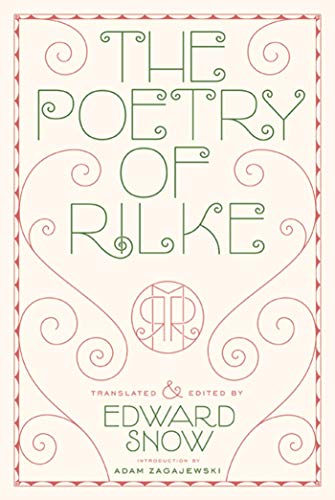
For the past twenty-five years, North Point Press has been working with Edward Snow, "Rilke's best contemporary translator" (Brian Phillips, The New Republic), to bring into English Rilke's major poetic works. The Poetry of Rilke—the single most comprehensive volume of Rilke's German poetry ever to be published in English—is the culmination of this effort. With more than two hundred and fifty selected poems by Rilke, including complete translations of the Sonnets to Orpheus and the Duino Elegies, The Poetry of Rilke spans the arc of Rilke's work, from the breakthrough poems of The Book of Hours to the visionary masterpieces written only weeks before his death. This landmark bilingual edition also contains all of Snow's commentaries on Rilke, as well as an important new introduction by the award-winning poet Adam Zagajewski. The Poetry of Rilke will stand as the authoritative single-volume translation of Rilke into English for years to come.
Die Inhaltsangabe kann sich auf eine andere Ausgabe dieses Titels beziehen.
Über die Autorinnen und Autoren
Rainer Maria Rilke was born in Prague in 1875 and traveled throughout Europe for much of his adult life, returning frequently to Paris. His last years were spent in Switzerland, where he completed his two poetic masterworks, the Duino Elegies and the Sonnets to Orpheus. He died of leukemia in December 1926.
Edward Snow is a professor of English at Rice University. He is the recipient of an American Academy of Arts and Letters Award for his Rilke translations and has twice received the Academy of American Poets' Harold Morton Landon Translation Award.
Rainer Maria Rilke was born in Prague in 1875 and traveled throughout Europe for much of his adult life, returning frequently to Paris. His last years were spent in Switzerland, where he completed his two poetic masterworks, the Duino Elegies and the Sonnets to Orpheus. He died of leukemia in December 1926.
Edward Snow is a professor of English at Rice University. He is the recipient of an American Academy of Arts and Letters Award for his Rilke translations and has twice received the Academy of American Poets' Harold Morton Landon Translation Award.
Auszug. © Genehmigter Nachdruck. Alle Rechte vorbehalten.
The Poetry of Rilke
Bilingual EditionBy Rilke, Rainer MariaNorth Point Press
Copyright © 2011 Rilke, Rainer MariaAll right reserved.
ISBN: 9780374532710
Introduction
Rereading Rilke by Adam Zagajewski
We read Rilke for his poetry, for his prose, for his novel The Notebooks of Malte Laurids Brigge, and for hundreds if not thousands of the letters he left, but there seems to be another important motive too: in our eyes his life presents itself as a .awless example of a modern artist’s existence, an example purer perhaps than any other, perfect in its relentless pursuit of beauty.
In the German literary tradition it is Johann Wolfgang von Goethe who enjoyed for a very long time the status not only of an immense poet, playwright, and novelist but also of a sublime role model, an ideal human being, highly successful yet knowing the price of resignation, standing in the middle of a bourgeois society that had just rediscovered the value of intellectual accomplishment; Goethe, who happily accepted the position of someone who represented more than just his own singular destiny, graciously allowing others?through the numerous windows of his letters, diaries, and conversations?to have a look at him in his different hours and moods; Goethe, the scion of a patrician Frankfurt family, who as a young man became a minister at the Weimar court and a scientist entertaining each night in his lovely house on Frauenplan visitors from every imaginable country, explaining to them secrets of geology, biology, and literature?someone Napoleon would wish to meet and, as we know, did meet. Goethe, who renewed the German imagination even as he remained skeptical of the newborn nationalism of his compatriots during the Napoleonic Wars; Goethe, who was proud of his long life and didn’t stop short of mocking others for dying too early; Goethe, a poet and thinker whose spiritual territory was so vast that it encompassed many elements of the Enlightenment but also involved vital ingredients of the Romantic era; and .nally, Goethe, who knew well the silence of the writer’s study but who also witnessed in 1792the misery of premodern warfare in the mud, hunger, and hopelessness of an unsuccessful military campaign?not as a soldier but as an observer sharing the misery of others.
And then, next to this giant, Rainer Maria Rilke?a dif.dent, homeless poet born on the periphery of the Habsburg Empire, an artist who had to invent his own pedigree, who claimed an aristocratic lineage?the claim seems rather doubtful?an introvert, a lover of solitude, someone who, especially in his later years, didn’t care much for publishing and remained until the end of his short life famous only among a rather small group of connoisseurs. Never a minister like Goethe, never a senator like Yeats, never an ambassador like Saint-John Perse. Yes, he enjoyed the company of aristocrats, but not at any court; he’d only see them as private persons, gladly when they were set against the background of their natural environment, their castles and palaces: they were for him colorful relics of a more or less imaginary medieval Europe. The fact that Duino Castle?its name is forever linked to Rilke’s poetry?which belonged to the Thurn und Taxis family, was destroyed in World War I (though later rebuilt) is symptomatic: the aristocrats Rilke knew were the shadows of once powerful magnates. None of the in.uential politicians of his time would have thought of meeting him. Clemenceau and Rilke? Lloyd George and Rilke? Lenin and Rilke? No, impossible, ridiculous: a joke. Paul Valéry? Yes, that makes sense; the two poets met and their meeting left a trace, a well-known photograph (but also and foremost Rilke’s translations of Valéry’s poetry).
What is so attractive for us in Rilke’s symbolic status has almost nothing to do with the external circumstances of the period. Unlike Goethe, Rilke was not a robust representative of his epoch; he seemed to be, rather, an elegant question mark on the margin of history. Within the spectrum of literary modernism he stood among the antimoderns (in the sense of being hostile to many characteristics of the newly born industrial civilization), though he didn’t care to develop his ideas in any coherent way. He was a poet, not a philosophical journalist, after all. He was like the Chopin of Gottfried Benn’s marvelous poem: ?when Delacroix propounded theories / he grew restless, for his part he could not / explain the Nocturnes.”
It is his inner discipline, the discipline of his life, the sacri.ces he made, that appeal to us. We cherish a certain intriguing narrowness of his external existence, which we can see and contemplate like an arrow ferociously speeding to its ultimate target: Rilke ’s poetic work. We believe we can see his rich inner life through the veil of his writings. If anything, Rilke was the epoch’s secret voice, we think, the epoch’s whisper, as opposed to its of.cial expression. This, we think sometimes, is how his time should have been: not the absurd, terrifying killing .elds of Verdun but the tranquillity of the poet’s meditation in the midst of a great city or an Alpine meadow. His life spent in travels, his life as a search for the .nal illumination, fascinates us, but also his willingness to learn from Rodin and Cézanne and, later, to teach a young poet what poetry is about. We like to imagine lonely Rilke in Toledo or in Ronda in Spain, or think of him in Rome or in Cairo?and we always remember that from each of these travels he would bring with him a few pebbles we later .nd in the splendid mosaic of the Duino Elegies.
A lonely person he was, and yet not a stranger to social life. An incredibly proli.c letter writer, he once told Merline?the nickname of Baladine Klossowska, the mother of Balthus?that he had to write 115 letters to make up for a backlog in his correspondence! These letters are extremely interesting, mostly written with the brio of the major artist he was, and should be seen as an important part of his oeuvre (as, for example, in the case of Elizabeth Bishop’s letters).
The most mesmerizing part of this biography is Rilke’s iron-willed waiting for the Duino Elegies to arrive, to visit his poetic mind. This is perhaps a unique case in the history of literature: a major poet who expected a certain poem for a long time?not any ?great poem” but a particular one?apprehending its very nature, just not receiving it yet. We, the latecomers, know that the .rst four of the ten elegies were written between 1912 and 1914 and that he had to wait eight years for the rest of them. In this perspective, World War I can be regarded as just a very unpleasant nuisance that kept the poems from coming?which, by the way, is how Rilke himself often felt about the Great War. He didn’t just wait?later, after the war was over and new possibilities opened up for him, he would, with some help from his friends, more or less actively look for a house, a tower, a quiet place on the planet in which to receive the Angel’s message. For this he eventually chose Switzerland, one of the very few European countries not dis.gured by the scars of trenches. The Duino Elegies, as we know, did eventually arrive and gave a glorious meaning to his entire pilgrimage, to his waiting, to his procrastinating, to his moving from one villa to another, to his patience. They gave Rilke’s life the shape of a...
„Über diesen Titel“ kann sich auf eine andere Ausgabe dieses Titels beziehen.
Suchergebnisse für The Poetry of Rilke

Foto des Verkäufers
The Poetry of Rilke
Anbieter: Goodwill Industries, Spokane, WA, USA
Verkäuferbewertung 5 von 5 Sternen

Zustand: good. Condition: Good â" Used book with some visible wear. May include stickers on the cover, wear or absence of the dust jacket, wear to the spine or inside cover, slight corner curling, minor staining, and wear along the fore edge. All orders are shipped via UPS Mail Innovations and may take up to 10 business days from the initial scan to be delivered. Bestandsnummer des Verkäufers INWV.0374532710.G
Gebraucht kaufen
EUR 11,48
EUR 3,55 Versand
Versand innerhalb von USA
Versand innerhalb von USA
Anzahl: 1 verfügbar
Beispielbild für diese ISBN
Poetry of Rilke
Anbieter: World of Books (was SecondSale), Montgomery, IL, USA
Verkäuferbewertung 5 von 5 Sternen
Paperback. Zustand: Good. For the past twenty-five years, North Point Press has been working with Edward Snow, "Rilke's best contemporary translator" (Brian Phillips, The New Republic), to bring into English Rilke's major poetic works. The Poetry of Rilke--the single most comprehensive volume of Rilke's German poetry ever to be published in English--is the culmination of this effort. With more than two hundred and fifty selected poems by Rilke, including complete translations of the Sonnets to Orpheus and the Duino Elegies, The Poetry of Rilke spans the arc of Rilke's work, from the breakthrough poems of The Book of Hours to the visionary masterpieces written only weeks before his death. This landmark bilingual edition also contains all of Snow's commentaries on Rilke, as well as an important new introduction by the award-winning poet Adam Zagajewski. The Poetry of Rilke will stand as the authoritative single-volume translation of Rilke into English for years to come. Bestandsnummer des Verkäufers 00110029614
Gebraucht kaufen
EUR 16,79
Versand gratis
Versand innerhalb von USA
Versand innerhalb von USA
Anzahl: 1 verfügbar
Beispielbild für diese ISBN
The Poetry of Rilke
Anbieter: Symposia Community Bookstore INC, Hoboken, NJ, USA
Verkäuferbewertung 5 von 5 Sternen
paperback. Zustand: New. Brand new. Bestandsnummer des Verkäufers 260920132
Neu kaufen
EUR 14,01
EUR 4,45 Versand
Versand innerhalb von USA
Versand innerhalb von USA
Anzahl: 1 verfügbar
Beispielbild für diese ISBN
Poetry of Rilke
Anbieter: World of Books Inc, Montgomery, IL, USA
Verkäuferbewertung 4 von 5 Sternen

Paperback. Zustand: Good. For the past twenty-five years, North Point Press has been working with Edward Snow, "Rilke's best contemporary translator" (Brian Phillips, The New Republic), to bring into English Rilke's major poetic works. The Poetry of Rilke--the single most comprehensive volume of Rilke's German poetry ever to be published in English--is the culmination of this effort. With more than two hundred and fifty selected poems by Rilke, including complete translations of the Sonnets to Orpheus and the Duino Elegies, The Poetry of Rilke spans the arc of Rilke's work, from the breakthrough poems of The Book of Hours to the visionary masterpieces written only weeks before his death. This landmark bilingual edition also contains all of Snow's commentaries on Rilke, as well as an important new introduction by the award-winning poet Adam Zagajewski. The Poetry of Rilke will stand as the authoritative single-volume translation of Rilke into English for years to come. Bestandsnummer des Verkäufers CIN0374532710G
Gebraucht kaufen
EUR 18,62
Versand gratis
Versand innerhalb von USA
Versand innerhalb von USA
Anzahl: 1 verfügbar
Beispielbild für diese ISBN
The Poetry of Rilke
Anbieter: Lakeside Books, Benton Harbor, MI, USA
Verkäuferbewertung 5 von 5 Sternen
Zustand: New. Brand New! Not Overstocks or Low Quality Book Club Editions! Direct From the Publisher! We're not a giant, faceless warehouse organization! We're a small town bookstore that loves books and loves it's customers! Buy from Lakeside Books! Bestandsnummer des Verkäufers OTF-S-9780374532710
Neu kaufen
EUR 16,83
EUR 3,55 Versand
Versand innerhalb von USA
Versand innerhalb von USA
Anzahl: 9 verfügbar
Foto des Verkäufers
Poetry of Rilke
Anbieter: GreatBookPrices, Columbia, MD, USA
Verkäuferbewertung 5 von 5 Sternen
Zustand: New. Bestandsnummer des Verkäufers 10245560-n
Neu kaufen
EUR 18,06
EUR 2,35 Versand
Versand innerhalb von USA
Versand innerhalb von USA
Anzahl: 7 verfügbar
Foto des Verkäufers
Poetry of Rilke
Anbieter: GreatBookPrices, Columbia, MD, USA
Verkäuferbewertung 5 von 5 Sternen
Zustand: As New. Unread book in perfect condition. Bestandsnummer des Verkäufers 10245560
Gebraucht kaufen
EUR 19,08
EUR 2,35 Versand
Versand innerhalb von USA
Versand innerhalb von USA
Anzahl: 7 verfügbar
Beispielbild für diese ISBN
The Poetry of Rilke Format: Paperback
Anbieter: INDOO, Avenel, NJ, USA
Verkäuferbewertung 5 von 5 Sternen
Zustand: As New. Unread copy in mint condition. Bestandsnummer des Verkäufers VH9780374532710
Gebraucht kaufen
EUR 21,51
Versand gratis
Versand innerhalb von USA
Versand innerhalb von USA
Anzahl: Mehr als 20 verfügbar
Beispielbild für diese ISBN
The Poetry of Rilke Format: Paperback
Anbieter: INDOO, Avenel, NJ, USA
Verkäuferbewertung 5 von 5 Sternen
Zustand: New. Brand New. Bestandsnummer des Verkäufers 9780374532710
Neu kaufen
EUR 21,60
Versand gratis
Versand innerhalb von USA
Versand innerhalb von USA
Anzahl: Mehr als 20 verfügbar
Foto des Verkäufers
Poetry of Rilke
Verlag:
Farrar, Straus and Giroux Inc, US, 2011
ISBN 10: 0374532710
ISBN 13: 9780374532710
Neu
Paperback
Anbieter: Rarewaves USA, HEBRON, KY, USA
Verkäuferbewertung 5 von 5 Sternen
Paperback. Zustand: New. Bestandsnummer des Verkäufers LU-9780374532710