
Verwandte Artikel zu The Elusive Embrace: Desire and the Riddle of Identity
Inhaltsangabe
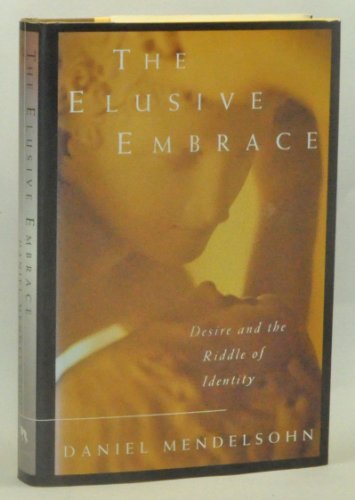
The gay classics scholar explores the meanings to be derived from conflicting and overlapping social and cultural experiences, family history, and personal identity
Die Inhaltsangabe kann sich auf eine andere Ausgabe dieses Titels beziehen.
Über die Autorin bzw. den Autor
Daniel Mendelsohn was born on Long Island in 1960 and was educated at the University of Virginia and at Princeton. His articles and reviews have appeared in numerous publications, including the <i>New York Times Book Review, The New Yorker, George, Lingua Franca</i>, and the <i>New York Observer.</i> A Lecturer in classics at Princeton, he lives in New York City and in New Jersey.
Aus dem Klappentext
e, profoundly moving literary debut--part personal history, part cultural commentary--that announces a writer of dazzling originality.<br><br>In an emotionally charged narrative that weaves together past and present, the personal and the scholarly, a young critic and classicist takes us on a search for the meaning of identity--while showing, through remarkably fresh and accessible readings of such classical Greek and Roman writers as Catullus and Sappho, Ovid and Sophocles, how ancient stories continue to hold truths for us today.<br><br>The landscapes through which Daniel Mendelsohn takes us: the deceptively quiet streets of the suburb where he grew up, torn between his mathematician father, who sought after scientific truth, and his Orthodox Jewish grandfather, who told "beautiful lies"; the Southern university, steeped in history and secret traditions, where he first experienced seductions both sexual and intellectual; Internet chat rooms and the streets of Chelsea,
Auszug. © Genehmigter Nachdruck. Alle Rechte vorbehalten.
From Chapter One
For a long time I have lived in two places.
One of these places is a quiet street lined with houses whose windows peer out from between wooden shutters at trees and the occasional car, a street in many ways like the nondescript one where I grew up, seething and afraid. When I am in that place, I live in one of those narrow squinting houses with a woman and a small child. I will come to that later.
The other place where I live is in New York City, slightly to the north of gay culture.
Half a block west of my front door lies Eighth Avenue, a one-way, four-lane, north-south artery that carries traffic uptown--that is, north. Eighth Avenue begins far downtown as the much smaller Hudson Street, still paved in places with cobblestones and endlessly subject to obscure and ongoing repairs; down there, it takes you past tiny cross-streets whose numberless names betray their great age, since once you get above the Village, above Fourteenth Street, the later, modern, rigid grid on which Manhattan is laid out supersedes the haphazard and twisted and ancient streets to the south. The grid is, for the most part, easy: its longitudinal lines are all called avenues, their numbers increasing as you go from east to west (with a few famous exceptions, like Park and Madison), and its latitudinal lines are streets, whose numbers escalate as you go from south to north. Attempts are occasionally made to impose names on these numbers--we are supposed to call Sixth Avenue "the Avenue of the Americas," for instance, and someone has rechristened a snippet of West Sixty-fifth Street near Lincoln Center "Leonard Bernstein Way"--but New Yorkers, always pressed for time, enjoy the brisk and unromantic efficiency of the numbers and ignore the names. In many ways we are a city of people who prefer numbers to names.
As Hudson Street arcs its way up through the West Village, which until recently was the center of New York gay life, it shakes off its curves and widens, becoming Eighth Avenue just below Fourteenth Street, which is the east-west thoroughfare that marks the southern boundary of the neighborhood called Chelsea, the current center of New York gay life. Fourteenth Street divides the Village from Chelsea. Most of the streets in Greenwich Village have names; all of the streets in Chelsea are numbered.
If you walk the half-block from my door to Eighth Avenue and make a right turn into it here, in the mid-Twenties, following the traffic north, it'll take you first past some nondescript lofts and tenements and, at Twenty-seventh Street, the Fashion Institute of Technology, which is known generally by its acronym, F.I.T., or, more locally, as "Fags In Training"; then it heads past the big train station at Thirty-fourth Street and the bus station at Forty-second. The avenue continues up through the glittering clutter of Times Square and, after dissolving briefly into the incoherent rapids of Columbus Circle, reemerges rather grandly as Central Park West. Lined by stout matronly prewar buildings on one side and the park on the other, Central Park West neatly divides Culture from Nature for the perusal of those well heeled enough to appreciate the view. It continues with bourgeois rectitude straight up along the park into the West Seventies and Eighties and Nineties--addresses that, at least until the rise of Chelsea as the city's premier gay neighborhood, were favored by a lot of gay men, but are now more likely to be associated, at least by the emigres here in my neighborhood, with yuppies, strollers, and, vaguely, heterosexuality.
But of course I rarely turn right at the end of my block. Instead I almost always head south, against the flow of traffic. When I do so it's only a couple of blocks from my street to Twenty-third Street, which is Chelsea's northern border. The neighborhood itself extends as far east as Broadway and as far west as Tenth Avenue; but its living heart is Eighth Avenue. Between Fourteenth Street on the south and Twenty-third Street on the north, Eighth Avenue is, for all intents and purposes, the Main Street of the gayest enclave of the gayest city in the world.
When I was in high school, in a newish suburb that had the word "Old" in its name, as if to assuage the insecurities of its first-generation American homeowners, a place where the houses, identical in structure, were distinguishable only by the color of their nonfunctional shutters, I dreamed of a place like this. I am sure that many other gay youths had (and still have) the same dream. Like me, they may have secretly read certain books over the course of successive weekends while standing nervously in the stacks of the local public library or in B. Dalton, so great was the terror of bringing those particular books home; like me, they may have kissed and fondled the soft demanding bodies of girls with the same sense of willed detachment they brought to laboratory dissections of frogs; like me, they may have needed to summon up the pictures of other classmates as they did so, classmates who were also boys, whose striped swimsuits and wide, awkward shoulders gave some of their friends a sense of panicked tenderness that, because unutterable, soon hardened into irony. I secretly imagined a place where all the people were other boys, and where all the stores and books and songs and movies and restaurants were by boys, about other boys. It would be a place where somehow the outside reality of the world that met your eyes and ears could finally be made to match the inner, hidden reality of what you knew yourself to be. A place where willed detachment and a carapace of irony would no longer be necessary.
This is the place I can go to if, when I reach the end of my street, I turn left instead of right. Curiously, now that I'm here it's not clear to me that this is the place I want to be. I divide my time now between my two geographies: the familiar streets of Chelsea, with its men and boys and flesh, and the street in the suburb about sixty miles away, lined with pin oaks and taciturn old houses. In front of these houses you will see no young men. You might see a retired widower mowing the lawn--"cutting the grass," he might say--with a rusting red mower, or an old woman sitting on the porch, fanning herself with a tabloid, scanning the street and other people's windows for some event, something to happen. Built long before the thinly shingled houses in the place where I grew up were hastily assembled, these houses are stolid: you sense about them that they know they will outlive, once again, the present generation of owners. These houses have real shutters, shutters that work.
Sometimes when I take a break from writing I walk down the east side of Eighth to Fourteenth Street, then cross over to the west side and walk back up. At the corner of Twenty-second Street is the Big Cup, a Day-Glo-painted coffeehouse that has proved even more popular as a late-night alternative to gay bars than it is as an afternoon gathering spot for other self-employeds. The latter tend, as far as I can see, to fall into two groups: writers, whose elaborate charade of using their laptops productively sags more and more with every hopeful glance up at the opening door, and a small but fairly regular collection of hustlers, who monopolize the telephone at the back of the room while checking off entries in what you assume must be small black books. In Twenty-second Street itself are Barracuda, a...
„Über diesen Titel“ kann sich auf eine andere Ausgabe dieses Titels beziehen.
Suchergebnisse für The Elusive Embrace: Desire and the Riddle of Identity

Beispielbild für diese ISBN
The Elusive Embrace
Anbieter: World of Books (was SecondSale), Montgomery, IL, USA
Verkäuferbewertung 5 von 5 Sternen

Zustand: Good. Item in good condition. Textbooks may not include supplemental items i.e. CDs, access codes etc. Bestandsnummer des Verkäufers 00089433413
Gebraucht kaufen
EUR 3,97
Versand gratis
Versand innerhalb von USA
Versand innerhalb von USA
Anzahl: 2 verfügbar
Foto des Verkäufers
The Elusive Embrace: Desire and the Riddle of Identity
Anbieter: Zoom Books Company, Lynden, WA, USA
Verkäuferbewertung 5 von 5 Sternen
Zustand: very_good. Book is in very good condition and may include minimal underlining highlighting. The book can also include "From the library of" labels. May not contain miscellaneous items toys, dvds, etc. . We offer 100% money back guarantee and 24 7 customer service. Bestandsnummer des Verkäufers ZBV.0375400958.VG
Gebraucht kaufen
EUR 3,97
Versand gratis
Versand innerhalb von USA
Versand innerhalb von USA
Anzahl: 1 verfügbar
Beispielbild für diese ISBN
The Elusive Embrace
Anbieter: World of Books Inc, Montgomery, IL, USA
Verkäuferbewertung 4 von 5 Sternen

Hardback. Zustand: Good. Hailed for its searing emotional insights, and for the astonishing originality with which it weaves together personal history, cultural essay, and readings of classical texts by Sophocles, Ovid, Euripides, and Sappho, The Elusive Embrace is a profound exploration of the mysteries of identity. It is also a meditation in which the author uses his own divided life to investigate the rich conflictedness of things, the double lives all of us lead. Daniel Mendelsohn recalls the deceptively quiet suburb where he grew up, torn between his mathematician father's pursuit of scientific truth and the exquisite lies spun by his Orthodox Jewish grandfather; the streets of manhattan's newest gay ghetto, where desire for love competes with love of desire; and the quiet moonlit house where a close friend's small son teaches him the meaning of fatherhood. And, finally, in a neglected Jewish cemetery, the author uncovers a family secret that reveals the universal need for storytelling, for inventing myths of the self. The book that Hilton Als calls equal to Whitman's 'Song of Myself, ' The Elusive Embrace marks a dazzling literary debut. Bestandsnummer des Verkäufers CIN0375400958G
Gebraucht kaufen
EUR 5,77
Versand gratis
Versand innerhalb von USA
Versand innerhalb von USA
Anzahl: 2 verfügbar
Beispielbild für diese ISBN
The Elusive Embrace : Desire and the Riddle of Identity
Verlag:
Knopf Doubleday Publishing Group, 1999
ISBN 10: 0375400958
ISBN 13: 9780375400957
Gebraucht
Hardcover
Anbieter: Better World Books, Mishawaka, IN, USA
Verkäuferbewertung 5 von 5 Sternen
Zustand: Good. Former library copy. Pages intact with minimal writing/highlighting. The binding may be loose and creased. Dust jackets/supplements are not included. Includes library markings. Stock photo provided. Product includes identifying sticker. Better World Books: Buy Books. Do Good. Bestandsnummer des Verkäufers 4717065-6
Gebraucht kaufen
EUR 8,17
Versand gratis
Versand innerhalb von USA
Versand innerhalb von USA
Anzahl: 1 verfügbar
Beispielbild für diese ISBN
The Elusive Embrace : Desire and the Riddle of Identity
Verlag:
Knopf Doubleday Publishing Group, 1999
ISBN 10: 0375400958
ISBN 13: 9780375400957
Gebraucht
Hardcover
Anbieter: Better World Books, Mishawaka, IN, USA
Verkäuferbewertung 5 von 5 Sternen
Zustand: Very Good. Pages intact with possible writing/highlighting. Binding strong with minor wear. Dust jackets/supplements may not be included. Stock photo provided. Product includes identifying sticker. Better World Books: Buy Books. Do Good. Bestandsnummer des Verkäufers 5541335-6
Gebraucht kaufen
EUR 8,17
Versand gratis
Versand innerhalb von USA
Versand innerhalb von USA
Anzahl: 4 verfügbar
Beispielbild für diese ISBN
The Elusive Embrace : Desire and the Riddle of Identity
Verlag:
Knopf Doubleday Publishing Group, 1999
ISBN 10: 0375400958
ISBN 13: 9780375400957
Gebraucht
Hardcover
Anbieter: Better World Books: West, Reno, NV, USA
Verkäuferbewertung 5 von 5 Sternen
Zustand: Good. Former library copy. Pages intact with minimal writing/highlighting. The binding may be loose and creased. Dust jackets/supplements are not included. Includes library markings. Stock photo provided. Product includes identifying sticker. Better World Books: Buy Books. Do Good. Bestandsnummer des Verkäufers 4717065-6
Gebraucht kaufen
EUR 8,17
Versand gratis
Versand innerhalb von USA
Versand innerhalb von USA
Anzahl: 1 verfügbar
Beispielbild für diese ISBN
The Elusive Embrace: Desire and the Riddle of Identity
Anbieter: HPB-Emerald, Dallas, TX, USA
Verkäuferbewertung 5 von 5 Sternen
hardcover. Zustand: Very Good. Connecting readers with great books since 1972! Used books may not include companion materials, and may have some shelf wear or limited writing. We ship orders daily and Customer Service is our top priority! Bestandsnummer des Verkäufers S_485278649
Gebraucht kaufen
EUR 5,39
EUR 3,28 Versand
Versand innerhalb von USA
Versand innerhalb von USA
Anzahl: 1 verfügbar
Beispielbild für diese ISBN
The Elusive Embrace: Desire and the Riddle of Identity
Anbieter: HPB-Movies, Dallas, TX, USA
Verkäuferbewertung 5 von 5 Sternen
hardcover. Zustand: Very Good. Connecting readers with great books since 1972! Used books may not include companion materials, and may have some shelf wear or limited writing. We ship orders daily and Customer Service is our top priority! Bestandsnummer des Verkäufers S_456294008
Gebraucht kaufen
EUR 5,40
EUR 3,28 Versand
Versand innerhalb von USA
Versand innerhalb von USA
Anzahl: 1 verfügbar
Foto des Verkäufers
THE ELUSIVE EMBRACE; Desire and the Riddle of Identity
Verlag:
Alfred A. Knopf, New York, 1999
ISBN 10: 0375400958
ISBN 13: 9780375400957
Gebraucht
Hardcover
Erstausgabe
Anbieter: Alta-Glamour Inc., Seattle, WA, USA
Verkäuferbewertung 5 von 5 Sternen
1st edition. 224pp. In an emotionally charged narrative that weaves together past and present, the personal and the scholarly, a young critic and classicist takes us on a search for the meaning of identity--while showing, through remarkably fresh and accessible readings of such classical Greek and Roman writers as Catullus and Sappho, Ovid and Sophocles, how ancient stories continue to hold truths for us today. The landscapes through which Daniel Mendelsohn takes us: the deceptively quiet streets of the suburb where he grew up, torn between his mathematician father, who sought after scientific truth, and his Orthodox Jewish grandfather, who told "beautiful lies"; the Southern university, steeped in history and secret traditions, where he first experienced seductions both sexual and intellectual; Internet chat rooms and the streets of Chelsea, Manhattan's newest gay ghetto, where "desire for love" competes with "love of desire"; the quiet, moonlit house where a close friend's small son teaches him the meaning of fatherhood. And, in a narrative tour de force that marks the book's conclusion, Mendelsohn's themes--desire and sexuality, the hidden meanings of classical and Hebrew writings, the restless search for cultural and personal identity--come together in a final revelation. In a neglected Jewish cemetery, the author uncovers a family secret that demonstrates the universal need for storytelling, for inventing myths of the self. Boards in dust jacket. Light shelfwear; former owner's name on inside front cover. Very Good. Bestandsnummer des Verkäufers 113431
Gebraucht kaufen
EUR 4,95
EUR 4,80 Versand
Versand innerhalb von USA
Versand innerhalb von USA
Anzahl: 1 verfügbar
Beispielbild für diese ISBN
The Elusive Embrace: Desire and the Riddle of Identity
Anbieter: Montclair Book Center, Montclair, NJ, USA
Verkäuferbewertung 4 von 5 Sternen
Hardcover. Zustand: USED Good. Bestandsnummer des Verkäufers 509505
Gebraucht kaufen
EUR 10,80
EUR 5,23 Versand
Versand innerhalb von USA
Versand innerhalb von USA
Anzahl: 1 verfügbar