
Verwandte Artikel zu Reading Rilke: Reflections on the Problems of Translation
Inhaltsangabe
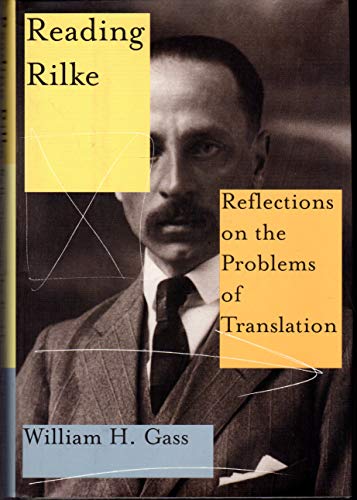
The renowned essayinst, philosopher, and novelist presents a close-up study and rendering of Rainer Maria Rilke's poetic masterpiece Duino Elegies as he reflects on the art of translating a work from another language while maintaining the true essence of the original. 15,000 first printing.
Die Inhaltsangabe kann sich auf eine andere Ausgabe dieses Titels beziehen.
Über die Autorin bzw. den Autor
William H. Gass was born in Fargo, North Dakota, in 1924. He has been the recipient of grants from the Rockefeller and Guggenheim Foundations, as well as the Academy and Institute of Arts and Letters Award for Fiction, the Academy and Institute of Arts and Letters Medal of Merit for Fiction, the Lannan Foundation Lifetime Achievement Award, and the National Book Critics Circle Award for Criticism (1985 and 1996). He has also won the Pushcart Prize (1976, 1983, 1987, 1992), and his work has appeared four times in <b>Best American Short Stories</b>. He lives in St. Louis, where he is the director of the International Writers' Center.
Aus dem Klappentext
admired essayist, novelist, and philosopher, author of <b>Cartesian Sonata</b>, <b>Finding a Form</b>, and <b>The Tunnel</b>, reflects on the art of translation and on Rainer Maria Rilke's <b>Duino Elegies</b> -- and gives us his own translation of Rilke's masterwork.<br><br>After nearly a lifetime of reading Rilke in English, William Gass undertook the task of translating Rilke's writing in order to see if he could, in that way, get closer to the work he so deeply admired. With Gass's own background in philosophy, it seemed natural to begin with the <b>Duino Elegies</b>, the poems in which Rilke's ideas are most fully expressed and which as a group are important not only as one of the supreme poetic achievements of the West but also because of the way in which they came to be written -- in a storm of inspiration. <br><br>Gass examines the genesis of the ideas that inform the <b>Elegies</b> and discusses previous translations. He writes, as well, about R
Auszug. © Genehmigter Nachdruck. Alle Rechte vorbehalten.
From "Lifeleading"
Open-eyed, Rainer Maria Rilke died in the arms of his doctor on December 29, 1926. The leukemia which killed him had been almost reluctantly diagnosed, and had struck like a storm, after a period of gathering clouds. Ulcerous sores appeared in his mouth, pain troubled his stomach and intestines, he slept a lot when his body let him, his spirit was weighed down by depression, while physically he became as thin and fluttery as a leaf. Since, according to the gloom that naturally descended on him, Rilke's creative life was over, he undertook translations during his last months: of Valery in particular -- "Eupalinos," "The Cemetery by the Sea " -- and composed his epitaph, too, invoking the flower he so devotedly tended.
rose, o pure contradiction, desire
to be no one's sleep beneath so many lids.
The myth concerning the onset of his illness was, even among his myths, the most remarkable. To honor a visitor, the Egyptian beauty Nimet Eloui, Rilke gathered some roses from his garden. While doing so, he pricked his hand on a thorn. This small wound failed to heal, grew rapidly worse, soon his entire arm was swollen, and his other arm became affected as well. According to the preferred story, this was the way Rilke's disease announced itself, although Ralph Freedman, his judicious and most recent biographer, puts that melancholy event more than a year earlier.
Roses climb his life as if he were their trellis. Turn the clock back twenty-four years to 1900. Rilke is a guest at Worpswede, an artists' colony near Bremen, and it is there he has made the acquaintance of the painter Paula Becker and his future wife, Clara Westhoff. One bright Sunday morning, in a romantic mood, Rilke brings his new friends a few flowers, and writes about the gesture in his diary:
I invented a new form of caress: placing a rose gently on a closed eye until its coolness can no longer be felt; only the gentle petal will continue to rest on the eyelid like sleep just before dawn.
The poet never forgets a metaphor. Nor do his friends forget the poet's passions. Move on to 1907 now, when, in Capri, Rilke composes "The Bowl of Roses," beginning this poem with an abrupt jumble of violent images:
You've seen their anger flare, seen two boys
bunch themselves into a ball of animosity
and roll across the ground
like some dumb animal set upon by bees;
you've seen those carny barkers, mile-high liars,
the careening tangle of bolting horses,
their upturned eyes and flashing teeth,
as if the skull were peeled back from the mouth.
Bullyboys, actors, tellers of tall tales, runaway horses -- fright, force, and falsification -- losing composure, pretending, revealing pain and terror: these are compared to the bowl of roses. Rilke has come from Berlin, where his new publisher, Insel Verlag, has been distressed to discover that Rilke's former publisher plans to bring out The Book of Hours as well as a revised Cornet. This does not get the new alliance off to a smooth and trusting start. Moreover, Rilke is broke again. During 1906, the poet had been bankrolled by his friend Karl von der Heydt, who twice generously deposited funds in Rilke's Paris bank, but Rilke's habit of staying in deluxe hotels and eating (modestly) in expensive restaurants, his dependence upon porters and maids and trains, had left him holding nothing more than his ticket to Alice Faehndrich's Villa Discopoli on Capri. Von der Heydt sent him some supplementary funds eventually, but not before making a face. Perhaps these unpleasantries account for the poem's oddly violent and discordant opening.
But now you know how to forget such things,
for now before you stands the bowl of roses,
unforgettable and wholly filled
with unattainable being and promise,
a gift beyond anyone's giving, a presence
that might be ours and our perfection.
More than a bowl was set before him. Though the New Year was approaching, the island was abloom with winter roses, and Rilke's cottage, on the grounds of the villa, was covered with them.
Living in silence, endlessly unfolding,
using space without space being taken
from a space even trinkets diminish;
scarcely the hint there of outline or ground
they are so utterly in, so strangely delicate
and self-lit--to the very edge:
is it possible we know anything like this?
And then like this: that a feeling arises
because now and then the petals kiss?
And this: that one should open like an eye,
to show more lids beneath, each closed
in a sleep as deep as ten, to quench
an inner fire of visionary power.
And this above all: that through these petals
light must make its way. Out of one thousand skies
they slowly drain each drop of darkness
so that this concentrated glow
will bestir the stamens till they stand.
The rose is a distilling eye. It gathers light and filters it until the concentration is powerful and pure, until its stamens become erect. If the rose is not a poem, the poem is surely a rose.
And the movement in the roses, look:
gestures which make such minute vibrations
they'd remain invisible if their rays
did not resolutely ripple out into the wide world.
Look at that white one which has blissfully unfolded
to stand amidst its splay of petals
like Venus boldly balanced on her shell;
look too at the bloom that blushes, bends
toward the one with more composure,
and see how the pale one aloofly withdraws;
and how the cold one stands, closed upon itself,
among those open roses, shedding all.
And what they shed: how it can be light or heavy,
a cloak, a burden, a wing, a mask -- it just depends --
and how they let it fall: as if disrobing for a lover.
E. M. Butler, whose Rilke of 1941 was the first biography of the poet to appear in English, writes:
"There is no doubt that roses cast a spell upon Rilke. Monique Saint-Helier recounts how he once sent her some fading flowers to die with her [sic -- Butler means "to die in her company"], because he was going away. His description of a vase of falling roses in Late Poems represents him as keeping them in his room until they were really dead, when he embalmed their petals in books and used them for pot-pourri. Rilke's roses were always explicitly in enclosed spaces: in death-bed chambers, in his study at night, in rose-bowls, bringing summer into a room, bestrewing the chimney-piece as they shed their petals. And even in his garden at Muzot, they seemed to be clad in pink silk boudoir-gowns and red summer dresses, like carefully tended and cherished, fragrant and fragile hothouse blooms."
The poet collects the world inside himself as the rose gathers the light of the skies, and there he intensifies it until the phallic element of the flower dominates the symbol. Eventually the rose bestrews itself. Petals, like poems, leave their tree. The beautiful unity the rose once was now becomes a fall of discoloring shards; yet these petals can help us see to another part of the world as through a stained-glass window.
What can't they be? Was that yellow one,
lying there hollow and open, not the rind
of a fruit in which the very same yellow
was its more intense and darkening juice?
And was this other undone by its opening,
since, so exposed, its ineffable pink
has picked up lilac's bitter aftertaste?
And the cambric, is it not a dress
to which a chemise, light and warm as breath,
still clings, though both were abandoned
amid morning shadows near the old woodland pool?
And this of opalescent porcelain
is a shallow fragile china cup
full of tiny shining butterflies --
and there -- that one's holding nothing but itself.
Later, in the August of an emptied Paris, Rilke will...
„Über diesen Titel“ kann sich auf eine andere Ausgabe dieses Titels beziehen.
Suchergebnisse für Reading Rilke: Reflections on the Problems of Translation

Beispielbild für diese ISBN
Reading Rilke : Reflections on the Problems of Translation
Verlag:
Knopf Doubleday Publishing Group, 1999
ISBN 10: 0375403124
ISBN 13: 9780375403125
Gebraucht
Hardcover
Erstausgabe
Anbieter: Better World Books, Mishawaka, IN, USA
Verkäuferbewertung 5 von 5 Sternen

Zustand: Good. 1st. Former library copy. Pages intact with minimal writing/highlighting. The binding may be loose and creased. Dust jackets/supplements are not included. Includes library markings. Stock photo provided. Product includes identifying sticker. Better World Books: Buy Books. Do Good. Bestandsnummer des Verkäufers GRP102151458
Gebraucht kaufen
EUR 7,49
Versand gratis
Versand innerhalb von USA
Versand innerhalb von USA
Anzahl: 3 verfügbar
Beispielbild für diese ISBN
Reading Rilke : Reflections on the Problems of Translation
Verlag:
Knopf Doubleday Publishing Group, 1999
ISBN 10: 0375403124
ISBN 13: 9780375403125
Gebraucht
Hardcover
Erstausgabe
Anbieter: Better World Books, Mishawaka, IN, USA
Verkäuferbewertung 5 von 5 Sternen
Zustand: Very Good. 1st. Former library copy. Pages intact with possible writing/highlighting. Binding strong with minor wear. Dust jackets/supplements may not be included. Includes library markings. Stock photo provided. Product includes identifying sticker. Better World Books: Buy Books. Do Good. Bestandsnummer des Verkäufers 7619627-6
Gebraucht kaufen
EUR 7,49
Versand gratis
Versand innerhalb von USA
Versand innerhalb von USA
Anzahl: 1 verfügbar
Beispielbild für diese ISBN
Reading Rilke: Reflections on the Problems of Translation
Anbieter: ThriftBooks-Dallas, Dallas, TX, USA
Verkäuferbewertung 5 von 5 Sternen
Hardcover. Zustand: Fair. No Jacket. Readable copy. Pages may have considerable notes/highlighting. ~ ThriftBooks: Read More, Spend Less. Bestandsnummer des Verkäufers G0375403124I5N00
Gebraucht kaufen
EUR 9,04
Versand gratis
Versand innerhalb von USA
Versand innerhalb von USA
Anzahl: 1 verfügbar
Foto des Verkäufers
Reading Rilke: Reflections on the Problems of Translation
Anbieter: MERS Goodwill-Kansas City, Blue Springs, MO, USA
Verkäuferbewertung 5 von 5 Sternen
Zustand: good. The book has been read but is in good condition. It has very minimal damage to the cover, including scuff marks, but no holes or tears. The dust jacket for hard covers may not be included. The binding has minimal wear. The majority of pages are undamaged with minimal creasing or tearing, minimal pencil underlining of text, no highlighting of text, and no writing in the margins. There are no missing pages. See the seller's listing for full details and a description of any imperfections. Bestandsnummer des Verkäufers WMEKV.0375403124.G
Gebraucht kaufen
EUR 6,54
EUR 3,52 Versand
Versand innerhalb von USA
Versand innerhalb von USA
Anzahl: 1 verfügbar
Beispielbild für diese ISBN
Reading Rilke: Reflections on the Problems of Translation
Anbieter: HPB-Diamond, Dallas, TX, USA
Verkäuferbewertung 5 von 5 Sternen
hardcover. Zustand: Very Good. Connecting readers with great books since 1972! Used books may not include companion materials, and may have some shelf wear or limited writing. We ship orders daily and Customer Service is our top priority! Bestandsnummer des Verkäufers S_483587159
Gebraucht kaufen
EUR 7,24
EUR 3,30 Versand
Versand innerhalb von USA
Versand innerhalb von USA
Anzahl: 1 verfügbar
Beispielbild für diese ISBN
Reading Rilke: Reflections on the Problems of Translation
Anbieter: Books-R-Keen, DuBois, PA, USA
Verkäuferbewertung 4 von 5 Sternen

hardcover. Zustand: Fair. Acceptable items may contain, highlighting, writing, tares, stains and other previous signs of use. Used items may not contain CD's, Dust Jackets, access codes and other accompanying items when applicable. Bestandsnummer des Verkäufers 30D48706
Gebraucht kaufen
EUR 7,24
EUR 3,51 Versand
Versand innerhalb von USA
Versand innerhalb von USA
Anzahl: 1 verfügbar
Foto des Verkäufers
Reading Rilke: Reflections on the Problems of Translation
Anbieter: ebooks Keystone, Reading, PA, USA
Verkäuferbewertung 4 von 5 Sternen
Zustand: good. This book is in good condition, with minimal signs of wear and tear. Bestandsnummer des Verkäufers GWKV.0375403124.G
Gebraucht kaufen
EUR 10,61
EUR 2,64 Versand
Versand innerhalb von USA
Versand innerhalb von USA
Anzahl: 1 verfügbar
Foto des Verkäufers
Reading Rilke Reflections on the Problems of Translation
Anbieter: True Oak Books, Highland, NY, USA
Verkäuferbewertung 5 von 5 Sternen
Hardcover. Zustand: Good. Zustand des Schutzumschlags: No Dust Jacket. 6.25 X 1.25 X 9 inches; 256 pages; Foxing to the exterior edge of pages only. Good overall condition. General wear. No major blemishes. No writing. ; - We offer free returns for any reason and respond promptly to all inquiries. Your order will be packaged with care and ship on the same or next business day. Buy with confidence. Bestandsnummer des Verkäufers TOB217-30767-A-0.50
Gebraucht kaufen
EUR 18,10
Versand gratis
Versand innerhalb von USA
Versand innerhalb von USA
Anzahl: 1 verfügbar
Beispielbild für diese ISBN
Reading Rilke: Reflections on the Problems of Translation
Anbieter: Inquiring Minds, Saugerties, NY, USA
Verkäuferbewertung 4 von 5 Sternen
Hardcover. Zustand: Used - Very Good. Bestandsnummer des Verkäufers 581943
Gebraucht kaufen
EUR 13,57
EUR 5,27 Versand
Versand innerhalb von USA
Versand innerhalb von USA
Anzahl: 1 verfügbar
Beispielbild für diese ISBN
Reading Rilke: Reflections on the Problems of Translation.
Anbieter: Bear Bookshop, John Greenberg, Brattleboro, VT, USA
Verkäuferbewertung 4 von 5 Sternen
233pp. Includes author's translation of 'The Duino Elegies' + numerous other poems. Address label on front endpaper, penned date on back endpaper, else Fine/Fine dj. Bestandsnummer des Verkäufers 22101105
Gebraucht kaufen
EUR 13,02
EUR 6,15 Versand
Versand innerhalb von USA
Versand innerhalb von USA
Anzahl: 1 verfügbar