
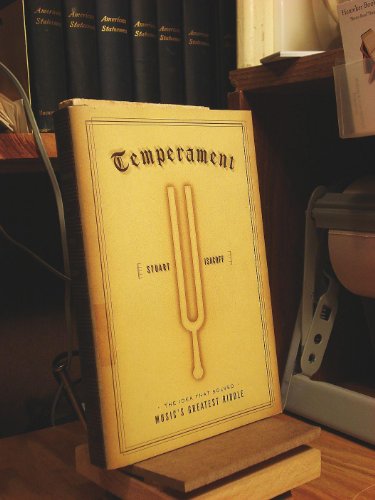
Verwandte Artikel zu Temperament: The Idea That Solved Music's Greatest...
Inhaltsangabe
Explores the eighteenth-century musical breakthrough that led to the creation of the modern piano keyboard, which greatly expanded the creative possibilities of classical composition.
Die Inhaltsangabe kann sich auf eine andere Ausgabe dieses Titels beziehen.
Über die Autorin bzw. den Autor
Stuart Isacoff, a recipient of the ASCAP Deems Taylor Award for excellence in writing about music, is a pianist, lecturer, composer, and the creator and editor in chief of the country's largest-circulation classical piano magazine, <i>Piano Today</i>. He has contributed to <i>The New Grove Dictionary of American Music</i> and has written for the <i>New York Times</i>. He lives in Bergen County, New Jersey.
Auszug. © Genehmigter Nachdruck. Alle Rechte vorbehalten.
Chapter 1
Ay me! what warbles yields mine instrument!
The basses shriek as though they were amiss!
-William Percy, "Coelia" (1594)
The piano is perhaps the most generous instrument ever invented. Its range, from bass to treble, is as large as an orchestra's. It allows ten tones-sometimes even more-to be struck simultaneously, and holds them in the air at a pianist's will. The piano can growl and sing and beat time. It can render arid fugues and impressionist waterfalls with equal naturalness. And, unlike the ungrateful French horn or the finicky oboe, if you keep it in tune, it will be an obedient servant. But the principle that truly underlies the piano's versatility is hidden beneath the geometry of its white and black keys.
Clusters of two blacks, then three, then two, and so on, form a repeating pattern above a solid row of whites. When one's eye has become accustomed to the terrain, the alternating groupings signal the names of each note on the keyboard. There are only twelve different ones (each tied to a letter of the alphabet), and in our modern tuning they are built in equidistant steps, like a well-made ladder.
This arrangement produces wondrous results: Through it, a Chopin prelude can gently weep across the keys; Debussy's perfumed phrases can swirl in gentle clouds; Webern can set in motion intricate strings of melody, like threads of glistening pearls.
All of this is possible only because the modern keyboard is a design in perfect symmetry-each pitch is reliably, unequivocally equidistant from the ones that precede and follow it. This tuning allows a musical pattern begun on one note to be duplicated when starting on any other; it creates a musical universe in which the relationships between musical tones are reliably, uniformly consistent. Playing a piano for which this was not true would be like playing a game of chess in which the rules changed from moment to moment.
Yet, that is precisely what many European musicians practicing before the nineteenth century demanded of their instruments. In fact, for hundreds of years, suggestions that our modern system be used were taken as a call to battle: Musicians, craftsmen, church officials, heads of state, and philosophers fought heatedly against the introduction of this equal-temperament tuning as something both unnatural and ugly. When Galileo's father, Vincenzo Galilei, supported it as an ideal as early as 1581, he promptly became embroiled in a feud with Gioseffo Zarlino, one of the most influential music theorists of the day. (Sensing a good thing, Chu Tsai-yü, a prince of the Ming dynasty, soon after attributed the concept to the work of Huai Nan Tzu in 122 b.c.e.)
The seventeenth-century instrument-maker Jean Denis-an advisor to Father Marin Mersenne, philosopher René Descartes's most trusted authority on science and math-rejected today's approach as "quite wretched." Denis's Treatise on Harpsichord Tuning was published in 1643, the year that a pupil of Galileo's, Evangelista Torricelli, conducted world-shaking experiments in atmospheric pressure, overturning essential elements of medieval cosmology. Though radical changes in worldview were erupting all around him, Denis remained steadfastly loyal to an old tuning system in which the musical distances between notes were determinedly inconsistent, forming a minefield of "wolf sounds" on his keyboard-notes so dissonant they reminded listeners of the howling of wolves.
Harpsichords and organs (precursors of the piano) thus tuned were capable of producing harmonies of magical, uncorrupted sweetness in one moment and-as musicians attempted to duplicate them while navigating the spans of their keyboards-of earsplitting clashes the next. Composers were prisoners of these torturous practicalities, as were vocalists and instrumentalists who tried to join in. Yet the resistance to a remedy that we find perfectly acceptable today-the tuning of equal temperament-was so powerful, the idea was for generations almost unspeakable.
The crux of the problem can be traced to the ancient Greeks, who defined music's most beautiful sounds as arising from inviolable mathematical relationships-the fingerprints of the gods. These were the proportions through which two separate tones could entwine to form a delightful union. Centuries after Pythagoras conceived of the notion, the great astronomer and music theorist Johannes Kepler restated the idea eloquently: "Geometry existed before the creation, is coeternal with the mind of God, is God himself. . . ." Musical harmony was that geometry made sensual, and was not to be toyed with. And yet . . .
As the art of music evolved, a startling paradox arose that threatened to undermine the entire arrangement. When harpsichords or organs were tuned so that they could consistently produce sounds corresponding to one of the venerable formulas, they were rendered incapable of playing the others. No instrument with fixed, unbending notes such as a piano can accommodate them all. Thus, certain combinations of tones that should have sounded sweet and placid could, on an early keyboard instrument, become sour and ragged. In search of a solution, musicians began to temper, or alter, their instrument's tunings away from the ancient ideals. The final solution-today's equal temperament-abandoned most of the revered musical proportions altogether.
Acceptance did not come easily. Critics claimed the resulting music had been robbed of its beauty and emotional impact; supporters countered that since all things are subjective, human ears and minds would learn to adapt. The arguments, however, went well beyond musical aesthetics. Equal temperament represented an assault on an idea that had gripped thinkers in nearly every field as a powerful metaphor for a universe ruled by mathematical law.
Saint Augustine found in music's magical proportions God's revealed plan for the building of his churches. Renaissance philosophers sought in them the secrets of obtaining life from the heavens; composers yearned for the power they had bestowed on ancient musicians to tame wild beasts, seduce the celestial spirits, even lure trees to the surface from beneath the sheltering earth. Kepler found in music's time-honored proportions the rules governing the motion of planets in the sky. And Isaac Newton matched the relationships these proportions established between pitches in a musical scale to the arrangement of colors formed by sunlight passing through a prism.
Music's prized proportions permeated not only the inner sanctums of the church, but the workshops of great artists like Filippo Brunelleschi and Leonardo da Vinci. They became entangled in the world of scientific inquiry-engaging the imaginations of such luminaries as Galileo, Kepler, Descartes, Newton, and Christiaan Huygens. They fed debates between the French encyclopedists, challenging the rhetorical skills of Denis Diderot, Jean-Jacques Rousseau, Jean d'Alembert, and Jean-Philippe Rameau on questions such as "What is 'art'?" "What is 'truth'?" and "What is 'natural'?"
They spurred strange musical inventions from remarkable figures like the sixteenth-century avant-garde composer Nicola Vicentino, Mersenne, and Juan Caramuel y Lobkowitz, a Spanish mathematician, professor of theology, and military engineer at the court of Ferdinand III in Prague. And they instigated the creation of countless tuning systems in an incessant negotiation between the old ways and the forces of change. Along the way, they pointed up the conceits and follies of generations of theologians, musicians, philosophers, and scholars who insisted that the proportions in the mind of God must fit in the mind of man.
The...
„Über diesen Titel“ kann sich auf eine andere Ausgabe dieses Titels beziehen.
Suchergebnisse für Temperament: The Idea That Solved Music's Greatest...

Beispielbild für diese ISBN
Temperament: The Idea That Solved Music's Greatest Riddle
Anbieter: World of Books (was SecondSale), Montgomery, IL, USA
Verkäuferbewertung 5 von 5 Sternen

Zustand: Very Good. Item in very good condition! Textbooks may not include supplemental items i.e. CDs, access codes etc. Bestandsnummer des Verkäufers 00110088448
Gebraucht kaufen
EUR 3,89
Versand gratis
Versand innerhalb von USA
Versand innerhalb von USA
Anzahl: 1 verfügbar
Beispielbild für diese ISBN
Temperament: The Idea That Solved Music's Greatest Riddle
Anbieter: World of Books (was SecondSale), Montgomery, IL, USA
Verkäuferbewertung 5 von 5 Sternen
Zustand: Good. Item in good condition and has highlighting/writing on text. Used texts may not contain supplemental items such as CDs, info-trac etc. Bestandsnummer des Verkäufers 00102800592
Gebraucht kaufen
EUR 3,89
Versand gratis
Versand innerhalb von USA
Versand innerhalb von USA
Anzahl: 1 verfügbar
Foto des Verkäufers
Temperament: The Idea That Solved Music's Greatest Riddle
Anbieter: 3Brothers Bookstore, Egg harbor township, NJ, USA
Verkäuferbewertung 5 von 5 Sternen
Zustand: very_good. Cover may have light wear, pages in very good condition and binding is sturdy; may have other light shelf wear or creases. May have notes or highlighting. Bestandsnummer des Verkäufers EVV.0375403558.VG
Gebraucht kaufen
EUR 3,90
Versand gratis
Versand innerhalb von USA
Versand innerhalb von USA
Anzahl: 1 verfügbar
Beispielbild für diese ISBN
Temperament: The Idea That Solved Music's Greatest Riddle
Anbieter: More Than Words, Waltham, MA, USA
Verkäuferbewertung 5 von 5 Sternen
Zustand: Good. . . Before placing your order for please contact us for confirmation on the book's binding. Check out our other listings to add to your order for discounted shipping. All orders guaranteed and ship within 24 hours. Bestandsnummer des Verkäufers BOS-N-07c-01385
Gebraucht kaufen
EUR 0,92
EUR 3,55 Versand
Versand innerhalb von USA
Versand innerhalb von USA
Anzahl: 1 verfügbar
Foto des Verkäufers
Temperament: The Idea That Solved Music's Greatest Riddle
Anbieter: Greenworld Books, Arlington, TX, USA
Verkäuferbewertung 5 von 5 Sternen
Zustand: good. Fast Free Shipping â" Good condition. It may show normal signs of use, such as light writing, highlighting, or library markings, but all pages are intact and the book is fully readable. A solid, complete copy that's ready to enjoy. Bestandsnummer des Verkäufers GWV.0375403558.G
Gebraucht kaufen
EUR 4,51
Versand gratis
Versand innerhalb von USA
Versand innerhalb von USA
Anzahl: 1 verfügbar
Beispielbild für diese ISBN
Temperament: The Idea That Solved Music's Greatest Riddle
Anbieter: BooksRun, Philadelphia, PA, USA
Verkäuferbewertung 5 von 5 Sternen
Hardcover. Zustand: Very Good. 1. It's a well-cared-for item that has seen limited use. The item may show minor signs of wear. All the text is legible, with all pages included. It may have slight markings and/or highlighting. Bestandsnummer des Verkäufers 0375403558-11-1
Gebraucht kaufen
EUR 5,76
Versand gratis
Versand innerhalb von USA
Versand innerhalb von USA
Anzahl: 1 verfügbar
Beispielbild für diese ISBN
Temperament: The Idea That Solved Music's Greatest Riddle
Anbieter: HPB Inc., Dallas, TX, USA
Verkäuferbewertung 5 von 5 Sternen
hardcover. Zustand: Very Good. Connecting readers with great books since 1972! Used books may not include companion materials, and may have some shelf wear or limited writing. We ship orders daily and Customer Service is our top priority! Bestandsnummer des Verkäufers S_471652412
Gebraucht kaufen
EUR 2,51
EUR 3,33 Versand
Versand innerhalb von USA
Versand innerhalb von USA
Anzahl: 1 verfügbar
Beispielbild für diese ISBN
Temperament: The Idea That Solved Music's Greatest Riddle
Anbieter: HPB-Emerald, Dallas, TX, USA
Verkäuferbewertung 5 von 5 Sternen
Hardcover. Zustand: Very Good. Connecting readers with great books since 1972! Used books may not include companion materials, and may have some shelf wear or limited writing. We ship orders daily and Customer Service is our top priority! Bestandsnummer des Verkäufers S_471850061
Gebraucht kaufen
EUR 2,51
EUR 3,33 Versand
Versand innerhalb von USA
Versand innerhalb von USA
Anzahl: 1 verfügbar
Beispielbild für diese ISBN
Temperament: The Idea That Solved Music's Greatest Riddle
Anbieter: ThriftBooks-Atlanta, AUSTELL, GA, USA
Verkäuferbewertung 5 von 5 Sternen
Hardcover. Zustand: Very Good. No Jacket. Former library book; May have limited writing in cover pages. Pages are unmarked. ~ ThriftBooks: Read More, Spend Less. Bestandsnummer des Verkäufers G0375403558I4N10
Gebraucht kaufen
EUR 6,79
Versand gratis
Versand innerhalb von USA
Versand innerhalb von USA
Anzahl: 1 verfügbar
Beispielbild für diese ISBN
Temperament: The Idea That Solved Music's Greatest Riddle
Anbieter: HPB-Red, Dallas, TX, USA
Verkäuferbewertung 5 von 5 Sternen
hardcover. Zustand: Good. Connecting readers with great books since 1972! Used textbooks may not include companion materials such as access codes, etc. May have some wear or writing/highlighting. We ship orders daily and Customer Service is our top priority! Bestandsnummer des Verkäufers S_435005032
Gebraucht kaufen
EUR 4,58
EUR 3,33 Versand
Versand innerhalb von USA
Versand innerhalb von USA
Anzahl: 1 verfügbar