
Verwandte Artikel zu Healthy Aging (Rough Cut)
Inhaltsangabe
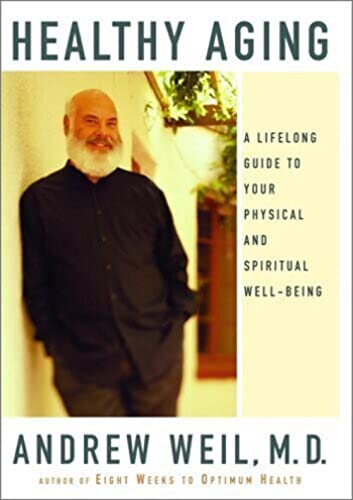
The author of Eight Weeks to Optimum Health draws on the latest medical research, as well as secrets of longevity and a combination of conventional and alternative approaches, to present an informative, inspirational guide to aging and healthy living that offers specific strategies dealing with a variety of physical, mental, and emotional problems that come with aging. 750,000 first printing.
Die Inhaltsangabe kann sich auf eine andere Ausgabe dieses Titels beziehen.
Über die Autorin bzw. den Autor
Andrew Weil, M.D. is the author of ten previous books, including Spontaneous Healing, Eight Weeks to Optimum Health, Eating Well for Optimum Health, and, with Rosie Daley, The Healthy Kitchen. A graduate of Harvard Medical School, he is clinical professor of medicine and director of the Program in Integrative Medicine at the University of Arizona. He writes Self Healing, a monthly newsletter, and maintains the Web site DrWeil.com. More of his work on aging can be found at www.healthyaging.com. He lives in Arizona.
Also available from Random House Audio, read by the author; in a Random House Large Print edition; and from Vintage Español, a division of Random House.
The Healthy Kitchen with Rosie Daley is available in Knopf paperback.
Auszug. © Genehmigter Nachdruck. Alle Rechte vorbehalten.
Immortality
Question: If you could live forever, would you and why?
Answer: I would not live forever, because we should not live forever, because if we were supposed to live forever, then we would live forever, but we cannot live forever, which is why I would not live forever.
—Miss Alabama in the 1994 Miss USA Contest
Our attitudes toward aging and our responses to the changes in appearance that aging brings are totally colored by our knowledge that we are moving inexorably toward death. It is not my intention to write about death or the fear of dying in this book, but I find it impossible to avoid mentioning them as the source of our negative feelings about aging, which are entirely based in fear.
Some species age more slowly than we do, others more rapidly. I have lived with dogs for many years and have watched several canine companions grow up, grow old, and die. As I write, I am looking at a photograph from several years ago of two of my Rhodesian ridgebacks on the front step of my house in southern Arizona. One is a young male, Jambo, who could not be more than a year old in the photo. He is standing—sleek, handsome, with all the vitality of youth. The other, B.T., must have been fifteen, very old for such a large breed. She is lying down, her face completely white. Soon she was unable to get up. I helped her through her decline but finally had to euthanize her a day before her sixteenth birthday.
Jambo is now eight years old, still in his prime, still sleek, handsome, and vital, with a deep, soulful personality that makes him an ideal companion animal. Most people who meet him comment on how good-looking he is, the perfect combination of strength and beauty. Sometimes if I am reading in bed at night, I invite him to come up and sit beside me for a few minutes. If I rub his chest in a certain way, he looks up toward the ceiling, extending his neck in a posture of noble contentment that I find very appealing. But when he is in this position, I cannot avoid noticing the first white hairs on his otherwise black chin. And whenever I see them, I also cannot avoid noticing that there are more than the last time I looked.
I know from experience that this dusting of white heralds the changes to come, that one day he, too, will be frosted with the white of old age; and when I see those signs of aging on his strong chin, I think about the disappearance of black from my own facial hair, about the unalterable passage of time, the relentless change of physical bodies as we decline. I think about the pain of the loss of previous companions, about separation from beings I love and who love me, about my own fear of the end and the sadness that is never separable from the joy of human experience. And all of this has come from the observation of a few white hairs on the chin of my dog.
We all sense the finiteness of life, and we all fantasize about living forever. Is it any wonder, then, that we put so much effort into denying the fact of our aging with cosmetics, plastic surgery, and verbal deceits (“You look so much younger!”), and why we are so enthralled by proponents of antiaging medicine who tell us that we can stop or even turn back the clock?
Immortality is an alluring concept, but I wonder how many of us have thought through its meaning and implications, which turn out not to be so simple. If you lived beyond the normal human life span, what would your life be like? I invite you to look at immortality with me through the lens of biology. Apart from framing this discussion of healthy aging, it will give you a chance to become acquainted with the latest findings of scientists who are studying the aging process. All of the practical advice I have to give you in Part Two of this book is based on this scientific evidence* and grounded in a philosophy that rejects immortality and eternal youthfulness as unworthy goals.
A tension between mortality and immortality is played out on all levels of our being, from our cells to our psyches. Understanding it will help you accept the fact of aging and motivate you to learn to do it as gracefully as possible.
******************
Let’s start with immortality on the cellular level. Until 1961, researchers believed that, in theory at least, normal cells, taken from the body and grown in laboratories, should be able to grow and divide forever if their needs were met: if they were provided with a constant supply of food and if their waste products were removed. In that year, Leonard Hayflick and Paul Moorhead at the Wistar Institute in Philadelphia demonstrated that this was not so, that all normal cells have a fixed limit on the number of times they can divide in order to replace themselves. This number is now known as the Hayflick limit. Hayflick, currently a professor of anatomy at the School of Medicine, at the University of California, San Francisco, is one of the foremost biogerontologists. His book How and Why We Age, first published in 1994, is the best I have found on the subject. I recommend it highly.
It turns out that the Hayflick limit varies from species to species and often correlates with life span. With a Hayflick limit of about 50 cell divisions, humans are the longest-lived mammals. Mice, which live about three years, have a limit of 15 divisions; for chickens, with an average life span of twelve years, the number is about 25. At the extreme of longevity, the Galápagos tortoise, which can live for 175 years, has a Hayflick limit of 110.
HeLa cells, however, can divide indefinitely. They do not senesce. They continue to grow and divide as long as they have nutrients, oxygen, space, and means of getting rid of their wastes. HeLa cells were the first human cells to be successfully cultured outside the body in large numbers. Given their longevity, they revolutionized biological and medical research and quickly established themselves in laboratories around the world. HeLa cells ignore the Hayflick limit for human cells. In a sense, they are immortal.
I was taught that “HeLa” was composed of the initial letters of the name of a woman, Helen Lane, who was said to be the original source of the cells. This turns out not to have been true. The real source was Henrietta Lacks, a poor African-American woman from Baltimore, whose story only came out years after her cells were growing in prodigious numbers everywhere.
Lacks was born to a family of tobacco pickers in Virginia, moved to Baltimore in 1943 at the age of twenty-three, married, and had five children in quick succession. Then, early in 1951, she noticed she had abnormal vaginal bleeding. She went to a clinic at The Johns Hopkins Hospital, where a doctor found an ominous-looking, quarter-sized tumor on her uterine cervix. He biopsied it and sent the tissue sample off for diagnosis. It was malignant. Shortly afterward, Lacks returned to the clinic to begin radium treatments, but before the first one, another tissue sample from the tumor was taken and sent, this time to George Gey, head of tissue culture research at Johns Hopkins.
Gey, with his wife, Margaret, had been trying to find human cells that would grow well outside the body. His greater goal was to study cancer in order to find a cure. Henrietta Lacks’s biopsy gave him exactly what he needed. Her cancer cells grew in test tubes as no other cells had ever grown, vigorously and aggressively. Of course, this did not augur well for their donor. Within months, Lacks’s tumor had metastasized throughout her body, creating tumors in all her organs until she expired painfully in a racially segregated ward of The Johns Hopkins Hospital on October 4,...
„Über diesen Titel“ kann sich auf eine andere Ausgabe dieses Titels beziehen.
Suchergebnisse für Healthy Aging (Rough Cut)

Beispielbild für diese ISBN
Healthy Aging
Anbieter: World of Books (was SecondSale), Montgomery, IL, USA
Verkäuferbewertung 5 von 5 Sternen

Hardback. Zustand: Good. A unique book about aging that draws on the science of biogerontology as well as on the secrets of healthy longevity, from the renowned Dr. Andrew Weil. In each of his widely acclaimed, best-selling books, Dr. Andrew Weil has been an authoritative and companionable guide through a uniquely effective combination of traditional and nontraditional approaches to health and healthy living. Dr. Weil explains that there are a myriad of things we can do to keep our bodies and minds in good working order through all phases of life. Hugely informative, practical, and uplifting, Healthy Aging is infused with the engaging candor and common sense that have made Dr. Weil our most trusted source on healthy living. With detailed information on: -Learning to eat right: Following the anti-inflammatory diet, Dr. Weil's guide to the nutritional components of a healthy lifestyle -Separating myth from fact about the would-be elixirs of life extension -- herbs, hormones, and anti-aging medicines -Learning exercise, breathing and stress-management techniques to benefit your mind and body -Understanding the science behind the aging process -Keeping record of your life lessons to share with loved ones Healthy Aging features a glossary, an appendix summarizing the Anti-Inflammatory Diet and an appendix of additional resources. Bestandsnummer des Verkäufers 00054374333
Gebraucht kaufen
EUR 3,86
Versand gratis
Versand innerhalb von USA
Versand innerhalb von USA
Anzahl: Mehr als 20 verfügbar
Beispielbild für diese ISBN
Healthy Aging
Anbieter: World of Books (was SecondSale), Montgomery, IL, USA
Verkäuferbewertung 5 von 5 Sternen
Hardback. Zustand: Very Good. A unique book about aging that draws on the science of biogerontology as well as on the secrets of healthy longevity, from the renowned Dr. Andrew Weil. In each of his widely acclaimed, best-selling books, Dr. Andrew Weil has been an authoritative and companionable guide through a uniquely effective combination of traditional and nontraditional approaches to health and healthy living. Dr. Weil explains that there are a myriad of things we can do to keep our bodies and minds in good working order through all phases of life. Hugely informative, practical, and uplifting, Healthy Aging is infused with the engaging candor and common sense that have made Dr. Weil our most trusted source on healthy living. With detailed information on: -Learning to eat right: Following the anti-inflammatory diet, Dr. Weil's guide to the nutritional components of a healthy lifestyle -Separating myth from fact about the would-be elixirs of life extension -- herbs, hormones, and anti-aging medicines -Learning exercise, breathing and stress-management techniques to benefit your mind and body -Understanding the science behind the aging process -Keeping record of your life lessons to share with loved ones Healthy Aging features a glossary, an appendix summarizing the Anti-Inflammatory Diet and an appendix of additional resources. Bestandsnummer des Verkäufers 00108757212
Gebraucht kaufen
EUR 3,86
Versand gratis
Versand innerhalb von USA
Versand innerhalb von USA
Anzahl: 1 verfügbar
Beispielbild für diese ISBN
Healthy Aging: A Lifelong Guide to Your Physical and Spiritual Well-Being
Anbieter: Your Online Bookstore, Houston, TX, USA
Verkäuferbewertung 5 von 5 Sternen
Hardcover. Zustand: Very Good. Bestandsnummer des Verkäufers 0375407553-2-21903014
Gebraucht kaufen
EUR 3,87
Versand gratis
Versand innerhalb von USA
Versand innerhalb von USA
Anzahl: 3 verfügbar
Beispielbild für diese ISBN
Healthy Aging: A Lifelong Guide to Your Physical and Spiritual Well-Being
Anbieter: Orion Tech, Kingwood, TX, USA
Verkäuferbewertung 5 von 5 Sternen
Hardcover. Zustand: Very Good. Bestandsnummer des Verkäufers 0375407553-2-22936840
Gebraucht kaufen
EUR 3,87
Versand gratis
Versand innerhalb von USA
Versand innerhalb von USA
Anzahl: 3 verfügbar
Beispielbild für diese ISBN
Healthy Aging: A Lifelong Guide to Your Physical and Spiritual Well-Being
Anbieter: Gulf Coast Books, Cypress, TX, USA
Verkäuferbewertung 5 von 5 Sternen
Hardcover. Zustand: Very Good. Bestandsnummer des Verkäufers 0375407553-2-22164768
Gebraucht kaufen
EUR 3,87
Versand gratis
Versand innerhalb von USA
Versand innerhalb von USA
Anzahl: 2 verfügbar
Foto des Verkäufers
Healthy Aging: A Lifelong Guide to Your Physical and Spiritual Well-Being
Anbieter: 3Brothers Bookstore, Egg harbor township, NJ, USA
Verkäuferbewertung 5 von 5 Sternen
Zustand: very_good. Cover may have light wear, pages in very good condition and binding is sturdy; may have other light shelf wear or creases. May have notes or highlighting. Bestandsnummer des Verkäufers EVV.0375407553.VG
Gebraucht kaufen
EUR 3,90
Versand gratis
Versand innerhalb von USA
Versand innerhalb von USA
Anzahl: 6 verfügbar
Foto des Verkäufers
Healthy Aging: A Lifelong Guide to Your Physical and Spiritual Well-Being
Anbieter: Dream Books Co., Denver, CO, USA
Verkäuferbewertung 5 von 5 Sternen
Zustand: good. Gently used with minimal wear on the corners and cover. A few pages may contain light highlighting or writing, but the text remains fully legible. Dust jacket may be missing, and supplemental materials like CDs or codes may not be included. May be ex-library with library markings. Ships promptly! Bestandsnummer des Verkäufers DBV.0375407553.G
Gebraucht kaufen
EUR 3,91
Versand gratis
Versand innerhalb von USA
Versand innerhalb von USA
Anzahl: 1 verfügbar
Foto des Verkäufers
Healthy Aging: A Lifelong Guide to Your Physical and Spiritual Well-Being
Anbieter: Used Book Company, Egg Harbor Township, NJ, USA
Verkäuferbewertung 5 von 5 Sternen
Zustand: As New. Shows minimal signs of wear and previous use. Can include minimal notes/highlighting. A portion of your purchase benefits nonprofits! - Note: Edition & format may differ from what is shown in stock photo & item details. May not include supplementary material (toys, access code, dvds, etc). Bestandsnummer des Verkäufers UBCV.0375407553.LN
Gebraucht kaufen
EUR 3,93
Versand gratis
Versand innerhalb von USA
Versand innerhalb von USA
Anzahl: 1 verfügbar
Foto des Verkäufers
Healthy Aging: A Lifelong Guide to Your Physical and Spiritual Well-Being
Anbieter: Zoom Books Company, Lynden, WA, USA
Verkäuferbewertung 5 von 5 Sternen
Zustand: very_good. Book is in very good condition and may include minimal underlining highlighting. The book can also include "From the library of" labels. May not contain miscellaneous items toys, dvds, etc. . We offer 100% money back guarantee and 24 7 customer service. Bestandsnummer des Verkäufers ZBV.0375407553.VG
Gebraucht kaufen
EUR 4,08
Versand gratis
Versand innerhalb von USA
Versand innerhalb von USA
Anzahl: 1 verfügbar
Foto des Verkäufers
Healthy Aging: A Lifelong Guide to Your Physical and Spiritual Well-Being
Anbieter: Zoom Books East, Glendale Heights, IL, USA
Verkäuferbewertung 5 von 5 Sternen
Zustand: very_good. Book is in very good condition and may include minimal underlining highlighting. The book can also include "From the library of" labels. May not contain miscellaneous items toys, dvds, etc. . We offer 100% money back guarantee and 24 7 customer service. Bestandsnummer des Verkäufers ZEV.0375407553.VG
Gebraucht kaufen
EUR 4,08
Versand gratis
Versand innerhalb von USA
Versand innerhalb von USA
Anzahl: 1 verfügbar