
Verwandte Artikel zu The Working Poor: Invisible in America (Rough Cut)
Inhaltsangabe
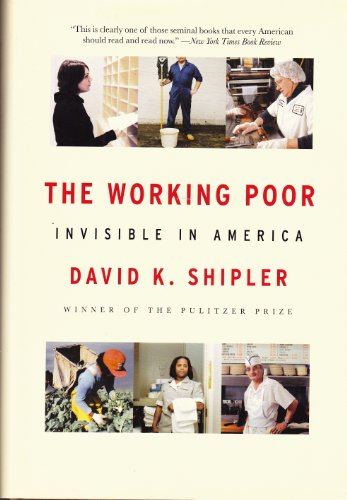
An intimate portrait of poverty-level working families from a range of ethnic backgrounds in America reveals their legacy of low-paying, dead-end jobs, dysfunctional parenting, and substance abuse and charges the government with failing to provide adequate housing, health care, and education. 40,000 first printing.
Die Inhaltsangabe kann sich auf eine andere Ausgabe dieses Titels beziehen.
Über die Autorinnen und Autoren
David K. Shipler worked for the New York Times from 1966 to 1988, reporting from New York, Saigon, Moscow, and Jerusalem before serving as chief diplomatic correspondent in Washington, D.C. He has also written for The New Yorker, the Washington Post, and the Los Angeles Times. He is the author of three other books—Russia: Broken Idols, Solemn Dreams; Arab and Jew: Wounded Spirits in a Promised Land (which won the Pulitzer Prize); and A Country of Strangers: Blacks and Whites in America. Mr. Shipler, who has been a guest scholar at the Brookings Institution and a senior associate at the Carnegie Endowment for International Peace, has taught at Princeton University, at American University in Washington, D.C., and at Dartmouth College. He lives in Chevy Chase, Maryland.
David K. Shipler is a senior associate at the Carnegie Endowment for International Peace, has taught at Princeton University, at American University in Washington, D.C., and at Dartmouth College.
Aus dem Klappentext
Most of the people I write about in this book do not have the luxury of rage. They are caught in exhausting struggles. Their wages do not lift them far enough from poverty to improve their lives, and their lives, in turn, hold them back. The term by which they are usually described, working poor, should be an oxymoron. Nobody who works hard should be poor in America. from the Introduction
From the author of the Pulitzer Prize winning Arab and Jew, a new book that presents a searing, intimate portrait of working American families struggling against insurmountable odds to escape poverty.
As David K. Shipler makes clear in this powerful, humane study, the invisible poor are engaged in the activity most respected in American ideology hard, honest work. But their version of the American Dream is a nightmare: low-paying, dead-end jobs; the profound failure of government to improve upon decaying housing, health care, and education; the failure of families to break the patterns of child abuse and substance abuse. Shipler exposes the interlocking problems by taking us into the sorrowful, infuriating, courageous lives of the poor white and black, Asian and Latino, citizens and immigrants. We encounter them every day, for they do jobs essential to the American economy.
We meet drifting farmworkers in North Carolina, exploited garment workers in New Hampshire, illegal immigrants trapped in the steaming kitchens of Los Angeles restaurants, addicts who struggle into productive work from the cruel streets of the nation s capital each life another aspect of a confounding, far-reaching urgent national crisis. And unlike most works on poverty, this one delves into the calculations of some employers as well their razor-thin profits, their anxieties about competition from abroad, their frustrations in finding qualified workers.
This impassioned book not only dissects the problems, but makes pointed, informed recommendations for change. It is a book that stands to make a difference.
Auszug. © Genehmigter Nachdruck. Alle Rechte vorbehalten.
Chapter One
Money and Its Opposite
You know, Mom, being poor is very expensive. —Sandy Brash, at age twelve
Tax time in poor neighborhoods is not April. It is January. And “income tax” isn’t what you pay; it’s what you receive. As soon as the W-2s arrive, working folks eager for their checks from the Internal Revenue Service hurry to the tax preparers, who have flourished and gouged impoverished laborers since the welfare time limits enacted by Congress in 1996. The checks that come from Washington include not only a refund of taxes withheld, but an additional payment known as the Earned Income Tax Credit, which is designed to subsidize low-wage working families. The refunds and subsidies are sometimes banked for savings toward a car, a house, an education; but they are often needed immediately for overdue bills and large purchases that can’t be funded from the trickle of wages throughout the year.
Christie, a child-care worker in Akron, earned too little to owe taxes but got $1,700 as an Earned Income Credit one year, which enabled her to avoid the Salvation Army’s used-furniture store and instead buy a new matching set of comfortable black couches and loveseats for her living room in public housing.
Caroline Payne’s check went for a down payment on her house in New Hampshire. “I used my income tax and paid a thousand down,” she said proudly. When she sold it five and a half years later and her daughter lent her money to rent a truck for her move, she planned to pay her back “when I get my taxes.”
“I’m waitin’ for my income tax to come in so I can pay my real estate taxes,” said Tom King, a single father and lumberjack who lived in a trailer on his own land.
Debra Hall, who had started at a Cleveland bakery, was keen with anticipation after filing her first tax return. “I’ll get $3,079 back! What am I gonna do with it? Pay all my bills off,” she declared, “and I haven’t had anything new in the house. Do some good with it, that’s for sure. Minor repairs on my car. The bills are first, for my credit [rating], to get all my back debts paid. It will be well spent.”
The Earned Income Tax Credit is one of those rare anti-poverty programs that appeal both to liberals and conservatives, invoking the virtue of both government help and self-help. You don’t get it unless you have some earned income, and since its payments are linked to your tax return, you don’t get it unless you file one. That leaves out low-wage workers—especially undocumented immigrants—who get paid under the table in cash and think they’re better off avoiding the IRS. By filing, however, they would end up ahead, because they’d get to keep everything they earned and would receive a payment on top of that. The benefits kick in at fairly high levels—at earnings of less than $33,692, for example, for a worker who supported more than one child in 2003. At the lower income levels, the Earned Income Tax Credit can add the equivalent of a dollar or two an hour to a worker’s wage.
Enacted in 1975, the program was expanded under Presidents Reagan, Bush, and Clinton, and in 2003 paid more than $32 billion to 18 million households. Treasury officials worry about erroneous claims, honest or fraudulent, which may rise to 27 to 32 percent of the total.1 On the other hand, an estimated 10 to 15 percent of those eligible don’t file for it,2 partly because employers and unions often don’t tell workers that it exists. The presidents of two local unions in Washington, D.C., for example, one representing janitors and the other parking garage attendants, had never heard of the Earned Income Tax Credit until I mentioned it to them. And I have not yet come across a single worker or boss who knew that with a simple form called a W-5, filed with the employer, a low-wage employee could get some of the payments in advance during the year. When I mentioned the W-5 to Debra Hall and she then asked at her bakery, the woman who handled the payroll waved her away impatiently and said she knew nothing about it. Later, the tax preparer told Debra it was better just to wait and get the payment in one lump sum after she filed her return.
It sure is better—if you’re the preparer. With cunning creativity, the preparers have devised schemes to separate low-wage workers from as much of their refunds and Earned Income Credits as feasible. The marvel of electronic filing, the speedy direct deposit into a bank account, the high-interest loan masquerading as a “rapid refund” all promise a sudden flush of dollars to cash-starved families. The trouble is, getting money costs money.
The preparers operate from sleazy check-cashing joints and from street-level outposts of respectable corporations. They do for a hefty fee what their clients could do for themselves for free with the math skills and the courage to tackle a 1040, or with a computer and a bank account to speed filing and receipt. But most low-wage workers don’t have the math, the courage, or the computer, and many don’t even have the bank account. They are so desperate for the check that they give up a precious $100 or so to get everything done quickly and correctly. “You get so scared,” said Debra Hall, who paid $95 to have her simple return done after ending twenty-one years of welfare. “I don’t know why it’s so scary, but I’d rather have it done right the first time.”
She was probably wise, because another disadvantage of being poor is that you’ve been more likely since 1999 to face an audit by the IRS. In that year, 1.36 percent of the returns filed by taxpayers making under $25,000 were audited, compared with 1.15 percent of those making $100,000 or more. The scrutiny was instigated by Republican congressional leaders who feared abuses of the Earned Income Tax Credit. In the face of bad publicity, the IRS shifted the balance in 2000 by auditing 0.6 percent of those under $25,000 versus 1.0 percent of those over $100,000. Thereafter, the audit rate tilted back and forth, to .86 and .69 percent, respectively, in 2001, then to .64 and .75 in 2002.3 In other words, as the IRS lost enforcement personnel, it dramatically reduced its scrutiny of well-to-do taxpayers, whose returns were once audited at the rate of 10 percent. This despite the fact that audits at the upper levels of income naturally tend to recover more dollars in lost revenue.
Evon Johnson never dared do another return herself after the IRS charged her $2,072 in taxes, penalties, and interest. Newly arrived from Honduras, she was working from 5 a.m. for a cleaning service in Boston that never withheld taxes and never sent her a W-2. She didn’t know they were supposed to do either. “I did my taxes, I fill it out, fine,” she said. But not so fine, evidently. “Three years after or four years after, IRS contact me saying that I owe them . . . like, $2,072. ‘Why do I owe you?’ And they say: because I didn’t declare my taxes. I say I did. . . . They say no. . . . I sent them a letter saying I was sending them $1,072 I think it was, ’cause I didn’t have no money at the time, and I was going to make small installments for the rest of the money. . . . You know what they did? I had a bank account, and they took the money from my bank account—every penny I had.” Ever since, she has happily paid $100 a year to a tax preparer, $100 a year for peace of mind. “I don’t want the IRS back on me,” she explained. “He do it and he sign it and put everything, so if any mistake, he gonna be the one who will have to deal with them.”
By the end of...
„Über diesen Titel“ kann sich auf eine andere Ausgabe dieses Titels beziehen.
Suchergebnisse für The Working Poor: Invisible in America (Rough Cut)

Beispielbild für diese ISBN
The Working Poor: Invisible in
Anbieter: World of Books (was SecondSale), Montgomery, IL, USA
Verkäuferbewertung 5 von 5 Sternen

Zustand: Good. Item in good condition. Textbooks may not include supplemental items i.e. CDs, access codes etc. Bestandsnummer des Verkäufers 00046612799
Gebraucht kaufen
EUR 3,80
Versand gratis
Versand innerhalb von USA
Versand innerhalb von USA
Anzahl: 14 verfügbar
Beispielbild für diese ISBN
The Working Poor: Invisible in
Anbieter: World of Books (was SecondSale), Montgomery, IL, USA
Verkäuferbewertung 5 von 5 Sternen
Zustand: Very Good. Item in very good condition! Textbooks may not include supplemental items i.e. CDs, access codes etc. Bestandsnummer des Verkäufers 00100524832
Gebraucht kaufen
EUR 3,80
Versand gratis
Versand innerhalb von USA
Versand innerhalb von USA
Anzahl: 4 verfügbar
Beispielbild für diese ISBN
The Working Poor: Invisible in
Anbieter: World of Books (was SecondSale), Montgomery, IL, USA
Verkäuferbewertung 5 von 5 Sternen
Zustand: Acceptable. Item in acceptable condition! Textbooks may not include supplemental items i.e. CDs, access codes etc. Bestandsnummer des Verkäufers 00108068634
Gebraucht kaufen
EUR 3,80
Versand gratis
Versand innerhalb von USA
Versand innerhalb von USA
Anzahl: 1 verfügbar
Beispielbild für diese ISBN
The Working Poor: Invisible in America
Anbieter: Gulf Coast Books, Cypress, TX, USA
Verkäuferbewertung 5 von 5 Sternen
Hardcover. Zustand: Good. Bestandsnummer des Verkäufers 0375408908-3-24609225
Gebraucht kaufen
EUR 3,81
Versand gratis
Versand innerhalb von USA
Versand innerhalb von USA
Anzahl: 1 verfügbar
Beispielbild für diese ISBN
The Working Poor: Invisible in America
Anbieter: Your Online Bookstore, Houston, TX, USA
Verkäuferbewertung 5 von 5 Sternen
Hardcover. Zustand: Good. Bestandsnummer des Verkäufers 0375408908-3-25059592
Gebraucht kaufen
EUR 3,81
Versand gratis
Versand innerhalb von USA
Versand innerhalb von USA
Anzahl: 1 verfügbar
Foto des Verkäufers
The Working Poor: Invisible in America
Anbieter: 3Brothers Bookstore, Egg harbor township, NJ, USA
Verkäuferbewertung 5 von 5 Sternen
Zustand: very_good. Cover may have light wear, pages in very good condition and binding is sturdy; may have other light shelf wear or creases. May have notes or highlighting. Bestandsnummer des Verkäufers EVV.0375408908.VG
Gebraucht kaufen
EUR 3,88
Versand gratis
Versand innerhalb von USA
Versand innerhalb von USA
Anzahl: 1 verfügbar
Beispielbild für diese ISBN
The Working Poor: Invisible in America
Anbieter: More Than Words, Waltham, MA, USA
Verkäuferbewertung 5 von 5 Sternen
Zustand: Good. A sound copy with only light wear. Overall a solid copy at a great price! Bestandsnummer des Verkäufers BOS-M-01i-01745
Gebraucht kaufen
EUR 1,15
EUR 3,52 Versand
Versand innerhalb von USA
Versand innerhalb von USA
Anzahl: 1 verfügbar
Beispielbild für diese ISBN
The Working Poor: Invisible in America
Anbieter: Bookmonger.Ltd, HILLSIDE, NJ, USA
Verkäuferbewertung 5 von 5 Sternen
hardcover. Zustand: Good. Crease on a few pages*. Bestandsnummer des Verkäufers mon0000721386
Gebraucht kaufen
EUR 1,59
EUR 3,53 Versand
Versand innerhalb von USA
Versand innerhalb von USA
Anzahl: 1 verfügbar
Beispielbild für diese ISBN
The Working Poor: Invisible in America
Anbieter: BooksRun, Philadelphia, PA, USA
Verkäuferbewertung 5 von 5 Sternen
Hardcover. Zustand: Very Good. 1. With dust jacket. It's a well-cared-for item that has seen limited use. The item may show minor signs of wear. All the text is legible, with all pages included. It may have slight markings and/or highlighting. Bestandsnummer des Verkäufers 0375408908-11-1-29
Gebraucht kaufen
EUR 5,26
Versand gratis
Versand innerhalb von USA
Versand innerhalb von USA
Anzahl: 2 verfügbar
Beispielbild für diese ISBN
The Working Poor: Invisible in America
Anbieter: Once Upon A Time Books, Siloam Springs, AR, USA
Verkäuferbewertung 4 von 5 Sternen

hardcover. Zustand: Acceptable. This is a used book. It may contain highlighting/underlining and/or the book may show heavier signs of wear . It may also be ex-library or without dustjacket. This is a used book. It may contain highlighting/underlining and/or the book may show heavier signs of wear . It may also be ex-library or without dustjacket. Bestandsnummer des Verkäufers mon0003414665
Gebraucht kaufen
EUR 1,92
EUR 3,49 Versand
Versand innerhalb von USA
Versand innerhalb von USA
Anzahl: 1 verfügbar