
Verwandte Artikel zu Yeats Is Dead!: A Mystery by Fifteen Irish Writers
Inhaltsangabe
“I think he was dead before I shot him.”
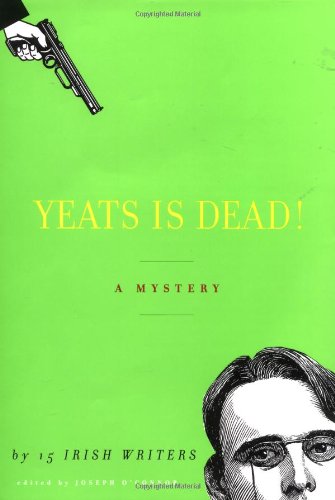
With these auspicious words begins a murder mystery so utterly unlike any other that it took fifteen of Ireland’s finest writers (working well below their peak) to bring it to its unlikely conclusion. The plot involves a mad search for the only manuscript of an unpublished novel by James Joyce, and features a stellar cast—including a sadistic sergeant with the unlikely name of Andy Andrews and the unforgettable mob boss Mrs. Bloom, a woman “who had tried everything but drew the line at honesty.” Raucous, raunchy, gratuitously violent and completely hilarious, Yeats Is Dead! is a diabolically entertaining mulligan stew of a novel. James Joyce would be proud.
Die Inhaltsangabe kann sich auf eine andere Ausgabe dieses Titels beziehen.
Über die Autorin bzw. den Autor
Joseph O’Connor’s debut novel, Cowboys and Indians, was short-listed for the Whitbread Prize. His work has been widely translated and has won many prizes. He lives in Ireland.
Yeats Is Dead! is a novel written by fifteen Irish authors as a fund-raiser for Amnesty International, a worldwide grassroots movement that promotes and defends human rights. Amnesty International works independently of all government and political ideologies to: secure the release of prisoners of conscience—people detained solely because of their beliefs, identity or ethnic origin, who have neither used nor advocated violence; ensure fair and prompt trials for all political prisoners; and end all use of torture, political killings, “disappearances” and the death penalty.
Auszug. © Genehmigter Nachdruck. Alle Rechte vorbehalten.
Chapter one
"I think he was dead before I shot him."
"I beg your pardon?" said Roberts.
"I think he was dead," said Nestor. "Already. Before . . . you know."
Roberts looked down at the dead man.
"He was talking to me," Roberts said. "He was right in the middle of a fucking sentence."
"But."
"'Tell her I'll have it by . . .' if I recall it correctly."
"But."
"And now," said Roberts, "we'll never know what he was going to say. Tonight? Christmas? The light of the silvery moon? Holy Jesus, what a mess."
"But," said Nestor.
"Yes?" snapped Roberts.
"He went really pale, like, and he"--Nestor grabbed his left tit--"Well, he . . ."
"Clutched?" Roberts offered.
"Yeah," said Nestor. "He clutched his chest."
"He had a heart attack. Is that what you're telling me?"
"Yeah," said Nestor. "He looked terrible. His face. I've seen it before. I've a cousin."
"Who had a heart attack."
"Yeah."
"And he looked just like that."
"Yeah."
"And he's still alive."
"Yeah."
"Oh good," said Roberts. "Maybe our friend here will stand up in a minute and shake himself. But hang on, though. You didn't shoot your cousin, sure you didn't?"
"Well no."
"And why would you have?" said Roberts. "Sure, he's your cousin."
". . . I," said Nestor.
And then Roberts hit him. Hard.
"What'll I do with you?" Roberts said.
And he hit him again, another almost friendly whack across the ear, harmless but for the car keys clasped between his fingers.
Nestor ducked away to a corner. He knocked over a pouffe and the mug of tea perched on it, placed there by the dead man four, five minutes before, just as Roberts had knocked on his door and walked in with Nestor.
"That'll stain," said Roberts.
The rug, the shaggy fleece of a synthetic sheep, was already soaking up the tea. Roberts took the centre pages from the Daily Mirror beside the pouffe and placed then gently over the stain. He patted the paper.
"So," he said.
Nestor was examining his ear. His right hand was still holding the gun. He drew back his head and nutted the wall. It clanged.
The dead man's home was made of tin. In a field near Courtown or Skerries it would have been a mobile home. Here, in the filthy backyard of a ruined cottage on the edge of the very edge of Dublin, it was a shack. Four tin walls; a tin roof that was snowing rust. The caravan was lopsided, up on assorted bricks and one flat wheel, surrounded, almost invaded by nettles and weeds that swayed and stank. Hardly a thing inside, only a few stacks of mouldy old newspapers, a grimy crumpled poster of James Joyce on the wall.
Roberts owned a house in Rathmines. With the help of his sister's husband, he'd converted it into thirteen bedsits. He looked around him now; a few bits of chipboard, a couple of extra beds and he could have squeezed in four students, even six, no problem--the dead body wouldn't have been noticed in the middle of their filth and parties. The place had potential. He'd find out who owned it.
He felt it wobble when he stood upright.
"So," he said.
Nestor had a handkerchief to his ear.
"She won't be happy," said Roberts. "She won't be happy at all at all." He was talking about Mrs. Bloom.
"She told us to worry him," said Roberts. "Does he look worried to you?"
"No," said Nestor.
"No," Roberts agreed. "I don't think I've ever seen a less worried-looking man."
"He had a heart attack," said Nestor.
"That would account for the hole in his chest," said Roberts.
"It was an accident."
"You really think I'm gonna go back and tell her that, do you?"
"He clutched his chest."
"I'll clutch your bollocks with pliers if you ever mention his chest or his heart again. Say after me: I shot him."
"But I didn't mean to."
"Say it."
"I shot him."
"Good. Fine. Now we're getting somewhere. You shot him. He had something she wanted. We were to worry him. A few slaps, a little glimpse at the gun there. A straightforward enough job of work. But you went and shot the poor chap. Didn't you?"
"It went off."
"Yes," said Roberts. "I noticed."
"It was the gloves."
"What?"
"They're new."
"They're nice."
"They're a bit . . ."
"Stiff?"
"Yeah," said Nestor.
"I know the way," said Roberts.
He toed the dead man's foot.
"It was the gloves did it, mister," he told the body. Then he looked at Nestor again.
"What am I going to say to her?"
Nestor said nothing.
"Well?"
"I don't know."
"And does that worry you at all?"
"Yeah."
"Good," said Roberts. "Because it worries me too. It worries me a lot. And I need the company."
Mrs. Bloom wasn't exactly their boss. Neither of them was financially dependent on her. They both had day jobs, permanent and pensionable, well away from Mrs. Bloom. In addition Roberts had his bedsits, and two or three other pots on the Baby Belling. He had a share in a kissogram service. He owned the '87 Lancia that ferried the French maids and naughty nurses and television continuity announcers--a Roberts invention, and a hit--out and around the city, from sad to sadder bastard, seven days a week. He held the croissant and baguette franchise in a twenty-four-hour shop around the corner from his bedsits.
"If you gave shite a nice smell you'd find plenty of people willing to buy it at four in the morning," he told Dymphna (the nun, schoolgirl and continuity announcer).
"I know," said Dymphna, as she cleared the steam off the passenger window and looked out for the right address.
"Talk dirty to me," said Roberts.
"Again?"
"Go on."
"The Flood Tribunal."
He had a bit of set-aside near his brother's farm, down home. He had a team of twenty-three boys and girls on the road throughout the year, selling guaranteed Irish Christmas cards, made in the Philippines, for spina bifida, Bosnian hospitals and Roberts. And he had one or two other things going as well. This and that. He saw possibilities everywhere. He clicked awake at five every morning, ideas already pinging around him before he had his feet in his slippers. An entrepreneur. That was what Roberts was. "You have to be born one," a woman sitting beside him at a Department of Industry training seminar had once said. And Roberts had agreed with her. He had been born one.
"That bollocks still has his communion money," it was often said of Roberts. About most people that was never meant literally, but in Roberts's case it was true, literally. Roberts's communion money, all £3 13s. 8d. of it in shiny old coins he had lovingly polished, was in a tobacco tin one foot under the sod, five paces--adult paces; ten on his communion day--to the right of the hinged gate of the field that was now his set-aside. Now the EU paid him money for doing nothing with the field. He wasn't even allowed to...
„Über diesen Titel“ kann sich auf eine andere Ausgabe dieses Titels beziehen.
Suchergebnisse für Yeats Is Dead!: A Mystery by Fifteen Irish Writers

Beispielbild für diese ISBN
The Founding Father The Story
Anbieter: World of Books (was SecondSale), Montgomery, IL, USA
Verkäuferbewertung 5 von 5 Sternen

Zustand: Good. Item in good condition. Textbooks may not include supplemental items i.e. CDs, access codes etc. Bestandsnummer des Verkäufers 00085943735
Gebraucht kaufen
EUR 4,61
Versand gratis
Versand innerhalb von USA
Versand innerhalb von USA
Anzahl: 2 verfügbar
Foto des Verkäufers
Yeats Is Dead! A Mystery by 15 Irish Writers
Anbieter: Greenworld Books, Arlington, TX, USA
Verkäuferbewertung 5 von 5 Sternen
Zustand: good. Fast Free Shipping â" Good condition. It may show normal signs of use, such as light writing, highlighting, or library markings, but all pages are intact and the book is fully readable. A solid, complete copy that's ready to enjoy. Bestandsnummer des Verkäufers GWV.0375412972.G
Gebraucht kaufen
EUR 4,62
Versand gratis
Versand innerhalb von USA
Versand innerhalb von USA
Anzahl: 1 verfügbar
Beispielbild für diese ISBN
Yeats Is Dead! A Mystery by 15 Irish Writers
Verlag:
Knopf (edition First American Edition), 2001
ISBN 10: 0375412972
ISBN 13: 9780375412974
Gebraucht
Hardcover
Anbieter: BooksRun, Philadelphia, PA, USA
Verkäuferbewertung 5 von 5 Sternen
Hardcover. Zustand: Very Good. First American Edition. With dust jacket. It's a well-cared-for item that has seen limited use. The item may show minor signs of wear. All the text is legible, with all pages included. It may have slight markings and/or highlighting. Bestandsnummer des Verkäufers 0375412972-11-1-29
Gebraucht kaufen
EUR 4,82
Versand gratis
Versand innerhalb von USA
Versand innerhalb von USA
Anzahl: 1 verfügbar
Foto des Verkäufers
The Founding Father: The story of Joseph P. Kennedy,
Anbieter: Used Book Company, Egg Harbor Township, NJ, USA
Verkäuferbewertung 5 von 5 Sternen
Zustand: Good. Shows moderate signs of wear and previous use. Can include notes/highlighting. A portion of your purchase benefits nonprofits! - Note: Edition & format may differ from what is shown in stock photo & item details. May not include supplementary material (toys, access code, dvds, etc). Bestandsnummer des Verkäufers 584UZG000BPG_ns
Gebraucht kaufen
EUR 4,96
Versand gratis
Versand innerhalb von USA
Versand innerhalb von USA
Anzahl: 1 verfügbar
Beispielbild für diese ISBN
Yeats Is Dead! A Mystery by 15 Irish Writers
Anbieter: Once Upon A Time Books, Siloam Springs, AR, USA
Verkäuferbewertung 4 von 5 Sternen

hardcover. Zustand: Acceptable. This is a used book. It may contain highlighting/underlining and/or the book may show heavier signs of wear . It may also be ex-library or without dustjacket. This is a used book. It may contain highlighting/underlining and/or the book may show heavier signs of wear . It may also be ex-library or without dustjacket. Bestandsnummer des Verkäufers mon0001292314
Gebraucht kaufen
EUR 2,04
EUR 3,47 Versand
Versand innerhalb von USA
Versand innerhalb von USA
Anzahl: 1 verfügbar
Beispielbild für diese ISBN
Yeats Is Dead! A Mystery by 15 Irish Writers
Anbieter: Read&Dream, SAINT LOUIS, MO, USA
Verkäuferbewertung 4 von 5 Sternen
Zustand: Good. Bestandsnummer des Verkäufers 3.3M_MG_H0006COB
Gebraucht kaufen
EUR 5,61
Versand gratis
Versand innerhalb von USA
Versand innerhalb von USA
Anzahl: 1 verfügbar
Beispielbild für diese ISBN
Yeats Is Dead! A Mystery by 15 Irish Writers
Anbieter: HPB-Ruby, Dallas, TX, USA
Verkäuferbewertung 5 von 5 Sternen
hardcover. Zustand: Very Good. Connecting readers with great books since 1972! Used books may not include companion materials, and may have some shelf wear or limited writing. We ship orders daily and Customer Service is our top priority! Bestandsnummer des Verkäufers S_469268691
Gebraucht kaufen
EUR 2,71
EUR 3,29 Versand
Versand innerhalb von USA
Versand innerhalb von USA
Anzahl: 1 verfügbar
Beispielbild für diese ISBN
Yeats Is Dead! A Mystery by 15 Irish Writers
Anbieter: HPB-Emerald, Dallas, TX, USA
Verkäuferbewertung 5 von 5 Sternen
hardcover. Zustand: Very Good. Connecting readers with great books since 1972! Used books may not include companion materials, and may have some shelf wear or limited writing. We ship orders daily and Customer Service is our top priority! Bestandsnummer des Verkäufers S_476377480
Gebraucht kaufen
EUR 2,71
EUR 3,29 Versand
Versand innerhalb von USA
Versand innerhalb von USA
Anzahl: 1 verfügbar
Beispielbild für diese ISBN
The Founding Father: The story of Joseph P. Kennedy,
Anbieter: HPB Inc., Dallas, TX, USA
Verkäuferbewertung 5 von 5 Sternen
hardcover. Zustand: Very Good. Connecting readers with great books since 1972! Used books may not include companion materials, and may have some shelf wear or limited writing. We ship orders daily and Customer Service is our top priority! Bestandsnummer des Verkäufers S_470720960
Gebraucht kaufen
EUR 2,71
EUR 3,29 Versand
Versand innerhalb von USA
Versand innerhalb von USA
Anzahl: 1 verfügbar
Beispielbild für diese ISBN
Yeats Is Dead! : A Mystery by Fifteen Irish Writers
Verlag:
Knopf Doubleday Publishing Group, 2001
ISBN 10: 0375412972
ISBN 13: 9780375412974
Gebraucht
Hardcover
Anbieter: Better World Books, Mishawaka, IN, USA
Verkäuferbewertung 5 von 5 Sternen
Zustand: Good. 1st American ed. Former library copy. Pages intact with minimal writing/highlighting. The binding may be loose and creased. Dust jackets/supplements are not included. Includes library markings. Stock photo provided. Product includes identifying sticker. Better World Books: Buy Books. Do Good. Bestandsnummer des Verkäufers GRP92996221
Gebraucht kaufen
EUR 6,25
Versand gratis
Versand innerhalb von USA
Versand innerhalb von USA
Anzahl: 2 verfügbar