
Verwandte Artikel zu Unforgivable Blackness: The Rise and Fall of Jack Johnson
Inhaltsangabe
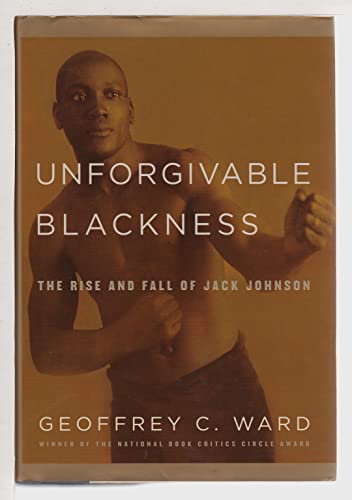
The National Book Critics Circle Award-winning author of A First-Class Temperament presents a full-scale portrait that draws on a wealth of period sources, including Johnson's never-before-published prison memoir, of heavyweight boxing champion Jack Johnson, from his rise to success to his prison sentence and life in exile.
Die Inhaltsangabe kann sich auf eine andere Ausgabe dieses Titels beziehen.
Über die Autorin bzw. den Autor
Geoffrey C. Ward won the National Book Critics Circle Award in 1989. With Ken Burns, he is coauthor of The Civil War and Jazz. He lives in New York City.
Aus dem Klappentext
He was the first black heavyweight champion in history, the most celebrated and most reviled African American of his age. In Unforgivable Blackness, the prizewinning biographer Geoffrey C. Ward brings to vivid life the real Jack Johnson, a figure far more complex and compelling than the newspaper headlines he inspired could ever convey. Johnson battled his way from obscurity to the top of the heavyweight ranks and in 1908 won the greatest prize in American sports one that had always been the private preserve of white boxers. At a time when whites ran everything in America, he took orders from no one and resolved to live as if color did not exist. While most blacks struggled just to survive, he reveled in his riches and his fame. And at a time when the mere suspicion that a black man had flirted with a white woman could cost him his life, he insisted on sleeping with whomever he pleased, and married three. Because he did so the federal government set out to destroy him, and he was forced to endure a year of prison and seven years of exile. Ward points out that to most whites (and to some African Americans as well) he was seen as a perpetual threat profligate, arrogant, amoral, a dark menace, and a danger to the natural order of things.
Unforgivable Blackness is the first full-scale biography of Johnson in more than twenty years. Accompanied by more than fifty photographs and drawing on a wealth of new material including Johnson s never-before-published prison memoir it restores Jack Johnson to his rightful place in the pantheon of American individualists.
Auszug. © Genehmigter Nachdruck. Alle Rechte vorbehalten.
The Pure-Blooded American
In the spring of 1910, Halley’s comet returned to the heavens after an absence of seventy-five years. Some believed it a sign from God that the world was about to end. Nearly everyone saw it as a momentous event, and during the week of May 18, when astronomers predicted the earth would pass through the comet’s tail, adults and sleepy children all over the country stumbled out of their homes at night to see if they could get a glimpse of it.
On the Lower East Side of New York, thousands of tenement dwellers, mostly immigrants and their families, filled the streets to peer up at the cloudy skies, while on the roof of the Waldorf-Astoria hotel uptown, Speaker of the House Joseph G. Cannon led two hundred tuxedoed guests attending the annual dinner of the National Association of Manufacturers in a champagne toast to the comet’s passing. In Memphis, Tennessee, separate all-night revivals were held for white and black believers awaiting Judgment Day. In Chicago, panicked householders blocked their doors and windows against deadly gases they believed the comet would release.
And early one morning, at the fashionable Seal Rock House on Ocean Beach at San Francisco’s western edge, guests and staff members alike gathered on the sand beneath the stars, listening to the rhythm of the surf and waiting to chart the comet’s brilliant course above the sea.
But the hotel’s most celebrated guest—the most celebrated black man on earth—remained in bed in his suite on the second floor. A member of his entourage had slipped up the stairs a few minutes earlier and tried to rouse him, but the heavyweight champion of the world had ordered him out of the room. He saw no need to get up. Over the coming centuries there would be hundreds of comets, he said. “But there ain’t gonna be but one Jack Johnson.”
Like a good many of his claims, this one was both outrageous and entirely accurate. He had, after all, battered his way from obscurity to the top of the heavyweight ranks and won the greatest prize in American sports—a prize that had always been the private preserve of white combatants. At a time when whites ran everything in America, he took orders from no one and resolved to live always as if color did not exist. While most Negroes struggled merely to survive, he reveled in his riches and his fame. And at a time when the mere suspicion that a black man had flirted with a white woman could cost him his life, he insisted on sleeping with whomever he pleased. Most whites (and some Negroes as well) saw him as a perpetual threat—profligate, arrogant, amoral, a dark menace, and a danger to the natural order of things.
The real Jack Johnson was both more and less than those who loved or those who hated him ever knew. He embodied American individualism in its purest form; nothing—no law or custom, no person white or black, male or female—could keep him for long from whatever he wanted. He was in the great American tradition of self-invented men, too, and no one admired his handiwork more than he did. All his life, whites and blacks alike would ask him, “Just who do you think you are?” The answer, of course, was always “Jack Johnson”—and that would prove to be more than enough for turn-of-the-twentieth-century America to handle.
Johnson visited Paris for the first time in June of 1908, before sailing to Australia and his long-delayed battle with the heavyweight champion Tommy Burns. It may have been then that he and an unknown French journalist began laboring together over the manuscript that would become the first of his autobiographies.* The language of its opening passage seems stilted, especially in translation, but the thoughts are unmistakably Jack Johnson’s:
When a white man writes his memoirs . . . he anxiously begins with the history of his family from earliest times. It seems the higher one ascends the more interested one is in it. And I think that most authors embroider their genealogy. Basically, none of it interests anyone other than family members.
But I don’t want to exempt myself from this ancient custom and wish to say a few words about my genealogy.
Our [Negro] memories are handed down from father to son. Whites don’t think so, but we blacks are also proud of our ancestors and during long days and still longer nights, though we knew neither schools nor books, we still transmited memories of past centuries. I don’t doubt that the stories have been modified over time, but the salient facts remain. If some parts are merely fables it doesn’t matter much. Who can tell among the white stories what is fact and what is fable?
Facts about Johnson’s ancestry are hard to come by, and he was himself a cheerful fabulist when it came to retelling his own life. But the first thing he wanted people to understand about him was that because his enslaved forebears had arrived in America long “before the United States was dreamed of,” he was himself a “pure-blooded American.” And because he knew that that was what he was, he saw no reason ever to accept any limitations on himself to which other Americans were not also subject.*
Why he insisted on acting that way at a time when most American Negroes were relegated to second-class citizenship remains the essential mystery of his life. No amount of sleuthing will ever fully solve it, but a few clues may lie half-hidden in what little we know of his boyhood.
He was born Arthur John Johnson in Galveston, Texas, on March 31, 1878, the year after the last Union troops were withdrawn from the former Confederacy, leaving freed blacks to fend for themselves.† His parents, Henry and Tina (known as Tiny) Johnson, both ex-slaves, did just that. She was from either North or South Carolina; government records and her son’s various accounts differ. Henry was born in Maryland or Virginia sometime during the 1830s; after serving as a civilian teamster attached to the U.S. Army’s 38th (Colored) Infantry, he settled in Galveston in 1867. His son loyally remembered him as “the most perfect physical specimen I have ever seen.” In fact, Henry stood just five foot five and was severely disabled by an atrophied right leg, the result of exposure to cold and rain and snow in the trenches at Petersburg, Virginia, that had caused the “disease of rheumatism” to distort his right knee—or so his attorneys would later claim in one of several unsuccessful bids he made for a veteran’s pension.
Despite his injury, despite the fact that he could not read and that neither he nor his wife could write, Henry Johnson never failed to find ways to support his family. He worked as a porter in a saloon, then as a school janitor, finally as supervising janitor for Galveston’s East School District. His wife took in washing. Both were faithful Methodists, and Henry sometimes helped with the preaching on Sundays; Jack Johnson’s glib tongue and enthusiasm for public speaking may have been an inheritance from him.
The Johnsons had nine children, four of whom lived to adulthood. They kept them all fed and clothed, saw to it that they attended at least five years of school, and somehow managed to put enough money aside to buy a plot of land at 808 Broadway at the island’s eastern end, and build their own single-story home.
Jack was the Johnsons’ third child and first son, and from the beginning seems to have been the focus of his family’s attention. He was bright, talkative, and filled with energy, but, as he and his mother both remembered, he’d also been frail as a small boy and was...
„Über diesen Titel“ kann sich auf eine andere Ausgabe dieses Titels beziehen.
Suchergebnisse für Unforgivable Blackness: The Rise and Fall of Jack Johnson

Foto des Verkäufers
Unforgivable Blackness: The Rise and Fall of Jack Johnson
Anbieter: Dream Books Co., Denver, CO, USA
Verkäuferbewertung 5 von 5 Sternen

Zustand: very_good. Pages are clean with no markings. May show minor signs of wear or cosmetic defects marks, cuts, bends, or scuffs on the cover, spine, pages, or dust jacket. May have remainder marks on edges. Bestandsnummer des Verkäufers DBV.0375415327.VG
Gebraucht kaufen
EUR 5,47
Versand gratis
Versand innerhalb von USA
Versand innerhalb von USA
Anzahl: 1 verfügbar
Beispielbild für diese ISBN
Unforgivable Blackness: The Rise and Fall of Jack Johnson
Anbieter: BooksRun, Philadelphia, PA, USA
Verkäuferbewertung 5 von 5 Sternen
Hardcover. Zustand: Fair. With dust jacket. The item might be beaten up but readable. May contain markings or highlighting, as well as stains, bent corners, or any other major defect, but the text is not obscured in any way. Bestandsnummer des Verkäufers 0375415327-7-1-29
Gebraucht kaufen
EUR 5,57
Versand gratis
Versand innerhalb von USA
Versand innerhalb von USA
Anzahl: 1 verfügbar
Beispielbild für diese ISBN
Unforgivable Blackness: The Rise and Fall of Jack Johnson
Anbieter: ThriftBooks-Dallas, Dallas, TX, USA
Verkäuferbewertung 5 von 5 Sternen
Hardcover. Zustand: Very Good. No Jacket. May have limited writing in cover pages. Pages are unmarked. ~ ThriftBooks: Read More, Spend Less. Bestandsnummer des Verkäufers G0375415327I4N00
Gebraucht kaufen
EUR 6,57
Versand gratis
Versand innerhalb von USA
Versand innerhalb von USA
Anzahl: 1 verfügbar
Beispielbild für diese ISBN
Unforgivable Blackness: The Rise and Fall of Jack Johnson
Anbieter: ThriftBooks-Dallas, Dallas, TX, USA
Verkäuferbewertung 5 von 5 Sternen
Hardcover. Zustand: Fair. No Jacket. Former library book; Readable copy. Pages may have considerable notes/highlighting. ~ ThriftBooks: Read More, Spend Less. Bestandsnummer des Verkäufers G0375415327I5N10
Gebraucht kaufen
EUR 6,57
Versand gratis
Versand innerhalb von USA
Versand innerhalb von USA
Anzahl: 1 verfügbar
Beispielbild für diese ISBN
Unforgivable Blackness: The Rise and Fall of Jack Johnson
Anbieter: ThriftBooks-Dallas, Dallas, TX, USA
Verkäuferbewertung 5 von 5 Sternen
Hardcover. Zustand: Good. No Jacket. Pages can have notes/highlighting. Spine may show signs of wear. ~ ThriftBooks: Read More, Spend Less. Bestandsnummer des Verkäufers G0375415327I3N00
Gebraucht kaufen
EUR 6,57
Versand gratis
Versand innerhalb von USA
Versand innerhalb von USA
Anzahl: 1 verfügbar
Beispielbild für diese ISBN
Unforgivable Blackness: The Rise and Fall of Jack Johnson
Anbieter: ThriftBooks-Atlanta, AUSTELL, GA, USA
Verkäuferbewertung 5 von 5 Sternen
Hardcover. Zustand: Good. No Jacket. Pages can have notes/highlighting. Spine may show signs of wear. ~ ThriftBooks: Read More, Spend Less. Bestandsnummer des Verkäufers G0375415327I3N00
Gebraucht kaufen
EUR 6,57
Versand gratis
Versand innerhalb von USA
Versand innerhalb von USA
Anzahl: 1 verfügbar
Beispielbild für diese ISBN
Unforgivable Blackness: The Rise and Fall of Jack Johnson
Anbieter: ThriftBooks-Phoenix, Phoenix, AZ, USA
Verkäuferbewertung 5 von 5 Sternen
Hardcover. Zustand: Very Good. No Jacket. May have limited writing in cover pages. Pages are unmarked. ~ ThriftBooks: Read More, Spend Less. Bestandsnummer des Verkäufers G0375415327I4N00
Gebraucht kaufen
EUR 6,57
Versand gratis
Versand innerhalb von USA
Versand innerhalb von USA
Anzahl: 1 verfügbar
Beispielbild für diese ISBN
Unforgivable Blackness: The Rise and Fall of Jack Johnson
Anbieter: ThriftBooks-Atlanta, AUSTELL, GA, USA
Verkäuferbewertung 5 von 5 Sternen
Hardcover. Zustand: Very Good. No Jacket. May have limited writing in cover pages. Pages are unmarked. ~ ThriftBooks: Read More, Spend Less. Bestandsnummer des Verkäufers G0375415327I4N00
Gebraucht kaufen
EUR 6,57
Versand gratis
Versand innerhalb von USA
Versand innerhalb von USA
Anzahl: 2 verfügbar
Beispielbild für diese ISBN
Unforgivable Blackness: The Rise and Fall of Jack Johnson
Anbieter: ThriftBooks-Atlanta, AUSTELL, GA, USA
Verkäuferbewertung 5 von 5 Sternen
Hardcover. Zustand: Very Good. No Jacket. Former library book; May have limited writing in cover pages. Pages are unmarked. ~ ThriftBooks: Read More, Spend Less. Bestandsnummer des Verkäufers G0375415327I4N10
Gebraucht kaufen
EUR 6,57
Versand gratis
Versand innerhalb von USA
Versand innerhalb von USA
Anzahl: 1 verfügbar
Beispielbild für diese ISBN
Unforgivable Blackness: The Rise and Fall of Jack Johnson
Anbieter: ThriftBooks-Reno, Reno, NV, USA
Verkäuferbewertung 5 von 5 Sternen
Hardcover. Zustand: Very Good. No Jacket. May have limited writing in cover pages. Pages are unmarked. ~ ThriftBooks: Read More, Spend Less. Bestandsnummer des Verkäufers G0375415327I4N00
Gebraucht kaufen
EUR 6,57
Versand gratis
Versand innerhalb von USA
Versand innerhalb von USA
Anzahl: 1 verfügbar