
Inhaltsangabe
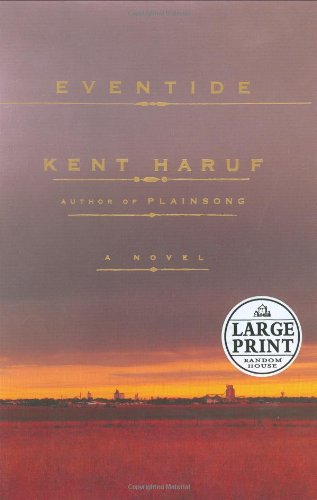
One of the most beloved novels in recent years, Plainsong was a best-seller from coast to coast—and now Kent Haruf returns to the High Plains community of Holt, Colorado, with a story of even more masterful authority.
When the McPheron brothers see Victoria Roubideaux, the single mother they’d taken in, move from their ranch to begin college, an emptiness opens before them—and for many other townspeople it also promises to be a long, hard winter. A young boy living alone with his grandfather helps out a neighbor whose husband, off in Alaska, suddenly isn’t coming home, leaving her to raise their two daughters. At school the children of a disabled couple suffer indignities that their parents know all too well in their own lives, with only a social worker to look after them and a violent relative to endanger them further. But in a small town a great many people encounter one another frequently, often surprisingly, and destinies soon become entwined—for good and for ill—as they confront events that sorely test the limits of their resilience and means, with no refuge available except what their own character and that of others afford them.
Spring eventually does reach across the land, and how the people of Eventide get there makes for an engrossing, profoundly moving novel rich in the wisdom, humor, and humanity for which Kent Haruf is justly acclaimed.
Die Inhaltsangabe kann sich auf eine andere Ausgabe dieses Titels beziehen.
Über die Autorin bzw. den Autor
Kent Haruf’s honors include a Whiting Foundation Award and a special citation from the PEN/Hemingway Foundation. His most recent novel, Plainsong, won the Mountains & Plains Booksellers Award and was a finalist for the National Book Award, the Los Angeles Times Book Prize, and the New Yorker Book Award. He lives with his wife, Cathy, in his native Colorado.
Aus dem Klappentext
One of the most beloved novels in recent years, Plainsong was a best-seller from coast to coast and now Kent Haruf returns to the High Plains community of Holt, Colorado, with a story of even more masterful authority.
When the McPheron brothers see Victoria Roubideaux, the single mother they d taken in, move from their ranch to begin college, an emptiness opens before them and for many other townspeople it also promises to be a long, hard winter. A young boy living alone with his grandfather helps out a neighbor whose husband, off in Alaska, suddenly isn t coming home, leaving her to raise their two daughters. At school the children of a disabled couple suffer indignities that their parents know all too well in their own lives, with only a social worker to look after them and a violent relative to endanger them further. But in a small town a great many people encounter one another frequently, often surprisingly, and destinies soon become entwined for good and for ill as they confront events that sorely test the limits of their resilience and means, with no refuge available except what their own character and that of others afford them.
Spring eventually does reach across the land, and how the people of Eventide get there makes for an engrossing, profoundly moving novel rich in the wisdom, humor, and humanity for which Kent Haruf is justly acclaimed.
Auszug. © Genehmigter Nachdruck. Alle Rechte vorbehalten.
They came up from the horse barn in the slanted light of early morning. The McPheron brothers, Harold and Raymond. Old men approaching an old house at the end of summer. They came on across the gravel drive past the pickup and the car parked at the hogwire fencing and came one after the other through the wire gate. At the porch they scraped their boots on the saw blade sunken in the dirt, the ground packed and shiny around it from long use and mixed with barnlot manure, and walked up the plank steps onto the screened porch and entered the kitchen where the nineteen-year-old girl Victoria Roubideaux sat at the pinewood table feeding oatmeal to her little daughter.
In the kitchen they removed their hats and hung them on pegs set into a board next to the door and began at once to wash up at the sink. Their faces were red and weather-blasted below their white foreheads, the coarse hair on their round heads grown iron-gray and as stiff as the roached mane of a horse. When they finished at the sink they each in turn used the kitchen towel to dry off, but when they began to dish up their plates at the stove the girl made them sit down.
There's no use in you waiting on us, Raymond said.
I want to, she said. I'll be gone tomorrow.
She rose with the child on her hip and brought two coffee cups and two bowls of oatmeal and a plate of buttered toast to the table and then sat down again.
Harold sat eyeing the oatmeal. You think she might of at least give us steak and eggs this once, he said. On account of the occasion. But no sir, it's still only warm mush. Which tastes about like the back page of a wet newspaper. Delivered yesterday.
You can eat what you want after I'm gone. I know you will anyway.
Yes ma'am, probably so. Then he looked at her. But I'm not in any rush for you to leave here. I'm just trying to joke you a little.
I know you are. She smiled at him. Her teeth were very white in her brown face, and her black hair was thick and shiny and cut off neat below her shoulders. I'm almost ready, she said. First I want to feed Katie and get her dressed, then we can start.
Let me have her, Raymond said. Is she done eating?
No, she isn't, the girl said. She might eat something for you though. She just turns her head away for me.
Raymond stood and walked around the table and took up the little girl and returned to his seat and sat her on his lap and sprinkled sugar on the oatmeal in his bowl and poured out milk from the jar on the table and began to eat, the black-haired round-cheeked girl watching him as if she were fascinated by what he was doing. He held her easily, comfortably, his arm about her, and spooned up a small portion and blew over it and offered it to her. She took it. He ate more himself. Then he blew over another spoonful and gave that to her. Harold poured milk into a glass and she leaned forward over the table and drank a long time, using both hands, until she had to stop for breath.
What am I going to do in Fort Collins when she won't eat? Victoria said.
You can call on us, Harold said. We'll come see about this little girl in about two minutes. Won't we, Katie.
The child looked across the table at him, unblinking. Her eyes were as black as her mother's, like buttons or currants. She said nothing but took up Raymond's calloused hand and moved it toward the cereal bowl. When he held out the spoon she pushed his hand toward his mouth. Oh, he said. All right. He blew over it elaborately, puffing his cheeks, moving his red face back and forth, and now she would eat again.
When they were finished Victoria carried her daughter into the bathroom off the dining room to wash her face and then took her back to their bedroom and changed her clothes. The McPheron brothers went upstairs to their rooms and got into town clothes, dark trousers and pale shirts with pearl snaps and their good white hand-shaped Bailey hats. Back downstairs they carried Victoria's suitcases out to the car and set them in the trunk. The backseat was already loaded with boxes of the little girl's clothes and blankets and bedsheets and toys, and a child's padded car seat. Behind the car was the pickup and in its bed, together with the spare tire and the jack and a half dozen empty oil cans and dry wisps of brome hay and a piece of rusted barbed wire, were the little girl's high chair and her daybed, its mattress wrapped in a new tarp, all of it lashed down with orange binder twine.
They returned to the house and came out with Victoria and the little girl. On the porch Victoria paused for a moment, her dark eyes welling with sudden tears.
What's the matter here? Harold said. Is something wrong?
She shook her head.
You know you can always come back. We're expecting you to. We're counting on it. Maybe it'll help to keep that in mind.
It isn't that, she said.
Is it because you're kind of scared? Raymond said.
It's just that I'm going to miss you, she said. I haven't been gone before, not like this. That other time with Dwayne I can't even remember and I don't want to. She shifted the little girl from one arm to the other and wiped at her eyes. I'm just going to miss you, that's all it is.
You can call if you need something, Harold said. We'll still be here at the other end.
But I'm still going to miss you.
Yes, Raymond said. He looked out from the porch toward the barnlot and the brown pastures beyond. The blue sandhills in the far distance low on the low horizon, the sky so clear and empty, the air so dry. We're going to miss you too, he said. We'll be about like old played-out workhorses once you're gone. Standing around lonesome, always looking over the fence. He turned to study her face. A face familiar and dear to him now, the three of them and the baby living in the same open country, in the same old weathered house. But you think you can come on? he said. We probably ought to get this thing started if we're going to.
Raymond drove her car with Victoria sitting beside him so she could reach into the back and tend to Katie in her padded chair. Harold followed them in the pickup, out the lane onto the gravel county road, headed west to the two-lane blacktop, then north toward Holt. The country both sides of the highway was flat and treeless, the ground sandy, the wheat stubble in the flat fields still bright and shiny since its cutting in July. Beyond the barrow ditches the irrigated corn stood up eight feet tall, darkly green and heavy. The grain elevators in the distance showed tall and white in town beside the railroad tracks. It was a bright warm day with the wind coming hot out of the south.
In Holt they turned onto US 34 and stopped at the Gas and Go where Main Street intersected the highway. The McPherons got out and stood at the pumps, gassing up both vehicles as Victoria went in to buy them cups of coffee and a Coke for herself and a bottle of juice for the little girl. Ahead of her in line at the cash register a heavy black-haired man and his wife were standing with a young girl and a small boy. She had seen them walking at all hours along the streets of Holt and she had heard the stories. She thought that if it weren't for the McPheron brothers she might be like them herself. She watched as the girl moved to the front of the store and took a magazine from the rack at the plateglass windows and flipped through it with her back turned away as if she were not related in any manner to the people at the counter. But after the man had paid for a box of cheese crackers and four cans of pop with food stamps, she put the magazine back and followed the rest of her family out the door.
When Victoria came out, the man and the woman were standing in the tarred parking lot deciding something between themselves. She couldn't see the girl or her brother, then turned and saw they...
„Über diesen Titel“ kann sich auf eine andere Ausgabe dieses Titels beziehen.
Weitere beliebte Ausgaben desselben Titels

Suchergebnisse für Eventide (Random House Large Print)

Beispielbild für diese ISBN
Eventide (Random House Large Print)
Verlag:
Random House Large Print, 2004
ISBN 10: 0375433317
ISBN 13: 9780375433313
Gebraucht
Hardcover
Anbieter: World of Books (was SecondSale), Montgomery, IL, USA
Verkäuferbewertung 5 von 5 Sternen

Zustand: Good. Good condition ex-library book with usual library markings and stickers. Bestandsnummer des Verkäufers 00103422499
Gebraucht kaufen
EUR 6,40
Versand gratis
Versand innerhalb von USA
Versand innerhalb von USA
Anzahl: 1 verfügbar
Beispielbild für diese ISBN
Eventide
Verlag:
Random House Large Print, 2004
ISBN 10: 0375433317
ISBN 13: 9780375433313
Gebraucht
Hardcover
Anbieter: Better World Books, Mishawaka, IN, USA
Verkäuferbewertung 5 von 5 Sternen
Zustand: Good. Pages intact with minimal writing/highlighting. The binding may be loose and creased. Dust jackets/supplements are not included. Stock photo provided. Product includes identifying sticker. Better World Books: Buy Books. Do Good. Bestandsnummer des Verkäufers 2295817-6
Gebraucht kaufen
EUR 6,41
Versand gratis
Versand innerhalb von USA
Versand innerhalb von USA
Anzahl: 1 verfügbar
Beispielbild für diese ISBN
Eventide (Random House Large Print)
Verlag:
Random House Large Print, 2004
ISBN 10: 0375433317
ISBN 13: 9780375433313
Gebraucht
Hardcover
Anbieter: ThriftBooks-Dallas, Dallas, TX, USA
Verkäuferbewertung 5 von 5 Sternen
Hardcover. Zustand: Good. No Jacket. Former library book; Pages can have notes/highlighting. Spine may show signs of wear. ~ ThriftBooks: Read More, Spend Less. Bestandsnummer des Verkäufers G0375433317I3N10
Gebraucht kaufen
EUR 7,15
Versand gratis
Versand innerhalb von USA
Versand innerhalb von USA
Anzahl: 1 verfügbar