
Verwandte Artikel zu Proud to Be
Inhaltsangabe
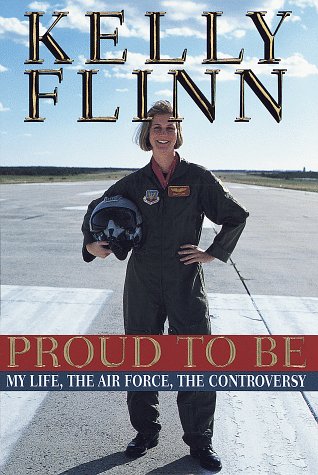
The first woman to fly a B-52 recounts how she was forced to resign from the Air Force in 1997 because of her relationship with a fellow officer, which came to light during a highly publicized, controversial investigation
Die Inhaltsangabe kann sich auf eine andere Ausgabe dieses Titels beziehen.
Über die Autorin bzw. den Autor
Kelly Flinn majored in biology at the U.S. Air Force Academy and graduated in 1993. She is the first woman to pilot a B-52. She resigned from the Air Force in 1997 but hopes to serve again. She has lived primarily in St. Louis and Atlanta.
Aus dem Klappentext
nary young woman. An extraordinary controversy. This is Kelly Flinn's story--the one she couldn't tell when she was in uniform.<br><br>"I fell in love with the wrong man."--Kelly Flinn <br><br>She is the first woman to pilot a B-52, a charismatic twenty-six-year-old from a proper Georgia family who has always distinguished herself--as a fifteen- year-old at U.S. Space Camp and as a cadet at the U.S. Air Force Academy. There, she overcame considerable odds and earned a coveted position as a combat pilot. But nothing prepared Lieutenant Kelly Flinn for the controversy that erupted when the military began an investigation into her relationship with Marc Zigo, a man who lied to her about his marital status and then betrayed her to military authorities. Flinn was forced to resign amid charges of disobeying orders--charges she disputes in this poignant and powerful memoir. <br><br>This is the story of Flinn's love affair with flying . . . and the love affair that ended her trailb
Auszug. © Genehmigter Nachdruck. Alle Rechte vorbehalten.
CHAPTER 1
Playing to Win
No one can predict to what heights you can soar, even you will not know until you spread your wings.
--FROM A POSTER ENTITLED "GOALS"
Anyone who says that women aren't meant to be worriors doesn't know much about little girls. Little girls are intense, stubborn, and passionate. Some, of course, put their intensity into pushing baby buggies and dressing up their dolls. But others are simply wildcats. They're the fastest kids in the class. They're the terrors of the jungle gym and swings. They play competitive sports to win. They don't mind getting down and dirty in the mud. And they're no less girlish for it.
I was that kind of little girl. I was the baby of my family, with four much older brothers and sisters. (Another older brother, Kevin, died of spina bifida after only one month of life.) For the first years of my life, my role in the family was to be cute. At my Catholic school, St. Monica's, I tried to give the impression of being a perfect student. I sat quietly, day in and day out, in my red-and-black-plaid jumper, trying to please the sisters. But I wore red athletic shorts under my jumper, and the moment I was out of the classroom, there was no stopping me. I was the terror of the playground: fast, furious, competitive. When I was five, I joined my first soccer league. I played on a boys' team--there wasn't a girls' team in Creve Coeur, Missouri, then. When the boys ran around the field trying to kiss me, I'd run the other way. I was there to play--and to win. I was training to beat my brother Don, who'd taught me to play by kicking a soccer ball around the yard with me when he came home from college. Never mind that he was fourteen years older and a varsity athlete. With daily practice, I believed, I could take him on. I had to be combative, with two older brothers. Getting what I wanted, holding my own, was often a matter of hand-to-hand combat. My brother Tim, for example, used to fight me every afternoon over my choice of TV programs. I could watch whatever I wanted--provided I could get past him to the TV set to change channels. He was eight years older than I, so this wasn't easy, particularly since he had a trick: he'd pick me up by my feet, hold me upside down, and scream: "It's the pile driver!" That usually put an end to the fight, left me screaming and laughing while my father yelled, "Knock it off!" from upstairs. The next day, we would start up again. It was like trench warfare: little progress, many casualties. Tim also used to practice his hockey skills with me in the basement. I'd don a goalie mask and a baseball mitt and grab a hockey stick; then he'd move a few paces back and take slap shots at me with a tennis ball. Every once in a while, he'd body-slam me against our rec room walls. I defended myself pretty well, considering that he was sixteen and I was only eight. It honed the reflexes I'd need for soccer playing. And my survival skills.
Things were different, of course, with my sisters, Patti and Gail. Unfortunately, since they were ten and eleven years older than I, we weren't very close while I was a child. I glimpsed their teenage lives from a distance: clothes, makeup, hair worries, and dates were all part of a mysterious world just out of my reach. Gail was a cheerleader who knew how to have a good time; Patti, who is deaf, was a top swimmer and basketball player. I admired them enormously, but I couldn't really be like them. I tried to play with the dolls they'd handed down to me, but I couldn't figure out how. The dolls seemed like such lifeless things. They were boring. One of them, Chatty Kathy, actually frightened me. I'd inherited her from a neighboring family after their daughter, a good friend of Gail, committed suicide. The doll was eighteen inches long, with brown hair and a slot in her back for a two-inch record. You would insert the record into the slot and pull a string on her back and she'd repeat, "I'm Chatty Kathy," over and over again. I used to have nightmares about Chatty Kathy. The thought of her still spooks me today.
Patti and Gail's Barbie dolls simply stumped me. I just didn't know how to play with them. I'd take two of the dolls by their skinny plastic legs and hold them opposite each other, pretending that they were having a conversation; I'd shake them up and down, move them around, try to create some action. But nothing ever happened. So I'd throw them aside and end up reaching for the yellow Tonka trucks or Hot Wheels cars I'd inherited from my brothers. I'd rush out of my bedroom and into the backyard, climb onto the dirt pile, and toss the trucks to the ground, filling them with dirt, battling with ants and worms, throwing spiders into the back of the cement truck and taking them for a ride. My parents tried to spur my interest in dolls by buying me Barbie's airplane set. I loved the plane: I pictured myself flying around the world, solving mysteries, having adventures. Barbie and friends just tagged along for the ride.
Had there been some little girls in my neighborhood, they might have been able to show me how to play with dolls. But there were just little boys. My best friend was a boy named Tommy who lived next door. He had all the orange plastic tracks for the Hot Wheels car set and was always up for a race or for building a fort in his living room. Or, if we felt like going outside, we'd hike off to our nearby creek, where we'd chase frogs, catch tadpoles and turtles, and cover ourselves head to toe in mud. Being a tomboy wasn't anything I ever thought about as a child. With no girls in the neighborhood, I had no one to compare myself with, and my parents didn't pressure me to be a "real" girl. My mother did try, it's true, to interest me in ballet and tap dancing. But she let those go pretty easily, once it became clear that I wasn't having any of them. She'd learned, early on, that it was virtually impossible to get me to do something I didn't want to do. I never wanted, for example, to wear skirts or dresses. I felt they cramped my style. They kept me from scrambling up jungle gyms and from running as fast as I could in races, beating all the boys. This wasn't much of a problem on school days--I wore shorts under my jumper. But it led to a major conflict when I was seven and first-communion time came around. The ceremony was extremely important to my mother. We were practicing Catholics; we went to mass every Sunday and on devotional days. My mother insisted I dress correctly: white dress, white veil, no shorts. We battled over this for weeks. My mother--as I came to realize when the Air Force turned our lives into a circus--is every bit as strong-willed as I am. So I gave in. I dressed; she inspected me, making sure I didn't have on shorts, and then she went to the ceremony. Little did she know I had hidden a pair of red gym shorts in the car. I balled them up in my hands, took them with me into the school assembly room, ran to the back, hid behind the coats, and discreetly put my shorts on under my dress. Then I donned my white gloves and fell in line for the procession with a big smile on my face.
Puberty changed everything. When you're a little girl, you can basically get away with doing and being whatever you want, provided you have the support and encouragement to do so. But once you start maturing, it's as though you have to make a choice. You have to be a "real" girl, or be an outsider. I was afraid of losing the freedom and fun I'd always known as a child. When I turned eleven and we moved to Georgia, I immediately signed up for all the teams and sporting activities I could. I was scared of becoming a teenager, of the mixed-up world of boys and sex and experimentation of all kinds that lay ahead. I saw the girls around me developing and heard how people snickered at them, commenting on their bras and...
„Über diesen Titel“ kann sich auf eine andere Ausgabe dieses Titels beziehen.
Weitere beliebte Ausgaben desselben Titels

Suchergebnisse für Proud to Be

Beispielbild für diese ISBN
Proud to be
Anbieter: World of Books (was SecondSale), Montgomery, IL, USA
Verkäuferbewertung 5 von 5 Sternen

Zustand: Very Good. Item in very good condition! Textbooks may not include supplemental items i.e. CDs, access codes etc. Bestandsnummer des Verkäufers 00085964985
Gebraucht kaufen
EUR 4,35
Versand gratis
Versand innerhalb von USA
Versand innerhalb von USA
Anzahl: 3 verfügbar
Beispielbild für diese ISBN
Proud to be
Anbieter: World of Books (was SecondSale), Montgomery, IL, USA
Verkäuferbewertung 5 von 5 Sternen
Zustand: Good. Item in good condition. Textbooks may not include supplemental items i.e. CDs, access codes etc. Bestandsnummer des Verkäufers 00094828978
Gebraucht kaufen
EUR 4,35
Versand gratis
Versand innerhalb von USA
Versand innerhalb von USA
Anzahl: 11 verfügbar
Foto des Verkäufers
Proud to Be: My Life, The Airforce, The Controversy
Anbieter: Reliant Bookstore, El Dorado, KS, USA
Verkäuferbewertung 5 von 5 Sternen
Zustand: good. This book is in good condition with very minimal damage. Pages may have minimal notes or highlighting. Cover image on the book may vary from photo. Ships out quickly in a secure plastic mailer. Bestandsnummer des Verkäufers RDV.0375501096.G
Gebraucht kaufen
EUR 4,36
Versand gratis
Versand innerhalb von USA
Versand innerhalb von USA
Anzahl: 1 verfügbar
Foto des Verkäufers
Proud to Be: My Life, The Airforce, The Controversy
Anbieter: Greenworld Books, Arlington, TX, USA
Verkäuferbewertung 5 von 5 Sternen
Zustand: good. Fast Free Shipping â" Good condition. It may show normal signs of use, such as light writing, highlighting, or library markings, but all pages are intact and the book is fully readable. A solid, complete copy that's ready to enjoy. Bestandsnummer des Verkäufers GWV.0375501096.G
Gebraucht kaufen
EUR 4,54
Versand gratis
Versand innerhalb von USA
Versand innerhalb von USA
Anzahl: 1 verfügbar
Beispielbild für diese ISBN
Proud to Be: My Life, The Airforce, The Controversy
Anbieter: More Than Words, Waltham, MA, USA
Verkäuferbewertung 5 von 5 Sternen
Zustand: Very Good. . . All orders guaranteed and ship within 24 hours. Before placing your order for please contact us for confirmation on the book's binding. Check out our other listings to add to your order for discounted shipping. Bestandsnummer des Verkäufers WAL-F-4b-002466
Gebraucht kaufen
EUR 1,12
EUR 3,44 Versand
Versand innerhalb von USA
Versand innerhalb von USA
Anzahl: 1 verfügbar
Foto des Verkäufers
Proud to Be: My Life, The Airforce, The Controversy
Anbieter: Greenworld Books, Arlington, TX, USA
Verkäuferbewertung 5 von 5 Sternen
Zustand: very_good. Fast Free Shipping â" Very Good condition book with a firm cover and clean pages. Shows normal use and some light wear or limited notes markings. A solid, nice copy to enjoy. Bestandsnummer des Verkäufers GWV.0375501096.VG
Gebraucht kaufen
EUR 4,87
Versand gratis
Versand innerhalb von USA
Versand innerhalb von USA
Anzahl: 1 verfügbar
Beispielbild für diese ISBN
Proud to Be: My Life, The Airforce, The Controversy
Anbieter: Open Books, Chicago, IL, USA
Verkäuferbewertung 5 von 5 Sternen
hardcover. Zustand: Very Good. Open Books is a nonprofit social venture that provides literacy experiences for thousands of readers each year through inspiring programs and creative capitalization of books. Bestandsnummer des Verkäufers mon0000814082
Gebraucht kaufen
EUR 1,55
EUR 3,44 Versand
Versand innerhalb von USA
Versand innerhalb von USA
Anzahl: 1 verfügbar
Beispielbild für diese ISBN
Proud to Be: My Life, The Airforce, The Controversy
Verlag:
Random House (edition ), 1997
ISBN 10: 0375501096
ISBN 13: 9780375501098
Gebraucht
Hardcover
Anbieter: BooksRun, Philadelphia, PA, USA
Verkäuferbewertung 5 von 5 Sternen
Hardcover. Zustand: Fair. With dust jacket. The item might be beaten up but readable. May contain markings or highlighting, as well as stains, bent corners, or any other major defect, but the text is not obscured in any way. Bestandsnummer des Verkäufers 0375501096-7-1-29
Gebraucht kaufen
EUR 5,34
Versand gratis
Versand innerhalb von USA
Versand innerhalb von USA
Anzahl: 1 verfügbar
Beispielbild für diese ISBN
Proud to Be
Verlag:
Random House Inc, 1997
ISBN 10: 0375501096
ISBN 13: 9780375501098
Gebraucht
Hardcover
Erstausgabe
Anbieter: Too Little Time Used Books, Marysville, MI, USA
Verkäuferbewertung 1 von 5 Sternen

Hardcover. Zustand: Very Good. Zustand des Schutzumschlags: Very Good. 1st Edition. Clean, crisp copy. DJ not clipped. No markings. Bestandsnummer des Verkäufers 000857
Gebraucht kaufen
EUR 1,78
EUR 3,88 Versand
Versand innerhalb von USA
Versand innerhalb von USA
Anzahl: 1 verfügbar
Beispielbild für diese ISBN
Proud to Be: My Life, The Airforce, The Controversy
Anbieter: HPB-Diamond, Dallas, TX, USA
Verkäuferbewertung 5 von 5 Sternen
hardcover. Zustand: Very Good. Connecting readers with great books since 1972! Used books may not include companion materials, and may have some shelf wear or limited writing. We ship orders daily and Customer Service is our top priority! Bestandsnummer des Verkäufers S_462575047
Gebraucht kaufen
EUR 2,49
EUR 3,24 Versand
Versand innerhalb von USA
Versand innerhalb von USA
Anzahl: 1 verfügbar