
Verwandte Artikel zu The Essential Conversation: What Parents and Teachers...
Inhaltsangabe
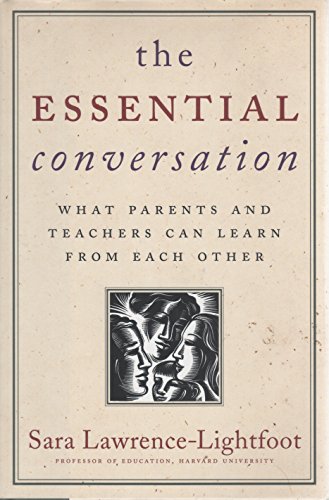
Offers practical guidelines on how to establish an effective dialogue between parents and teachers, examining the dynamics of such conversations, the nature of the learning process, and the diverse principles and practices of improving family-school relationships. 25,000 first printing.
Die Inhaltsangabe kann sich auf eine andere Ausgabe dieses Titels beziehen.
Über die Autorin bzw. den Autor
Sara Lawrence-Lightfoot, a sociologist, is a professor of education at Harvard University, where, since 1972, she has studied the culture of schools, families, and communities. She is the author of eight books, including The Good High School, Respect, I ve Known Rivers, and Balm in Gilead, which won the 1988 Christopher Award for literary merit and humanitarian achievement. In 1984, she was the recipient of the prestigious MacArthur Prize Fellowship. In 1993, she was awarded Harvard s George Ledlie Prize for research that makes the most valuable contribution to science and is to the benefit of mankind. She is the first African-American woman in Harvard s history to have an endowed professorship named in her honor.
Aus dem Klappentext
With the insights she has gleaned from her close and subtle observation of parent-teacher conferences, renowned Harvard University professor Sara Lawrence-Lightfoot has written a wise, useful book about the ways in which parents and teachers can make the most of their essential conversation the dialogue between the most vital people in a child s life.
The essential conversation is the crucial exchange that occurs between parents and teachers a dialogue that takes place more than one hundred million times a year across our country and is both mirror of and metaphor for the larger cultural forces that define family-school relationships and shape the development of our children. Participating in this twice-yearly ritual, so friendly and benign in its apparent goals, parents and teachers are often wracked with anxiety. In a meeting marked by decorum and politeness, they frequently exhibit wariness and assume defensive postures. Even though the conversation appears to be focused on the student, adults may find themselves playing out their own childhood histories, insecurities, and fears.
Through vivid portraits and parables, Sara Lawrence-Lightfoot captures the dynamics of this complex, intense relationship from the perspective of both parents and teachers. She also identifies new principles and practices for improving family-school relationships. In a voice that combines the passion of a mother, the skepticism of a social scientist, and the keen understanding of one of our nation s most admired educators, Lawrence-Lightfoot offers penetrating analysis and an urgent call to arms for all those who want to act in the best interests of their children.
For parents and teachers who seek productive dialogues and collaborative alliances in support of the learning and growth of their children, this book will offer valuable insights, incisive lessons, and deft guidance on how to communicate more effectively. In The Essential Conversation, Sara Lawrence-Lightfoot brings scholarship, warmth, and wisdom to an immensely important cultural subject the way we raise our children.
Auszug. © Genehmigter Nachdruck. Alle Rechte vorbehalten.
CHAPTER 1
Ghosts in the Classroom
The Doorknob Phenomenon
The parent-teacher conference is over; the father rises to leave and heads for the door. He touches the doorknob, then turns back abruptly with one final thought that he delivers passionately. “And another thing,” he blurts out, referring to a topic that was covered earlier in the meeting. “That same thing happened to me in fifth grade, and I swear it is not going to happen to my child!” His tone is threatening; his teeth are bared. His anguished outburst surprises even him. His passion explodes in defense of his child and in self-defense of the child he was.
Generational Echoes
Every time parents and teachers encounter one another in the classroom, their conversations are shaped by their own autobiographi- cal stories and by the broader cultural and historical narratives that inform their identities, their values, and their sense of place in the world. These autobiographical stories—often-unconscious replays of childhood experiences in families and in school—are powerful forces in defining the quality and trajectory of parent-teacher dialogues. There is something immediate, reflexive, and regressive, for both parents and teachers, about their encounters with one another, a turning inward and backward, a sense of primal urgency. The parents come to the meeting, sit facing the teacher in the chairs that their children inhabit each day, and begin to feel the same way they felt when they were students—small and powerless. And when the teachers offer observations and evaluations of their students, they are often using values and frameworks carved out of their own early childhood experiences. The adults come together prepared to focus on the present and the future of the child, but instead they feel themselves drawn back into their own pasts, visited by the ghosts of their parents, grandparents, siblings, and former teachers, haunted by ancient childhood dramas. These visitations and echoes reverberate through the room, complicating the conversation and filling the space with the voices of people who are not there, people who are often long gone. The “doorknob phenomenon,” a typical but surprising aftershock of the visitation of ghosts during the conference, is evidence that parent-teacher dialogues are imprinted with ancient, psychological themes; that conversations between them reverberate with intergenerational voices; and that part of the power of these ghostly appearances is that they are usually hidden from consciousness.
For a long time, of course, the psychological literature has emphasized the power of early childhood experiences—primarily formed within the intimacy and potency of parent-child relationships—to the shaping of adult temperament and personality. It has also underscored the ways in which these primal relationships get replayed and reconfigured in the next generation. For example, in a famous essay by psychoanalyst Selma Fraiberg, she speaks about the unwelcome and unconscious presence of these ghosts hovering in the nursery, establishing residence at the baby’s side, casting a spell on the way the parents relate to the child. She says, “These are ghosts in the nur- sery . . . visitors from the unremembered pasts of the parents, the uninvited guests at the christening.” Although the ghosts to whom Fraiberg refers are imaginary, they are real in the emotional lives of parents. The images and stories of ancestral figures in the parents’ families make a claim on their unique view of their child and on their hopes and dreams for who he/she is and will become.
In this chapter we see that these ancestral figures make their appearance in school as well. They are particularly intrusive when parents and teachers come together, each with their own autobiographical scripts. Just like the father whose parting shot echoed with an ancient pain, teachers also surprise themselves by beginning almost every conversation about their relationship to parents with emotion-packed reflections on their own childhood experiences. They speak about how their work with students and parents offers them the chance to undo early traumas in their lives or replay and enhance good memories that made them strong. They discover that their relationships with individual students—their overidentification with one, their unfettered admiration of another, or their feelings of revulsion with another—are often the result of seeing their own childhoods mirrored in their students.
These generational echoes are double-edged for both parents and teachers. They are a source of both guidance and distraction, insight and bias. They sometimes lead to important breakthroughs and discoveries in the conversation, and at other times force an abrupt breakdown and impasse. But for the most part, these meta-messages remain hidden, inaudible, unarticulated. They are the raw, unvarnished subtext to the ritualized, polite, public text of the conversation. They are the unconscious, diffuse backdrop to the precise words that fill the foreground dialogue.
What is fascinating about these generational echoes is how deep and penetrating they are and yet how easily they are uncovered. They are both subterranean and open to revelation. Given a safe place to talk about their lives and their work and an attentive, respectful listener who is genuinely curious about their experiences, people discover, often for the first time, the early roots of their current preoccupations and actions. When these long-ago tales are uncovered, their power and influence are indisputable.
Every one of the teachers I interviewed, for example, finds it necessary to begin with her life story, her perspective as a young child. For some teachers their autobiographical references capture only fragments of a story, metaphors or images that reverberate with broad and deep meaning: a father’s frown of disapproval, a competitive sibling’s fierce determination to earn better grades, a humiliating moment forgetting the practiced prose of a valedictory speech, a teacher’s insinuating insult. For others the narratives are detailed and sequential, embedded in context and rich with emotional texture. Interestingly, most of the teachers’ references to their childhood stories refer to traumatic, painful experiences rather than memories of triumph, and these have a huge impact on how they work with their students and build relationships with parents.
It is important to recognize that teachers’ reflections on their life stories as touchstones for their work with students and families flies in the face of much of the scholarly literature on teachers. That literature describes them as—assumes them to be—neutral, unemotional, and static adults with no interior life, no phantoms from the past, no ambivalence, and no fears. Philosopher Maxine Greene challenges this pervasive view of teachers as bound up in their professional, rationalistic, and objective straitjackets and urges us to recognize the power of their “personal biographies.” This narrow conception of teachers, says Greene, is not only a distortion of the complex, layered lives of teachers both within and outside the classroom, it also limits the repertoire of ways in which they might successfully relate to children and their families, and the range of human qualities and emotions in them that might support communication and rapport with parents.
The teacher is frequently addressed as if he had no life of his own, no body, and no inwardness. Lecturers seem to presuppose a “man within a man” when they describe a good teacher as infinitely controlled and accommodating, technically efficient, impervious to moods. They are likely to define him by the role he is expected...
„Über diesen Titel“ kann sich auf eine andere Ausgabe dieses Titels beziehen.
Suchergebnisse für The Essential Conversation: What Parents and Teachers...

Beispielbild für diese ISBN
The Essential Conversation: What Parents and Teachers Can Learn from Each Other
Anbieter: World of Books (was SecondSale), Montgomery, IL, USA
Verkäuferbewertung 5 von 5 Sternen

Zustand: Acceptable. Item in acceptable condition! Textbooks may not include supplemental items i.e. CDs, access codes etc. Bestandsnummer des Verkäufers 00101911794
Gebraucht kaufen
EUR 4,34
Versand gratis
Versand innerhalb von USA
Versand innerhalb von USA
Anzahl: 1 verfügbar
Beispielbild für diese ISBN
The Essential Conversation: What Parents and Teachers Can Learn from Each Other
Anbieter: World of Books (was SecondSale), Montgomery, IL, USA
Verkäuferbewertung 5 von 5 Sternen
Zustand: Good. Good condition ex-library book with usual library markings and stickers. Bestandsnummer des Verkäufers 00101201024
Gebraucht kaufen
EUR 4,34
Versand gratis
Versand innerhalb von USA
Versand innerhalb von USA
Anzahl: 1 verfügbar
Foto des Verkäufers
The Essential Conversation: What Parents and Teachers Can Learn from Each Other
Anbieter: Used Book Company, Egg Harbor Township, NJ, USA
Verkäuferbewertung 5 von 5 Sternen
Zustand: As New. Shows very minimal signs of wear and previous use. A portion of your purchase benefits nonprofits! - Note: Edition & format may differ from what is shown in stock photo & item details. May not include supplementary material (toys, access code, dvds, etc). Bestandsnummer des Verkäufers 584ZSU000DAT_ns
Gebraucht kaufen
EUR 4,35
Versand gratis
Versand innerhalb von USA
Versand innerhalb von USA
Anzahl: 1 verfügbar
Foto des Verkäufers
The Essential Conversation: What Parents and Teachers Can Learn from Each Other
Anbieter: Greenworld Books, Arlington, TX, USA
Verkäuferbewertung 5 von 5 Sternen
Zustand: good. Fast Free Shipping â" Good condition. It may show normal signs of use, such as light writing, highlighting, or library markings, but all pages are intact and the book is fully readable. A solid, complete copy that's ready to enjoy. Bestandsnummer des Verkäufers GWV.037550527X.G
Gebraucht kaufen
EUR 4,68
Versand gratis
Versand innerhalb von USA
Versand innerhalb von USA
Anzahl: 3 verfügbar
Beispielbild für diese ISBN
The Essential Conversation: What Parents and Teachers Can Learn from Each Other
Anbieter: More Than Words, Waltham, MA, USA
Verkäuferbewertung 5 von 5 Sternen
Zustand: Very Good. . Good. All orders guaranteed and ship within 24 hours. Before placing your order for please contact us for confirmation on the book's binding. Check out our other listings to add to your order for discounted shipping. Bestandsnummer des Verkäufers WAL-A-3h-002053
Gebraucht kaufen
EUR 1,16
EUR 3,55 Versand
Versand innerhalb von USA
Versand innerhalb von USA
Anzahl: 1 verfügbar
Beispielbild für diese ISBN
The Essential Conversation: What Parents and Teachers Can Learn from Each Other
Anbieter: More Than Words, Waltham, MA, USA
Verkäuferbewertung 5 von 5 Sternen
Zustand: Good. A sound copy with only light wear. Overall a solid copy at a great price! Bestandsnummer des Verkäufers BOS-M-03b-01591
Gebraucht kaufen
EUR 1,16
EUR 3,55 Versand
Versand innerhalb von USA
Versand innerhalb von USA
Anzahl: 1 verfügbar
Beispielbild für diese ISBN
The Essential Conversation: What Parents and Teachers Can Learn from Each Other
Verlag:
Random House (edition 1), 2003
ISBN 10: 037550527X
ISBN 13: 9780375505270
Gebraucht
Hardcover
Anbieter: BooksRun, Philadelphia, PA, USA
Verkäuferbewertung 5 von 5 Sternen
Hardcover. Zustand: Very Good. 1. With dust jacket. It's a well-cared-for item that has seen limited use. The item may show minor signs of wear. All the text is legible, with all pages included. It may have slight markings and/or highlighting. Bestandsnummer des Verkäufers 037550527X-11-1-29
Gebraucht kaufen
EUR 4,80
Versand gratis
Versand innerhalb von USA
Versand innerhalb von USA
Anzahl: 1 verfügbar
Beispielbild für diese ISBN
The Essential Conversation: What Parents and Teachers Can Learn from Each Other
Anbieter: ThriftBooks-Dallas, Dallas, TX, USA
Verkäuferbewertung 5 von 5 Sternen
Hardcover. Zustand: Very Good. No Jacket. Missing dust jacket; May have limited writing in cover pages. Pages are unmarked. ~ ThriftBooks: Read More, Spend Less. Bestandsnummer des Verkäufers G037550527XI4N01
Gebraucht kaufen
EUR 5,98
Versand gratis
Versand innerhalb von USA
Versand innerhalb von USA
Anzahl: 1 verfügbar
Beispielbild für diese ISBN
The Essential Conversation: What Parents and Teachers Can Learn from Each Other
Anbieter: World of Books Inc, Montgomery, IL, USA
Verkäuferbewertung 4 von 5 Sternen

Hardback. Zustand: Good. With the insights she has gleaned from her close and subtle observation of parent-teacher conferences, renowned Harvard University professor Sara Lawrence-Lightfoot has written a wise, useful book about the ways in which parents and teachers can make the most of their essential conversation--the dialogue between the most vital people in a child's life. The essential conversation is the crucial exchange that occurs between parents and teachers--a dialogue that takes place more than one hundred million times a year across our country and is both mirror of and metaphor for the larger cultural forces that define family-school relationships and shape the development of our children. Participating in this twice-yearly ritual, so friendly and benign in its apparent goals, parents and teachers are often wracked with anxiety. In a meeting marked by decorum and politeness, they frequently exhibit wariness and assume defensive postures. Even though the conversation appears to be focused on the student, adults may find themselves playing out their own childhood histories, insecurities, and fears. Through vivid portraits and parables, Sara Lawrence-Lightfoot captures the dynamics of this complex, intense relationship from the perspective of both parents and teachers. She also identifies new principles and practices for improving family-school relationships. In a voice that combines the passion of a mother, the skepticism of a social scientist, and the keen understanding of one of our nation's most admired educators, Lawrence-Lightfoot offers penetrating analysis and an urgent call to arms for all those who want to act in the best interests of their children. For parents and teachers who seek productive dialogues and collaborative alliances in support of the learning and growth of their children, this book will offer valuable insights, incisive lessons, and deft guidance on how to communicate more effectively. In The Essential Conversation, Sara Lawrence-Lightfoot brings scholarship, warmth, and wisdom to an immensely important cultural subject--the way we raise our children. From the Hardcover edition. Bestandsnummer des Verkäufers CIN037550527XG
Gebraucht kaufen
EUR 6,17
Versand gratis
Versand innerhalb von USA
Versand innerhalb von USA
Anzahl: 1 verfügbar
Beispielbild für diese ISBN
The Essential Conversation: What Parents and Teachers Can Learn from Each Other
Anbieter: World of Books Inc, Montgomery, IL, USA
Verkäuferbewertung 4 von 5 Sternen
Hardback. Zustand: Fair. With the insights she has gleaned from her close and subtle observation of parent-teacher conferences, renowned Harvard University professor Sara Lawrence-Lightfoot has written a wise, useful book about the ways in which parents and teachers can make the most of their essential conversation--the dialogue between the most vital people in a child's life. The essential conversation is the crucial exchange that occurs between parents and teachers--a dialogue that takes place more than one hundred million times a year across our country and is both mirror of and metaphor for the larger cultural forces that define family-school relationships and shape the development of our children. Participating in this twice-yearly ritual, so friendly and benign in its apparent goals, parents and teachers are often wracked with anxiety. In a meeting marked by decorum and politeness, they frequently exhibit wariness and assume defensive postures. Even though the conversation appears to be focused on the student, adults may find themselves playing out their own childhood histories, insecurities, and fears. Through vivid portraits and parables, Sara Lawrence-Lightfoot captures the dynamics of this complex, intense relationship from the perspective of both parents and teachers. She also identifies new principles and practices for improving family-school relationships. In a voice that combines the passion of a mother, the skepticism of a social scientist, and the keen understanding of one of our nation's most admired educators, Lawrence-Lightfoot offers penetrating analysis and an urgent call to arms for all those who want to act in the best interests of their children. For parents and teachers who seek productive dialogues and collaborative alliances in support of the learning and growth of their children, this book will offer valuable insights, incisive lessons, and deft guidance on how to communicate more effectively. In The Essential Conversation, Sara Lawrence-Lightfoot brings scholarship, warmth, and wisdom to an immensely important cultural subject--the way we raise our children. From the Hardcover edition. Bestandsnummer des Verkäufers CIN037550527XA
Gebraucht kaufen
EUR 6,17
Versand gratis
Versand innerhalb von USA
Versand innerhalb von USA
Anzahl: 1 verfügbar