
Verwandte Artikel zu Nothing Is Impossible: Reflections on a New Life
Inhaltsangabe
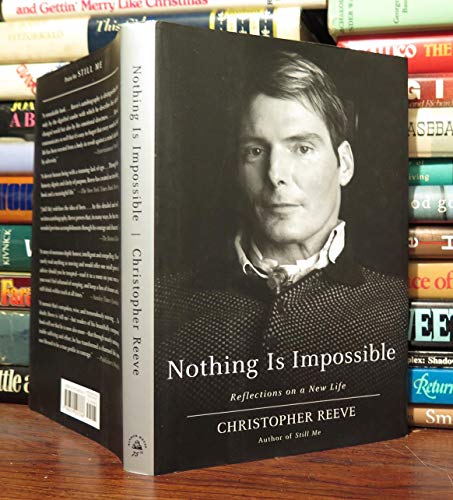
Drawing on his own personal experience and those of others, the author of Still Me explains how we can overcome seemingly insurmountable problems and challenges and that life should never be taken for granted but should be lived fully with gratitude, zeal, and curiosity. 150,000 first printing.
Die Inhaltsangabe kann sich auf eine andere Ausgabe dieses Titels beziehen.
Über die Autorin bzw. den Autor
Actor, director and activist are just some of the words used to describe Christopher Reeve. From his first appearance at the Williamstown Theatre Festival at the age of 15, Reeve established a reputation as one of the country’s leading actors. However, since he was paralyzed in an equestrian competition in 1995, Reeve has not only put a human face on spinal cord injury but he has motivated neuroscientists around the world to conquer the most complex diseases of the brain and central nervous system. <br><br>After graduating from Cornell University in 1974, Reeve pursued his dream of acting, studying at Juilliard under the legendary John Houseman. He made his Broadway debut opposite Katharine Hepburn in A Matter of Gravity in 1976 and then went on to distinguish himself in a variety of stage, screen and television roles with a passion that continues today. Film credits include: “Superman” in 1978 and its subsequent sequels, “Deathtrap,” “Somewhere in Time,” “The Bostonians,” “Street Smart,” “Speechless,” “Noises Off,” “Above Suspicion” and the Oscar-nominated “The Remains of the Day.” Stage credits include: The Marriage of Figaro, Fifth of July, My Life, Summer and Smoke, Love Letters and The Aspern Papers.<br><br>Reeve made his directorial debut with “In the Gloaming” on HBO in April 1997. The film was met with rave reviews, was nominated for 5 Emmys and won six Cable Ace Awards, including Best Dramatic Special and Best Director. Reeve’s autobiography, <b>Still Me</b>, was published by Random House in April 1998 and spent 11 weeks on the New York Times Bestseller List. His audio recording of <b>Still Me</b> earned Reeve a Grammy for Best Spoken Word Album in February 1999. In his first major role since becoming paralyzed, Reeve starred in an updated version of the classic Hitchcock thriller “Rear Window,” for which he was nominated for a Golden Globe Award and won the Screen Actors Guild Award for Best Actor in a Television Movie or Miniseries. He also served as Executive Producer of the film. <br><br>Reeve continues his directing work in television and film as well as his arts-advisory service as a board member of the Williamstown Theatre Festival. In early 2001, Reeve began combining his directing efforts with his activism when he directed four commercials featuring Ray Romano, Randy Newman, Toni Morrison and himself for Johnson & Johnson that focused on helping parents talk to their kids. The same year he filmed a spot for the American Red Cross that celebrated volunteerism.<br><br>In 1999, Reeve became the Chairman of the Board of the Christopher Reeve Paralysis Foundation (CRPF). CRPF, a national, nonprofit organization, supports research to develop effective treatments and a cure for paralysis caused by spinal cord injury and other central nervous system disorders. CRPF also allocates a portion of its resources to grants that improve the quality of life for people with disabilities. <br><br>As Vice Chairman of the National Organization on Disability (N.O.D.), he works on quality of life issues for the disabled. In partnership with Senator Jim Jeffords of Vermont, he helped pass the <i>1999 Work Incentives Improvement Act</i>, which allows people with disabilities to return to work and still receive disability benefits. Reeve is on the Board of Directors of World T.E.A.M. Sports, a group that organizes and sponsors challenging sporting events for athletes with disabilities; TechHealth, a private company that assists in the relationship between patients and their insurance companies; and LIFE (Leaders in Furthering Education) a charitable organization that supports education and opportunities for the underserved population.<br><br>In addition to his work on behalf of CRPF, Reeve’s advocacy efforts include:<br><br>· Lobbying on behalf of the National Institutes of Health to double the NIH budget in five years. In part because of his leadership, the NIH budget grew from 12 billion dollars in 1998 to nearly 27.2 billion dollars in fiscal 2003.<br><br>· Testifying before the Senate Appropriations Subcommittee on Labor, Health and Human Services, Education and Related Agencies in favor of federally funded stem cell research;<br><br>· Providing instrumental and crucial support for the passage of the New York State Spinal Cord Injury Research Bill (7287C), landmark legislation that makes available up to $8.5 million annually in funds collected from violations of the state’s motor vehicle laws to be appropriated among the leading research facilities in New York. Reeve was also involved in lobbying efforts for similar bills in New Jersey, Kentucky, Virginia and California;<br><br>· Testifying before the House Appropriations Subcommittee on Labor, Health and Human Services, Education and Related Agencies on behalf of the National Fund for Health Research Act;<br><br>· Working with Senators Jeffords and Rockefeller and Congresswoman Eshoo to raise lifetime caps on insurance policies from $1million to $10 million;<br><br>· Serving as a member of the Executive Committee of <i>Funding First</i>, an initiative for medical research in honor of Mary Woodard Lasker, begun by former Senator Mark Hatfield;<br><br>· Establishing a line of celebrity neckwear that is carried at over 1,000 JC Penney department stores across the United States. A portion of the proceeds benefits CRPF;<br><br>· Continuing to work tirelessly to obtain increased funding from both the public and private sectors to cure Parkinson’s, Alzheimer’s, MS, ALS, stroke, as well as to repair the damaged spinal cord;<br><br>· Helping to establish the Reeve-Irvine Research Center at the UCI College of Medicine. The center supports the study of trauma to the spinal cord and diseases affecting it, with an emphasis on the development of therapies to promote the recovery and repair of neurological function;<br><br>· Working with Dr. John MacDonald of Washington University on a study to demonstrate that activity dependent training promotes functional recovery in patients with chronic spinal cord injuries.<br><br>While Reeve raises public awareness about the significance of medical research and the challenges facing those with disabilities, he is also educating families about the importance of having adequate health and disability coverage. In 1997, Reeve joined with HealthExtras, the first company to offer subscribers a tax-free non-accountable payment of 1 million dollars in the event of a permanent accidental disability. The cost of this policy is a mere $10 a month and is available through Visa, American Express or via the internet. Reeve serves as company spokesman.<br><br>Reeve’s community and political involvement pre-dates his spinal cord injury. Over the course of many years, he has served as a national spokesman on behalf of the arts, campaign finance reform and the environment. A founder and Co-President of The Creative Coalition he helped to create recycling in New York City and to persuade state legislature to set aside 1 billion dollars to protect the city’s water supply. Since 1976 he has been actively involved with Save the Children, Amnesty International, Natural Resources Defense Council, The Environmental Air Force and America’s Watch. In 1987, he demonstrated in Santiago, Chile on behalf of 77 actors threatened with execution by the Pinochet regime. For this action, Reeve was given a special Obie Award in 1988 and the annual award from the Walter Briehl Human Rights Foundation.<br><br>His second book, <b>Nothing is Impossible: Reflections on a New Life</b>, was published by Random House in September 2002. At the same time a documentary film about his advocacy and road to recovery aired on ABC and was distributed around the world. A native of Princeton, New Jersey, he is the father of three children and husband to wife Dana.
Aus dem Klappentext
<i>So many of our dreams at first seem impossible, then they seem improbable, and then, when we summon the will, they soon become inevitable. If we can conquer outer space, we can conquer inner space, too.<br></i><br>Christopher Reeve has mastered the art of turning the impossible into the inevitable. In <b>Nothing Is Impossible</b><i>,</i> the author of the bestselling autobiography <b>Still Me</b> shows that we are all capable of overcoming seemingly insurmountable hardships. He interweaves anecdotes from his own life with excerpts from speeches and interviews he’s given and with evocative photos taken by his son Matthew.<br><br>Reeve teaches us that for able-bodied people, paralysis is a choice―a choice to live with self-doubt and a fear of taking risks―and that it is not an acceptable one. Reeve knows from experience that the work of conquering inner space is hard and that it requires some suffering―after all, nothing worth having is easy to get. He asks challenging questions about why it seems so difficult―if not impossible―for us to work together as a society. He steers the reader gently, offering his reflections and guidance but not the pat answers that often characterize inspirational works. <br><br>Published on the eve of both his fiftieth birthday and the seventh anniversary of his spinal cord injury, Christopher Reeve’s <b>Nothing Is Impossible<i> </i></b>reminds us that life is not to be taken for granted but to be lived fully with zeal, curiosity, and gratitude. That is a powerful message in itself, but it is the messenger who gives it its full resonance.
Auszug. © Genehmigter Nachdruck. Alle Rechte vorbehalten.
Chapter 1
The First Decision
As the old saying goes, you better know what you want because you might get it and you've got to accept it. Whether you succeed or whether you encounter adversity you always have to believe in your worth as a person. That's what counts.
-Remarks at a success seminar in Portland, Oregon, February 6, 2001
When I made those comments in 2001, it was no longer difficult for me to say to anyone that you have to believe in your worth as a person. But in the intensive care unit at the University of Virginia on June 1, 1995, I had no such belief. Far from it. On that day I regained consciousness to find myself lying in traction, a heavy metal ball suspended behind my head attached to a metal frame secured by screws in each temple. I learned that as the result of a fall during an equestrian competition I had broken my neck just centimeters below the brain stem, and that my chances of surviving the surgery to reattach my head to my spinal column were 50/50 at best. Even if the operation was successful, I would still remain paralyzed from the shoulders down and unable to breathe on my own. I heard the whooshing sound of a ventilator as it pumped oxygen into my lungs through a long tube inserted into a hole in my neck. I've lived with that sound for many years.
The moment I understood the gravity of my situation my immediate reaction was that such a life was unacceptable, even though I knew absolutely nothing about living as a vent-dependent quadriplegic. I realized that there was no cure for spinal cord injuries like mine and that I would forever be dependent on others for the basic necessities of daily existence. My role as a husband and the father of three children would be severely compromised, because paralysis had suddenly transformed me into a forty-two-year-old infant. I thought it would be selfish and unfair to remain alive.
I remember going over my life, taking an inventory of all the cuts, bruises, broken bones, and illnesses I had weathered, ranging from mononucleosis to malaria and mastocytosis (a rare disease that destroys red blood cells as they emerge from the bone marrow). At age sixteen, I developed alopecia areata, a condition that causes patches of baldness in an otherwise healthy head of hair. Fortunately I was able to comb over the spots, and there were long periods of remission when the baldness disappeared. I was a survivor; I always had been. A part of me insisted that this situation shouldn't be any different; another part acknowledged that this time I had gone over the edge and was free-falling into the unknown.
The month I spent in the intensive care unit was an emotional roller-coaster ride created by my own inner turmoil and contradictions coming from those involved in my case. The critical care was nothing short of miraculous. Dr. John Jane-arguably one of the best neurosurgeons in the world-achieved the nearly impossible feat of reattaching the base of my skull to my spinal column with wire, titanium, and bone grafted from my hip. Under his watchful eye, a team of internists and pulmonologists cured me of ulcers and pneumonia. By the second week I was able to turn my head about half an inch from side to side, and I could raise my shoulders slightly. Dr. Jane was confident that before too long I would be able to move my deltoids, which might lead to the functional recovery of my right arm. Perhaps I could learn to feed myself, and someday be able to drive a specially adapted car. My spirits rose.
In the third week of June I was visited by Dr. Marcalee Sipski, director of the Spinal Cord Injury Unit at the Kessler Rehabilitation Institute in West Orange, New Jersey. My wife, Dana, and my younger brother, Benjamin, had surveyed rehab centers from Georgia to Colorado and concluded that Kessler was the best choice, because I would receive the highest quality care without having to go far from home. Dr. Sipski gave me a thorough examination and then told me point blank that my injury was "complete"-meaning that the cord had been severed at the second cervical vertebra (known as "C-2"). Signals from the brain would never be able to get past the injury site. Without any direction from above, the spinal cord would remain useless and the skin, muscles, bones, and tissues of my body would begin a steady progression of atrophy and decay. All I knew about the regeneration of cut or damaged nerves was that it was possible in the peripheral nervous system but not in the central nervous system.
I asked questions about the spinal cord and why the nerves inside it could not regenerate. Usually I had these conversations late at night with the residents and nurses on duty in the unit. (The days were filled with family, visitors, and the routines of necessary care.) Nobody claimed to know for certain, but the prevailing explanation was that it had to do with evolution. An animal paralyzed by a spinal cord injury would most likely be a ready-to-serve meal for another animal higher on the food chain. Even if nerve regeneration in the spinal cord was possible it couldn't happen quickly, so the injured animal would still be easy prey. Without medical intervention the victim of a spinal cord injury-animal or human-usually dies within hours or days, depending on the severity of the case. Almost every one of these late-night discussions ended with the conclusion that I should just consider myself lucky to be alive. I wasn't so sure.
Apparently no one in my little nighttime universe knew that a handful of scientists around the world had been investigating the possibility of regeneration in the spinal cord as early as the 1970s. In 1981 Dr. Alberto Aguayo, at McGill University in Montreal, using a cocktail of growth-enhancing chemicals, achieved regeneration and modest functional recovery in rats.
I only began to focus on spinal cord research in early September 1995. Until then my primary concern was survival, not only for me as a patient but for Dana and my three children, Matthew (fifteen), Alexandra (eleven), and Will (three). Their love and the love that flowed from my extended family, as well as from friends and even complete strangers all over the world, had saved me from my initial desire to end it all. In 2002, seven years after the accident and in the year of my fiftieth birthday, I look back with almost indescribable gratitude at the moment when Dana knelt by my bedside and said, "You're still you, and I love you."
Her simple but profound declaration became the basis for my autobiography, Still Me, which was published in 1998. But in describing that scene I never mentioned one critical detail: in response to my thoughts about ending my life, she said that we should wait for at least two years. Then, if I still felt the same, we could find a way to let me go. On one level, you could say she used the oldest selling technique in the book: you offer customers a free trial, a free sample, with no obligation and no money down, in order to get them on the hook. On another level, a much deeper one where our love and respect for each other has always lived, she knew that I was only in the first stage of a natural reaction to tragedy. Asking me to wait was the perfect course of action. She was giving me room, the freedom to make a choice, yet knowing what that choice would be in time.
The first decision flowed from Dana's words and the look on the faces of all three children when they came into my room. While Dana supported the option to reconsider the value of life at a point in the future, I could tell in an instant that the children wanted me to live and be there for them now. I consented to the surgery. I gave the doctors permission to suction secretions out of my lungs and use IV antibiotics to treat the pneumonia that otherwise would have caused my death. Although I didn't...
„Über diesen Titel“ kann sich auf eine andere Ausgabe dieses Titels beziehen.
Suchergebnisse für Nothing Is Impossible: Reflections on a New Life

Beispielbild für diese ISBN
Nothing Is Impossible: Reflections on a New Life
Anbieter: Orion Tech, Kingwood, TX, USA
Verkäuferbewertung 5 von 5 Sternen

Hardcover. Zustand: Good. Bestandsnummer des Verkäufers 0375507787-3-14453651
Gebraucht kaufen
EUR 3,83
Versand gratis
Versand innerhalb von USA
Versand innerhalb von USA
Anzahl: 1 verfügbar
Beispielbild für diese ISBN
Nothing Is Impossible: Reflections on a New Life
Anbieter: Gulf Coast Books, Cypress, TX, USA
Verkäuferbewertung 5 von 5 Sternen
hardcover. Zustand: Fair. Bestandsnummer des Verkäufers 0375507787-4-27479325
Gebraucht kaufen
EUR 3,83
Versand gratis
Versand innerhalb von USA
Versand innerhalb von USA
Anzahl: 1 verfügbar
Beispielbild für diese ISBN
Nothing Is Impossible: Reflections on a New Life
Anbieter: Your Online Bookstore, Houston, TX, USA
Verkäuferbewertung 5 von 5 Sternen
hardcover. Zustand: Good. Bestandsnummer des Verkäufers 0375507787-3-28336612
Gebraucht kaufen
EUR 3,83
Versand gratis
Versand innerhalb von USA
Versand innerhalb von USA
Anzahl: 2 verfügbar
Beispielbild für diese ISBN
Nothing Is Impossible: Reflections on a New Life
Anbieter: Gulf Coast Books, Cypress, TX, USA
Verkäuferbewertung 5 von 5 Sternen
Hardcover. Zustand: Good. Bestandsnummer des Verkäufers 0375507787-3-14123168
Gebraucht kaufen
EUR 3,83
Versand gratis
Versand innerhalb von USA
Versand innerhalb von USA
Anzahl: 1 verfügbar
Beispielbild für diese ISBN
Nothing Is Impossible: Reflections on a New Life
Anbieter: World of Books (was SecondSale), Montgomery, IL, USA
Verkäuferbewertung 5 von 5 Sternen
Hardback. Zustand: Fair. Christopher Reeve has mastered the art of turning the impossible into the inevitable. In these candid reflections, Reeve shows that we are all capable of overcoming seemingly insurmountable hardships. He teaches us that for able-bodied people, paralysis is a choice--a choice to live with self-doubt and a fear of taking risks--and that it is not an acceptable one. Reeve knows from experience that the work of conquering inner space is hard and that it requires some suffering--after all, nothing worth having is easy to attain. He asks challenging questions about why it seems so difficult--if not impossible--for us to work together as a society. Nothing Is Impossible reminds us that life is not to be taken for granted but to be lived fully with zeal, curiosity, and gratitude. Bestandsnummer des Verkäufers 00085650530
Gebraucht kaufen
EUR 3,84
Versand gratis
Versand innerhalb von USA
Versand innerhalb von USA
Anzahl: 2 verfügbar
Beispielbild für diese ISBN
Nothing Is Impossible: Reflections on a New Life
Anbieter: World of Books (was SecondSale), Montgomery, IL, USA
Verkäuferbewertung 5 von 5 Sternen
Hardback. Zustand: Very Good. Christopher Reeve has mastered the art of turning the impossible into the inevitable. In these candid reflections, Reeve shows that we are all capable of overcoming seemingly insurmountable hardships. He teaches us that for able-bodied people, paralysis is a choice--a choice to live with self-doubt and a fear of taking risks--and that it is not an acceptable one. Reeve knows from experience that the work of conquering inner space is hard and that it requires some suffering--after all, nothing worth having is easy to attain. He asks challenging questions about why it seems so difficult--if not impossible--for us to work together as a society. Nothing Is Impossible reminds us that life is not to be taken for granted but to be lived fully with zeal, curiosity, and gratitude. Bestandsnummer des Verkäufers 00093793716
Gebraucht kaufen
EUR 3,84
Versand gratis
Versand innerhalb von USA
Versand innerhalb von USA
Anzahl: 1 verfügbar
Beispielbild für diese ISBN
Nothing Is Impossible: Reflections on a New Life
Anbieter: World of Books (was SecondSale), Montgomery, IL, USA
Verkäuferbewertung 5 von 5 Sternen
Hardback. Zustand: Good. Christopher Reeve has mastered the art of turning the impossible into the inevitable. In these candid reflections, Reeve shows that we are all capable of overcoming seemingly insurmountable hardships. He teaches us that for able-bodied people, paralysis is a choice--a choice to live with self-doubt and a fear of taking risks--and that it is not an acceptable one. Reeve knows from experience that the work of conquering inner space is hard and that it requires some suffering--after all, nothing worth having is easy to attain. He asks challenging questions about why it seems so difficult--if not impossible--for us to work together as a society. Nothing Is Impossible reminds us that life is not to be taken for granted but to be lived fully with zeal, curiosity, and gratitude. Bestandsnummer des Verkäufers 00079015982
Gebraucht kaufen
EUR 3,84
Versand gratis
Versand innerhalb von USA
Versand innerhalb von USA
Anzahl: 20 verfügbar
Foto des Verkäufers
Nothing Is Impossible: Reflections on a New Life
Anbieter: Zoom Books East, Glendale Heights, IL, USA
Verkäuferbewertung 5 von 5 Sternen
Zustand: very_good. Book is in very good condition and may include minimal underlining highlighting. The book can also include "From the library of" labels. May not contain miscellaneous items toys, dvds, etc. . We offer 100% money back guarantee and 24 7 customer service. Bestandsnummer des Verkäufers ZEV.0375507787.VG
Gebraucht kaufen
EUR 4,06
Versand gratis
Versand innerhalb von USA
Versand innerhalb von USA
Anzahl: 2 verfügbar
Beispielbild für diese ISBN
Nothing Is Impossible: Reflections on a New Life
Verlag:
Random House (edition 1), 2002
ISBN 10: 0375507787
ISBN 13: 9780375507786
Gebraucht
Hardcover
Anbieter: BooksRun, Philadelphia, PA, USA
Verkäuferbewertung 5 von 5 Sternen
Hardcover. Zustand: Fair. 1. With dust jacket. The item might be beaten up but readable. May contain markings or highlighting, as well as stains, bent corners, or any other major defect, but the text is not obscured in any way. Bestandsnummer des Verkäufers 0375507787-7-1-29
Gebraucht kaufen
EUR 4,53
Versand gratis
Versand innerhalb von USA
Versand innerhalb von USA
Anzahl: 1 verfügbar
Foto des Verkäufers
Nothing Is Impossible: Reflections on a New Life
Anbieter: ZBK Books, Carlstadt, NJ, USA
Verkäuferbewertung 5 von 5 Sternen
Zustand: good. Fast & Free Shipping â" Good condition. It may show normal signs of use, such as light writing, highlighting, or library markings, but all pages are intact and the book is fully readable. A solid, complete copy that's ready to enjoy. Bestandsnummer des Verkäufers ZWV.0375507787.G
Gebraucht kaufen
EUR 4,81
Versand gratis
Versand innerhalb von USA
Versand innerhalb von USA
Anzahl: 1 verfügbar