
Verwandte Artikel zu The Bridge: The Life and Rise of Barack Obama
Inhaltsangabe
National Bestseller
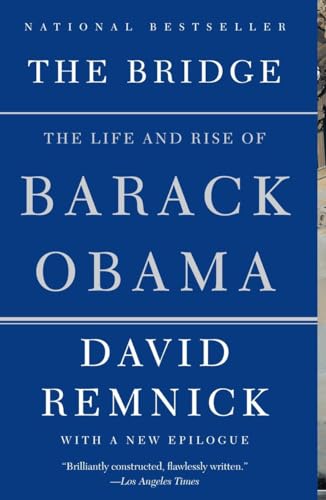
In this nuanced and complex portrait of Barack Obama, Pulitzer Prize-winner David Remnick offers a thorough, intricate, and riveting account of the unique experiences that shaped our nation’s first African American president.
Through extensive on-the-record interviews with friends and teachers, mentors and disparagers, family members and Obama himself, Remnick explores the elite institutions that first exposed Obama to social tensions, and the intellectual currents that contributed to his identity. Using America’s racial history as a backdrop for Obama’s own story, Remnick further reveals how an initially rootless and confused young man built on the experiences of an earlier generation of black leaders to become one of the central figures of our time.
Masterfully written and eminently readable, The Bridge is destined to be a lasting and illuminating work for years to come, by a writer with an unparalleled gift for revealing the historical significance of our present moment.
Die Inhaltsangabe kann sich auf eine andere Ausgabe dieses Titels beziehen.
Über die Autorin bzw. den Autor
David Remnick was a reporter for The Washington Post for ten years, including four in Moscow. He joined The New Yorker as a writer in 1992 and has been the magazine’s editor since 1998. His previous book, King of the World, a biography of Muhammad Ali, was selected by Time as the top nonfiction book of the year. Lenin’s Tomb: The Last Days of the Soviet Empire won a Pulitzer Prize.
Auszug. © Genehmigter Nachdruck. Alle Rechte vorbehalten.
Prologue
The Joshua Generation
Brown Chapel
Selma, Alabama
This is how it began, the telling of a story that changed America.
At midday on March 4, 2007, Barack Obama, the junior senator from Illinois, was scheduled to speak at Brown Chapel, in Selma, Alabama. His campaign for President was barely a month old, and he had come South prepared to confront, for the first time, the Democratic frontrunner, Hillary Clinton. He planned to discuss in public what so many believed would ultimately be his undoing—his race, his youth, his “exotic” background. “Who is Barack Obama?” Barack Hussein Obama? From now until Election Day, his opponents, Democratic and Republican, would ask the question on public platforms, in television and radio commercials, often insinuating a disqualifying otherness about the man: his childhood in Hawaii and Indonesia; his Kenyan father; his Kansas- born, yet cosmopolitan, mother.
Obama’s answer to that question helped form the language and distinctiveness of his campaign. Two years out of the Illinois State Senate and barely free of his college loans, Obama entered the Presidential race with a serious, yet unexceptional, set of center- left policy positions. They were not radically different from Clinton’s, save on the crucial question of the Iraq war. Nor did he possess an impressive résumé of executive experience or legislative accomplishment. But who Obama was, where he came from, how he came to understand himself, and, ultimately, how he managed to project his own temperament and personality as a reflection of American ambitions and hopes would be at the center of his rhetoric and appeal. In addition to his political views, what Obama proposed as the core of his candidacy was a self—a complex, cautious, intelligent, shrewd, young African-American man. He was not a great man yet by any means, but he was the promise of greatness. There, in large measure, was the wellspring of his candidacy, its historical dimension and conceit, and there was no escaping its gall. Obama himself used words like “presumptuous” and “audacious.”
In Selma, Obama prepared to nominate himself as the inheritor of the most painful of all American struggles, the struggle of race: not race as invoked by his predecessors in electoral politics or in the civil- rights movement, not race as an insistence on ethnicity or redress; rather, Obama would make his biracial ancestry a metaphor for his ambition to create a broad coalition of support, to rally Americans behind a narrative of moral and political progress. He was not necessarily the hero of that narrative, but he just might be its culmination. In the months to come, Obama borrowed brazenly from the language and imagery of an epochal American movement and applied it to a campaign for the Presidency.
The city of Selma clusters around the murky waters of the Alabama River. Selma had been a prosperous manufacturing center and an arsenal for the Confederate Army. Now it is a forlorn place of twenty thousand souls. Broad Street ordinarily lacks all but the most listless human traffic. African Americans live mostly in modest houses, shotgun shacks, and projects on the east side of town; whites tend to live, more prosperously, on the west side.
Selma’s economy experiences a burst of vitality during the annual flowerings of historical memory. The surviving antebellum plantation houses are, for the most part, kept up for the few tourists who still come. In mid- April, Civil War buffs arrive in town to commemorate the Confederate dead in a re- enactment of the Battle of Selma, where, in 1865, a Confederate general, a particularly sadistic racist named Nathan Bedford Forrest, suffered defeat. The blacks in town do not share in the mood of Confederate nostalgia. An almost entirely black housing project just outside of town was, for decades, named for General Forrest, who had traded slaves and became Grand Wizard of the Ku Klux Klan.
After the Civil War, black students came to Selma University, a small Bible college, and the town—a town of churches—became renowned as a center of African- American preaching. Selma, Ralph Abernathy wrote in his memoirs, “was to many of us the ‘Capital of the Black Belt,’ a place where intelligent young people and learned elders gathered.” At the same time, because of the grip of Jim Crow, Selma was, as late as the nineteensixties, a place of literacy tests and poll taxes; almost no blacks were able to register to vote. Surrounded by disdainful white registrars, they were made to answer questions like “How many bubbles are there in a bar of soap?”
The local sheriff, Jim Clark, was in the grotesque folkloric mold of Birmingham’s Bull Connor; he wore a button reading “Never” on his uniform and could be relied upon to take the most brutal measures against any sign of anti- segregationist protest—which is why, as the civil-rights movement developed, the grassroots leaders of the Southern Christian Leadership Conference (S.C.L.C.) made Selma a test case in the struggle for voting rights.
On January 2, 1965, Martin Luther King, Jr., came to Brown Chapel, a brick citadel of the African Methodist Episcopal Church, and told the congregation that Selma had become a “symbol of bitter-end resistance to the civil-rights movement in the Deep South.” Just as Montgomery had been the focus of the first bus boycotts and the struggle for civil rights and equal access to public facilities, Selma, King and his comrades decided, would be the battleground for voting rights.
Barack Obama had been invited to Selma more than a month before the anniversary event by his friend John Lewis, a veteran congressman from Atlanta. In his late sixties, portly and bald, Lewis was known around Capitol Hill and in the African-American community less as a legislator than as a popularly elected griot, a moral exemplar and a wizened truthteller of the civil-rights movement. During the long “conservative darkness,” from the first Reagan inaugural onward, Lewis said, it was especially “hard and essential” to keep progressive politics alive. “And the only way to do that was to keep telling the story,” he said.While King was organizing for the S.C.L.C. in Alabama, Lewis had been the chairman of the Student Nonviolent Coordinating Committee (sncc). Lewis was present at nearly every important march. He was at King’s side at the front of countless demonstrations and in meetings with John Kennedy and Lyndon Johnson in the Oval Office. He was the youngest—and most militant—of the many speakers at the March on Washington in 1963; now he was the only one among them still alive. People called John Lewis a hero every day of his life, but now he was feeling quite unheroic, unsure whom to support: the Clintons, who had “never disappointed” him over the years, or a young and talented man who had introduced himself to the country with a thrilling speech at the 2004 Democratic Convention in Boston. At first, Lewis signaled to Obama that he would be with him, but the Clintons and their circle were appealing to his sense of friendship and loyalty—and they were almost as hard to resist as the lure of history. Feeling acute pressure, Lewis promised both the Clintons and Obama that he would soon have “an executive session with myself” and decide.
For Lewis, growing up in Pike County, Alabama, Jim Crow was like a familiar but ominous neighbor. As a boy, he wanted to leave so badly that he dreamed of making a wooden bus out of the pine trees that surrounded his family’s house and riding it all the way to California. His parents were sharecroppers and...
„Über diesen Titel“ kann sich auf eine andere Ausgabe dieses Titels beziehen.
Suchergebnisse für The Bridge: The Life and Rise of Barack Obama

Beispielbild für diese ISBN
The Bridge: The Life and Rise of Barack Obama
Anbieter: World of Books (was SecondSale), Montgomery, IL, USA
Verkäuferbewertung 5 von 5 Sternen

Zustand: Acceptable. Item in acceptable condition! Textbooks may not include supplemental items i.e. CDs, access codes etc. Bestandsnummer des Verkäufers 00108382334
Gebraucht kaufen
EUR 3,78
Versand gratis
Versand innerhalb von USA
Versand innerhalb von USA
Anzahl: 1 verfügbar
Beispielbild für diese ISBN
The Bridge: The Life and Rise of Barack Obama
Anbieter: World of Books (was SecondSale), Montgomery, IL, USA
Verkäuferbewertung 5 von 5 Sternen
Zustand: Good. Item in good condition. Textbooks may not include supplemental items i.e. CDs, access codes etc. Bestandsnummer des Verkäufers 00099724903
Gebraucht kaufen
EUR 3,78
Versand gratis
Versand innerhalb von USA
Versand innerhalb von USA
Anzahl: 4 verfügbar
Beispielbild für diese ISBN
The Bridge: The Life and Rise of Barack Obama
Anbieter: Orion Tech, Kingwood, TX, USA
Verkäuferbewertung 5 von 5 Sternen
paperback. Zustand: Good. Bestandsnummer des Verkäufers 037570230X-3-32919626
Gebraucht kaufen
EUR 3,79
Versand gratis
Versand innerhalb von USA
Versand innerhalb von USA
Anzahl: 1 verfügbar
Foto des Verkäufers
The Bridge: The Life and Rise of Barack Obama
Anbieter: 3Brothers Bookstore, Egg harbor township, NJ, USA
Verkäuferbewertung 5 von 5 Sternen
Zustand: good. Books may contain some notes and highlighting. Supplements such as Access Codes, Cd's Dust Jackets, etc. are not guaranteed with used book purchases. Bestandsnummer des Verkäufers EVV.037570230X.G
Gebraucht kaufen
EUR 3,86
Versand gratis
Versand innerhalb von USA
Versand innerhalb von USA
Anzahl: 1 verfügbar
Beispielbild für diese ISBN
The Bridge: The Life and Rise of Barack Obama (Vintage)
Anbieter: More Than Words, Waltham, MA, USA
Verkäuferbewertung 5 von 5 Sternen
Zustand: Very Good. A bright, square, and overall a nice copy. Bestandsnummer des Verkäufers BOS-P-10j-01504
Gebraucht kaufen
EUR 1,59
EUR 3,51 Versand
Versand innerhalb von USA
Versand innerhalb von USA
Anzahl: 1 verfügbar
Beispielbild für diese ISBN
The Bridge: The Life and Rise of Barack Obama
Anbieter: World of Books Inc, Montgomery, IL, USA
Verkäuferbewertung 4 von 5 Sternen

Paperback. Zustand: Good. National Bestseller In this nuanced and complex portrait of Barack Obama, Pulitzer Prize-winner David Remnick offers a thorough, intricate, and riveting account of the unique experiences that shaped our nation's first African American president. Through extensive on-the-record interviews with friends and teachers, mentors and disparagers, family members and Obama himself, Remnick explores the elite institutions that first exposed Obama to social tensions, and the intellectual currents that contributed to his identity. Using America's racial history as a backdrop for Obama's own story, Remnick further reveals how an initially rootless and confused young man built on the experiences of an earlier generation of black leaders to become one of the central figures of our time. Masterfully written and eminently readable, The Bridge is destined to be a lasting and illuminating work for years to come, by a writer with an unparalleled gift for revealing the historical significance of our present moment. Bestandsnummer des Verkäufers CIN037570230XG
Gebraucht kaufen
EUR 5,59
Versand gratis
Versand innerhalb von USA
Versand innerhalb von USA
Anzahl: 4 verfügbar
Beispielbild für diese ISBN
The Bridge: The Life and Rise of Barack Obama
Anbieter: The Maryland Book Bank, Baltimore, MD, USA
Verkäuferbewertung 5 von 5 Sternen
paperback. Zustand: Good. Reprint. Corners are slightly bent. Used - Good. Bestandsnummer des Verkäufers 1-Q-4-1594
Gebraucht kaufen
EUR 2,00
EUR 4,12 Versand
Versand innerhalb von USA
Versand innerhalb von USA
Anzahl: 1 verfügbar
Beispielbild für diese ISBN
The Bridge: The Life and Rise of Barack Obama
Anbieter: ThriftBooks-Atlanta, AUSTELL, GA, USA
Verkäuferbewertung 5 von 5 Sternen
Paperback. Zustand: Very Good. No Jacket. Former library book; May have limited writing in cover pages. Pages are unmarked. ~ ThriftBooks: Read More, Spend Less. Bestandsnummer des Verkäufers G037570230XI4N10
Gebraucht kaufen
EUR 6,28
Versand gratis
Versand innerhalb von USA
Versand innerhalb von USA
Anzahl: 1 verfügbar
Beispielbild für diese ISBN
The Bridge: The Life and Rise of Barack Obama
Anbieter: Wonder Book, Frederick, MD, USA
Verkäuferbewertung 5 von 5 Sternen
Zustand: Very Good. Very Good condition. A copy that may have a few cosmetic defects. May also contain light spine creasing or a few markings such as an owner's name, short gifter's inscription or light stamp. Bestandsnummer des Verkäufers M05H-01843
Gebraucht kaufen
EUR 6,33
Versand gratis
Versand innerhalb von USA
Versand innerhalb von USA
Anzahl: 1 verfügbar
Beispielbild für diese ISBN
The Bridge: The Life and Rise of Barack Obama
Anbieter: Wonder Book, Frederick, MD, USA
Verkäuferbewertung 5 von 5 Sternen
Zustand: Good. Good condition. A copy that has been read but remains intact. May contain markings such as bookplates, stamps, limited notes and highlighting, or a few light stains. Bestandsnummer des Verkäufers O08F-02460
Gebraucht kaufen
EUR 6,33
Versand gratis
Versand innerhalb von USA
Versand innerhalb von USA
Anzahl: 2 verfügbar