
Verwandte Artikel zu Thunder from the East: Portrait of a Rising Asia
Inhaltsangabe
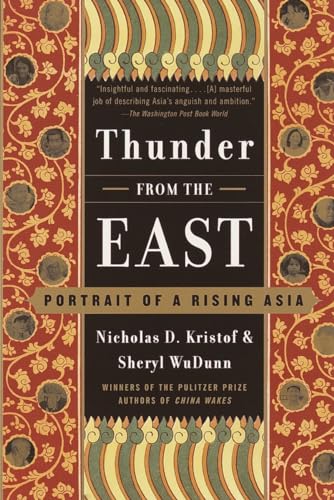
An insightful and comprehensive look at Asia on the rise—a "masterful job of describing Asia's anguish and ambition" (The Washington Post Book World)—from the Pulitzer Prize–winning journalists and bestselling authors of Half a Sky and Tightrope
The 1997 economic crisss in Asia heaped devastation upon millions. Yet Nicholas Kristof and Sheryl WuDunn argue that it was the best thing that could have happened to Asia. It destroyed the cronyism, protectionism, and government regulation that had been crippling Asian business for decades, and it left in its wake a vast region of resilient and determined millions poised to wrest economic, diplomatic and military power from the West.
Thunder from the East is a riveting look at a complex region, a fascinating panoply of compelling characters, and a prophetic analysis from arguably the West's most informed and intelligent writers on Asia.
Die Inhaltsangabe kann sich auf eine andere Ausgabe dieses Titels beziehen.
Über die Autorin bzw. den Autor
NICHOLAS D. KRISTOF and SHERYL WuDUNN, the first husband and wife to share a Pulitzer Prize for journalism, have coauthored four previous books: A Path Appears, Half the Sky, Thunder from the East, and China Wakes. They were awarded a Pulitzer in 1990 for their coverage of China, as well as the 2009 Dayton Literary Peace Prize for Lifetime Achievement. Now an op-ed columnist for The New York Times, Kristof was previously bureau chief in Hong Kong, Beijing, and Tokyo. He won his second Pulitzer in 2006 for his columns on Darfur. WuDunn worked at the Times as a business editor and foreign correspondent in Tokyo and Beijing, and now works in finance and consulting. They live in Oregon.
Von der hinteren Coverseite
From the Pulitzer Prize-winning journalists and authors of China Wakes" comes this insightful and comprehensive look at Asia on the rise.
The recent economic crisis in Asia heaped devastation upon millions. Yet Nicholas Kristof and Sheryl WuDunn argue that it was the best thing that could have happened to Asia. It destroyed the cronyism, protectionism, and government regulation that had been crippling Asian business for decades, and it left in its wake a vast region of resilient and determined millions poised to wrest economic, diplomatic and military power from the West. Thunder from the East is a riveting look at a complex region, a fascinating panoply of compelling characters, and a prophetic analysis from arguably the West's most informed and intelligent writers on Asia.
Auszug. © Genehmigter Nachdruck. Alle Rechte vorbehalten.
Chapter One
He must have been a raffishly handsome young man, with his bushy eyebrows, large coal-black eyes, high-cheekboned face, and thick mop of black hair dangling over his ears. He looked pale but improbably serene, showing no sign of the torture he had endured, and those eyes were still wide open and frozen in a final instant of surprise. He had a strong, projecting chin, but his head ended a few inches below that chin in a jagged eruption of blood, tissue, and bone. His head had been hacked off with a machete and was impaled on a bamboo stake, and he seemed to be staring at me.
I stared back. That abrupt transition from human flesh to bamboo stake wrenched my gut and paralyzed my legs. I was scared stiff. The mob that had killed him was in front of me now, the killers waving machetes and screaming Allahu akbar, God is great. There were about two dozen of them, mostly men in their twenties and thirties, all riding motorcycles slowly down the main street of the little farmtown of Turen, Indonesia.
It was a typical warm afternoon in what seemed a bucolic, prospering community. A tropical drizzle had created a shine on the beautifully paved blacktop road, but there were plenty of trees to shield people from the rain. Comfortable one- and two-story homes lined the road, their walls neatly whitewashed, their roofs made up of pleasant red tile. A few repair shops and small restaurants competed for business, and a billboard advertised "Sun Silk Shampoo" with an image of a young woman with thick, beautiful, black hair. A few bicycle rickshaws were waiting for rides and several pushcart vendors were selling fried rice and noodles. Townspeople were emerging by the side of the road to see what was causing the racket.
It seemed like any of Indonesia's tens of thousands of little villages, except that it had abruptly tumbled into savagery. Some motorcyclists were waving S-shaped machetes, two feet long and bloody, while others wielded sickles that were equally grisly. A few were clenching their fists in power salutes of victory, and they were all grinning happily, cheering and shouting, while the fast-forming crowd on the sidewalk waved back and roared its approval. In the middle of the cluster of motorcycles was a glossy black one, and its driver smiled proudly at the responsibility he had been given. Behind him on the same motorcycle was a long-haired younger man, perhaps twenty years old, his black shirt unbuttoned to the waist, his face gleaming with excitement. Black Shirt was standing up on the footrests, holding on to the driver's shoulder with his left hand, and with his right he was holding up the bamboo stake. Exultantly, he waved it all around, as if he were exhibiting a doll's head on a handle, so that everyone could admire it. Black Shirt was small and skinny, shining with his eagerness to please, and he looked less like a killer than like a proud high-school kid in the center of a homecoming parade.
I was standing under a tree to keep out of the drizzle, and the motorcyclists did not see me at first. But now the cries faded as the mob became aware of the presence of a foreigner. Black Shirt frowned, switched hands and thrust the severed head toward me, he too shouting Allahu akbar. The head was raised high, and my eyes locked on the bloody tissue, jagged and ragged, where the neck ended.
Instinctively, I transferred my notebook to my left hand and reached up with my right to feel my own neck. I massaged it absentmindedly with trembling fingers, appreciating its continuity and imagining a motorcyclist's machete arcing down on it and parting the skin.
. . .
I had come to Java not in search of a beheading but to understand the upheavals in rural Indonesia caused by the economic crisis in Asia. The crisis had begun in Thailand in July 1997 and then had devastated once-booming economies throughout the region, leaving Indonesia worst hit of all. I was staying in a town in East Java called Mojokerto, where I met Salamet, a twenty-seven-year-old rickshaw driver. Salamet was a gentle man with a round face, a drooping moustache, and a pleasing smile. Years of work as a rickshaw driver, rock-crusher, and gravel-hauler had left him as strong as an ox, and with roughly the same build. He was of only average height, but he had a barrel chest and a boxer's neck, and he might have looked intimidating if he hadn't spent so much time gently cradling his youngest daughter. He would sit back in his rickshaw, his bare feet dangling out over the footrest, rocking the girl on his knee and griping about the rising price of food.
The neighborhood seemed as placid as the nearby river running through the town, but Salamet had been telling me that tensions were mounting. One day when he was eating a bowl of noodles, he told me between loud slurps that one bad sign was the rise of sorcery. "Sorcerers are taking advantage of the confusion these days," he warned. Slurp. "There didn't used to be much black magic around, but now it's beginning again." Slurp.
Salamet referred to a series of two hundred gruesome murders in East Java, mostly of Muslim leaders whose bodies were chopped into pieces that were left hanging in the trees. I believed that some army unit was behind the killings, trying to create political instability or even conditions for a coup d'?tat, but to Salamet and most people in Mojokerto the obvious suspects were sorcerers. Javanese have always believed in black magic and sorcery, and rumors were spreading that the killers wore black and could vanish into thin air. "Those killings -- that's the work of sorcerers," Salamet told me confidently. Slurp.
In nearby towns angry mobs began to kill suspected witches and sorcerers. And even in Mojokerto vigilante groups were organized to fight against the sorcerers, whom people called "ninja" after the Japanese warriors. Salamet joined one of these vigilante groups, and the men in it spent their days sharpening their knives and their nights roaming around looking for sorcerers to kill. They were good family men, and I went with some of them to a meeting at the local mosque where a charismatic man named Ahmed Banu was urging the crowd to butcher the sorcerers. Banu and the others greeted me warmly, made sure I was seated comfortably, and then got down to business.
"If we Muslims are being treated like animals, will we stand for it?" Banu asked, his voice rising to a crescendo.
"No!" his followers yelled back.
"If we catch the ninja, what should we do? Give them to the police or kill them?"
"Kill them!"
"So send this message to your families," Banu added grimly: "When we catch the attackers, we must kill them."
That night, I tossed and turned. Would these villagers, who had been so hospitable to me, actually attack people they suspected to be sorcerers? I wondered whether I had lent credibility to Banu by attending the meeting, increasing the chance that he and his friends would butcher strangers. Finally, I decided that it was all talk and fell into a comfortable slumber. But in the morning, my interpreter brought a local newspaper and I learned that at roughly the same time that Banu was holding his meeting, mobs a bit farther to the south had been tearing apart five men who lacked identification and were consequently suspected of being sorcerers. Two were burned alive and three were beheaded, their heads impaled on pikes and paraded through the nearby towns.
"Where did that happen?" I asked.
"In a little town called Turen," replied my interpreter, a local journalist. As I looked at the articles, I felt revulsion and fear, but in the mix there was also a large dose of curiosity. What kind of people could commit such grotesque acts? How could citizens behead their neighbors? The killings struck me as...
„Über diesen Titel“ kann sich auf eine andere Ausgabe dieses Titels beziehen.
Suchergebnisse für Thunder from the East: Portrait of a Rising Asia

Beispielbild für diese ISBN
Thunder from the East: Portrait of a Rising Asia
Verlag:
Knopf Doubleday Publishing Group, 2001
ISBN 10: 0375703012
ISBN 13: 9780375703010
Gebraucht
Softcover
Anbieter: World of Books (was SecondSale), Montgomery, IL, USA
Verkäuferbewertung 5 von 5 Sternen

Zustand: Good. Item in good condition. Textbooks may not include supplemental items i.e. CDs, access codes etc. Bestandsnummer des Verkäufers 00087486546
Gebraucht kaufen
EUR 3,91
Versand gratis
Versand innerhalb von USA
Versand innerhalb von USA
Anzahl: 4 verfügbar
Beispielbild für diese ISBN
Thunder from the East: Portrait of a Rising Asia
Verlag:
Knopf Doubleday Publishing Group, 2001
ISBN 10: 0375703012
ISBN 13: 9780375703010
Gebraucht
Softcover
Anbieter: World of Books (was SecondSale), Montgomery, IL, USA
Verkäuferbewertung 5 von 5 Sternen
Zustand: Very Good. Item in very good condition! Textbooks may not include supplemental items i.e. CDs, access codes etc. Bestandsnummer des Verkäufers 00098467225
Gebraucht kaufen
EUR 3,91
Versand gratis
Versand innerhalb von USA
Versand innerhalb von USA
Anzahl: 1 verfügbar
Beispielbild für diese ISBN
Thunder from the East: Portrait of a Rising Asia
Verlag:
Knopf Doubleday Publishing Group, 2001
ISBN 10: 0375703012
ISBN 13: 9780375703010
Gebraucht
paperback
Anbieter: Gulf Coast Books, Cypress, TX, USA
Verkäuferbewertung 5 von 5 Sternen
paperback. Zustand: Fair. Bestandsnummer des Verkäufers 0375703012-4-34890510
Gebraucht kaufen
EUR 3,92
Versand gratis
Versand innerhalb von USA
Versand innerhalb von USA
Anzahl: 1 verfügbar
Foto des Verkäufers
Thunder from the East: Portrait of a Rising Asia
Verlag:
Knopf Doubleday Publishing Group, 2001
ISBN 10: 0375703012
ISBN 13: 9780375703010
Gebraucht
Softcover
Anbieter: Greenworld Books, Arlington, TX, USA
Verkäuferbewertung 5 von 5 Sternen
Zustand: very_good. Fast Free Shipping â" Very Good condition book with a firm cover and clean pages. Shows normal use and some light wear or limited notes markings. A solid, nice copy to enjoy. Bestandsnummer des Verkäufers GWV.0375703012.VG
Gebraucht kaufen
EUR 4,42
Versand gratis
Versand innerhalb von USA
Versand innerhalb von USA
Anzahl: 1 verfügbar
Beispielbild für diese ISBN
Thunder from the East: Portrait of a Rising Asia
Anbieter: World of Books Inc, Montgomery, IL, USA
Verkäuferbewertung 4 von 5 Sternen

Paperback. Zustand: Very Good. An insightful and comprehensive look at Asia on the rise--a "masterful job of describing Asia's anguish and ambition" (The Washington Post Book World)--from the Pulitzer Prize-winning journalists and bestselling authors of Half a Sky and Tightrope The 1997 economic crisss in Asia heaped devastation upon millions. Yet Nicholas Kristof and Sheryl WuDunn argue that it was the best thing that could have happened to Asia. It destroyed the cronyism, protectionism, and government regulation that had been crippling Asian business for decades, and it left in its wake a vast region of resilient and determined millions poised to wrest economic, diplomatic and military power from the West. Thunder from the East is a riveting look at a complex region, a fascinating panoply of compelling characters, and a prophetic analysis from arguably the West's most informed and intelligent writers on Asia. Bestandsnummer des Verkäufers CIN0375703012VG
Gebraucht kaufen
EUR 5,71
Versand gratis
Versand innerhalb von USA
Versand innerhalb von USA
Anzahl: 1 verfügbar
Beispielbild für diese ISBN
Thunder from the East: Portrait of a Rising Asia
Anbieter: World of Books Inc, Montgomery, IL, USA
Verkäuferbewertung 4 von 5 Sternen
Paperback. Zustand: Good. An insightful and comprehensive look at Asia on the rise--a "masterful job of describing Asia's anguish and ambition" (The Washington Post Book World)--from the Pulitzer Prize-winning journalists and bestselling authors of Half a Sky and Tightrope The 1997 economic crisss in Asia heaped devastation upon millions. Yet Nicholas Kristof and Sheryl WuDunn argue that it was the best thing that could have happened to Asia. It destroyed the cronyism, protectionism, and government regulation that had been crippling Asian business for decades, and it left in its wake a vast region of resilient and determined millions poised to wrest economic, diplomatic and military power from the West. Thunder from the East is a riveting look at a complex region, a fascinating panoply of compelling characters, and a prophetic analysis from arguably the West's most informed and intelligent writers on Asia. Bestandsnummer des Verkäufers CIN0375703012G
Gebraucht kaufen
EUR 5,71
Versand gratis
Versand innerhalb von USA
Versand innerhalb von USA
Anzahl: 4 verfügbar
Beispielbild für diese ISBN
Thunder from the East: Portrait of a Rising Asia
Verlag:
Knopf Doubleday Publishing Group, 2001
ISBN 10: 0375703012
ISBN 13: 9780375703010
Gebraucht
Softcover
Anbieter: Wonder Book, Frederick, MD, USA
Verkäuferbewertung 5 von 5 Sternen
Zustand: Good. Good condition. A copy that has been read but remains intact. May contain markings such as bookplates, stamps, limited notes and highlighting, or a few light stains. Bestandsnummer des Verkäufers Q09S-00212
Gebraucht kaufen
EUR 6,27
Versand gratis
Versand innerhalb von USA
Versand innerhalb von USA
Anzahl: 1 verfügbar
Beispielbild für diese ISBN
Thunder from the East: Portrait of a Rising Asia
Verlag:
Knopf Doubleday Publishing Group, 2001
ISBN 10: 0375703012
ISBN 13: 9780375703010
Gebraucht
Softcover
Anbieter: Wonder Book, Frederick, MD, USA
Verkäuferbewertung 5 von 5 Sternen
Zustand: Very Good. Very Good condition. A copy that may have a few cosmetic defects. May also contain light spine creasing or a few markings such as an owner's name, short gifter's inscription or light stamp. Bestandsnummer des Verkäufers F16BB-03844
Gebraucht kaufen
EUR 6,27
Versand gratis
Versand innerhalb von USA
Versand innerhalb von USA
Anzahl: 1 verfügbar
Beispielbild für diese ISBN
Thunder from the East : Portrait of a Rising Asia
Verlag:
Knopf Doubleday Publishing Group, 2001
ISBN 10: 0375703012
ISBN 13: 9780375703010
Gebraucht
Softcover
Anbieter: Better World Books, Mishawaka, IN, USA
Verkäuferbewertung 5 von 5 Sternen
Zustand: Good. Former library copy. Pages intact with minimal writing/highlighting. The binding may be loose and creased. Dust jackets/supplements are not included. Includes library markings. Stock photo provided. Product includes identifying sticker. Better World Books: Buy Books. Do Good. Bestandsnummer des Verkäufers 9043749-6
Gebraucht kaufen
EUR 6,41
Versand gratis
Versand innerhalb von USA
Versand innerhalb von USA
Anzahl: 1 verfügbar
Beispielbild für diese ISBN
Thunder from the East : Portrait of a Rising Asia
Verlag:
Knopf Doubleday Publishing Group, 2001
ISBN 10: 0375703012
ISBN 13: 9780375703010
Gebraucht
Softcover
Anbieter: Better World Books, Mishawaka, IN, USA
Verkäuferbewertung 5 von 5 Sternen
Zustand: Very Good. Pages intact with possible writing/highlighting. Binding strong with minor wear. Dust jackets/supplements may not be included. Stock photo provided. Product includes identifying sticker. Better World Books: Buy Books. Do Good. Bestandsnummer des Verkäufers 9567291-6
Gebraucht kaufen
EUR 6,41
Versand gratis
Versand innerhalb von USA
Versand innerhalb von USA
Anzahl: 1 verfügbar