
Verwandte Artikel zu Dangerous Nation: America's Foreign Policy from...
Dangerous Nation: America's Foreign Policy from Its Earliest Days to the Dawn of the Twentieth Century (Dangerous Nation Trilogy, Band 1) - Softcover
Buch 1 von 2: Dangerous Nation Trilogy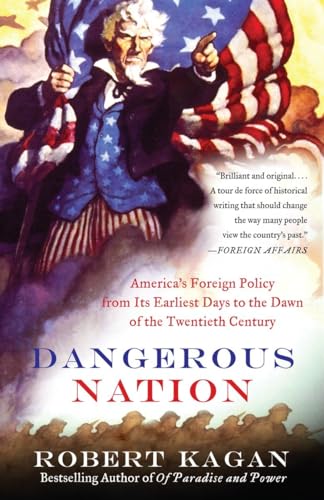
Inhaltsangabe
Most Americans believe the United States had been an isolationist power until the twentieth century. This is wrong. In a riveting and brilliantly revisionist work of history, Robert Kagan, bestselling author of Of Paradise and Power, shows how Americans have in fact steadily been increasing their global power and influence from the beginning. Driven by commercial, territorial, and idealistic ambitions, the United States has always perceived itself, and been seen by other nations, as an international force. This is a book of great importance to our understanding of our nation’s history and its role in the global community.
Die Inhaltsangabe kann sich auf eine andere Ausgabe dieses Titels beziehen.
Über die Autorin bzw. den Autor
Robert Kagan is senior associate at the Carnegie Endowment for International Peace, where he is director of the U.S. Leadership Project. He is the author of A Twilight Struggle: American Power and Nicaragua, 1977-1990 and coeditor with William Kristol, of Present Dangers: Crisis and Opportunity in American Foreign and Defense Policy. Kagan served in the State Department from 1984-1988. He lives in Brussels with his wife and two children.
Auszug. © Genehmigter Nachdruck. Alle Rechte vorbehalten.
Chapter 1 The First Imperialists This is a commonwealth of the fabric that hath an open ear, and a public concernment. She is not made for herself only, but given as a magistrate of God unto mankind, for the vindication of common right and the law of nature. Wherefore saith Cicero of the . . . Romans, Nos magis patronatum orbis terrarrum suscepimus quam imperium, we have rather undertaken the patronage than the empire of the world. —James Harrington, The Commonwealth of Oceana, 1656 The Myth of the “City upon a Hill”: The Americanization of the Puritan MissionMisperceptions about the history, traditions, and nature of American foreign policy begin with the popular image of the Puritans who settled in New England in the 1630s. John Winthrop’s hopeful description of the Massachusetts Bay theocracy as a “city upon a hill” is emblazoned in the American self-image, a vivid symbol of what are widely seen as dominant isolationist and “exceptionalist” tendencies in American foreign policy. The Puritan “mission,” as the historian Frederick Merk once put it, was “to redeem the Old World by high example,” and generations of Americans have considered this “exemplarist” purpose the country’s original mission in its pure, uncorrupted form: the desire to set an example to the world, but from a safe distance.1 Felix Gilbert argued that the unique combination of idealism and isolationism in American thought derived from the Puritans’ “utopian” aspirations, which required “separation” from Europe and the severing of “ties which might spread the diseases of Europe to America.”2 The true American “mission,” therefore, was inherently isolationist, passive, and restrained; it was, as Merk put it, both “idealistic” and “self-denying . . . a force that fought to curb expansionism of the aggressive variety.”3This picture of Puritan America as a pious Greta Garbo, wanting only to be left alone in her self-contained world, is misleading. For one thing, Winthrop’s Puritans were not isolationists. They were global revolutionaries.4 They escaped persecution in the Old World to establish the ideal religious commonwealth in America, their “new Jerusalem.” But unlike the biblical Jews, they looked forward to the day, they hoped not far off, when they might return to a reformed Egypt. Far from seeking permanent separation from the Old World, the Puritans’ “errand into the wilderness” aimed to establish a base from which to launch a counteroffensive across the Atlantic. Their special covenant with God was not tied to the soil of the North American continent.5 America was not the Puritans’ promised land but a temporary refuge.6 God had “peopled New England in order that the reformation of England and Scotland may be hastened.”7 As the great scholar of Puritan thought Perry Miller explained many years ago, the Puritan migration “was no retreat from Europe: it was a flank attack.” The “large unspoken assumption in the errand of 1630” was that success in New England would mean a return to old England.8The Massachusetts Bay colonists neither sought isolation from the Old World nor considered themselves isolated.9 The Puritan leaders did not even believe they were establishing a “new” world distinct from the old. In their minds New England and Old England were the same world, spiritually if not geographically. A hundred years after Winthrop’s settlement, when the Puritan evangelist Jonathan Edwards spoke of “our nation,” he meant both Britain and the British North American colonies. It was a measure of how little the New England Puritans sought isolation from the Old World that their greatest disappointment came when England’s Puritan revolution in the mid-seventeenth century abandoned rigid Calvinism, the Puritans’ model, thus leaving the Puritans theologically isolated in their American wilderness.10America, in turn, became not a promised land but a burial ground for the kind of Puritan theocracy Winthrop and his followers had hoped to establish. Puritanism died in part because the American wilderness, like the biblical Israel, was a land of milk and honey. The New World was too vast for the Puritans’ worldly asceticism. Their rigid theocracy required control and obedience and self-restraint, but the expansive North American wilderness created freedom, dissent, independence, and the lust for land. The abundance of land and economic opportunities for men and women of all social stations diverted too many minds from godly to worldly pursuits. It undermined patriarchal hierarchy and shattered orthodoxy. Those who did not like the way the doctrines of Calvinism were construed and enforced in the Massachusetts Bay Colony had only to move up the Connecticut Valley. Within a dozen years after Winthrop’s arrival, Puritan divines were decrying their parishioners’ sinful desire for ever more “elbow-room” in their New World. “Land! Land! hath been the Idol of many in New-England,” cried Increase Mather. “They that profess themselves Christians, have foresaken Churches, and Ordinances, and all for land and elbow-room enough in the World.”11The rich lands of North America also helped unleash liberal, materialist forces within Protestantism that overwhelmed the Puritan fathers’ original godly vision and brought New England onto the path on which the rest of British-American civilization was already traveling: toward individualism, progress, and modernity. With so many opportunities for personal enrichment available in the New World, the “Protestant ethic,” as Max Weber called it, which countenanced the rewards of labor as a sign of God’s favor and which demanded hard work in one’s “calling” as a sign of election, became a powerful engine of material progress. In a short time, settlers, plantation owners, and the increasingly prosperous and powerful merchants of Boston—the so-called River Gods—came to worship at altars other than those of their Calvinist fathers and grandfathers. The liberal, commercial ethos of these new mercantile groups represented the spirit of a new age, whose “guiding principles were not social stability, order, and the discipline of the senses, but mobility, growth, and the enjoyment of life.”12By the early eighteenth century Puritan New England had entered “the emerging secular and commercial culture” of Anglo-America. The New Englanders “relinquished their grand vision of building a city upon a hill,” and Puritanism itself melted into the new, modernizing society.13 The burst of religious revivalism in the early to mid-eighteenth century, termed the Great Awakening, was a monument to Puritanism’s failure, a worried response to the increasing secularization of American society and to the spread of Christian rationalism and Deism among colonial elites. From its original pious ambitions, Jonathan Edwards lamented, the Puritans’ America had fallen into sin. History had never witnessed “such a casting off [of] the Christian religion,” nor “so much scoffing at and ridiculing the gospel of Christ by those that have been brought up under gospel light.”14 Even Edwards’s own reactionary revivalism was shaped by the new realities of life in an expansive, modernizing, and free America, for his was a democratized, antihierarchical Puritanism that conformed to the increasingly fluid nature of colonial American society. His effort to stem the tide of liberalism and modernity was futile. As Edwards...
„Über diesen Titel“ kann sich auf eine andere Ausgabe dieses Titels beziehen.
Suchergebnisse für Dangerous Nation: America's Foreign Policy from...

Foto des Verkäufers
Dangerous Nation: America's Foreign Policy from Its Earliest Days to the Dawn of the Twentieth Century (Dangerous Nation Trilogy)
Anbieter: Dream Books Co., Denver, CO, USA
Verkäuferbewertung 5 von 5 Sternen

Zustand: good. Gently used with minimal wear on the corners and cover. A few pages may contain light highlighting or writing, but the text remains fully legible. Dust jacket may be missing, and supplemental materials like CDs or codes may not be included. May be ex-library with library markings. Ships promptly! Bestandsnummer des Verkäufers DBV.0375724915.G
Gebraucht kaufen
EUR 4,05
Versand gratis
Versand innerhalb von USA
Versand innerhalb von USA
Anzahl: 2 verfügbar
Beispielbild für diese ISBN
Dangerous Nation: America's Foreign Policy from Its Earliest Days to the Dawn of the Twentieth Century
Anbieter: World of Books (was SecondSale), Montgomery, IL, USA
Verkäuferbewertung 5 von 5 Sternen
Zustand: Acceptable. Item in acceptable condition! Textbooks may not include supplemental items i.e. CDs, access codes etc. Bestandsnummer des Verkäufers 00103194712
Gebraucht kaufen
EUR 4,11
Versand gratis
Versand innerhalb von USA
Versand innerhalb von USA
Anzahl: 1 verfügbar
Beispielbild für diese ISBN
Dangerous Nation: America's Foreign Policy from Its Earliest Days to the Dawn of the Twentieth Century
Anbieter: World of Books (was SecondSale), Montgomery, IL, USA
Verkäuferbewertung 5 von 5 Sternen
Zustand: Good. Item in good condition. Textbooks may not include supplemental items i.e. CDs, access codes etc. Bestandsnummer des Verkäufers 00105595894
Gebraucht kaufen
EUR 4,11
Versand gratis
Versand innerhalb von USA
Versand innerhalb von USA
Anzahl: 4 verfügbar
Beispielbild für diese ISBN
Dangerous Nation: America's Foreign Policy from Its Earliest Days to the Dawn of the Twentieth Century (Dangerous Nation Trilogy)
Verlag:
Vintage (edition Reprint), 2007
ISBN 10: 0375724915
ISBN 13: 9780375724916
Gebraucht
Paperback
Anbieter: BooksRun, Philadelphia, PA, USA
Verkäuferbewertung 5 von 5 Sternen
Paperback. Zustand: Very Good. Reprint. It's a well-cared-for item that has seen limited use. The item may show minor signs of wear. All the text is legible, with all pages included. It may have slight markings and/or highlighting. Bestandsnummer des Verkäufers 0375724915-11-1
Gebraucht kaufen
EUR 5,14
Versand gratis
Versand innerhalb von USA
Versand innerhalb von USA
Anzahl: 1 verfügbar
Foto des Verkäufers
Dangerous Nation: America's Foreign Policy from Its Earliest Days to the Dawn of the Twentieth Century (Dangerous Nation Trilogy)
Anbieter: ZBK Books, Carlstadt, NJ, USA
Verkäuferbewertung 5 von 5 Sternen
Zustand: good. Fast & Free Shipping â" Good condition. It may show normal signs of use, such as light writing, highlighting, or library markings, but all pages are intact and the book is fully readable. A solid, complete copy that's ready to enjoy. Bestandsnummer des Verkäufers ZWV.0375724915.G
Gebraucht kaufen
EUR 5,37
Versand gratis
Versand innerhalb von USA
Versand innerhalb von USA
Anzahl: 2 verfügbar
Beispielbild für diese ISBN
Dangerous Nation: America's Foreign Policy from Its Earliest Days to the Dawn of the Twentieth Century
Verlag:
Knopf Doubleday Publishing Group, 2007
ISBN 10: 0375724915
ISBN 13: 9780375724916
Gebraucht
Paperback
Anbieter: ThriftBooks-Dallas, Dallas, TX, USA
Verkäuferbewertung 5 von 5 Sternen
Paperback. Zustand: Fair. No Jacket. Readable copy. Pages may have considerable notes/highlighting. ~ ThriftBooks: Read More, Spend Less. Bestandsnummer des Verkäufers G0375724915I5N00
Gebraucht kaufen
EUR 6,04
Versand gratis
Versand innerhalb von USA
Versand innerhalb von USA
Anzahl: 1 verfügbar
Beispielbild für diese ISBN
Dangerous Nation: America's Foreign Policy from Its Earliest Days to the Dawn of the Twentieth Century
Verlag:
Knopf Doubleday Publishing Group, 2007
ISBN 10: 0375724915
ISBN 13: 9780375724916
Gebraucht
Paperback
Anbieter: ThriftBooks-Atlanta, AUSTELL, GA, USA
Verkäuferbewertung 5 von 5 Sternen
Paperback. Zustand: Good. No Jacket. Missing dust jacket; Pages can have notes/highlighting. Spine may show signs of wear. ~ ThriftBooks: Read More, Spend Less. Bestandsnummer des Verkäufers G0375724915I3N01
Gebraucht kaufen
EUR 6,04
Versand gratis
Versand innerhalb von USA
Versand innerhalb von USA
Anzahl: 1 verfügbar
Beispielbild für diese ISBN
Dangerous Nation: America's Foreign Policy from Its Earliest Days to the Dawn of the Twentieth Century
Anbieter: ThriftBooks-Atlanta, AUSTELL, GA, USA
Verkäuferbewertung 5 von 5 Sternen
Paperback. Zustand: Good. No Jacket. Former library book; Pages can have notes/highlighting. Spine may show signs of wear. ~ ThriftBooks: Read More, Spend Less. Bestandsnummer des Verkäufers G0375724915I3N10
Gebraucht kaufen
EUR 6,04
Versand gratis
Versand innerhalb von USA
Versand innerhalb von USA
Anzahl: 1 verfügbar
Beispielbild für diese ISBN
Dangerous Nation: America's Foreign Policy from Its Earliest Days to the Dawn of the Twentieth Century
Verlag:
Knopf Doubleday Publishing Group, 2007
ISBN 10: 0375724915
ISBN 13: 9780375724916
Gebraucht
Paperback
Anbieter: ThriftBooks-Atlanta, AUSTELL, GA, USA
Verkäuferbewertung 5 von 5 Sternen
Paperback. Zustand: Fair. No Jacket. Readable copy. Pages may have considerable notes/highlighting. ~ ThriftBooks: Read More, Spend Less. Bestandsnummer des Verkäufers G0375724915I5N00
Gebraucht kaufen
EUR 6,04
Versand gratis
Versand innerhalb von USA
Versand innerhalb von USA
Anzahl: 1 verfügbar
Beispielbild für diese ISBN
Dangerous Nation: America's Foreign Policy from Its Earliest Days to the Dawn of the Twentieth Century
Anbieter: Wonder Book, Frederick, MD, USA
Verkäuferbewertung 5 von 5 Sternen
Zustand: Good. Good condition. A copy that has been read but remains intact. May contain markings such as bookplates, stamps, limited notes and highlighting, or a few light stains. Bestandsnummer des Verkäufers A01L-00712
Gebraucht kaufen
EUR 6,17
Versand gratis
Versand innerhalb von USA
Versand innerhalb von USA
Anzahl: 1 verfügbar