
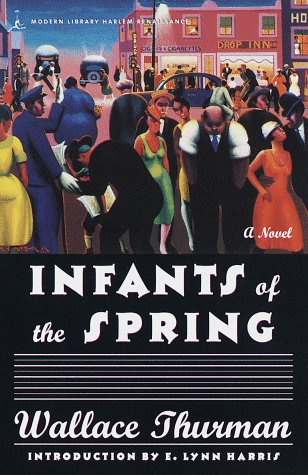
Inhaltsangabe
Harlem in the 1920s is a hopping scene when Stephen Jorgenson arrives from Canada and is taken uptown, where he embraces his new environment but is balanced by the artist Paul, who is cynical about himself and his people. Reprint. 12,500 first printing.
Die Inhaltsangabe kann sich auf eine andere Ausgabe dieses Titels beziehen.
Über die Autorin bzw. den Autor
Wallace Thurman, author of The Blacker the Berry and the hit Broadway play Harlem, was a dark-skinned bisexual alcoholic who never thought he was accepted by his peers. Raised in Salt Lake City, he died destitute in New York in 1934. Infants of the Spring was his last laugh. E. Lynn Harris is the bestselling author of Invisible Life, And This Too Shall Pass, and If This World Were Mine.
The fertile artistic period now known as the Harlem Renaissance (1920-1930) gave birth to many of the world-renowned masters of black literature and is the model for today's renaissance of black writers.
Aus dem Klappentext
Library Harlem Renaissance
It's 1920s Harlem, and man, the joint is jumpin'. Folks are coming and going and everything's copacetic as long as the gin keeps flowing. This is the scene Stephen Jorgenson dives into when he arrives from Canada for the first time. He is taken to "The Niggerati Manor," an apartment building in Harlem inhabited by aspiring artists whose true talents lie in living, and where everything's black and white--with a lot of grayness in between. Counterbalancing Stephen's embrace of these folks is Raymond Taylor, a writer who is the only truly talented artist in the manor. Raymond's cynical take on the "new Negro artist" is the tightrope he walks between the love and hatred of himself and his people. Characters representing Langston Hughes, Zora Neale Hurston, and Alain Locke all appear, and part of the fun of this book is figuring out who's who.
Auszug. © Genehmigter Nachdruck. Alle Rechte vorbehalten.
Raymond opened the door with a flourish, pushed the electric switch and preceded his two guests into the dimly illuminated room.
"Here we are, gentlemen."
"Nice diggings you have here," Stephen said.
"Damn right," Raymond agreed. "I'm nuts about 'em. Sam doesn't like my studio, though. He thinks it's decadent."
"I merely objected to some of the decorations, Ray."
"Namely, the red and black draperies, the red and black bed cover, the crimson wicker chairs, the riotous hook rugs, and Paul's erotic drawings. You see, Steve, Sam thinks it's all rather flamboyant and vulgar. He can't forget that he's a Nordic and that I'm a Negro, and according to all the sociology books, my taste is naturally crass and vulgar. I must not go in for loud colors. It's a confession of my inferior race heritage. Am I right, Sam?"
"It's all Greek to me anyhow," Stephen murmured. "I like the room. . . . And these pictures are rather astonishing. Who did them?"
"The most impossible person in the world," Samuel answered.
"Wrong again," Raymond said. "Paul is one of the most delightful people in the world. I only hope he drops in before you leave, Steve. You'll enjoy meeting him."
"He certainly handles his colors well."
"But his pictures are obscene," Samuel protested. "They are nothing but highly colored phalli."
Raymond shrugged his shoulders.
"You argue with him, Steve. I'm worn to a frazzle trying to make him see the light. Everything that Sam doesn't understand, he labels depraved and degenerate. As an old friend, maybe you're willing to take up his education where I'm leaving off. Right now, I'm going to have a highball. Shall I fix three?"
Raymond retired to the alcove addition to his studio, and prepared the three highballs. When he returned to the room, Stephen Jorgenson was minutely examining the various drawings which adorned the wall, while Samuel stood stiffly in front of the false fireplace, patently annoyed by his friend's interest in what he considered obscene trivia.
"I made yours weak, Sam."
"You have educated him, at that," Stephen said. "When he was at the University of Toronto, he wouldn't even take a drop of ale."
"I'm glad I didn't know him then. He's impossible enough now."
Raymond smiled maliciously at Samuel, then held his glass aloft.
"Here's to your first time in Harlem, Stephen Jorgenson, to your first day in New York, and to your first visit to these United States. Prosit."
Raymond and Stephen drained their glasses. Samuel sipped a little of the liquid, made a wry face, then placed his glass upon the ledge of the mantlepiece.
"It's funny," Raymond mused, "how things happen. Three hours ago we were total strangers. Twenty-four hours ago we were not even aware of one another's existence. And now, Steve, I feel as if I had known you all of my life. It's strange, too, because the acquaintanceship began under such evil auspices. First of all Samuel introduced us, and I always dislike Samuel's friends. He knows the most godawful people in the world . . . social service workers, reformed socialistic ministers, foreign missionaries, caponized radicals, lady versifiers who gush all over the place, Y. M. C. A. secretaries and others of the same dogassed ilk. They are all so saccharine and benevolent. They talk of nothing but service to mankind, not realizing that the greatest service they could render mankind would be self extermination. And you have no idea how they sympathize with me, a poor, benighted Negro.
"Consequently, when I came to dinner tonight, I was prepared to be bored and uncomfortable. Sam had told me nothing except that he had a foreign friend whom he wanted me to meet. And surprisingly enough you were foreign, foreign to everything familiar either to Samuel or myself."
"You were foreign to me, too," Stephen said.
"I know it," Raymond replied. "And you can imagine my surprise to find that you were the uncomfortable one. It rather startled me to find someone usurping my position at one of Samuel's dinners. I didn't know--I still don't know for that matter--what our host had told you about me. And of course I had no idea what you thought or felt about Negroes. I got the impression, though, that you were anticipating some sort of cannibal attack. Actually. The expression on your face as you entered the cafe plainly said: I hope these Negroes find their dinners ample. Otherwise they're liable to pounce upon me."
"Ray!" Samuel exclaimed. There was a note of reproof in his voice, but before he could continue, Stephen spoke:
"By golly, you're right. I was frightened. After all I had never seen a Negro before in my life, that is, not over two or three, and they were only dim, passing shadows with no immediate reality. New York itself was alarming enough, but when I emerged from the subway at 135th Street, I was actually panic stricken. It was the most eerie experience I have ever had. I felt alien, creepy, conspicuous, ashamed. I wanted to camouflage my white skin, and assume some protective coloration. Although, in reality, I suppose no one paid the slightest attention to me, I felt that everyone was sizing me up, regarding me with hostile eyes. It was ghastly. The strange dark faces, the suspicious eyes, the undercurrent of racial antagonism which I felt sweeping around me, the squalid streets, barricaded by grim tenement houses, and then that depressing public dining room in which Samuel and I were the only white persons. I was ready to bolt."
"See, Sam," Raymond said, "how unconsciously cruel you are? Of all the places to bring an innocent foreigner the moment he sets foot in America. Harlem terrifies me, and I've been here long enough to be acclimated, to say nothing of my natural affinity to the place."
"I think Steve's exaggerating."
"Exaggerating my great aunt. I'm guilty of understatement, if anything."
"Certainly," Raymond said. "There are perhaps a dozen or more things you'd like to say about your impressions, but you desist for fear of wounding me. Don't, for God's sake. I'm not the least bit self conscious about my race. And I prefer brutal frankness to genteel evasion anytime."
Stephen's keen, blue eyes once more regarded the small and slender Negro who sat opposite him, noting the smooth dark skin to which the amber colored bulbs imparted red overtones, and becoming particularly interested in the facial features. They were, Stephen thought, neither Nordic nor Negroid, but rather a happy combination of the two, retaining the slender outlines of the first, and the warm vigor of the second, thus escaping both Nordic rigidity, and African coarseness. Equally as interesting were the eyes. When in repose they seemed to be covered by some muddy mask, which rendered them dull and lifeless. But Stephen had noticed that when Raymond became animated, his eyes shed this mask and became large, brilliant and fiery.
Samuel interrupted his reverie.
"I think it's time we were getting downtown, Steve."
"Why? Have we something else to do? This place is so restful, I don't want to move."
"Stay, then," Raymond said. "Sam's afraid I'll contaminate you if you stay around me too long."
"You're being ridiculous, Ray."
"Tell me," Stephen said. "Do you two always get along so famously?"
"Umhuh," Raymond answered. "We're really quite fond of one another, though. Otherwise I'd never countenance Samuel's Puritanism and spirit of uplift, and I'm sure he'd resent my persistent badgering. We disagree...
„Über diesen Titel“ kann sich auf eine andere Ausgabe dieses Titels beziehen.
Weitere beliebte Ausgaben desselben Titels

Suchergebnisse für Infants of the Spring (Harlem Renaissance)

Beispielbild für diese ISBN
Infants of the Spring (Modern
Anbieter: World of Books (was SecondSale), Montgomery, IL, USA
Verkäuferbewertung 5 von 5 Sternen

Zustand: Good. Item in good condition and has highlighting/writing on text. Used texts may not contain supplemental items such as CDs, info-trac etc. Bestandsnummer des Verkäufers 00102318236
Gebraucht kaufen
EUR 89,52
Versand gratis
Versand innerhalb von USA
Versand innerhalb von USA
Anzahl: 1 verfügbar
Beispielbild für diese ISBN
Infants of the Spring (Harlem Renaissance)
Anbieter: POQUETTE'S BOOKS, DEWITT, MI, USA
Verkäuferbewertung 4 von 5 Sternen

paperback. Zustand: Good. Bestandsnummer des Verkäufers mon0000162811
Gebraucht kaufen
EUR 85,70
EUR 5,44 Versand
Versand innerhalb von USA
Versand innerhalb von USA
Anzahl: 1 verfügbar