
Verwandte Artikel zu To End a War: The Conflict in Yugoslavia--America's...
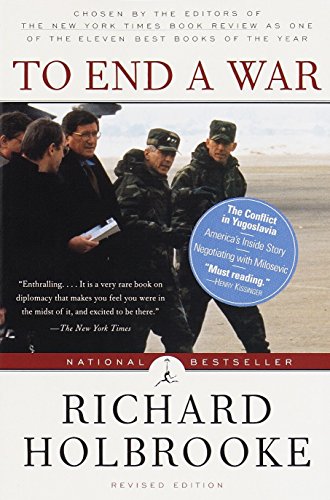
To End a War: The Conflict in Yugoslavia--America's Inside Story--Negotiating with Milosevic (Modern Library (Paperback)) - Softcover
Inhaltsangabe
When President Clinton sent Richard Holbrooke to Bosnia as America's chief negotiator in late 1995, he took a gamble that would eventually redefine his presidency. But there was no saying then, at the height of the war, that Holbrooke's mission would succeed. The odds were strongly against it.
As passionate as he was controversial, Holbrooke believed that the only way to bring peace to the Balkans was through a complex blend of American leadership, aggressive and creative diplomacy, and a willingness to use force, if necessary, in the cause for peace. This was not a universally popular view. Resistance was fierce within the United Nations and the chronically divided Contact Group, and in Washington, where many argued that the United States should not get more deeply involved. This book is Holbrooke's gripping inside account of his mission, of the decisive months when, belatedly and reluctantly but ultimately decisively, the United States reasserted its moral authority and leadership and ended Europe's worst war in over half a century. To End a War reveals many important new details of how America made this historic decision.
What George F. Kennan has called Holbrooke's "heroic efforts" were shaped by the enormous tragedy with which the mission began, when three of his four team members were killed during their first attempt to reach Sarajevo. In Belgrade, Sarajevo, Zagreb, Paris, Athens, and Ankara, and throughout the dramatic roller-coaster ride at Dayton, he tirelessly imposed, cajoled, and threatened in the quest to stop the killing and forge a peace agreement. Holbrooke's portraits of the key actors, from officials in the White House and the Élysée Palace to the leaders in the Balkans, are sharp and unforgiving. His explanation of how the United States was finally forced to intervene breaks important new ground, as does his discussion of the near disaster in the early period of the implementation of the Dayton agreement.
To End a War is a brilliant portrayal of high-wire, high-stakes diplomacy in one of the toughest negotiations of modern times. A classic account of the uses and misuses of American power, its lessons go far beyond the boundaries of the Balkans and provide a powerful argument for continued American leadership in the modern world.
Die Inhaltsangabe kann sich auf eine andere Ausgabe dieses Titels beziehen.
Über die Autorin bzw. den Autor
Richard Holbrooke began his diplomatic career in Vietnam in 1962, serving in the Mekong Delta and the American embassy in Saigon. After a tour on President Johnson's White House staff in 1966-67, he wrote one volume of the Pentagon Papers, served as special assistant to Undersecretaries of State Nicholas Katzenbach and Elliot Richardson, and was a member of the American delegation to the Paris peace talks on Vietnam. Holbrooke was Peace Corps director in Morocco from 1970 to 1972 and managing editor of Foreign Policy from 1972 to 1976. He served as Assistant Secretary of State for East Asian and Pacific Affairs (1977-81) and U.S. Ambassador to Germany (1993-94). He was Assistant Secretary of State for European and Canadian Affairs from 1994 to 1996, when he became the chief architect of the Dayton Peace Accords. He is co-author of Clark Clifford's memoir, Counsel to the President, and is currently a vice chairman of Credit Suisse First Boston, based in New York. He is married to the author Kati Marton and has two sons, David and Anthony.
Von der hinteren Coverseite
When President Clinton sent Richard Holbrooke to Bosnia as America's chief negotiator in late 1995, he took a gamble that would eventually redefine his presidency. But there was no saying then, at the height of the war, that Holbrooke's mission would succeed. The odds were strongly against it.
As passionate as he was controversial, Holbrooke believed that the only way to bring peace to the Balkans was through a complex blend of American leadership, aggressive and creative diplomacy, and a willingness to use force, if necessary, in the cause for peace. This was not a universally popular view. Resistance was fierce within the United Nations and the chronically divided Contact Group, and in Washington, where many argued that the United States should not get more deeply involved. This book is Holbrooke's gripping inside account of his mission, of the decisive months when, belatedly and reluctantly but ultimately decisively, the United States reasserted its moral authority and leadership and ended Europe's worst war in over half a century. To End a War reveals many important new details of how America made this historic decision.
What George F. Kennan has called Holbrooke's "heroic efforts" were shaped by the enormous tragedy with which the mission began, when three of his four team members were killed during their first attempt to reach Sarajevo. In Belgrade, Sarajevo, Zagreb, Paris, Athens, and Ankara, and throughout the dramatic roller-coaster ride at Dayton, he tirelessly imposed, cajoled, and threatened in the quest to stop the killing and forge a peace agreement. Holbrooke's portraits of the key actors, from officials in the White House and the Élysée Palace to the leaders in the Balkans, are sharp and unforgiving. His explanation of how the United States was finally forced to intervene breaks important new ground, as does his discussion of the near disaster in the early period of the implementation of the Dayton agreement.
To End a War is a brilliant portrayal of high-wire, high-stakes diplomacy in one of the toughest negotiations of modern times. A classic account of the uses and misuses of American power, its lessons go far beyond the boundaries of the Balkans and provide a powerful argument for continued American leadership in the modern world.
Auszug. © Genehmigter Nachdruck. Alle Rechte vorbehalten.
The Most Dangerous Road in Europe (August 15-21, 1995)
For all of us there is a twilight zone between history and memory; between the past as a generalized record which is open to relatively dispassionate inspection and the past as a remembered part of, or background to, one's own life. --ERIC HOBSBAWM, The Age of Empire: 1875-1914
THE MOUNT IGMAN ROUTE TO SARAJEVO was often described as the most dangerous road in Europe. Parts of the road, a narrow, winding red-dirt track originally used only by farmers and shepherds, were controlled by Serb machine gunners, who regularly shot at U.N. vehicles trying to reach the Bosnian capital. The roadbed itself had little foundation and no reinforcement along its sides, and in several of its narrower sections it was difficult for two cars to pass other. The wreckage of vehicles that had slid off the road or been hit by Serb gunners littered the steep slopes and ravines. In the summer of 1995, however, with the airport closed by Serb artillery, the two-hour drive over Mount Igman was the only way to reach Sarajevo without going through Bosnian Serb lines.
The chief European negotiator, Carl Bildt of Sweden, had been shot at as he crossed Serb territory only weeks earlier. He urged us not to use the Igman road. But without visiting Bosnia's beleaguered capital we could not carry out our mission. On August 15, we made our first attempt, taking a United Nations helicopter from the Croatian coastal town of Split to a landing zone high on Mount Igman, after which we would drive in armored vehicles to Sarajevo. Our helicopter was unable to find a break in the heavy clouds over the landing site. After circling for several unpleasant hours, we returned, frustrated and tired, to Split.
Hearing that we could not reach Sarajevo, Bosnian Foreign Minister Muhamed Sacirbey, accompanied by the senior American diplomat in Bosnia, John Menzies, drove over Mount Igman to meet us at the Split airport. Known to most Americans via television as the eloquent face of his embattled new nation, Sacirbey was perhaps proudest of the fact that he had been a first-string defensive back at Tulane University. He was tough, strong, and fit. Still, the long and bumpy road trip had tired him, and he was as exhausted as we were. To avoid being overheard, we squeezed into the cabin of our small Air Force jet as it sat on the tarmac, and briefed him on our plans. I stressed that while our mission had the full backing of President Clinton, and represented a last, best hope for peace in the Balkans, there was no guarantee of its success. Our discussion finished as darkness fell over the Balkans, and we flew on to Zagreb, the capital of Croatia, to meet Croatian President Franjo Tudjman. After a day in Zagreb, we arrived in Belgrade on August 17 to meet the key actor in this stage of the drama, President Slobodan Milosevic of Serbia.
Although I knew the other major leaders in the region, this would be my first meeting with the man who, in our view, bore the heaviest responsibility for the war. I approached the meeting with great uncertainty, and was guided by my deputy, Robert Frasure, who had spent many hours negotiating with Milosevic earlier that spring.
Frasure's main bargaining chip with Milosevic had been the economic sanctions that the United Nations had imposed in 1992 against the "Federal Republic of Yugoslavia," the name by which Serbia and Montenegro still called themselves even though the four other republics of the original Yugoslavia--Slovenia, Croatia, Macedonia, and Bosnia-Herzegovina--had declared themselves independent nations. The sanctions had seriously damaged Serbia's economy, and Milosevic wanted them ended. But for more than sixteen months he had refused to offer anything concrete in return for our suspending or lifting them.
Our first meeting with Milosevic, on August 17, lasted almost six hours. He was smart, charming, and evasive. As Warren Zimmermann, our last Ambassador to Yugoslavia, put it: "Milosevic makes a stunning first impression on those who do not have the information to refute his often erroneous assertions. Many is the U.S. senator or congressman who has reeled out of his office exclaiming, ''Why, he's not nearly as bad as I expected!''" But despite his cleverness, Milosevic was playing word games devoid of substance--and he knew it. Without budging, he focused on inconsequential changes in draft documents over which he and Frasure had been arguing since the beginning of the year. His goal remained to get the sanctions lifted at no cost.
Our most important point concerned whom we would negotiate with. The United States, we said, would never again deal directly with the Bosnian Serbs, who still rained artillery and racist rhetoric down upon the Muslims and the Croats from their mountain capital of Pale. "You must speak for Pale," I said. "We won''t deal with them ever again."
Frasure thought the meeting had gone well. Nonetheless, it left me dissatisfied. I decided to see Milosevic again the next morning to make clear that we would not continue the cat-and-mouse game he had played with previous negotiators. To emphasize this, it was necessary to change the ground rules a bit. Our entire team of six people had attended the first meeting, but Milosevic had had only two people with him--his new Foreign Minister, Milan Milutinovic, and his chief of staff, Goran Milinovic. Nine people were simply too many to establish the sort of direct relationship necessary for a frank dialogue.
Early on the morning of August 18, before our second meeting with Milosevic, I met with Frasure and Rudy Perina, the senior American diplomat in Belgrade, in the garden of the ambassadorial residence. As we walked between the imposing old stone house and the tennis court, under magnificent chestnut trees and presumably out of the range of prying microphones, I said that I "planned to throw a controlled fit" to make clear to Milosevic that what he was doing was unacceptable. Because of this plan, I added that the next meeting needed to be smaller.
Apologizing to Rudy, I asked him to drop out of the meeting. Returning to the house, I asked the other two members of our team--Joseph Kruzel, the Senior Deputy Assistant Secretary of Defense; and Lieutenant General Wesley Clark, the Chief of Plans for the Joint Chiefs of Staff--to drop out as well. I would take only Frasure and Nelson Drew, an Air Force colonel who, as the National Security Council staff member on our team, represented the White House. Frasure concurred in this suggestion.
Nothing generates more heat in the government than the question of who is chosen to participate in important meetings. My request ran against a diplomatic custom I greatly respected--that the senior resident American diplomatic representative should normally attend every official meeting with a head of government. But although unhappy, all three men agreed without objection. It could have been a difficult moment; I was deeply gratified by this early sign of our cohesiveness as a team.
Less than an hour later Frasure, Drew, and I were seated in a high-ceilinged meeting room in the Presidential Palace--one of Tito''s old offices--in Belgrade. It was a room we would come to know well in the next seven months. Like other such meeting rooms in communist and former communist countries from Beijing to Bratislava, the room tried to make up for its lack of charm by a drab giganticism. The three of us sat on a long sofa. Milosevic took an armchair a few feet from where I sat at the end of the sofa. Foreign Minister Milutinovic sat on another soft chair facing us directly, and Goran Milinovic, always the loyal staff officer, sat at the edge of the group, taking notes.
As we talked, I thought of the difficulties and dangers we would face each time we tried to reach Sarajevo. It was annoying that we had...
„Über diesen Titel“ kann sich auf eine andere Ausgabe dieses Titels beziehen.
Suchergebnisse für To End a War: The Conflict in Yugoslavia--America's...

Beispielbild für diese ISBN
To End a War: The Conflict in Yugoslavia--America's Inside Story--Negotiating with Milosevic
Anbieter: World of Books (was SecondSale), Montgomery, IL, USA
Verkäuferbewertung 5 von 5 Sternen

Paperback. Zustand: Good. When President Clinton sent Richard Holbrooke to Bosnia as America's chief negotiator in late 1995, he took a gamble that would eventually redefine his presidency. But there was no saying then, at the height of the war, that Holbrooke's mission would succeed. The odds were strongly against it. As passionate as he was controversial, Holbrooke believed that the only way to bring peace to the Balkans was through a complex blend of American leadership, aggressive and creative diplomacy, and a willingness to use force, if necessary, in the cause for peace. This was not a universally popular view. Resistance was fierce within the United Nations and the chronically divided Contact Group, and in Washington, where many argued that the United States should not get more deeply involved. This book is Holbrooke's gripping inside account of his mission, of the decisive months when, belatedly and reluctantly but ultimately decisively, the United States reasserted its moral authority and leadership and ended Europe's worst war in over half a century. To End a War reveals many important new details of how America made this historic decision. What George F. Kennan has called Holbrooke's "heroic efforts" were shaped by the enormous tragedy with which the mission began, when three of his four team members were killed during their first attempt to reach Sarajevo. In Belgrade, Sarajevo, Zagreb, Paris, Athens, and Ankara, and throughout the dramatic roller-coaster ride at Dayton, he tirelessly imposed, cajoled, and threatened in the quest to stop the killing and forge a peace agreement. Holbrooke's portraits of the key actors, from officials in the White House and the Élysée Palace to the leaders in the Balkans, are sharp and unforgiving. His explanation of how the United States was finally forced to intervene breaks important new ground, as does his discussion of the near disaster in the early period of the implementation of the Dayton agreement. To End a War is a brilliant portrayal of high-wire, high-stakes diplomacy in one of the toughest negotiations of modern times. A classic account of the uses and misuses of American power, its lessons go far beyond the boundaries of the Balkans and provide a powerful argument for continued American leadership in the modern world. Bestandsnummer des Verkäufers 00104695715
Gebraucht kaufen
EUR 4,50
Versand gratis
Versand innerhalb von USA
Versand innerhalb von USA
Anzahl: 11 verfügbar
Beispielbild für diese ISBN
To End a War: The Conflict in Yugoslavia--America's Inside Story--Negotiating with Milosevic
Anbieter: World of Books (was SecondSale), Montgomery, IL, USA
Verkäuferbewertung 5 von 5 Sternen
Paperback. Zustand: Fair. When President Clinton sent Richard Holbrooke to Bosnia as America's chief negotiator in late 1995, he took a gamble that would eventually redefine his presidency. But there was no saying then, at the height of the war, that Holbrooke's mission would succeed. The odds were strongly against it. As passionate as he was controversial, Holbrooke believed that the only way to bring peace to the Balkans was through a complex blend of American leadership, aggressive and creative diplomacy, and a willingness to use force, if necessary, in the cause for peace. This was not a universally popular view. Resistance was fierce within the United Nations and the chronically divided Contact Group, and in Washington, where many argued that the United States should not get more deeply involved. This book is Holbrooke's gripping inside account of his mission, of the decisive months when, belatedly and reluctantly but ultimately decisively, the United States reasserted its moral authority and leadership and ended Europe's worst war in over half a century. To End a War reveals many important new details of how America made this historic decision. What George F. Kennan has called Holbrooke's "heroic efforts" were shaped by the enormous tragedy with which the mission began, when three of his four team members were killed during their first attempt to reach Sarajevo. In Belgrade, Sarajevo, Zagreb, Paris, Athens, and Ankara, and throughout the dramatic roller-coaster ride at Dayton, he tirelessly imposed, cajoled, and threatened in the quest to stop the killing and forge a peace agreement. Holbrooke's portraits of the key actors, from officials in the White House and the Élysée Palace to the leaders in the Balkans, are sharp and unforgiving. His explanation of how the United States was finally forced to intervene breaks important new ground, as does his discussion of the near disaster in the early period of the implementation of the Dayton agreement. To End a War is a brilliant portrayal of high-wire, high-stakes diplomacy in one of the toughest negotiations of modern times. A classic account of the uses and misuses of American power, its lessons go far beyond the boundaries of the Balkans and provide a powerful argument for continued American leadership in the modern world. Bestandsnummer des Verkäufers 00107654640
Gebraucht kaufen
EUR 4,50
Versand gratis
Versand innerhalb von USA
Versand innerhalb von USA
Anzahl: 2 verfügbar
Foto des Verkäufers
To End a War: The Conflict in Yugoslavia--America's Inside Story--Negotiating with Milosevic (Modern Library (Paperback))
Anbieter: Reliant Bookstore, El Dorado, KS, USA
Verkäuferbewertung 5 von 5 Sternen
Zustand: good. This book is in good condition with very minimal damage. Pages may have minimal notes or highlighting. Cover image on the book may vary from photo. Ships out quickly in a secure plastic mailer. Bestandsnummer des Verkäufers RDV.0375753605.G
Gebraucht kaufen
EUR 4,51
Versand gratis
Versand innerhalb von USA
Versand innerhalb von USA
Anzahl: 1 verfügbar
Foto des Verkäufers
To End a War: The Conflict in Yugoslavia--America's Inside Story--Negotiating with Milosevic (Modern Library (Paperback))
Anbieter: 2nd Life Books, Burlington, NJ, USA
Verkäuferbewertung 5 von 5 Sternen
Zustand: very_good. Used book in very good condition. May have some minor wear. May NOT include discs, or access code or other supplemental material. Ships directly from Amazon and is eligible for Prime or super saver FREE shipping. We ship Monday-Saturday and respond to inquiries within 24 hours. Bestandsnummer des Verkäufers BXM.EHXZ
Gebraucht kaufen
EUR 1,64
EUR 3,57 Versand
Versand innerhalb von USA
Versand innerhalb von USA
Anzahl: 1 verfügbar
Foto des Verkäufers
To End a War: The Conflict in Yugoslavia--America's Inside Story--Negotiating with Milosevic (Modern Library (Paperback))
Anbieter: Greenworld Books, Arlington, TX, USA
Verkäuferbewertung 5 von 5 Sternen
Zustand: very_good. Fast Free Shipping â" Very Good condition book with a firm cover and clean pages. Shows normal use and some light wear or limited notes markings. A solid, nice copy to enjoy. Bestandsnummer des Verkäufers GWV.0375753605.VG
Gebraucht kaufen
EUR 5,27
Versand gratis
Versand innerhalb von USA
Versand innerhalb von USA
Anzahl: 1 verfügbar
Foto des Verkäufers
To End a War: The Conflict in Yugoslavia--America's Inside Story--Negotiating with Milosevic (Modern Library (Paperback))
Anbieter: Dream Books Co., Denver, CO, USA
Verkäuferbewertung 5 von 5 Sternen
Zustand: acceptable. This copy has clearly been enjoyedâ"expect noticeable shelf wear and some minor creases to the cover. Binding is strong, and all pages are legible. May contain previous library markings or stamps. Bestandsnummer des Verkäufers 4EKGRJ00D4HD_ns
Gebraucht kaufen
EUR 5,46
Versand gratis
Versand innerhalb von USA
Versand innerhalb von USA
Anzahl: 1 verfügbar
Beispielbild für diese ISBN
To End a War (Revised Edition) (Modern Library Paperbacks)
Anbieter: BookHolders, Towson, MD, USA
Verkäuferbewertung 5 von 5 Sternen
Zustand: Good. [ No Hassle 30 Day Returns ][ Ships Daily ] [ Underlining/Highlighting: NONE ] [ Writing: SOME ] [ Edition: Reprint ] Publisher: Modern Library Pub Date: 5/25/1999 Binding: Paperback Pages: 464 Reprint edition. Bestandsnummer des Verkäufers 6827787
Gebraucht kaufen
EUR 5,53
Versand gratis
Versand innerhalb von USA
Versand innerhalb von USA
Anzahl: 1 verfügbar
Beispielbild für diese ISBN
To End a War: The Conflict in Yugoslavia--America's Inside Story--Negotiating with Milosevic (Modern Library (Paperback))
Verlag:
Modern Library (edition Revised), 1999
ISBN 10: 0375753605
ISBN 13: 9780375753602
Gebraucht
Paperback
Anbieter: BooksRun, Philadelphia, PA, USA
Verkäuferbewertung 5 von 5 Sternen
Paperback. Zustand: Fair. Revised. The item might be beaten up but readable. May contain markings or highlighting, as well as stains, bent corners, or any other major defect, but the text is not obscured in any way. Bestandsnummer des Verkäufers 0375753605-7-1
Gebraucht kaufen
EUR 5,62
Versand gratis
Versand innerhalb von USA
Versand innerhalb von USA
Anzahl: 1 verfügbar
Beispielbild für diese ISBN
To End a War: The Conflict in Yugoslavia--America's Inside Story--Negotiating with Milosevic
Anbieter: ThriftBooks-Phoenix, Phoenix, AZ, USA
Verkäuferbewertung 5 von 5 Sternen
Paperback. Zustand: Good. No Jacket. Pages can have notes/highlighting. Spine may show signs of wear. ~ ThriftBooks: Read More, Spend Less. Bestandsnummer des Verkäufers G0375753605I3N00
Gebraucht kaufen
EUR 5,96
Versand gratis
Versand innerhalb von USA
Versand innerhalb von USA
Anzahl: 1 verfügbar
Beispielbild für diese ISBN
To End a War: The Conflict in Yugoslavia--America's Inside Story--Negotiating with Milosevic
Anbieter: ThriftBooks-Atlanta, AUSTELL, GA, USA
Verkäuferbewertung 5 von 5 Sternen
Paperback. Zustand: Very Good. No Jacket. May have limited writing in cover pages. Pages are unmarked. ~ ThriftBooks: Read More, Spend Less. Bestandsnummer des Verkäufers G0375753605I4N00
Gebraucht kaufen
EUR 6,27
Versand gratis
Versand innerhalb von USA
Versand innerhalb von USA
Anzahl: 1 verfügbar