
Verwandte Artikel zu The Fun of It: Stories from The Talk of the Town (Modern...
Inhaltsangabe
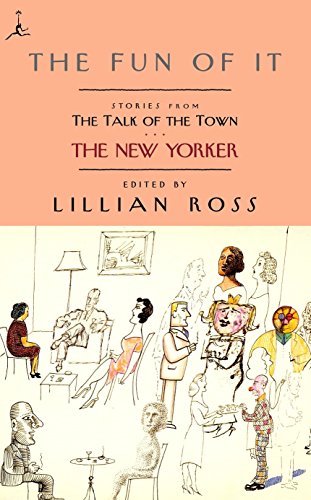
William Shawn once called The Talk of the Town the soul of the magazine. The section began in the first issue, in 1925. But it wasn't until a couple of years later, when E. B. White and James Thurber arrived, that the Talk of the Town story became what it is today: a precise piece of journalism that always gets the story and has a little fun along the way.
The Fun of It is the first anthology of Talk pieces that spans the magazine's life. Edited by Lillian Ross, the longtime Talk reporter and New Yorker staff writer, the book brings together pieces by the section's most original writers. Only in a collection of Talk stories will you find E. B. White visiting a potter's field; James Thurber following Gertrude Stein at Brentano's; Geoffrey Hellman with Cole Porter at the Waldorf Towers; A. J. Liebling on a book tour with Albert Camus; Maeve Brennan ventriloquizing the long-winded lady; John Updike navigating the passageways of midtown; Calvin Trillin marching on Washington in 1963; Jacqueline Onassis chatting with Cornell Capa; Ian Frazier at the Monster Truck and Mud Bog Fall Nationals; John McPhee in virgin forest; Mark Singer with sixth-graders adopting Hudson River striped bass; Adam Gopnik in Flatbush visiting the ìgrandest theatre devoted exclusively to the movies; Hendrik Hertzberg pinning down a Sulzberger on how the Times got colorized; George Plimpton on the tennis court with Boris Yeltsin; and Lillian Ross reporting good little stories for more than forty-five years. They and dozens of other Talk contributors provide an entertaining tour of the most famous section of the most famous magazine in the world.
Die Inhaltsangabe kann sich auf eine andere Ausgabe dieses Titels beziehen.
Über die Autorin bzw. den Autor
As Lillian Ross writes in her Preface, Talk stories have today evolved into the sharpest, funniest, and often timeliest short-form writing in the history of the magazine. These little (a thousand words or less) gems now bear out the ultimate refinement of what Harold Ross wanted his magazine to be.
Von der hinteren Coverseite
William Shawn once called "The Talk of the Town the soul of the magazine. The section began in the first issue, in 1925. But it wasn't until a couple of years later, when E. B. White and James Thurber arrived, that the "Talk of the Town story became what it is today: a precise piece of journalism that always gets the story and has a little fun along the way.
The Fun of It is the first anthology of "Talk pieces that spans the magazine's life. Edited by Lillian Ross, the longtime "Talk reporter and "New Yorker staff writer, the book brings together pieces by the section's most original writers. Only in a collection of "Talk stories will you find E. B. White visiting a potter's field; James Thurber following Gertrude Stein at Brentano's; Geoffrey Hellman with Cole Porter at the Waldorf Towers; A. J. Liebling on a book tour with Albert Camus; Maeve Brennan ventriloquizing the long-winded lady; John Updike navigating the passageways of midtown; Calvin Trillin marching on Washington in 1963; Jacqueline Onassis chatting with Cornell Capa; Ian Frazier at the Monster Truck and Mud Bog Fall Nationals; John McPhee in virgin forest; Mark Singer with sixth-graders adopting Hudson River striped bass; Adam Gopnik in Flatbush visiting the igrandest theatre devoted exclusively to the movies; Hendrik Hertzberg pinning down a Sulzberger on how the" Times got colorized; George Plimpton on the tennis court with Boris Yeltsin; and Lillian Ross reporting good little stories for more than forty-five years. They and dozens of other Talk contributors provide an entertaining tour of the most famous section of the most famous magazine in the world.
Aus dem Klappentext
n once called The Talk of the Town the soul of the magazine. The section began in the first issue, in 1925. But it wasn't until a couple of years later, when E. B. White and James Thurber arrived, that the Talk of the Town story became what it is today: a precise piece of journalism that always gets the story and has a little fun along the way.
The Fun of It is the first anthology of Talk pieces that spans the magazine's life. Edited by Lillian Ross, the longtime Talk reporter and New Yorker staff writer, the book brings together pieces by the section's most original writers. Only in a collection of Talk stories will you find E. B. White visiting a potter's field; James Thurber following Gertrude Stein at Brentano's; Geoffrey Hellman with Cole Porter at the Waldorf Towers; A. J. Liebling on a book tour with Albert Camus; Maeve Brennan ventriloquizing the long-winded lady; John Updike navigating the
Auszug. © Genehmigter Nachdruck. Alle Rechte vorbehalten.
Chapter 1
ROBERT BENCHLEY
"UP THE DARK STAIRS-"
Among the major menaces to American journalism today (and there are so many that it hardly seems worth while even beginning this little article) is the O. Henry-Irvin Cobb tradition. According to this pretty belief, every reporter is potentially master of the short-story, and because of it we find Human Interest raising its ugly head in seven out of every eight news columns and a Human Document being turned out every time Henry H. Mackle of 1356 Grand Boulevard finds a robin or Mrs. Rasher Feiman of 425 West Forty-ninth Street attacks the scissors grinder.
Copy readers in the old days used to insist that all the facts in the story be bunched together in the opening paragraph. This never made for a very moving chronicle, but at least you got the idea of what was going on. Under the new system, where every reporter has his eye on George Horace Lorimer, you first establish your atmosphere, then shake a pair of doves out of the handkerchief, round off your lead with a couple of bars from a Chopin étude, and finally, in the next to last paragraph, divulge the names and addresses and what it was that happened.
A story which, under the old canons of journalism, would have read as follows:
"Mary J. Markezan, of 1278 Ocean Parkway, was found early this morning by Officer Charles Norbey of the Third Precinct in a fainting condition from lack of gin, etc."
now appeals to our hearts and literary sensibilities as follows:
"Up the dark stairs in a shabby house on Ocean Parkway plodded a bent, weary figure. An aroma of cooking cabbage filled the hall. Somebody's mother was coming home. Somebody's mother was bringing in an arm-full of wood for the meagre fire at 1857 Ocean Parkway. Soon the tired form would be at the top of the shadowy stairs. But Fate, in the person of Officer Norbey, was present, etc."
A fine bit of imaginative writing, satisfying everybody except the reader who wants to know what happened at 1857 Ocean Parkway.
Most of the trouble began about ten years ago when the Columbia School of Journalism began unloading its graduates on what was then the N. Y. Tribune (retaining the best features of neither). Every one of the boys had the O. Henry light in his eyes, and before long the market report was the only thing in the paper that didn't lead off with "Up the dark stairs at-"
Fine writing in news stories was actually encouraged by the management and daily prizes were offered for the best concealed facts. The writer of this article (Robert Benchley) was a reporter at the time-"the worst reporter in New York City" the editors affectionately called him-and one day he won the prize with a couple of sticks on the funeral of Ada Rehan. This story consisted of two paragraphs of sentimental contemplation of old-time English comedy with a bitterly satirical comparison with modern movie comedy, and a short paragraph at the end saying that Ada Rehan was buried yesterday. Unfortunately the exigencies of make-up necessitated the cutting of the last paragraph; so the readers of the Tribune the next morning never did find out what had inspired this really beautiful tribute to somebody.
From the Tribune the scourge of fine news writing has spread to all the other papers with the exception of the Times. Your Monday morning copy of the World reads like something you find on the table by the guest room bed-"Twenty Tales of Danger and Daring" or "My Favorite Ghost Story: An Anthology". The news of the day is dished up like the Comédie Humaine with leads running from: "Up the dark stairs at-" to "This is the story of a little boy who lost his kitty." A picture of the City Room of the World, by one who has never been there, would disclose a dozen or so nervous word artists, each sitting in a cubicle furnished to represent an attic, sipping at black coffee, with now and then a dab of cocaine, writing and tearing up, writing and tearing up, pacing back and forth in what the French call (in French) le travail du style. There must be a little hidden music, too, to make the boys write as they do. One feels that back copies of the World should be bound and saved for perusal on rainy days when the volumes of "Harpers Round Table" have begun to pall.
Soon it will creep into the foreign dispatches, hitherto held somewhat in check by cable rates. From a debt conference in London we may have something like this:
"Up the dark stairs at 17 Downing Street trudged a tired figure in a silk hat. Under his arm he carried a brief case. Outside, the unheeding swirl of London swept by, but in the heart of the tired man there was peace. Austen Chamberlain had brought to a conclusion the negotiations for the day."
Or:
"The twilight falls quickly on the left bank of the Seine, and yesterday it fell even more quickly than usual. At a table on the sidewalk of a little café on Montparnasse, a pale man sat figuring on the back of an envelope. Not a man that you would look at a second time, perhaps, but, as Kipling says, that is another story. This man was Jules Delatour and he ran a little shop on the Boulevard Raspail. And Jules Delatour was sad last evening as the quick twilight fell over Montparnasse. For yesterday the franc dropped again, to twenty-six to the dollar."
When this has happened, we can have newstickers installed in our homes and let the newspapers give themselves over entirely to the belles lettres.
1925
AUTHOR UNKNOWN
A MARQUISE AT HOME
Gloria swanson is back with her titled husband, the Marquis de la Falaise de la Coudraie. A day or so after her arrival, she journeyed over to the Famous Players' Astoria studio, accompanied, of course, by the marquis. The reception was a touching one.
Attracted by advance announcements, a large crowd had gathered in front of the studio. The whole studio force was assembled on the steps and four policemen struggled to keep a lane open for Gloria's car.
Suddenly the cry went up, "Here she is!" The crowd surged forward, the quartet of police officers labored with might and main, and a smart foreign car slipped up to the steps.
Out stepped a dapper chap. "The marquis!" gasped the assembled stenographers in one breath. News cameras clicked. Cheers shook the studio. Bushels of confetti were tossed into midair.
When the air cleared it developed that the dapper chap was James R. Quirk, editor of Photoplay.
When Gloria and the marquis did appear a few seconds later, it was an anti-climax. Still, it was prettily done. The marquis looked pleasantly democratic, Gloria burst into tears and everyone cheered all over again.
The marquis is tall, smartly garbed and speaks excellent English.
There is, as was inevitable, a little story of the trip over from Paris. Gloria and the marquis had been pursued daily by curious passengers and finally the star decided to grace a ship's concert. Ranged alongside were some friends of the old lady in Dubuque. Gloria's nose tilted a bit in midair.
The marquis leaned close to his stellar wife. "Don't be a snob, Gloria," he said.
1925
BILL CORUM
THE KING'S PAJAMAS
They were pink and they positively set the exclusive social circles of Asheville and Biltmore, N.C., agog, for the pajamas in question belonged to King Babe Ruth himself.
In Asheville it was, as all the world knows now, that the King first swooned away. The fourth breakfast porterhouse and a rough train ride had upset His Majesty. Doctors were called. Consultations held. It was decided that the indisposed monarch must be sent home to New York. Then came the question of moving him from the hotel to the train. It was suggested...
„Über diesen Titel“ kann sich auf eine andere Ausgabe dieses Titels beziehen.
Suchergebnisse für The Fun of It: Stories from The Talk of the Town (Modern...

Beispielbild für diese ISBN
The Fun of It: Stories from The Talk of the Town (Modern Library (Paperback))
Verlag:
Random House Publishing Group, 2001
ISBN 10: 0375756493
ISBN 13: 9780375756498
Gebraucht
Softcover
Anbieter: World of Books (was SecondSale), Montgomery, IL, USA
Verkäuferbewertung 5 von 5 Sternen

Zustand: Acceptable. Item in acceptable condition! Textbooks may not include supplemental items i.e. CDs, access codes etc. Bestandsnummer des Verkäufers 00105023550
Gebraucht kaufen
EUR 5,14
Versand gratis
Versand innerhalb von USA
Versand innerhalb von USA
Anzahl: 2 verfügbar
Beispielbild für diese ISBN
The Fun of It: Stories from The Talk of the Town (Modern Library (Paperback))
Verlag:
Random House Publishing Group, 2001
ISBN 10: 0375756493
ISBN 13: 9780375756498
Gebraucht
Softcover
Anbieter: World of Books (was SecondSale), Montgomery, IL, USA
Verkäuferbewertung 5 von 5 Sternen
Zustand: Good. Item in good condition. Textbooks may not include supplemental items i.e. CDs, access codes etc. Bestandsnummer des Verkäufers 00095001383
Gebraucht kaufen
EUR 5,14
Versand gratis
Versand innerhalb von USA
Versand innerhalb von USA
Anzahl: 4 verfügbar
Beispielbild für diese ISBN
The Fun of It: Stories from The Talk of the Town (Modern Library (Paperback))
ISBN 10: 0375756493
ISBN 13: 9780375756498
Gebraucht
Paperback
Anbieter: BooksRun, Philadelphia, PA, USA
Verkäuferbewertung 5 von 5 Sternen
Paperback. Zustand: Fair. Modern Library pbk. ed. The item might be beaten up but readable. May contain markings or highlighting, as well as stains, bent corners, or any other major defect, but the text is not obscured in any way. Bestandsnummer des Verkäufers 0375756493-7-1
Gebraucht kaufen
EUR 5,15
Versand gratis
Versand innerhalb von USA
Versand innerhalb von USA
Anzahl: 1 verfügbar
Beispielbild für diese ISBN
The Fun of It : Stories from the Talk of the Town
Verlag:
Random House Publishing Group, 2001
ISBN 10: 0375756493
ISBN 13: 9780375756498
Gebraucht
Softcover
Anbieter: Better World Books, Mishawaka, IN, USA
Verkäuferbewertung 5 von 5 Sternen
Zustand: Good. Modern Library Pbk. Ed. Pages intact with minimal writing/highlighting. The binding may be loose and creased. Dust jackets/supplements are not included. Stock photo provided. Product includes identifying sticker. Better World Books: Buy Books. Do Good. Bestandsnummer des Verkäufers 4168392-6
Gebraucht kaufen
EUR 6,31
Versand gratis
Versand innerhalb von USA
Versand innerhalb von USA
Anzahl: 2 verfügbar
Beispielbild für diese ISBN
The Fun of It : Stories from the Talk of the Town
Verlag:
Random House Publishing Group, 2001
ISBN 10: 0375756493
ISBN 13: 9780375756498
Gebraucht
Softcover
Anbieter: Better World Books, Mishawaka, IN, USA
Verkäuferbewertung 5 von 5 Sternen
Zustand: Good. Modern Library Pbk. Ed. Former library copy. Pages intact with minimal writing/highlighting. The binding may be loose and creased. Dust jackets/supplements are not included. Includes library markings. Stock photo provided. Product includes identifying sticker. Better World Books: Buy Books. Do Good. Bestandsnummer des Verkäufers 2296592-6
Gebraucht kaufen
EUR 6,31
Versand gratis
Versand innerhalb von USA
Versand innerhalb von USA
Anzahl: 1 verfügbar
Beispielbild für diese ISBN
The Fun of It: Stories from The Talk of the Town (Modern Library (Paperback))
Verlag:
Random House Publishing Group, 2001
ISBN 10: 0375756493
ISBN 13: 9780375756498
Gebraucht
paperback
Anbieter: Half Price Books Inc., Dallas, TX, USA
Verkäuferbewertung 5 von 5 Sternen
paperback. Zustand: Very Good. Connecting readers with great books since 1972! Used books may not include companion materials, and may have some shelf wear or limited writing. We ship orders daily and Customer Service is our top priority! Bestandsnummer des Verkäufers S_424290017
Gebraucht kaufen
EUR 3,56
EUR 3,02 Versand
Versand innerhalb von USA
Versand innerhalb von USA
Anzahl: 1 verfügbar
Beispielbild für diese ISBN
The Fun of It: Stories from The Talk of the Town
Verlag:
Random House Publishing Group, 2001
ISBN 10: 0375756493
ISBN 13: 9780375756498
Gebraucht
Paperback
Anbieter: ThriftBooks-Reno, Reno, NV, USA
Verkäuferbewertung 5 von 5 Sternen
Paperback. Zustand: Good. No Jacket. Pages can have notes/highlighting. Spine may show signs of wear. ~ ThriftBooks: Read More, Spend Less. Bestandsnummer des Verkäufers G0375756493I3N00
Gebraucht kaufen
EUR 6,65
Versand gratis
Versand innerhalb von USA
Versand innerhalb von USA
Anzahl: 1 verfügbar
Beispielbild für diese ISBN
The Fun of It: Stories from The Talk of the Town
Verlag:
Random House Publishing Group, 2001
ISBN 10: 0375756493
ISBN 13: 9780375756498
Gebraucht
Paperback
Anbieter: ThriftBooks-Phoenix, Phoenix, AZ, USA
Verkäuferbewertung 5 von 5 Sternen
Paperback. Zustand: Good. No Jacket. Pages can have notes/highlighting. Spine may show signs of wear. ~ ThriftBooks: Read More, Spend Less. Bestandsnummer des Verkäufers G0375756493I3N00
Gebraucht kaufen
EUR 6,65
Versand gratis
Versand innerhalb von USA
Versand innerhalb von USA
Anzahl: 1 verfügbar
Foto des Verkäufers
The Fun of It: Stories from The Talk of the Town (Modern Library (Paperback))
Verlag:
Random House Publishing Group, 2001
ISBN 10: 0375756493
ISBN 13: 9780375756498
Gebraucht
Softcover
Anbieter: Goodwill, Brooklyn Park, MN, USA
Verkäuferbewertung 4 von 5 Sternen

Zustand: good. The corners are bent. Bestandsnummer des Verkäufers MINV.0375756493.G
Gebraucht kaufen
EUR 3,24
EUR 3,45 Versand
Versand innerhalb von USA
Versand innerhalb von USA
Anzahl: 1 verfügbar
Beispielbild für diese ISBN
The Fun of It: Stories from The Talk of the Town
Verlag:
Random House Publishing Group, 2001
ISBN 10: 0375756493
ISBN 13: 9780375756498
Gebraucht
Paperback
Anbieter: ThriftBooks-Atlanta, AUSTELL, GA, USA
Verkäuferbewertung 5 von 5 Sternen
Paperback. Zustand: Very Good. No Jacket. May have limited writing in cover pages. Pages are unmarked. ~ ThriftBooks: Read More, Spend Less. Bestandsnummer des Verkäufers G0375756493I4N00
Gebraucht kaufen
EUR 6,71
Versand gratis
Versand innerhalb von USA
Versand innerhalb von USA
Anzahl: 1 verfügbar