
Verwandte Artikel zu Vanity Fair: A Novel without a Hero (Modern Library...
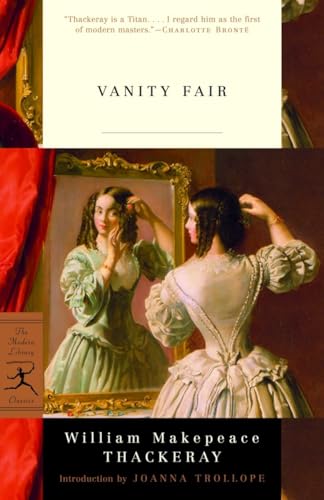
Inhaltsangabe
A marvelous, incisive social satire that gleefully exposes the greed and corruption raging in England during the turmoil of the Napoleonic wars through its tracing of the changing fortunes of two unforgettable women. It is a comic masterpiece that still resonates today.
"Re-reading Vanity Fair, one realises what a brilliant innovation this was in the English novel," remarked V. S. Pritchett. "Thackeray is like the modern novelists who derive from James and Proust, in his power of dissecting (and of desiccating!) character."
Generally considered to be his masterpiece, Vanity Fair is Thackeray's resplendent social satire that exposes the greed and corruption raging in England during the turmoil of the Napoleonic wars. Subtitled "A Novel Without a Hero," it traces the changing fortunes of two unforgettable women: the scheming opportunist Becky Sharp—one of literature's most resourceful, engaging, and amoral heroines—and her foil, the faithful, naive Amelia Sedley. Thackeray's subversive, comic attack on the hypocrisy and "dismal roguery" of an avaricious world resonates 150 years later with implications for our own times.
"Thackeray is an urbane nineteenth-century guide and commentator in a portrait gallery that is for all time," observed Louis Auchincloss. "He is the restless inhabitant of a prudish age, nostalgic, discursive, anecdotal, sentimental, worldly-wise, now warning us, now making fun of us, now reproving us .... Thackeray's harshest criticism of humanity is simply the point where ours commences. His perception of self-interest in every act is the ABC of modem psychology."
Die Inhaltsangabe kann sich auf eine andere Ausgabe dieses Titels beziehen.
Über die Autorin bzw. den Autor
About the Contributor:
Joanna Trollope is the author of THE BEST OF FRIENDS, OTHER PEOPLE'S CHILDREN, and most recently, MARRYING THE MISTRESS, among other books. She lives in England.
William Makepeace Thackeray, whose satiric novels are often regarded as the great upper-class counterpart to Dickens's panoramic depiction of lower-class Victorian society, was born on July 18, 1811, in Calcutta, India. His father, a prosperous official of the British East India Company, died four years later, and at the age of six Thackeray was sent to England to be educated. After graduating from the Charterhouse School in London, he entered Trinity College, Cambridge, in 1829 but left the following year without taking a degree. After reading law for a short time at the Middle Temple he moved to Paris in 1832 to study art. Although he eventually abandoned the idea of painting as a career, Thackeray continued to draw throughout his life, illustrating many of his own works. When financial reversals wiped out his inheritance, he resettled in London and turned to journalism for a livelihood. By then he had married Isabella Shawe, a young Irishwoman with whom he had three daughters.
Thackeray's earliest literary success, The Yellowplush Correspondence, a group of satiric sketches written in the guise of a cockney footman's memoirs, was serialized in Fraser's Magazine beginning in 1837. Catherine (serialized 1839-40; published 1869), his first novel, parodied the crime stories popular in Victorian England. Under the name Michael Angelo Titmarsh, the most famous of his many pseudonyms, Thackeray turned out The Paris Sketch Book (1840) and The Irish Sketch-Book (1843), two popular volumes of travel writing. The Luck of Barry Lyndon (1844), which chronicles the adventures of an Irish knave in eighteenth-century England, marked his first serious attack on social pretension. In The Book of Snobs (1848), a collection of satiric portraits originally published in Punch magazine (1846-47), he lampooned the avarice and snobbery occasioned by the Industrial Revolution.
Vanity Fair, Thackeray's resplendent social satire exposing the greed and corruption raging in England during the turmoil of the Napoleonic wars, brought him immediate acclaim when it appeared in Punch beginning in 1847. "The more I read Thackeray's works," wrote Charlotte Bronte, "the more certain I am that he stands alone—alone in his sagacity, alone in his truth, alone in his feeling (his feeling, though he makes no noise about it, is about the most genuine that ever lived on a printed page), alone in his power, alone in his simplicity, alone in his self-control. Thackeray is a Titan. . . . I regard him as the first of modern masters."
From the eBook edition.
Auszug. © Genehmigter Nachdruck. Alle Rechte vorbehalten.
Chiswick Mall
While the present century was in its teens, and on one sunshiny morning in June, there drove up to the great iron gate of Miss Pinkerton's academy for young ladies, on Chiswick Mall, a large family coach, with two fat horses in blazing harness, driven by a fat coachman in a three-cornered hat and wig, at the rate of four miles an hour. A black servant, who reposed on the box beside the fat coachman, uncurled his bandy legs as soon as the equipage drew up opposite Miss Pinkerton's shining brass plate, and as he pulled the bell at least a score of young heads were seen peering out of the narrow windows of the stately old brick house. Nay, the acute observer might have recognized the little red nose of good-natured Miss Jemima Pinkerton herself, rising over some geranium pots in the window of that lady's own drawing-room.
"It is Mrs. Sedley's coach, sister," said Miss Jemima. "Sambo, the black servant, has just rung the bell; and the coachman has a new red waistcoat."
"Have you completed all the necessary preparations incident to Miss Sedley's departure, Miss Jemima?" asked Miss Pinkerton herself, that majestic lady; the Semiramis of Hammersmith, the friend of Doctor Johnson, the correspondent of Mrs. Chapone herself.
"The girls were up at four this morning, packing her trunks, sister," replied Miss Jemima; "we have made her a bow-pot."
"Say a bouquet, sister Jemima, 'tis more genteel."
"Well, a booky as big almost as a haystack; I have put up two bottles of the gillyflower water for Mrs. Sedley, and the receipt for making it, in Amelia's box."
"And I trust, Miss Jemima, you have made a copy of Miss Sedley's account. This is it, is it? Very good--ninety-three pounds, four shillings. Be kind enough to address it to John Sedley, Esquire, and to seal this billet which I have written to his lady."
In Miss Jemima's eyes an autograph letter of her sister, Miss Pinkerton, was an object of as deep veneration as would have been a letter from a sovereign. Only when her pupils quitted the establishment, or when they were about to be married, and once, when poor Miss Birch died of the scarlet fever, was Miss Pinkerton known to write personally to the parents of her pupils; and it was Jemima's opinion that if anything could console Mrs. Birch for her daughter's loss, it would be that pious and eloquent composition in which Miss Pinkerton announced the event.
In the present instance Miss Pinkerton's "billet" was to the following effect:
-The Mall, Chiswick, June 15, 18-
Madam,
After her six years' residence at the Mall, I have the honour and happiness of presenting Miss Amelia Sedley to her parents, as a young lady not unworthy to occupy a fitting position in their polished and refined circle. Those virtues which characterize the young English gentlewoman, those accomplishments which become her birth and station, will not be found wanting in the amiable Miss Sedley, whose industry and obedience have endeared her to her instructors, and whose delightful sweetness of temper has charmed her aged and her youthful companions.
In music, in dancing, in orthography, in every variety of embroidery and needlework, she will be found to have realized her friends' fondest wishes. In geography there is still much to be desired; and a careful and undeviating use of the backboard, for four hours daily during the next three years, is recommended as necessary to the acquirement of that dignified deportment and carriage, so requisite for every young lady of fashion.
In the principles of religion and morality, Miss Sedley will be found worthy of an establishment which has been honoured by the presence of The Great Lexicographer, and the patronage of the admirable Mrs. Chapone. In leaving the Mall, Miss Amelia carries with her the hearts of her companions, and the affectionate regards of her mistress, who has the honour to subscribe herself, Madam,
Your most obliged humble servant,
Barbara Pinkerton
P.S.--Miss Sharp accompanies Miss Sedley. It is particularly requested that Miss Sharp's stay in Russell Square may not exceed ten days. The family of distinction with whom she is engaged, desire to avail themselves of her services as soon as possible.
This letter completed, Miss Pinkerton proceeded to write her own name, and Miss Sedley's, in the fly-leaf of a Johnson's Dictionary--the interesting work which she invariably presented to her scholars, on their departure from the Mall. On the cover was inserted a copy of "Lines addressed to a young lady on quitting Miss Pinkerton's school, at the Mall; by the late revered Doctor Samuel Johnson." In fact, the Lexicographer's name was always on the lips of this majestic woman, and a visit he had paid to her was the cause of her reputation and her fortune.
Being commanded by her elder sister to get "the Dictionary" from the cupboard, Miss Jemima had extracted two copies of the book from the receptacle in question. When Miss Pinkerton had finished the inscription in the first, Jemima, with rather a dubious and timid air, handed her the second.
"For whom is this, Miss Jemima?" said Miss Pinkerton, with awful coldness.
"For Becky Sharp," answered Jemima, trembling very much, and blushing over her withered face and neck, as she turned her back on her sister. "For Becky Sharp: she's going too."
"MISS JEMIMA!" exclaimed Miss Pinkerton, in the largest capitals. "Are you in your senses? Replace the Dixonary in the closet, and never venture to take such a liberty in future."
"Well, sister, it's only two-and-ninepence, and poor Becky will be miserable if she don't get one."
"Send Miss Sedley instantly to me," said Miss Pinkerton. And so venturing not to say another word, poor Jemima trotted off, exceedingly flurried and nervous.
Miss Sedley's papa was a merchant in London, and a man of some wealth; whereas Miss Sharp was an articled pupil, for whom Miss Pinkerton had done, as she thought, quite enough, without conferring upon her at parting the high honour of the Dixonary.
Although schoolmistresses' letters are to be trusted no more nor less than churchyard epitaphs; yet, as it sometimes happens that a person departs this life who is really deserving of all the praises the stone-cutter carves over his bones; who is a good Christian, a good parent, child, wife, or husband; who actually does leave a disconsolate family to mourn his loss; so in academies of the male and female sex it occurs every now and then that the pupil is fully worthy of the praises bestowed by the disinterested instructor. Now, Miss Amelia Sedley was a young lady of this singular species; and deserved not only all that Miss Pinkerton said in her praise, but had many charming qualities which that pompous old Minerva of a woman could not see, from the differences of rank and age between her pupil and herself.
For she could not only sing like a lark, or a Mrs. Billington, and dance like Hillisberg or Parisot; and embroider beautifully; and spell as well as a Dixonary itself; but she had such a kindly, smiling, tender, gentle, generous heart of her own, as won the love of everybody who came near her, from Minerva herself down to the poor girl in the scullery, and the one-eyed tart-woman's daughter, who was permitted to vend her wares once a week to the young ladies in the Mall. She had twelve intimate and bosom friends out of the twenty-four young ladies. Even envious Miss Briggs never spoke ill of her; high and mighty Miss Saltire (Lord Dexter's granddaughter) allowed that her figure was genteel; and as for Miss Swartz, the rich woolly-haired mulatto from St. Kitt's, on the day Amelia went away, she...
„Über diesen Titel“ kann sich auf eine andere Ausgabe dieses Titels beziehen.
Suchergebnisse für Vanity Fair: A Novel without a Hero (Modern Library...

Beispielbild für diese ISBN
Vanity Fair: A Novel without a Hero (Modern Library Classics)
Verlag:
Modern Library (edition 1), 2001
ISBN 10: 0375757260
ISBN 13: 9780375757266
Gebraucht
Paperback
Anbieter: BooksRun, Philadelphia, PA, USA
Verkäuferbewertung 5 von 5 Sternen

Paperback. Zustand: Fair. 1. The item might be beaten up but readable. May contain markings or highlighting, as well as stains, bent corners, or any other major defect, but the text is not obscured in any way. Bestandsnummer des Verkäufers 0375757260-7-1
Gebraucht kaufen
EUR 5,36
Versand gratis
Versand innerhalb von USA
Versand innerhalb von USA
Anzahl: 1 verfügbar
Beispielbild für diese ISBN
Vanity Fair: A Novel without a Hero (Modern Library Classics)
Verlag:
Modern Library (edition 1), 2001
ISBN 10: 0375757260
ISBN 13: 9780375757266
Gebraucht
Paperback
Anbieter: BooksRun, Philadelphia, PA, USA
Verkäuferbewertung 5 von 5 Sternen
Paperback. Zustand: Very Good. 1. It's a well-cared-for item that has seen limited use. The item may show minor signs of wear. All the text is legible, with all pages included. It may have slight markings and/or highlighting. Bestandsnummer des Verkäufers 0375757260-11-1
Gebraucht kaufen
EUR 5,46
Versand gratis
Versand innerhalb von USA
Versand innerhalb von USA
Anzahl: 1 verfügbar
Beispielbild für diese ISBN
Vanity Fair: A Novel Without a Hero
Anbieter: ThriftBooks-Reno, Reno, NV, USA
Verkäuferbewertung 5 von 5 Sternen
Paperback. Zustand: Fair. No Jacket. Readable copy. Pages may have considerable notes/highlighting. ~ ThriftBooks: Read More, Spend Less. Bestandsnummer des Verkäufers G0375757260I5N00
Gebraucht kaufen
EUR 6,06
Versand gratis
Versand innerhalb von USA
Versand innerhalb von USA
Anzahl: 1 verfügbar
Beispielbild für diese ISBN
Vanity Fair: A Novel Without a Hero
Anbieter: ThriftBooks-Reno, Reno, NV, USA
Verkäuferbewertung 5 von 5 Sternen
Paperback. Zustand: Good. No Jacket. Pages can have notes/highlighting. Spine may show signs of wear. ~ ThriftBooks: Read More, Spend Less. Bestandsnummer des Verkäufers G0375757260I3N00
Gebraucht kaufen
EUR 6,06
Versand gratis
Versand innerhalb von USA
Versand innerhalb von USA
Anzahl: 1 verfügbar
Beispielbild für diese ISBN
Vanity Fair: A Novel Without a Hero
Anbieter: ThriftBooks-Atlanta, AUSTELL, GA, USA
Verkäuferbewertung 5 von 5 Sternen
Paperback. Zustand: Good. No Jacket. Pages can have notes/highlighting. Spine may show signs of wear. ~ ThriftBooks: Read More, Spend Less. Bestandsnummer des Verkäufers G0375757260I3N00
Gebraucht kaufen
EUR 6,08
Versand gratis
Versand innerhalb von USA
Versand innerhalb von USA
Anzahl: 1 verfügbar
Beispielbild für diese ISBN
Vanity Fair: A Novel Without a Hero
Anbieter: ThriftBooks-Atlanta, AUSTELL, GA, USA
Verkäuferbewertung 5 von 5 Sternen
Paperback. Zustand: Fair. No Jacket. Readable copy. Pages may have considerable notes/highlighting. ~ ThriftBooks: Read More, Spend Less. Bestandsnummer des Verkäufers G0375757260I5N00
Gebraucht kaufen
EUR 6,08
Versand gratis
Versand innerhalb von USA
Versand innerhalb von USA
Anzahl: 1 verfügbar
Beispielbild für diese ISBN
Vanity Fair: A Novel Without a Hero
Anbieter: ThriftBooks-Dallas, Dallas, TX, USA
Verkäuferbewertung 5 von 5 Sternen
Paperback. Zustand: Fair. No Jacket. Readable copy. Pages may have considerable notes/highlighting. ~ ThriftBooks: Read More, Spend Less. Bestandsnummer des Verkäufers G0375757260I5N00
Gebraucht kaufen
EUR 6,08
Versand gratis
Versand innerhalb von USA
Versand innerhalb von USA
Anzahl: 1 verfügbar
Beispielbild für diese ISBN
Vanity Fair: A Novel Without a Hero
Anbieter: ThriftBooks-Dallas, Dallas, TX, USA
Verkäuferbewertung 5 von 5 Sternen
Paperback. Zustand: Good. No Jacket. Pages can have notes/highlighting. Spine may show signs of wear. ~ ThriftBooks: Read More, Spend Less. Bestandsnummer des Verkäufers G0375757260I3N00
Gebraucht kaufen
EUR 6,08
Versand gratis
Versand innerhalb von USA
Versand innerhalb von USA
Anzahl: 1 verfügbar
Beispielbild für diese ISBN
Vanity Fair : A Novel Without a Hero
Verlag:
Random House Publishing Group, 2001
ISBN 10: 0375757260
ISBN 13: 9780375757266
Gebraucht
Softcover
Erstausgabe
Anbieter: Better World Books: West, Reno, NV, USA
Verkäuferbewertung 5 von 5 Sternen
Zustand: Good. 1st Edition. Former library copy. Pages intact with minimal writing/highlighting. The binding may be loose and creased. Dust jackets/supplements are not included. Includes library markings. Stock photo provided. Product includes identifying sticker. Better World Books: Buy Books. Do Good. Bestandsnummer des Verkäufers 6195248-6
Gebraucht kaufen
EUR 6,26
Versand gratis
Versand innerhalb von USA
Versand innerhalb von USA
Anzahl: 1 verfügbar
Beispielbild für diese ISBN
Vanity Fair : A Novel Without a Hero
Verlag:
Random House Publishing Group, 2001
ISBN 10: 0375757260
ISBN 13: 9780375757266
Gebraucht
Softcover
Erstausgabe
Anbieter: Better World Books, Mishawaka, IN, USA
Verkäuferbewertung 5 von 5 Sternen
Zustand: Good. 1st Edition. Pages intact with minimal writing/highlighting. The binding may be loose and creased. Dust jackets/supplements are not included. Stock photo provided. Product includes identifying sticker. Better World Books: Buy Books. Do Good. Bestandsnummer des Verkäufers 3224384-6
Gebraucht kaufen
EUR 6,26
Versand gratis
Versand innerhalb von USA
Versand innerhalb von USA
Anzahl: 2 verfügbar