
Verwandte Artikel zu Dialogue Concerning the Two Chief World Systems (Modern...
Inhaltsangabe
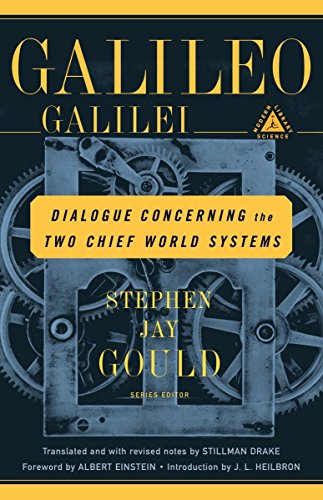
Galileo’s Dialogue Concerning the Two Chief World Systems, published in Florence in 1632, was the most proximate cause of his being brought to trial before the Inquisition. Using the dialogue form, a genre common in classical philosophical works, Galileo masterfully demonstrates the truth of the Copernican system over the Ptolemaic one, proving, for the first time, that the earth revolves around the sun. Its influence is incalculable. The Dialogue is not only one of the most important scientific treatises ever written, but a work of supreme clarity and accessibility, remaining as readable now as when it was first published. This edition uses the definitive text established by the University of California Press, in Stillman Drake’s translation, and includes a Foreword by Albert Einstein and a new Introduction by J. L. Heilbron.
Die Inhaltsangabe kann sich auf eine andere Ausgabe dieses Titels beziehen.
Über die Autorin bzw. den Autor
J. L. Heilbron is a professor of history and Vice Chancellor Emeritus, University of California at Berkeley, and currently Senior Research Fellow, Worcester College, Oxford. He is the author of numerous books on the history of science, including most recently The Sun in the Church: Cathedrals as Solar Observatories and Geometry Civilized: History, Culture, and Technique.
Stephen Jay Gould is the Alexander Agassiz professor of zoology and professor of geology at Harvard and the Vincent Astor visiting professor of biology at New York University. Recent books include Full House, Dinosaur in a Haystack, and Questioning the Millennium. He lives in Cambridge, Massachusetts, and New York City.
Von der hinteren Coverseite
Galileo's Dialogue Concerning the Two Chief World Systems, published in Florence in 1632, was the most proximate cause of his being brought to trial before the Inquisition. Using the dialogue form, a genre common in classical philosophical works, Galileo masterfully demonstrates the truth of the Copernican system over the Ptolemaic one, proving, for the first time, that the earth revolves around the sun. Its influence is incalculable. The Dialogue is not only one of the most important scientific treatises ever written, but a work of supreme clarity and accessibility, remaining as readable now as when it was first published. This edition uses the definitive text established by the University of California Press, in Stillman Drake's translation, and includes a Foreword by Albert Einstein and a new Introduction by J. L. Heilbron.
Aus dem Klappentext
7;s Dialogue Concerning the Two Chief World Systems, published in Florence in 1632, was the most proximate cause of his being brought to trial before the Inquisition. Using the dialogue form, a genre common in classical philosophical works, Galileo masterfully demonstrates the truth of the Copernican system over the Ptolemaic one, proving, for the first time, that the earth revolves around the sun. Its influence is incalculable. The Dialogue is not only one of the most important scientific treatises ever written, but a work of supreme clarity and accessibility, remaining as readable now as when it was first published. This edition uses the definitive text established by the University of California Press, in Stillman Drake s translation, and includes a Foreword by Albert Einstein and a new Introduction by J. L. Heilbron.
Auszug. © Genehmigter Nachdruck. Alle Rechte vorbehalten.
The First Day
Interlocutors Salviati, Sagredo, and Simplicio
Salviati. Yesterday we resolved to meet today and discuss as clearly and in as much detail as possible the character and the efficacy of those laws of nature which up to the present have been put forth by the partisans of the Aristotelian and Ptolemaic position on the one hand, and by the followers of the Copernican system on the other. Since Copernicus places the earth among the movable heavenly bodies, making it a globe like a planet, we may well begin our discussion by examining the Peripatetic steps in arguing the impossibility of that hypothesis; what they are, and how great is their force and effect. For this it is necessary to introduce into nature two substances which differ essentially. These are the celestial and the elemental, the former being invariant and eternal; the latter, temporary and destructible. This argument Aristotle treats in his book De Caelo, introducing it with some discourses dependent upon certain general assumptions, and afterwards confirming it by experiments and specific demonstrations. Following the same method, I shall first propound, and then freely speak my opinion, submitting myself to your criticisms-particularly those of Simplicio, that stout champion and defender of Aristotelian doctrines.
The first step in the Peripatetic arguments is Aristotle's proof of the completeness and perfection of the world. For, he tells us, it is not a mere line, nor a bare surface, but a body having length, breadth, and depth. Since there are only these three dimensions, the world, having these, has them all, and, having the Whole, is perfect. To be sure, I much wish that Aristotle had proved to me by rigorous deductions that simple length constitutes the dimension which we call a line, which by the addition of breadth becomes a surface; that by further adding altitude or depth to this there results a body, and that after these three dimensions there is no passing farther-so that by these three alone, completeness, or, so to speak, wholeness is concluded. Especially since he might have done so very plainly and speedily.
Simp. What about the elegant demonstrations in the second, third, and fourth texts, after the definition of "continuous"? Is it not there first proved that there are no more than three dimensions, since Three is everything, and everywhere? And is this not confirmed by the doctrine and authority of the Pythagoreans, who say that all things are determined by three-beginning, middle, and end-which is the number of the Whole? Also, why leave out another of his reasons; namely, that this number is used, as if by a law of nature, in sacrifices to the gods? Furthermore, is it not dictated by nature that we attribute the title of "all" to those things that are three, and not less? For two are called "both," and one does not say "all" unless there are three.
„Über diesen Titel“ kann sich auf eine andere Ausgabe dieses Titels beziehen.
Suchergebnisse für Dialogue Concerning the Two Chief World Systems (Modern...

Beispielbild für diese ISBN
Dialogue Concerning the Two Chief World Systems: Ptolemaic and Copernican
Anbieter: HPB-Emerald, Dallas, TX, USA
Verkäuferbewertung 5 von 5 Sternen

Paperback. Zustand: Very Good. Connecting readers with great books since 1972! Used books may not include companion materials, and may have some shelf wear or limited writing. We ship orders daily and Customer Service is our top priority! Bestandsnummer des Verkäufers S_481274415
Gebraucht kaufen
EUR 5,04
EUR 3,34 Versand
Versand innerhalb von USA
Versand innerhalb von USA
Anzahl: 1 verfügbar
Beispielbild für diese ISBN
Dialogue Concerning the Two Chief World Systems
Verlag:
Random House Publishing Group, 2001
ISBN 10: 037575766X
ISBN 13: 9780375757662
Gebraucht
Softcover
Anbieter: Better World Books, Mishawaka, IN, USA
Verkäuferbewertung 5 von 5 Sternen
Zustand: Very Good. Pages intact with possible writing/highlighting. Binding strong with minor wear. Dust jackets/supplements may not be included. Stock photo provided. Product includes identifying sticker. Better World Books: Buy Books. Do Good. Bestandsnummer des Verkäufers 10203687-75
Gebraucht kaufen
EUR 10,37
Versand gratis
Versand innerhalb von USA
Versand innerhalb von USA
Anzahl: 1 verfügbar
Beispielbild für diese ISBN
Dialogue Concerning the Two Chief World Systems
Anbieter: World of Books (was SecondSale), Montgomery, IL, USA
Verkäuferbewertung 5 von 5 Sternen
Paperback. Zustand: Good. This is the standard translation of one of the greatest single works by one of Western sciences' greatest single men, the Renaissance physicist Galileo Galilei. Written near the end of his life, the book had to be published abroad and led to Galileo's condemnation. But he nevertheless considered it to be superior to everything else of mine published.Despite the fact that the book encompasses thirty years of highly original experimentation and theorizing on the part of this singular man, it is eminently readable. Written as a discussion between a master and two students, it sets forth its hundreds of experiments and summarizes the conclusions Galileo drew from those experiments in a brisk, direct style. Using helpful geometric demonstrations, Galileo discusses aspects of fracture of solid bodies, cohesion, leverage, the speed of light, sound, pendulums, falling bodies, projectiles, uniform motion, accelerated motion, and the strength of wires, rods, and beams under different loadings and placements.Not only does the book display the genius of one of the makers of our civilization, but it also presents, for the historian of science, considerable information about Renaissance misapprehensions that Galileo refuted.The publishers are to be congratulated for making this celebrated book once more readily available. Quarterly of Applied Physics. Bestandsnummer des Verkäufers 00110055934
Gebraucht kaufen
EUR 10,42
Versand gratis
Versand innerhalb von USA
Versand innerhalb von USA
Anzahl: 3 verfügbar
Foto des Verkäufers
Dialogue Concerning the Two Chief World Systems: Ptolemaic and Copernican
Anbieter: Goodwill of Central and Coastal Virginia, Richmond, VA, USA
Verkäuferbewertung 4 von 5 Sternen

Zustand: acceptable. Bestandsnummer des Verkäufers CCVV.037575766X.A
Gebraucht kaufen
EUR 5,40
EUR 5,12 Versand
Versand innerhalb von USA
Versand innerhalb von USA
Anzahl: 1 verfügbar
Beispielbild für diese ISBN
Dialogue Concerning the Two Chief World Systems: Ptolemaic and Copernican
Anbieter: HPB-Diamond, Dallas, TX, USA
Verkäuferbewertung 5 von 5 Sternen
Paperback. Zustand: Very Good. Connecting readers with great books since 1972! Used books may not include companion materials, and may have some shelf wear or limited writing. We ship orders daily and Customer Service is our top priority! Bestandsnummer des Verkäufers S_480060363
Gebraucht kaufen
EUR 7,34
EUR 3,34 Versand
Versand innerhalb von USA
Versand innerhalb von USA
Anzahl: 1 verfügbar
Beispielbild für diese ISBN
Dialogue Concerning the Two Chief World Systems: Ptolemaic and Copernican
Anbieter: Half Price Books Inc., Dallas, TX, USA
Verkäuferbewertung 5 von 5 Sternen
Paperback. Zustand: Very Good. Connecting readers with great books since 1972! Used books may not include companion materials, and may have some shelf wear or limited writing. We ship orders daily and Customer Service is our top priority! Bestandsnummer des Verkäufers S_486371016
Gebraucht kaufen
EUR 7,34
EUR 3,34 Versand
Versand innerhalb von USA
Versand innerhalb von USA
Anzahl: 1 verfügbar
Beispielbild für diese ISBN
Dialogue Concerning the Two Chief World Systems: Ptolemaic and Copernican
Anbieter: The Book Escape, Baltimore, MD, USA
Verkäuferbewertung 5 von 5 Sternen
Soft cover. Zustand: Very Good. Nice copy with just minor wear. Pages of text are clean, bright and free of markings. Binding is tight and secure. ***Shipped within 24 hours from the beautiful Baltimore inner harbor area. First class service; accurate descriptions. Most items packed in boxes, not envelopes.***. Bestandsnummer des Verkäufers 006941
Gebraucht kaufen
EUR 7,81
EUR 3,52 Versand
Versand innerhalb von USA
Versand innerhalb von USA
Anzahl: 1 verfügbar
Foto des Verkäufers
Dialogue Concerning the Two Chief World Systems: Ptolemaic and Copernican
Anbieter: Goodwill of Greater Milwaukee and Chicago, Racine, WI, USA
Verkäuferbewertung 5 von 5 Sternen
Zustand: good. Book is considered to be in good or better condition. The actual cover image may not match the stock photo. Hard cover books may show signs of wear on the spine, cover or dust jacket. Paperback book may show signs of wear on spine or cover as well as having a slight bend, curve or creasing to it. Book should have minimal to no writing inside and no highlighting. Pages should be free of tears or creasing. Stickers should not be present on cover or elsewhere, and any CD or DVD expected with the book is included. Book is not a former library copy. Bestandsnummer des Verkäufers SEWV.037575766X.G
Gebraucht kaufen
EUR 9,34
EUR 2,67 Versand
Versand innerhalb von USA
Versand innerhalb von USA
Anzahl: 1 verfügbar
Beispielbild für diese ISBN
Dialogue Concerning the Two Chief World Systems
Anbieter: World of Books Inc, Montgomery, IL, USA
Verkäuferbewertung 4 von 5 Sternen
Paperback. Zustand: Good. This is the standard translation of one of the greatest single works by one of Western sciences' greatest single men, the Renaissance physicist Galileo Galilei. Written near the end of his life, the book had to be published abroad and led to Galileo's condemnation. But he nevertheless considered it to be superior to everything else of mine published.Despite the fact that the book encompasses thirty years of highly original experimentation and theorizing on the part of this singular man, it is eminently readable. Written as a discussion between a master and two students, it sets forth its hundreds of experiments and summarizes the conclusions Galileo drew from those experiments in a brisk, direct style. Using helpful geometric demonstrations, Galileo discusses aspects of fracture of solid bodies, cohesion, leverage, the speed of light, sound, pendulums, falling bodies, projectiles, uniform motion, accelerated motion, and the strength of wires, rods, and beams under different loadings and placements.Not only does the book display the genius of one of the makers of our civilization, but it also presents, for the historian of science, considerable information about Renaissance misapprehensions that Galileo refuted.The publishers are to be congratulated for making this celebrated book once more readily available. Quarterly of Applied Physics. Bestandsnummer des Verkäufers CIN037575766XG
Gebraucht kaufen
EUR 12,26
Versand gratis
Versand innerhalb von USA
Versand innerhalb von USA
Anzahl: 3 verfügbar
Beispielbild für diese ISBN
Dialogue/2 Chief World Systems (Modern Library Classics) (Modern Library Science)
Anbieter: WorldofBooks, Goring-By-Sea, WS, Vereinigtes Königreich
Verkäuferbewertung 5 von 5 Sternen
Paperback. Zustand: Very Good. The book has been read, but is in excellent condition. Pages are intact and not marred by notes or highlighting. The spine remains undamaged. Bestandsnummer des Verkäufers GOR003475299
Gebraucht kaufen
EUR 8,50
EUR 6,68 Versand
Versand von Vereinigtes Königreich nach USA
Versand von Vereinigtes Königreich nach USA
Anzahl: 1 verfügbar