
Verwandte Artikel zu Paradise Lost (Modern Library Classics)
Inhaltsangabe
Edited by William Kerrigan, John Rumrich, and Stephen M. Fallon
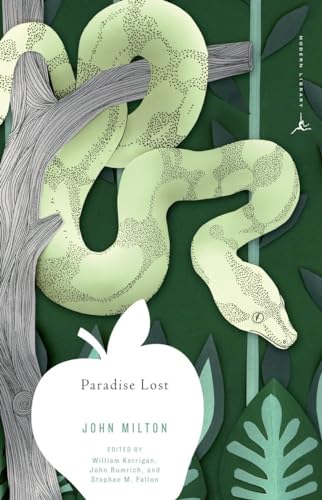
John Milton’s Paradise Lost, an epic poem on the clash between God and his fallen angel, Satan, is a profound meditation on fate, free will, and divinity, and one of the most beautiful works in world literature. Extracted from the Modern Library’s highly acclaimed The Complete Poetry and Essential Prose of John Milton, this edition reflects up-to-date scholarship and includes a substantial Introduction, fresh commentary, and other features—annotations on Milton’s classical allusions, a chronology of the writer’s life, clean page layouts, and an index—that make it the definitive twenty-first-century presentation of John Milton’s timeless signature work.
Die Inhaltsangabe kann sich auf eine andere Ausgabe dieses Titels beziehen.
Über die Autorin bzw. den Autor
John Milton (1608-74) was one of England’s greatest poets and a master of polemical prose. He was a private tutor and served as Secretary for Foreign Tongues under Oliver Cromwell.
William Kerrigan, former president of the Milton Society of America and recipient of its award for lifetime achievement, is professor emeritus at the University of Massachusetts.
John Rumrich is the author of Matter of Glory and Milton Unbound. He is Thaman Professor of English at the University of Texas at Austin.
Stephen M. Fallon, author of Milton’s Peculiar Grace and Milton among the Philosophers, is professor of liberal studies and English at the University of Notre Dame.
Auszug. © Genehmigter Nachdruck. Alle Rechte vorbehalten.
PARADISE LOST the printer to the reader
Courteous Reader, there was no argument at first intended to the book, but for the satisfaction of many that have desired it, I have procured it, and withal a reason of that which stumbled many others, why the poem rhymes not. S. Simmons
The Verse
The measure is English heroic verse without rhyme, as that of Homer in Greek, and of Vergil in Latin; rhyme being no necessary adjunct or true ornament of poem or good verse, in longer works especially, but the invention of a barbarous age, to set off wretched matter and lame meter; graced indeed since by the use of some famous modern poets, carried away by custom, but much to their own vexation, hindrance, and constraint to express many things otherwise, and for the most part worse than else they would have expressed them. Not without cause therefore some both Italian and Spanish poets of prime note have rejected rhyme both in longer and shorter works, as have also long since our best English tragedies, as a thing of itself, to all judicious ears, trivial and of no true musical delight; which consists only in apt numbers, fit quantity of syllables, and the sense variously drawn out from one verse into another, not in the jingling sound of like endings, a fault avoided by the learned ancients both in poetry and all good oratory.
1. The defense of blank verse and the prose arguments summarizing each book “procured” by Milton’s printer, Samuel Simmons, were inserted in bound copies of the first edition beginning in 1668, with this brief note.
This neglect then of rhyme so little is to be taken for a defect, though it may seem so perhaps to vulgar readers, that it rather is to be esteemed an example set, the first in English, of ancient liberty recovered to heroic poem from the troublesome and modern bondage of rhyming.
Book I The Argument
This first book proposes, first in brief, the whole subject, man’s disobedience, and the loss thereupon of Paradise wherein he was placed: then touches the prime cause of his fall, the serpent, or rather Satan in the serpent, who revolting from God, and drawing to his side many legions of angels, was by the command of God driven out of Heaven with all his crew into the great deep. Which action passed over, the poem hastes into the midst of things, presenting Satan with his angels now fallen into Hell, described here, not in the center (for heaven and earth may be supposed as yet not made, certainly not yet accursed) but in a place of utter darkness, fitliest called Chaos. Here Satan with his angels lying on the burning lake, thunder-struck and astonished, after a certain space recovers, as from confusion, calls up him who next in order and dignity lay by him. They confer of their miserable fall. Satan awakens all his legions, who lay till then in the same manner confounded; they rise, their numbers, array of battle, their chief leaders named, according to the idols known afterwards in Canaan and the countries adjoining. To these Satan directs his speech, comforts them with hope yet of regaining Heaven, but tells them lastly of a new world and new kind of creature to be created, according to an ancient prophecy or report in Heaven; for that angels were long before this visible creation was the opinion of many ancient Fathers. To find out the truth of this prophecy, and what to determine thereon, he refers to a full council. What his associates thence attempt. Pandaemonium the palace of Satan rises, suddenly built out of the deep. The infernal peers there sit in council.
Of man’s first disobedience, and the fruit
Of that forbidden tree, whose mortal taste
Brought death into the world, and all our woe,
With loss of Eden, till one greater man
Restore us, and regain the blissful seat,
Sing Heav’nly Muse, that on the secret top
Of Oreb, or of Sinai, didst inspire
That shepherd, who first taught the chosen seed,
In the beginning how the heavens and earth
Rose out of Chaos: or if Sion hill
Delight thee more, and Siloa’s brook that flowed
Fast by the oracle of God, I thence
Invoke thy aid to my advent’rous song,
That with no middle flight intends to soar
Above th’ Aonian mount, while it pursues
Things unattempted yet in prose or rhyme.
And chiefly thou, O Spirit, that dost prefer
Before all temples th’ upright heart and pure,
Instruct me, for thou know’st; thou from the first
Wast present, and with mighty wings outspread
Dove-like sat’st brooding on the vast abyss
And mad’st it pregnant: what in me is dark
Illumine, what is low raise and support,
That to the highth of this great argument
I may assert eternal providence,
And justify the ways of God to men.
Say first, for Heav’n hides nothing from thy view
Nor the deep tract of Hell, say first what cause
Moved our grand parents in that happy state,
Favored of Heav’n so highly, to fall off
From their Creator, and transgress his will
For one restraint, lords of the world besides?
Who first seduced them to that foul revolt?
Th’ infernal serpent; he it was, whose guile
Stirred up with envy and revenge, deceived
The mother of mankind, what time his pride
Had cast him out from Heav’n, with all his host
Of rebel angels, by whose aid aspiring
To set himself in glory above his peers,
He trusted to have equaled the Most High,
If he opposed; and with ambitious aim
Against the throne and monarchy of God
Raised impious war in Heav’n and battle proud
With vain attempt. Him the Almighty Power
Hurled headlong flaming from th’ ethereal sky
With hideous ruin and combustion down
To bottomless perdition, there to dwell
In adamantine chains and penal fire,
Who durst defy th’ Omnipotent to arms.
Nine times the space that measures day and night
To mortal men, he with his horrid crew
1. The first line’s introduction of an exemplary man recalls the epics of Homer and Vergil. Milton’s theme, however, is neither martial nor imperial but spiritual: humanity’s disastrous failure to obey God counterpoised by the promise of redemption. Of man’s: The proper name Adam is also the Hebrew word for generic man or humankind. He is both an individual male and, with Eve, the entire species: “so God created man . . . ; male and female he created them” (Gen. 1.27). Of man translates the Hebrew for “woman” (Gen. 2.23). fruit: Its dual meanings (outcome, food) are put in play by enjambment, a primary formal device by which Milton draws out sense “from one verse into another” (The Verse).
4. one greater man: Jesus, second Adam (1 Cor. 15.21–22; Rom. 5.19). Cp. PR 1.1–4.
5. blissful seat: translates Vergil’s epithet for Elysium, Aen. 6.639.
6. Sing Heav’nly Muse: the verb and subject of the magnificently inverted sixteen-line opening sentence. By invoking a Muse, Milton follows a convention that dates from Homer. Yet Milton’s Muse is not the muse of classical epic (Calliope) but the inspiration of Moses, David, and the prophets (cp. 17–18n). secret: set apart, not common. When the Lord descends to give Moses the law, thick clouds and smoke obscure the mountaintop, and the people are forbidden on pain of death to cross boundaries around the mountain (Exod. 19.16, 23).
8. shepherd: The vocation of shepherd is a key vehicle for Milton’s integration of classical and scriptural traditions. Moses encounters God while tending sheep on Mount Horeb (Oreb) and later receives the law on Sinai, a...
„Über diesen Titel“ kann sich auf eine andere Ausgabe dieses Titels beziehen.
Weitere beliebte Ausgaben desselben Titels

Suchergebnisse für Paradise Lost (Modern Library Classics)

Foto des Verkäufers
Paradise Lost (Modern Library Classics)
Anbieter: -OnTimeBooks-, Phoenix, AZ, USA
Verkäuferbewertung 5 von 5 Sternen

Zustand: good. A copy that has been read, remains in good condition. All pages are intact, and the cover is intact. The spine and cover show signs of wear. Pages can include notes and highlighting and show signs of wear, and the copy can include "From the library of" labels or previous owner inscriptions. 100% GUARANTEE! Shipped with delivery confirmation, if you're not satisfied with purchase please return item! Ships via media mail. Bestandsnummer des Verkäufers OTV.0375757961.G
Gebraucht kaufen
EUR 6,80
Versand gratis
Versand innerhalb von USA
Versand innerhalb von USA
Anzahl: 1 verfügbar
Beispielbild für diese ISBN
Paradise Lost (Modern Library Classics)
Anbieter: HPB-Diamond, Dallas, TX, USA
Verkäuferbewertung 5 von 5 Sternen
Paperback. Zustand: Very Good. Connecting readers with great books since 1972! Used books may not include companion materials, and may have some shelf wear or limited writing. We ship orders daily and Customer Service is our top priority! Bestandsnummer des Verkäufers S_477466343
Gebraucht kaufen
EUR 4,27
EUR 3,25 Versand
Versand innerhalb von USA
Versand innerhalb von USA
Anzahl: 1 verfügbar
Beispielbild für diese ISBN
Paradise Lost (Modern Library Classics)
Anbieter: HPB Inc., Dallas, TX, USA
Verkäuferbewertung 5 von 5 Sternen
Paperback. Zustand: Very Good. Connecting readers with great books since 1972! Used books may not include companion materials, and may have some shelf wear or limited writing. We ship orders daily and Customer Service is our top priority! Bestandsnummer des Verkäufers S_476506122
Gebraucht kaufen
EUR 4,27
EUR 3,25 Versand
Versand innerhalb von USA
Versand innerhalb von USA
Anzahl: 1 verfügbar
Beispielbild für diese ISBN
Paradise Lost (Modern Library Classics)
Anbieter: HPB-Ruby, Dallas, TX, USA
Verkäuferbewertung 5 von 5 Sternen
Paperback. Zustand: Very Good. Connecting readers with great books since 1972! Used books may not include companion materials, and may have some shelf wear or limited writing. We ship orders daily and Customer Service is our top priority! Bestandsnummer des Verkäufers S_481304693
Gebraucht kaufen
EUR 4,89
EUR 3,25 Versand
Versand innerhalb von USA
Versand innerhalb von USA
Anzahl: 1 verfügbar
Foto des Verkäufers
Paradise Lost (Modern Library Classics)
Anbieter: Goodwill Southern California, Los Angeles, CA, USA
Verkäuferbewertung 5 von 5 Sternen
Zustand: acceptable. Paperback Book. Book shows signs of Use and Wear on Cover s - All Pages are still legible and in Acceptable Condition. Bestandsnummer des Verkäufers LACV.0375757961.A
Gebraucht kaufen
EUR 6,24
EUR 2,60 Versand
Versand innerhalb von USA
Versand innerhalb von USA
Anzahl: 1 verfügbar
Beispielbild für diese ISBN
Paradise Lost (Modern Library Classics)
Anbieter: Campus Bookstore, Denton, TX, USA
Verkäuferbewertung 4 von 5 Sternen

Paperback. Zustand: Good. May contain highlighting/underlining/notes/etc. May have used stickers on cover. Access codes and supplements are not guaranteed to be included with used books. Ships same or next day. Expedited shipping: 3-5 business days, Standard shipping: 4-14 business days. Bestandsnummer des Verkäufers mon0000183021
Gebraucht kaufen
EUR 6,06
EUR 3,45 Versand
Versand innerhalb von USA
Versand innerhalb von USA
Anzahl: 3 verfügbar
Beispielbild für diese ISBN
Paradise Lost
Verlag:
Random House Publishing Group, 2008
ISBN 10: 0375757961
ISBN 13: 9780375757969
Gebraucht
Softcover
Anbieter: Better World Books: West, Reno, NV, USA
Verkäuferbewertung 5 von 5 Sternen
Zustand: Good. Former library copy. Pages intact with minimal writing/highlighting. The binding may be loose and creased. Dust jackets/supplements are not included. Includes library markings. Stock photo provided. Product includes identifying sticker. Better World Books: Buy Books. Do Good. Bestandsnummer des Verkäufers 12998106-6
Gebraucht kaufen
EUR 9,80
Versand gratis
Versand innerhalb von USA
Versand innerhalb von USA
Anzahl: 1 verfügbar
Beispielbild für diese ISBN
Paradise Lost
Verlag:
Random House Publishing Group, 2008
ISBN 10: 0375757961
ISBN 13: 9780375757969
Gebraucht
Softcover
Anbieter: Better World Books, Mishawaka, IN, USA
Verkäuferbewertung 5 von 5 Sternen
Zustand: Good. Pages intact with minimal writing/highlighting. The binding may be loose and creased. Dust jackets/supplements are not included. Stock photo provided. Product includes identifying sticker. Better World Books: Buy Books. Do Good. Bestandsnummer des Verkäufers 4028584-6
Gebraucht kaufen
EUR 9,80
Versand gratis
Versand innerhalb von USA
Versand innerhalb von USA
Anzahl: 2 verfügbar
Beispielbild für diese ISBN
Paradise Lost
Verlag:
Modern Library, New York, NY, 2008
ISBN 10: 0375757961
ISBN 13: 9780375757969
Gebraucht
Soft cover
Anbieter: Montana Book Company, Fond du Lac, WI, USA
Verkäuferbewertung 5 von 5 Sternen
Soft cover. Zustand: Very Good. 433 pp. Tightly bound. Spine not compromised. Text is free of markings. No ownership markings. Remainder mark bottom fore-edge. Bestandsnummer des Verkäufers 084155
Gebraucht kaufen
EUR 7,12
EUR 3,44 Versand
Versand innerhalb von USA
Versand innerhalb von USA
Anzahl: 1 verfügbar
Beispielbild für diese ISBN
Paradise Lost (Modern Library Classics)
Anbieter: Lakeside Books, Benton Harbor, MI, USA
Verkäuferbewertung 5 von 5 Sternen
Zustand: New. Brand New! Not Overstocks or Low Quality Book Club Editions! Direct From the Publisher! We're not a giant, faceless warehouse organization! We're a small town bookstore that loves books and loves it's customers! Buy from Lakeside Books! Bestandsnummer des Verkäufers OTF-S-9780375757969
Neu kaufen
EUR 7,32
EUR 3,45 Versand
Versand innerhalb von USA
Versand innerhalb von USA
Anzahl: Mehr als 20 verfügbar