
Verwandte Artikel zu Chesty: The Story of Lieutenant General Lewis B. Puller,...
Inhaltsangabe
Featured on the Commandant of the Marine Corps’ Reading List and the Chief of Naval Operation’s “Naval Power” Reading List
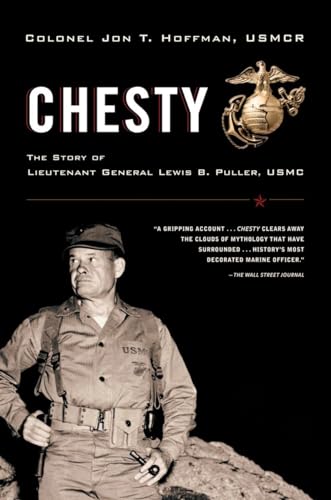
The Marine Corps is known for its heroes, and Lieutenant General Lewis B. Puller has long been considered the greatest of them all. His assignments and activities covered an extraordinary spectrum of warfare. Puller mastered small unit guerrilla warfare as a lieutenant in Haiti in the 1920s, and at the end of his career commanded a division in Korea. In between, he chased Sandino in Nicaragua and fought at Guadalcanal, Cape Gloucester, and Peleliu.
With his bulldog face, barrel chest (which earned him the nickname Chesty), gruff voice, and common touch, Puller became—and has remained—the epitome of the Marine combat officer. At times Puller's actions have been called into question—at Peleliu, for instance, where, against a heavily fortified position, he lost more than half of his regiment. And then there is the saga of his son, who followed in Chesty's footsteps as a Marine officer only to suffer horrible wounds in Vietnam (his book, Fortunate Son, won the Pulitzer Prize).
Jon Hoffman has been given special access to Puller's personal papers as well as his personnel record. The result will unquestionably stand as the last word about Chesty Puller.
Die Inhaltsangabe kann sich auf eine andere Ausgabe dieses Titels beziehen.
Über die Autorin bzw. den Autor
Jon Hoffman is a Lieutenant Colonel in the Marine Corps Reserve and is currently serving on extended active duty as the deputy director of the Marine Corps History & Museums Division. He has spent sixteen years on active duty as an infantry officer and historian. He has a Master’s Degree in military history from Ohio State and a law degree from Duke University. His first book, Once A Legend, a biography of Major General Merritt “Red Mike” Edson, won the Marine Corps’ prize as the best book of the year. LtCol Hoffman lives in Virginia.
Von der hinteren Coverseite
The Marine Corps is known for its heroes, and Lieutenant General Lewis B. Puller has long been considered the greatest of them all. His assignments and activities covered an extraordinary spectrum of warfare. Puller mastered small unit guerrilla warfare as a lieutenant in Haiti in the 1920s, and at the end of his career commanded a division in Korea. In between, he chased Sandino in Nicaragua and fought at Guadalcanal, Cape Gloucester, and Peleliu.
With his bulldog face, barrel chest (which earned him the nickname Chesty), gruff voice, and common touch, Puller became--and has remained--the epitome of the Marine combat officer. At times Puller's actions have been called into question--at Peleliu, for instance, where, against a heavily fortified position, he lost more than half of his regiment. And then there is the saga of his son, who followed in Chesty's footsteps as a Marine officer only to suffer horrible wounds in Vietnam (his book, Fortunate Son, won the Pulitzer Prize).
Jon Hoffman has been given special access to Puller's personal papers as well as his personnel record. The result will unquestionably stand as the last word about Chesty Puller.
"From the Hardcover edition.
Aus dem Klappentext
The Marine Corps is known for its heroes, and Lieutenant General Lewis B. Puller has long been considered the greatest of them all. His assignments and activities covered an extraordinary spectrum of warfare. Puller mastered small unit guerrilla warfare as a lieutenant in Haiti in the 1920s, and at the end of his career commanded a division in Korea. In between, he chased Sandino in Nicaragua and fought at Guadalcanal, Cape Gloucester, and Peleliu.
With his bulldog face, barrel chest (which earned him the nickname Chesty), gruff voice, and common touch, Puller became and has remained the epitome of the Marine combat officer. At times Puller's actions have been called into question at Peleliu, for instance, where, against a heavily fortified position, he lost more than half of his regiment. And then there is the saga of his son, who followed in Chesty's footsteps as a Marine officer only to suffer horrible wounds in Vietnam (his book, Fortunate Son, won the Pulitzer Prize).
Jon Hoffman has been given special access to Puller's personal papers as well as his personnel record. The result will unquestionably stand as the last word about Chesty Puller.
From the Hardcover edition.
Auszug. © Genehmigter Nachdruck. Alle Rechte vorbehalten.
Chapter 1
“Making a Man and a Soldier”
Genesis of a Marine
1898-1919
The 231 handpicked enlisted men marched into the gymnasium at the Marine Corps base in Quantico, Virginia, for their last muster as a unit. It was June 16, 1919, graduation day for the 3d Officers’ Training Camp (OTC). After five months of strenuous effort, each man had earned a commission as a second lieutenant in the Marine Corps Reserve. The post band opened the ceremonies with a medley of martial tunes capped by John Philip Sousa’s march “Semper Fidelis.” The music turned out to be the most stirring portion of the program, which otherwise consisted of short speeches and the presentation of commissions. A reporter noted that the “striking feature of the proceedings” was their solemnity and simplicity in comparison with graduations at West Point and Annapolis. Although the writer ascribed this difference to “that precision and lack of fuss so characteristic of the doings of Marines,” in truth there was little to celebrate at the moment. Seven months earlier there had been rejoicing when an armistice ended the “war to end all wars.” Now the United States was rapidly demobilizing its forces. The Commandant of the Marine Corps, Major General George Barnett, pointedly noted in his speech that this placed the class “in a peculiar position.” This commissioning ceremony would not launch the lieutenants on a grand and glorious new career; rather, for most of them it marked the end of their service as Marines.
With the exception of a few prewar NCOs, the vast majority of the men had joined the Corps with patriotic fervor to fight the Germans. Few of these wartime volunteers had seen action and they now had to return to civilian pursuits with the exhortations of the speakers as their only reward. Barnett told them: “Whatever after this you do in life your service will have left its traces in your hearts . . . once a Marine, always a Marine.” Major General Littleton W. T. Waller echoed that theme: “You have come in and absorbed our traditions and beliefs and I tell you you can’t go wrong if you live up to their principles.”
One of those men faced with an imminent return to the civilian world was Lewis Burwell Puller, a Marine private with less than a year in the Corps. At five feet, eight inches and 144 pounds, he was not a physically impressive figure, except for his pronounced barrel chest, serious square-blocked face, and outthrust jaw. His voice was his most distinctive trademark. One listener described it as a “Virginia drawl combined with an individual Brooklynese.” Young Puller spoke slowly, with more than a touch of Southern accent, underpinning his own unique pronunciations with a deep-throated, gravelly intonation. He was not normally loud, but when the situation warranted it, he could “bark like a howitzer” or “shout commands with all the vigor and carrying power of an angry bull.” He did not possess any special athletic ability or a superior intellect. His final standing in OTC, just below the middle of his class, did not indicate any outstanding military aptitude. He might have accepted his fate and gone quietly into the military obscurity that awaited all of his companions, but his reaction demonstrated what may have been his greatest strength. He had his mind set on a military career and would persevere with relentless resolution in pursuit of his dream. He would not only find a way to remain in the Corps, but would excel as a combat leader. Decades later, he would be the most legendary Marine of all and his deeds and words would do much to establish the traditions, beliefs, and principles that continue to mold succeeding generations of Marines.
. . .
Lewis Puller was the product of a distinguished line of Virginia gentry on his maternal side. His mother could trace her roots back to Lewis Burwell, who had come over from England in the mid-1600s as a leader in a company of military settlers. Four generations later, another Lewis Burwell fought as a colonel in command of Virginia militia during the American Revolution, owned a 3,400-acre plantation, and served in the state House of Delegates. His daughter, Alice Grymes Burwell, married William Clayton Williams, a lawyer and also a delegate in the Virginia legislature. Their son, Lewis Burwell Williams, became an attorney and followed in the political footsteps of his father and grandfather. His daughter, Mary Blair Williams, gave birth to Martha Richardson Leigh, Lewis Puller’s mother.
Lewis Puller’s distant paternal ancestors apparently were not so illustrious. Samuel and Mary W. Puller were the first to leave a permanent record, but little survives about them beyond the fact that they had five children and lived in Gloucester County, Virginia. This small district occupied part of the peninsula formed by the Rappahannock and York rivers, in the eastern region of the state known as the Tidewater. Mary gave birth in 1833 to John William, her second child and first boy. Apparently Samuel died before 1850. By that time, seventeen-year-old John already was working as a blacksmith to help the family. At the age of twenty-two, now a farmer, he married Emily Simcoe. Their first child, born in 1858, was Matthew Miller, Lewis Puller’s father.
John Puller clearly had ambition and ability. He aspired to something more than manual labor and soon opened a hotel with his younger brother Sam. His neighbors obviously put some faith in his potential. In 1859 they elected him to a captaincy in the local militia, a cavalry unit known as the Gloucester Light Dragoons. The honor was all the more notable given that he was only twenty-six, far younger than the norm for such a position of responsibility in those years. Sam joined him in this endeavor, too, enlisting as a private. Outsiders with a financial background were not so certain of the capabilities of the two brothers. A credit-rating bureau placed a hesitant appraisal in its books in the fall of 1860: “Shd [should] not sell them largely on cr. [credit] not much means & quite extravagant notions. May be good. Wd. [would] advise caution.” January 1861 brought a harsher assessment: “Fast men, advise cash sales.”
If “fast” could be construed as aggressive or freewheeling, John W. Puller appears to have fit that description, though he had no immediate opportunity to demonstrate it. In May 1861, less than a month after the first shots of the Civil War were fired at Fort Sumter, the seventy-eight men of his militia unit reelected him as their captain. The cavalrymen remained close to home for the next ten months, however, outposting the entrance to the York River at Gloucester Point. In March 1862, during the Peninsula Campaign, they saw their first fighting. A few weeks later, they merged into the newly formed 5th Virginia Cavalry Regiment. Thereafter, action was plentiful. The Tidewater horsemen participated in the Seven Days’ Battles in June, the cavalry raid on Catlett’s Station and the Second Battle of Manassas in August, the Battle of Sharpsburg in September, Major General J.E.B. Stuart’s ride through Pennsylvania and Maryland in October, and clashes in the Shenandoah Valley in early November. In the last action, Sam Puller was captured by the Yankees, but was exchanged for Union prisoners days later.
The regiment was winning a high reputation in the Army of Northern Virginia. Following another raid in late December, Major General Fitzhugh Lee, the brigade commander, praised the 5th’s attack across a difficult river ford as “one of the most admirable performances of cavalry I have ever witnessed.” Jeb Stuart, commander of the cavalry division,...
„Über diesen Titel“ kann sich auf eine andere Ausgabe dieses Titels beziehen.
Suchergebnisse für Chesty: The Story of Lieutenant General Lewis B. Puller,...

Foto des Verkäufers
Chesty: The Story of Lieutenant General Lewis B. Puller, USMC
Verlag:
Random House Trade Paperbacks, 2002
ISBN 10: 037576044X
ISBN 13: 9780375760440
Gebraucht
Softcover
Anbieter: Used Book Company, Egg Harbor Township, NJ, USA
Verkäuferbewertung 5 von 5 Sternen

Zustand: Fair. Former library copy. Shows considerable signs of wear and previous use. Can include notes/highlighting. A portion of your purchase benefits nonprofits! - Note: Edition & format may differ from what is shown in stock photo & item details. May not include supplementary material (toys, access code, dvds, etc). Bestandsnummer des Verkäufers 584ZSU0016WD_ns
Gebraucht kaufen
EUR 4,11
Versand gratis
Versand innerhalb von USA
Versand innerhalb von USA
Anzahl: 1 verfügbar
Beispielbild für diese ISBN
Chesty: The Story of Lieutenant General Lewis B. Puller, USMC
Verlag:
Random House Trade Paperbacks, 2002
ISBN 10: 037576044X
ISBN 13: 9780375760440
Gebraucht
paperback
Anbieter: New Legacy Books, Annandale, NJ, USA
Verkäuferbewertung 5 von 5 Sternen
paperback. Zustand: Good. The cover shows normal wear. The pages show normal wear. Fast shipping and order satisfaction guaranteed. A portion of your purchase benefits Non-Profit Organizations, First Aid and Fire Stations! Bestandsnummer des Verkäufers mon0000168500
Gebraucht kaufen
EUR 2,23
EUR 2,17 Versand
Versand innerhalb von USA
Versand innerhalb von USA
Anzahl: 1 verfügbar
Beispielbild für diese ISBN
Chesty: The Story of Lieutenant General Lewis B. Puller, USMC
Verlag:
Random House Trade Paperbacks, 2002
ISBN 10: 037576044X
ISBN 13: 9780375760440
Gebraucht
Softcover
Anbieter: World of Books (was SecondSale), Montgomery, IL, USA
Verkäuferbewertung 5 von 5 Sternen
Zustand: Acceptable. Item in acceptable condition! Textbooks may not include supplemental items i.e. CDs, access codes etc. Bestandsnummer des Verkäufers 00097165242
Gebraucht kaufen
EUR 4,46
Versand gratis
Versand innerhalb von USA
Versand innerhalb von USA
Anzahl: 4 verfügbar
Beispielbild für diese ISBN
Chesty: The Story of Lieutenant General Lewis B. Puller, USMC
Verlag:
Random House Trade Paperbacks, 2002
ISBN 10: 037576044X
ISBN 13: 9780375760440
Gebraucht
Softcover
Anbieter: World of Books (was SecondSale), Montgomery, IL, USA
Verkäuferbewertung 5 von 5 Sternen
Zustand: Good. Item in good condition. Textbooks may not include supplemental items i.e. CDs, access codes etc. Bestandsnummer des Verkäufers 00104766362
Gebraucht kaufen
EUR 4,46
Versand gratis
Versand innerhalb von USA
Versand innerhalb von USA
Anzahl: 7 verfügbar
Foto des Verkäufers
Chesty: The Story of Lieutenant General Lewis B. Puller, USMC
Verlag:
Random House Trade Paperbacks, 2002
ISBN 10: 037576044X
ISBN 13: 9780375760440
Gebraucht
Softcover
Anbieter: Greenworld Books, Arlington, TX, USA
Verkäuferbewertung 5 von 5 Sternen
Zustand: good. Fast Free Shipping â" Good condition. It may show normal signs of use, such as light writing, highlighting, or library markings, but all pages are intact and the book is fully readable. A solid, complete copy that's ready to enjoy. Bestandsnummer des Verkäufers GWV.037576044X.G
Gebraucht kaufen
EUR 4,77
Versand gratis
Versand innerhalb von USA
Versand innerhalb von USA
Anzahl: 3 verfügbar
Foto des Verkäufers
Chesty: The Story of Lieutenant General Lewis B. Puller, USMC
Verlag:
Random House Trade Paperbacks, 2002
ISBN 10: 037576044X
ISBN 13: 9780375760440
Gebraucht
Softcover
Anbieter: MERS Goodwill-Kansas City, Blue Springs, MO, USA
Verkäuferbewertung 5 von 5 Sternen
Zustand: good. The book has been read but is in good condition. It has very minimal damage to the cover, including scuff marks, but no holes or tears. The dust jacket for hard covers may not be included. The binding has minimal wear. The majority of pages are undamaged with minimal creasing or tearing, minimal pencil underlining of text, no highlighting of text, and no writing in the margins. There are no missing pages. See the seller's listing for full details and a description of any imperfections. Bestandsnummer des Verkäufers WMEKV.037576044X.G
Gebraucht kaufen
EUR 2,21
EUR 3,48 Versand
Versand innerhalb von USA
Versand innerhalb von USA
Anzahl: 1 verfügbar
Beispielbild für diese ISBN
Chesty: The Story of Lieutenant General Lewis B. Puller, USMC
Verlag:
Random House Trade Paperbacks (edition Reprint), 2002
ISBN 10: 037576044X
ISBN 13: 9780375760440
Gebraucht
Paperback
Anbieter: BooksRun, Philadelphia, PA, USA
Verkäuferbewertung 5 von 5 Sternen
Paperback. Zustand: Very Good. Reprint. It's a well-cared-for item that has seen limited use. The item may show minor signs of wear. All the text is legible, with all pages included. It may have slight markings and/or highlighting. Bestandsnummer des Verkäufers 037576044X-11-22
Gebraucht kaufen
EUR 6,07
Versand gratis
Versand innerhalb von USA
Versand innerhalb von USA
Anzahl: 1 verfügbar
Beispielbild für diese ISBN
Chesty : The Story of Lieutenant General Lewis B. Puller, USMC
Verlag:
Random House Publishing Group, 2002
ISBN 10: 037576044X
ISBN 13: 9780375760440
Gebraucht
Softcover
Anbieter: Better World Books: West, Reno, NV, USA
Verkäuferbewertung 5 von 5 Sternen
Zustand: Good. Random Hou. Pages intact with minimal writing/highlighting. The binding may be loose and creased. Dust jackets/supplements are not included. Stock photo provided. Product includes identifying sticker. Better World Books: Buy Books. Do Good. Bestandsnummer des Verkäufers 4229714-6
Gebraucht kaufen
EUR 6,20
Versand gratis
Versand innerhalb von USA
Versand innerhalb von USA
Anzahl: 1 verfügbar
Beispielbild für diese ISBN
Chesty : The Story of Lieutenant General Lewis B. Puller, USMC
Verlag:
Random House Publishing Group, 2002
ISBN 10: 037576044X
ISBN 13: 9780375760440
Gebraucht
Softcover
Anbieter: Better World Books, Mishawaka, IN, USA
Verkäuferbewertung 5 von 5 Sternen
Zustand: Good. Random Hou. Pages intact with minimal writing/highlighting. The binding may be loose and creased. Dust jackets/supplements are not included. Stock photo provided. Product includes identifying sticker. Better World Books: Buy Books. Do Good. Bestandsnummer des Verkäufers 4229714-6
Gebraucht kaufen
EUR 6,20
Versand gratis
Versand innerhalb von USA
Versand innerhalb von USA
Anzahl: 7 verfügbar
Beispielbild für diese ISBN
Chesty : The Story of Lieutenant General Lewis B. Puller, USMC
Verlag:
Random House Publishing Group, 2002
ISBN 10: 037576044X
ISBN 13: 9780375760440
Gebraucht
Softcover
Anbieter: Better World Books, Mishawaka, IN, USA
Verkäuferbewertung 5 von 5 Sternen
Zustand: Very Good. Random Hou. Pages intact with possible writing/highlighting. Binding strong with minor wear. Dust jackets/supplements may not be included. Stock photo provided. Product includes identifying sticker. Better World Books: Buy Books. Do Good. Bestandsnummer des Verkäufers 5898132-6
Gebraucht kaufen
EUR 6,20
Versand gratis
Versand innerhalb von USA
Versand innerhalb von USA
Anzahl: 1 verfügbar