
Verwandte Artikel zu Books to Build On: A Grade-By-Grade Resource Guide...
Books to Build On: A Grade-By-Grade Resource Guide for Parents and Teachers (The Core Knowledge Series) - Softcover
Buch 3 von 9: The Core Knowledge Series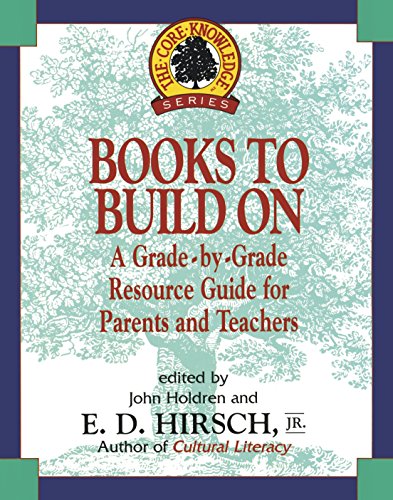
Inhaltsangabe
The invaluable grade-by-grade guide (kindergarten—sixth) is designed to help parents and teachers select some of the best books for children.
Books to Build On recommends:
• for kindergartners, lively collections of poetry and stories, such as The Children’s Aesop, and imaginative alphabet books such as Bill Martin, Jr.’s Chicka Chicka Boom Boom and Lucy Micklewait’s I Spy: An Alphabet in Art
• for first graders, fine books on the fine arts, such as Ann Hayes’s Meet the Orchestra, the hands-on guide My First Music Book, and the thought-provoking Come Look with Me series of art books for children
• for second graders, books that open doors to world cultures and history, such as Leonard Everett Fisher’s The Great Wall of China and Marcia Willaims’s humorous Greek Myths for Young Children
• for third graders, books that bring to life the wonders of ancient Rome, such as Living in Ancient Rome, and fascinating books about astronomy, such as Seymour Simon’s Our Solar System
• for fourth graders, engaging books on history, including Jean Fritz’s Shh! We're Writing the Constitution, and many books on Africa, including the stunningly illustrated story of Sundiata: Lion King of Mali
• for fifth graders, a version of Shakespeare’s A Midsummer Night’s Dream that retains much of the original language but condenses the play for reading or performance by young students, and Michael McCurdy’s Escape from Slavery: The Boyhood of Frederick Douglass
• for sixth graders, an eloquent retelling of the Iliad and the Odyssey, and the well-written American history series, A History of US
. . . and many, many more!
Die Inhaltsangabe kann sich auf eine andere Ausgabe dieses Titels beziehen.
Über die Autorin bzw. den Autor
E. D. Hirsch, Jr., is an emeritus professor at the University of Virginia and the author of The Knowledge Deficit, The Schools We Need, and the bestselling Cultural Literacy and the Dictionary of Cultural Literacy. He and his wife, Polly, live in Charlottesville, Virginia, where they raised their three children.
Auszug. © Genehmigter Nachdruck. Alle Rechte vorbehalten.
LANGUAGE ARTS
Introduction
Language Arts is a term used by schools to refer to reading and writing, spelling, grammar, vocabulary, creative writing, expository writing, library and research skills, literature, drama, public speaking, and more. While all of these should be taught at some point, the emphasis varies according to grade level.
In the primary grades—kindergarten through third grade—the emphasis of schools must be, first and foremost, on the crucial mission of early education: teaching children to read. As Elizabeth McPike of the American Federation of Teachers has put it, in no uncertain terms,
If a child in a modern society like ours does not learn to read, he doesn’t make it in life. If he doesn’t learn to read well enough to comprehend what he is reading, if he doesn’t learn to read effortlessly enough to render reading pleasurable, if he doesn’t learn to read fluently enough to read broadly and reflectively across all content areas, his chances for a fulfilling life, by whatever measure—academic success, financial success, the ability to find interesting work, personal autonomy, self-esteem—are practically nil.
While it is almost universally agreed that children should learn to read in the primary grades, there is disagreement about how to achieve that goal, as suggested by the subtitle of a classic study of the teaching of reading, Jeanne Chall’s Learning to Read: The Great Debate. But as that study and others have demonstrated,2 while fashions come and go in education, pulling schools toward one pedagogical extreme or another, there is a reasonable middle ground that is best for children.
This middle ground balances two approaches to the teaching of reading and writing that some educators (wrongly) see as mutually exclusive. The first approach emphasizes the systematic teaching of the “nuts and bolts” of written language: letter-sound combinations (phonics), handwriting, punctuation, grammar, spelling, vocabulary, sentence structure, paragraph form, and other rules and conventions. The second approach emphasizes the need for children to be nourished on a rich diet of meaningful poetry, fiction, and nonfiction, and to be given frequent opportunities to use language in creative and expressive ways.
In schools, both of these approaches need to be embraced, for the good of the children. In particular, at the time of this writing, many elementary schools need to pay much more attention to the “nuts and bolts”: they need to take steps to balance a worthwhile emphasis on literature and creative expression with an equally necessary emphasis on the basic, how-to skills of reading and writing.
Parents can support a child’s growth as a reader and a writer, but the schools, not parents, are responsible for teaching the nuts and bolts of language. Parents can reinforce what is (or should be) taught in school by playing language games with their children, by helping them read books for beginning readers, by engaging them in fun and useful writing activities (letters to relatives, party invitations, grocery lists), and more. To help in these endeavors, we have included below a selection of books and other resources on “Reading and Writing: Kindergarten—Grade 2.” These are meant to complement, not replace, the reading series and associated materials that schools use to teach reading and writing.
Without question, the single most important and helpful thing parents can do is to set aside fifteen or twenty minutes regularly, daily if possible, to read aloud to their children. Reading aloud is, of course, also a regular part of any good classroom. Reading aloud should continue long after children have learned to read independently.
Whether we are reading aloud to children or recommending books to them as they become independent readers, the question remains, what should they read? Some children will answer this for themselves: set loose in a library, they will walk out with a stack of books. But many children can benefit from some considered guidance and suggestions.
The world of children’s literature has something for every taste and diet. It includes such sustaining fare as Newbery Award-winning titles, or the works of acclaimed writers like Frances Hodgson Burnett or Scott O’Dell or Lloyd Alexander, or such cheering series as the “Ramona” books of Beverly Cleary and the Pippi Longstocking stories of Astrid Lindgren, to name just a few. It includes popular “lite” fare, such as Nancy Drew or Hardy Boys mysteries, or the Baby Sitters’ Club books. It includes novelizations of hit television shows and movies, such as the Star Trek and Star Wars books. It includes the literary equivalent of junk food in the Goosebumps series of horror stories.
An occasional sweet treat, of course, does no harm if you maintain a balanced diet. What’s unhealthy is to make a diet of nothing but sweet treats. That is why we need to give children the opportunity to hear and read nourishing and sustaining literature. Schools in particular need to make thoughtful and responsible choices about the books they read to children and ask children to read. Especially in light of the dramatic disparity in children’s home circumstances, schools should, for the sake of fairness, expose children to a common core of literature that has stood the test of time, to poems and stories with wonderful characters, adventure, humor, and language that have gripped the imaginations of readers for generation upon generation.
Even such classic literature, however, presents us with a vast field of choices. Inevitably, in choosing some titles and not others, a degree of arbitrariness enters into the selection—an arbitrariness we have endeavored to minimize by involving a wide range of people in the process of selecting the works suggested here.
Still, one might say, why read Charlotte’s Web but not Stuart Little? Or why read Charlotte’s Web instead of Black Beauty? Or why read Charlotte’s Web at all? Such questions could go on forever, but they miss the point. The point of defining a core of selected works is not to exclude, but to ensure that children will be exposed to a broad range of enriching literature, without glaring repetitions and gaps; that the children’s knowledge of good literature will build year by year; and that their experience of literature will sometimes be enriched by its connection to studies in other disciplines (such as, for example, the Greek myths recommended for second grade, which may be connected to the study of ancient Greek civilization in World History).
The works of poetry, fiction, and drama suggested here are meant to constitute a core of enriching literature. Teachers and parents are strongly encouraged to expose children to many more stories and poems than those listed below, including classic picture books, read-aloud books, perennial favorites by beloved children’s writers, popular favorites by contemporary writers, biographies, books about art and music, lots of nonfiction, and of course books that the children themselves choose. For suggestions on more good reading, see General Resources, Guides to Good Reading (this page–this page).
Language Arts in the Core Knowledge Sequence: A Summary
The Language Arts section of the Core Knowledge Sequence includes guidelines for the teaching of reading and writing, and specific recommendations for works of poetry, fiction, nonfiction, drama, and great speeches. Some works are recommended because they are connected with topics in the History section of the Sequence. The...
„Über diesen Titel“ kann sich auf eine andere Ausgabe dieses Titels beziehen.
Suchergebnisse für Books to Build On: A Grade-By-Grade Resource Guide...

Beispielbild für diese ISBN
Books to Build On: A Grade-by-Grade Resource Guide for Parents and Teachers (Core Knowledge Series)
Anbieter: NW Book Rescue, Hubbard, OR, USA
Verkäuferbewertung 1 von 5 Sternen

paperback. Zustand: Good. Good clean copy. Minimal signs of wear. Any images shown are stock photographs and product may differ from what is shown. Bestandsnummer des Verkäufers RSTR-SFRC-20260420-0013-123K-Q1807
Gebraucht kaufen
EUR 4,58
Versand gratis
Versand innerhalb von USA
Versand innerhalb von USA
Anzahl: 1 verfügbar
Beispielbild für diese ISBN
Books to Build On: A Grade-by-Grade Resource Guide for Parents and Teachers (Core Knowledge Series)
Verlag:
Random House Publishing Group, 1996
ISBN 10: 0385316402
ISBN 13: 9780385316408
Gebraucht
paperback
Anbieter: New Legacy Books, Annandale, NJ, USA
Verkäuferbewertung 5 von 5 Sternen

paperback. Zustand: Good. The cover shows normal wear. Fast shipping and order satisfaction guaranteed. A portion of your purchase benefits Non-Profit Organizations, First Aid and Fire Stations! Bestandsnummer des Verkäufers mon0000174320
Gebraucht kaufen
EUR 2,57
EUR 2,22 Versand
Versand innerhalb von USA
Versand innerhalb von USA
Anzahl: 1 verfügbar
Beispielbild für diese ISBN
Books to Build On: A Grade-By-Grade Resource Guide for Parents and Teachers
Verlag:
Bantam Doubleday Dell Publishing Group Inc, 1996
ISBN 10: 0385316402
ISBN 13: 9780385316408
Gebraucht
Paperback
Anbieter: World of Books (was SecondSale), Montgomery, IL, USA
Verkäuferbewertung 5 von 5 Sternen
Paperback. Zustand: Fair. This invaluable grade-by-grade guide (K-6th) is designed to help parents and teachers select some of the best books for children. It will lead you to enriching reading experiences and help your child build on the fundamentals in the popular Core Knowledge Series (What Your Kindergartner-Sixth Grader Needs to Know). Rare among resources guides in its emphasis on nonfiction, Books to Build On provides helpful annotations on excellent books in a wide range of subject areas. Bestandsnummer des Verkäufers 00098032133
Gebraucht kaufen
EUR 4,86
Versand gratis
Versand innerhalb von USA
Versand innerhalb von USA
Anzahl: 4 verfügbar
Beispielbild für diese ISBN
Books to Build On: A Grade-By-Grade Resource Guide for Parents and Teachers
Verlag:
Bantam Doubleday Dell Publishing Group Inc, 1996
ISBN 10: 0385316402
ISBN 13: 9780385316408
Gebraucht
Paperback
Anbieter: World of Books (was SecondSale), Montgomery, IL, USA
Verkäuferbewertung 5 von 5 Sternen
Paperback. Zustand: Good. This invaluable grade-by-grade guide (K-6th) is designed to help parents and teachers select some of the best books for children. It will lead you to enriching reading experiences and help your child build on the fundamentals in the popular Core Knowledge Series (What Your Kindergartner-Sixth Grader Needs to Know). Rare among resources guides in its emphasis on nonfiction, Books to Build On provides helpful annotations on excellent books in a wide range of subject areas. Bestandsnummer des Verkäufers 00103609631
Gebraucht kaufen
EUR 4,86
Versand gratis
Versand innerhalb von USA
Versand innerhalb von USA
Anzahl: 12 verfügbar
Beispielbild für diese ISBN
Books to Build On: A Grade-by-Grade Resource Guide for Parents and Teachers (Core Knowledge Series)
Verlag:
Random House Publishing Group, 1996
ISBN 10: 0385316402
ISBN 13: 9780385316408
Gebraucht
paperback
Anbieter: New Legacy Books, Annandale, NJ, USA
Verkäuferbewertung 5 von 5 Sternen
paperback. Zustand: Acceptable. The cover shows normal wear. Fast shipping and order satisfaction guaranteed. A portion of your purchase benefits Non-Profit Organizations, First Aid and Fire Stations! Bestandsnummer des Verkäufers mon0000195802
Gebraucht kaufen
EUR 2,75
EUR 2,22 Versand
Versand innerhalb von USA
Versand innerhalb von USA
Anzahl: 1 verfügbar
Foto des Verkäufers
Books to Build On: A Grade-by-Grade Resource Guide for Parents and Teachers (Core Knowledge Series)
Verlag:
Random House Publishing Group, 1996
ISBN 10: 0385316402
ISBN 13: 9780385316408
Gebraucht
Softcover
Anbieter: Dream Books Co., Denver, CO, USA
Verkäuferbewertung 5 von 5 Sternen
Zustand: good. Gently used with minimal wear on the corners and cover. A few pages may contain light highlighting or writing, but the text remains fully legible. Dust jacket may be missing, and supplemental materials like CDs or codes may not be included. May be ex-library with library markings. Ships promptly! Bestandsnummer des Verkäufers DBV.0385316402.G
Gebraucht kaufen
EUR 5,03
Versand gratis
Versand innerhalb von USA
Versand innerhalb von USA
Anzahl: 2 verfügbar
Beispielbild für diese ISBN
Books to Build On: A Grade-by-Grade Resource Guide for Parents and Teachers (Core Knowledge Series)
Verlag:
Random House Publishing Group (edition First Edition), 1996
ISBN 10: 0385316402
ISBN 13: 9780385316408
Gebraucht
Paperback
Erstausgabe
Anbieter: BooksRun, Philadelphia, PA, USA
Verkäuferbewertung 5 von 5 Sternen
Paperback. Zustand: Fair. First Edition. The item might be beaten up but readable. May contain markings or highlighting, as well as stains, bent corners, or any other major defect, but the text is not obscured in any way. Bestandsnummer des Verkäufers 0385316402-7-1
Gebraucht kaufen
EUR 5,40
Versand gratis
Versand innerhalb von USA
Versand innerhalb von USA
Anzahl: 2 verfügbar
Foto des Verkäufers
Books to Build On: A Grade-by-Grade Resource Guide for Parents and Teachers (Core Knowledge Series)
Verlag:
Random House Publishing Group, 1996
ISBN 10: 0385316402
ISBN 13: 9780385316408
Gebraucht
Softcover
Anbieter: ZBK Books, Carlstadt, NJ, USA
Verkäuferbewertung 5 von 5 Sternen
Zustand: very_good. Fast & Free Shipping â" Very Good condition book with a firm cover and clean pages. Shows normal use and some light wear or limited notes markings. A solid, nice copy to enjoy. Bestandsnummer des Verkäufers ZWV.0385316402.VG
Gebraucht kaufen
EUR 5,56
Versand gratis
Versand innerhalb von USA
Versand innerhalb von USA
Anzahl: 1 verfügbar
Foto des Verkäufers
Books to Build On: A Grade-by-Grade Resource Guide for Parents and Teachers (Core Knowledge Series)
Verlag:
Random House Publishing Group, 1996
ISBN 10: 0385316402
ISBN 13: 9780385316408
Gebraucht
Softcover
Anbieter: Greenworld Books, Arlington, TX, USA
Verkäuferbewertung 5 von 5 Sternen
Zustand: very_good. Fast Free Shipping â" Very Good condition book with a firm cover and clean pages. Shows normal use and some light wear or limited notes markings. A solid, nice copy to enjoy. Bestandsnummer des Verkäufers GWV.0385316402.VG
Gebraucht kaufen
EUR 5,56
Versand gratis
Versand innerhalb von USA
Versand innerhalb von USA
Anzahl: 2 verfügbar
Foto des Verkäufers
Books to Build On: A Grade-by-Grade Resource Guide for Parents and Teachers (Core Knowledge Series)
Verlag:
Random House Publishing Group, 1996
ISBN 10: 0385316402
ISBN 13: 9780385316408
Gebraucht
Softcover
Anbieter: Greenworld Books, Arlington, TX, USA
Verkäuferbewertung 5 von 5 Sternen
Zustand: good. Fast Free Shipping â" Good condition. It may show normal signs of use, such as light writing, highlighting, or library markings, but all pages are intact and the book is fully readable. A solid, complete copy that's ready to enjoy. Bestandsnummer des Verkäufers GWV.0385316402.G
Gebraucht kaufen
EUR 5,56
Versand gratis
Versand innerhalb von USA
Versand innerhalb von USA
Anzahl: 6 verfügbar