
Verwandte Artikel zu Fermat's Last Theorem: Unlocking the Secret of...
Inhaltsangabe
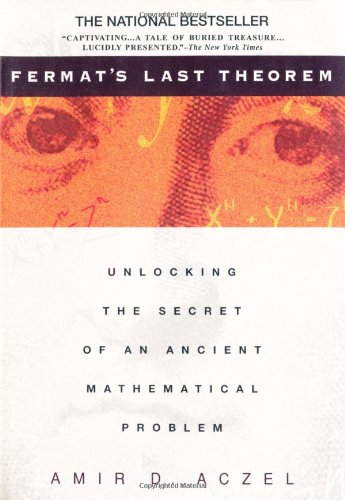
Over three hundred years ago, a French scholar scribbled a simple theorem in the margin of a book. It would become the world's most baffling mathematical mystery.
Simple, elegant, and utterly impossible to prove, Fermat's Last Theorem captured the imaginations of amateur and professional mathematicians for over three centuries. For some it became a wonderful passion. For others it was an obsession that led to deceit, intrigue, or insanity. In a volume filled with the clues, red herrings, and suspense of a mystery novel, Dr. Amir Aczel reveals the previously untold story of the people, the history, and the cultures that lie behind this scientific triumph.
From formulas devised for the farmers of ancient Babylonia to the dramatic proof of Fermat's theorem in 1993, this extraordinary work takes us along on an exhilarating intellectual treasure hunt. Revealing the hidden mathematical order of the natural world in everything from stars to sunflowers, Fermat's Last Theorem brilliantly combines philosophy and hard science with investigative journalism. The result: a real-life detective story of the intellect, at once intriguing, thought-provoking, and impossible to put down.
Die Inhaltsangabe kann sich auf eine andere Ausgabe dieses Titels beziehen.
Auszug. © Genehmigter Nachdruck. Alle Rechte vorbehalten.
Just before dawn on June 23, 1993, Professor John Conway approached the darkened mathematics building on the Princeton University campus. He unlocked the front door and quickly walked up to his office. For weeks preceding his colleague Andrew Wiles' departure for England, persistent but unspecific rumors had been circulating in the world's mathematical community. Conway was expecting something important to happen. Exactly what it was, he had no idea. He turned on his computer and sat down to stare at the screen. At 5 53 AM, a terse e-mail message flashed from across the Atlantic "Wiles proves F.L.T."
Cambridge, England, June 1993
Late in June of 1993, Professor Andrew Wiles flew to England. He was returning to Cambridge University, where he had been a graduate student twenty years earlier. Wiles' former doctoral thesis adviser at Cambridge, Professor John Coates, was organizing a conference on Iwasawa Theory--the particular area within number theory in which Andrew Wiles did his dissertation and about which he knew a great deal. Coates had asked his former student if he would mind giving a short, one-hour talk at the conference on a topic of his choice. To his great surprise and that of the other conference organizers, the shy Wiles--previously reluctant to speak in public--responded by asking if he could be given three hours of presentation.
The 40-year-old Wiles looked the typical mathematician when he arrived in Cambridge: white dress shirt with sleeves rolled up carelessly, thick horn-rimmed glasses, unruly strands of thinning light hair. Born in Cambridge, his return was a very special kind of homecoming--it was the realization of a childhood dream. In pursuit of this dream, Andrew Wiles had spent the last seven years of his life a virtual prisoner in his own attic. But he hoped that soon the sacrifice, the years of struggle and the long hours of solitude would end. Soon he might be able to spend more time with his wife and daughters, of whom he had seen so little for seven years. He had often failed to show up for lunch with his family, missed afternoon tea, barely made it to dinner. But now the accolades would be his alone.
The Sir Isaac Newton Institute for Mathematical Sciences at Cambridge had only recently opened by the time Professor Wiles arrived to deliver his three hour-long lectures. The Institute is spacious, set in scenic surroundings at some distance from the University of Cambridge. Wide areas outside the lecture halls are furnished with plush, comfortable chairs, designed to help facilitate the informal exchange of ideas among scholars and scientists, and to promote learning and knowledge.
Although he knew most of the other mathematicians who came to the specialized conference from around the world, Wiles kept to himself. When colleagues became curious about the length of his scheduled presentation, Wiles would only say they should come to his lectures and find out for themselves. Such secretiveness was unusual, even for a mathematician. While they often work alone trying to prove theorems and are generally not known to be the world's most gregarious people, mathematicians usually share research results with each other. Mathematical results are freely circulated by their authors in the form of research preprints. These preprints bring their authors outside comments that help them improve the papers before they are published. But Wiles didn't hand out preprints and didn't discuss his work. The title of Wiles' talks was "Modular Forms, Elliptic Curves, and Galois Representations," but the name gave no hint where the lectures would lead, and even experts in his field could not guess. The rumors intensified as time went on.
On the first day, Wiles rewarded the 20 or so mathematicians who came to his lecture with a powerful and unexpected mathematical result--and there were still two more lectures to go. What was coming? It became clear to everyone that Wiles' lectures were the place to be, and the suspense grew as expectant mathematicians flocked to the lectures.
On the second day, Wiles' presentation intensified. He had brought with him over 200 pages of formulas and derivations, original thoughts stated as new theorems with their lengthy, abstract proofs. The room was now filled to capacity. Everyone listened intently. Where would it lead? Wiles gave no hint. He dispassionately continued writing on the blackboard and when he was done for the day, he quickly disappeared.
The next day, Wednesday, June 23, 1993, was his last talk. As he neared the lecture hall, Wiles found it necessary to push his way in. People stood outside blocking the entrance and the room was overflowing. Many carried cameras. As Wiles again wrote seemingly endless formulas and theorems on the board, the tension increased. "There was only one possible climax, only one possible end to Wiles' presentation," Professor Ken Ribet of the University of California at Berkeley later told me. Wiles was finishing the last few lines of his proof of an enigmatic and complicated conjecture in mathematics, the Shimura-Taniyama Conjecture. Then suddenly he added one final line, a restatement of a centuries-old equation, one which Ken Ribet had proved seven years earlier would be a consequence of the conjecture. "And this proves Fermat's Last Theorem," he said, almost offhandedly. "I think I'll stop here."
There was a moment of stunned silence in the room. Then the audience erupted in spontaneous applause. Cameras flashed as everyone stood up to congratulate a beaming Wiles. Within minutes, electronic mail flashed and faxes rolled out of machines around the world. The most celebrated mathematical problem of all time appeared to have been solved.
"What was so unexpected was that the next day we were deluged by the world press," recalled Professor John Coates, who organized the conference without having the slightest idea that it would become the launching ground for one of the greatest mathematical achievements. Headlines in the world's newspapers hailed the unexpected breakthrough. "At Last, Shout of 'Eureka!' In Age-Old Math Mystery" announced the front page of the New York Times on June 24, 1993. The Washington Post called Wiles in a major article "The Math Dragon-Slayer," and news stories everywhere described the person who apparently solved the most persistent problem in all of mathematics, one that had defied resolution for over 350 years. Overnight, the quiet and very private Andrew Wiles became a household name.
Pierre de Fermat
Pierre de Fermat was a seventeenth-century French jurist who was also an amateur mathematician. But while he was technically an "amateur" since he had a day job as a jurist, the leading historian of mathematics E. T. Bell, writing in the early part of the twentieth century, aptly called Fermat the "Prince of Amateurs." Bell believed Fermat to have achieved more important mathematical results than most "professional" mathematicians of his day. Bell argued that Fermat was the most prolific mathematician of the seventeenth century, a century that witnessed the work of some of the greatest mathematical brains of all time.
One of...
„Über diesen Titel“ kann sich auf eine andere Ausgabe dieses Titels beziehen.
Suchergebnisse für Fermat's Last Theorem: Unlocking the Secret of...

Beispielbild für diese ISBN
Fermat's Last Theorem: Unlocking the Secret of an Ancient Mathematical Problem
Verlag:
Bantam Doubleday Dell Publishing Group Inc, 1997
ISBN 10: 0385319460
ISBN 13: 9780385319461
Gebraucht
Paperback
Anbieter: World of Books (was SecondSale), Montgomery, IL, USA
Verkäuferbewertung 5 von 5 Sternen

Paperback. Zustand: Fair. Bestandsnummer des Verkäufers 00109790810
Gebraucht kaufen
EUR 4,50
Versand gratis
Versand innerhalb von USA
Versand innerhalb von USA
Anzahl: 1 verfügbar
Beispielbild für diese ISBN
Fermat's Last Theorem: Unlocking the Secret of an Ancient Mathematical Problem
Verlag:
Bantam Doubleday Dell Publishing Group Inc, 1997
ISBN 10: 0385319460
ISBN 13: 9780385319461
Gebraucht
Paperback
Anbieter: World of Books (was SecondSale), Montgomery, IL, USA
Verkäuferbewertung 5 von 5 Sternen
Paperback. Zustand: Good. Bestandsnummer des Verkäufers 00090798227
Gebraucht kaufen
EUR 4,50
Versand gratis
Versand innerhalb von USA
Versand innerhalb von USA
Anzahl: 4 verfügbar
Beispielbild für diese ISBN
Fermat's Last Theorem: Unlocking the Secret of an Ancient Mathematical Problem
Verlag:
Bantam Doubleday Dell Publishing Group Inc, 1997
ISBN 10: 0385319460
ISBN 13: 9780385319461
Gebraucht
Paperback
Anbieter: World of Books (was SecondSale), Montgomery, IL, USA
Verkäuferbewertung 5 von 5 Sternen
Paperback. Zustand: Very Good. Bestandsnummer des Verkäufers 00089445904
Gebraucht kaufen
EUR 4,50
Versand gratis
Versand innerhalb von USA
Versand innerhalb von USA
Anzahl: 2 verfügbar
Beispielbild für diese ISBN
Fermat's Last Theorem: Unlocking the Secret of an Ancient Mathematical Problem
Anbieter: BooksRun, Philadelphia, PA, USA
Verkäuferbewertung 5 von 5 Sternen
Paperback. Zustand: Very Good. It's a well-cared-for item that has seen limited use. The item may show minor signs of wear. All the text is legible, with all pages included. It may have slight markings and/or highlighting. Bestandsnummer des Verkäufers 0385319460-11-1
Gebraucht kaufen
EUR 4,51
Versand gratis
Versand innerhalb von USA
Versand innerhalb von USA
Anzahl: 1 verfügbar
Beispielbild für diese ISBN
Fermat's Last Theorem: Unlocking the Secret of an Ancient Mathematical Problem
Anbieter: More Than Words, Waltham, MA, USA
Verkäuferbewertung 5 von 5 Sternen
Zustand: Good. A sound copy with only light wear. Overall a solid copy at a great price! Bestandsnummer des Verkäufers BOS-E-11c-01601
Gebraucht kaufen
EUR 1,29
EUR 3,55 Versand
Versand innerhalb von USA
Versand innerhalb von USA
Anzahl: 1 verfügbar
Beispielbild für diese ISBN
Fermat's Last Theorem: Unlocking the Secret of an Ancient Mathematical Problem
Anbieter: Evergreen Goodwill, Seattle, WA, USA
Verkäuferbewertung 5 von 5 Sternen
paperback. Zustand: Acceptable. Bestandsnummer des Verkäufers mon0000803905
Gebraucht kaufen
EUR 1,40
EUR 3,55 Versand
Versand innerhalb von USA
Versand innerhalb von USA
Anzahl: 1 verfügbar
Foto des Verkäufers
Fermat's Last Theorem: Unlocking the Secret of an Ancient Mathematical Problem
Anbieter: Greenworld Books, Arlington, TX, USA
Verkäuferbewertung 5 von 5 Sternen
Zustand: good. Fast Free Shipping â" Good condition. It may show normal signs of use, such as light writing, highlighting, or library markings, but all pages are intact and the book is fully readable. A solid, complete copy that's ready to enjoy. Bestandsnummer des Verkäufers GWV.0385319460.G
Gebraucht kaufen
EUR 5,13
Versand gratis
Versand innerhalb von USA
Versand innerhalb von USA
Anzahl: 1 verfügbar
Beispielbild für diese ISBN
Fermat's Last Theorem: Unlocking the Secret of an Ancient Mathematical Problem
Anbieter: HPB Inc., Dallas, TX, USA
Verkäuferbewertung 5 von 5 Sternen
paperback. Zustand: Very Good. Connecting readers with great books since 1972! Used books may not include companion materials, and may have some shelf wear or limited writing. We ship orders daily and Customer Service is our top priority! Bestandsnummer des Verkäufers S_471355386
Gebraucht kaufen
EUR 2,30
EUR 3,34 Versand
Versand innerhalb von USA
Versand innerhalb von USA
Anzahl: 1 verfügbar
Beispielbild für diese ISBN
Fermat's Last Theorem: Unlocking the Secret of an Ancient Mathematical Problem
Anbieter: HPB-Emerald, Dallas, TX, USA
Verkäuferbewertung 5 von 5 Sternen
paperback. Zustand: Very Good. Connecting readers with great books since 1972! Used books may not include companion materials, and may have some shelf wear or limited writing. We ship orders daily and Customer Service is our top priority! Bestandsnummer des Verkäufers S_471292379
Gebraucht kaufen
EUR 2,30
EUR 3,34 Versand
Versand innerhalb von USA
Versand innerhalb von USA
Anzahl: 1 verfügbar
Beispielbild für diese ISBN
Fermat's Last Theorem: Unlocking the Secret of an Ancient Mathematical Problem
Anbieter: Half Price Books Inc., Dallas, TX, USA
Verkäuferbewertung 5 von 5 Sternen
paperback. Zustand: Very Good. Connecting readers with great books since 1972! Used books may not include companion materials, and may have some shelf wear or limited writing. We ship orders daily and Customer Service is our top priority! Bestandsnummer des Verkäufers S_438594078
Gebraucht kaufen
EUR 2,30
EUR 3,34 Versand
Versand innerhalb von USA
Versand innerhalb von USA
Anzahl: 1 verfügbar