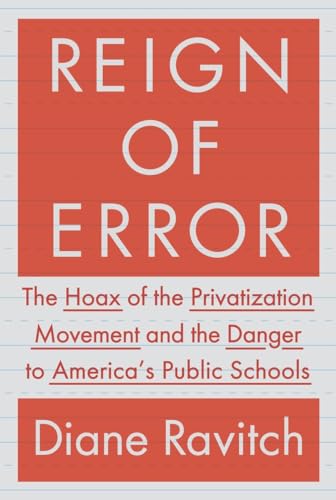
Reign of Error: The Hoax of the Privatization Movement and the Danger to America's Public Schools - Hardcover
Inhaltsangabe
From one of the foremost authorities on education in the United States, former U.S. assistant secretary of education, “whistle-blower extraordinaire” (The Wall Street Journal), author of the best-selling The Death and Life of the Great American School System (“Important and riveting”—Library Journal), The Language Police (“Impassioned . . . Fiercely argued . . . Every bit as alarming as it is illuminating”—The New York Times), and other notable books on education history and policy—an incisive, comprehensive look at today’s American school system that argues against those who claim it is broken and beyond repair; an impassioned but reasoned call to stop the privatization movement that is draining students and funding from our public schools.
In Reign of Error, Diane Ravitch argues that the crisis in American education is not a crisis of academic achievement but a concerted effort to destroy public schools in this country. She makes clear that, contrary to the claims being made, public school test scores and graduation rates are the highest they’ve ever been, and dropout rates are at their lowest point.
She argues that federal programs such as George W. Bush’s No Child Left Behind and Barack Obama’s Race to the Top set unreasonable targets for American students, punish schools, and result in teachers being fired if their students underperform, unfairly branding those educators as failures. She warns that major foundations, individual billionaires, and Wall Street hedge fund managers are encouraging the privatization of public education, some for idealistic reasons, others for profit. Many who work with equity funds are eyeing public education as an emerging market for investors.
Reign of Error begins where The Death and Life of the Great American School System left off, providing a deeper argument against privatization and for public education, and in a chapter-by-chapter breakdown, putting forth a plan for what can be done to preserve and improve it. She makes clear what is right about U.S. education, how policy makers are failing to address the root causes of educational failure, and how we can fix it.
For Ravitch, public school education is about knowledge, about learning, about developing character, and about creating citizens for our society. It’s about helping to inspire independent thinkers, not just honing job skills or preparing people for college. Public school education is essential to our democracy, and its aim, since the founding of this country, has been to educate citizens who will help carry democracy into the future.
Die Inhaltsangabe kann sich auf eine andere Ausgabe dieses Titels beziehen.
Über die Autorin bzw. den Autor
Diane Ravitch was born in Houston, Texas, and graduated from the Houston public schools, Wellesley College, and Columbia University. She is a research professor of education at New York University. She was appointed to the National Assessment Governing Board by President Bill Clinton in 1997 and 2001. Ravitch is the author of ten previous books. In 2011, she received the Daniel Patrick Moynihan Prize from the American Academy of Political and Social Science. Ravitch lives in Brooklyn, New York.
Auszug. © Genehmigter Nachdruck. Alle Rechte vorbehalten.
CHAPTER 2
The Context for Corporate Reform
Federal law and policy turned the education reform movement of the twenty-first century into a powerful force that no school or district dared to ignore.
Since the publication in 1983 of a report called A Nation at Risk, federal and state policy makers have searched for policy levers with which to raise academic performance. That report was the product of a commission—called the National Commission on Excellence in Education—appointed by Secretary of Education Terrel H. Bell, during the administration of President Ronald Reagan. The commission warned that the nation was endangered by “a rising tide of mediocrity” in the schools; it pointed to the poor standing of American students on international tests, a recurring phenomenon since the first international test was offered in the mid-1960s. Its basic claim was that the American standard of living was threatened by the loss of major manufacturing industries—such as automobiles, machine tools, and steel mills—to other nations, which the commission attributed to the mediocre quality of our public educational system; this claim shifted the blame from shortsighted corporate leadership to the public schools. The commission called for better curriculum standards, higher graduation requirements, better teacher training, higher teacher pay, and other customary improvements. The commission said very little about testing, account- ability, and choice.
The first Bush administration, in which I served, had little appetite for an expanded federal role in education. It announced a program called America 2000, which relied mainly on voluntarism since a Democratic Congress would not consider any education bills sponsored by President George H. W. Bush. Congressional Democrats in the early 1990s wanted greater resources and greater equity in public schools, not standards and tests. The Clinton administration liked the idea of national standards and national testing, but when Republicans took control of Congress in 1995, that idea died. The administration settled for a program called Goals 2000, which offered money to states to set their own standards and tests.
Along came the George W. Bush administration in 2001, which proposed sweeping federal legislation called No Child Left Behind (NCLB). On the campaign trail, Bush spoke of “the Texas miracle,” claiming that testing and accountability had led to startling improvements in student performance. He said that test scores and graduation rates were up, and the achievement gap was narrowing, thanks to the Texas reforms. We now know that there was no such miracle; Texas made some increases on federal tests, like many other states, but its students register at the national average, nowhere near the top. In 2001, no one listened to those who warned that the “Texas miracle” was an illusion.1 Congress swiftly passed the law, which dramatically changed the federal role in education.
The law declared that all states must test every child annually in grades 3 through 8 in reading and mathematics and report test scores by race, ethnicity, low-income status, disability status, and limited- English proficiency. By the year 2014, all students were supposed to achieve proficiency on state tests. The states were required to monitor every school to see if every group was on track to reach proficiency. Any school that persistently failed to meet its annual target would be labeled a school in need of improvement (in the eyes of the media and thus the public, that means a “failing” school). With each year that the school failed to meet its target, the sanctions became increasingly more punitive. Eventually, if the school kept failing, it was at risk of having its staff fired or having the school closed, handed over to state control or private management, or turned into a charter school or “any other major restructuring.” Many schools “failed” year after year, and as 2014 approached, the majority of public schools in the nation had been declared failures, including some excellent, highly regarded schools (typically, the group that was not making sufficient progress toward 100 percent proficiency was students with disabilities, and the schools that were likeliest to be labeled as failing enrolled high proportions of poor and minority students). In Massachusetts, for example, the state with the nation’s highest-performing students as judged by federal tests, 80 percent of the state’s public schools were “failing” by NCLB standards in 2012.
Let’s be clear: 100 percent proficiency is an impossible goal; no nation in the world has ever achieved this, nor has any other nation ever passed legislation to punish its schools for not reaching an unattainable goal. It was as though Congress had passed a law saying that every city in America should be crime-free. Who could disapprove of such a laudable goal? What city would not want to be crime-free? But imagine if the law set a deadline twelve years off and said that any city that did not meet the goal would be punished; its police stations would be closed and privatized; its police officers would lose their badges. The first to close would be the police stations in the poorest neighborhoods, where crime rates were highest. Eventually, the scythe would swing even in affluent neighborhoods, because no city is completely crime- free. Wishing that it might be so, or passing laws to require that it be so, does not make it so.
NCLB opened the door to huge entrepreneurial opportunities. Federal funds were set aside for after-school tutoring, and thousands of tutoring companies sprang up overnight to claim a share. Many new ventures opened to advise schools on how to meet NCLB testing tar- gets, how to analyze NCLB data, how to “turn around” failing schools, and how to meet other goals embedded in the legislation.
NCLB encouraged the growth of the charter sector by proposing that charter schools were a remedy for failing public schools. When NCLB was passed, charters were a new and untested idea. The original idea for charters was first suggested in 1988, not to promote competition, but to allow teachers to try out new ideas. One of its originators, Ray Budde, was a professor at the University of Massachusetts who envisioned charters run by teachers, free to teach without interference by the local district bureaucracy. The other originator was Albert Shanker, president of the American Federation of Teachers, who envisioned charters where teachers sought out the lowest-performing students, the dropouts, and the disengaged, then figured out innovative ways to ignite their interest in education. Both these men, unknown to each other, saw charters as schools empowered to devise innovative practices and ready to collaborate and share what they had learned with their colleagues and existing schools. Certainly, neither imagined a charter sector that was nearly 90 percent non-union or one that in some states presented profit- making opportunities for entrepreneurs.
Minnesota passed the first charter law in 1991, and the first charter school opened in 1992. Only nine years later, Congress passed the No Child Left Behind law, recommending conversion of a low-performing school to a charter as a remedy. At the time, there was no evidence that charters would succeed where the local public school had failed. Nonetheless, the congressional endorsement was valuable publicity for charters, which gained public recognition and new opportunities to expand and compete with neighborhood public schools for higher test scores. In addition, it paved the way for federal appropriations and federal tax breaks for charter school...
„Über diesen Titel“ kann sich auf eine andere Ausgabe dieses Titels beziehen.
Weitere beliebte Ausgaben desselben Titels

Suchergebnisse für Reign of Error: The Hoax of the Privatization Movement...

Beispielbild für diese ISBN
Hoax The Privatization Movemen
Anbieter: World of Books (was SecondSale), Montgomery, IL, USA
Verkäuferbewertung 5 von 5 Sternen

Zustand: Very Good. Item in very good condition! Textbooks may not include supplemental items i.e. CDs, access codes etc. Bestandsnummer des Verkäufers 00088035173
Beispielbild für diese ISBN
Hoax The Privatization Movemen
Anbieter: World of Books (was SecondSale), Montgomery, IL, USA
Verkäuferbewertung 5 von 5 Sternen
Zustand: Good. Item in good condition. Textbooks may not include supplemental items i.e. CDs, access codes etc. Bestandsnummer des Verkäufers 00081135263
Beispielbild für diese ISBN
Reign of Error: The Hoax of the Privatization Movement and the Danger to America's Public Schools
Anbieter: Gulf Coast Books, Cypress, TX, USA
Verkäuferbewertung 5 von 5 Sternen
Hardcover. Zustand: Good. Bestandsnummer des Verkäufers 0385350880-3-24262266
Beispielbild für diese ISBN
Reign of Error: The Hoax of the Privatization Movement and the Danger to America's Public Schools
Anbieter: Orion Tech, Kingwood, TX, USA
Verkäuferbewertung 5 von 5 Sternen
Hardcover. Zustand: Good. Bestandsnummer des Verkäufers 0385350880-3-22836071
Foto des Verkäufers
Reign of Error: The Hoax of the Privatization Movement and the Danger to America's Public Schools
Anbieter: Reliant Bookstore, El Dorado, KS, USA
Verkäuferbewertung 4 von 5 Sternen

Zustand: good. This book is in good condition with very minimal damage. Pages may have minimal notes or highlighting. Cover image on the book may vary from photo. Ships out quickly in a secure plastic mailer. Bestandsnummer des Verkäufers RDV.0385350880.G
Foto des Verkäufers
Reign of Error: The Hoax of the Privatization Movement and the Danger to America's Public Schools
Anbieter: Greenworld Books, Arlington, TX, USA
Verkäuferbewertung 5 von 5 Sternen
Zustand: good. Fast Free Shipping â" Good condition book with a firm cover and clean, readable pages. Shows normal use, including some light wear or limited notes highlighting, yet remains a dependable copy overall. Supplemental items like CDs or access codes may not be included. Bestandsnummer des Verkäufers GWV.0385350880.G
Foto des Verkäufers
Reign of Error: The Hoax of the Privatization Movement and the Danger to America's Public Schools
Anbieter: ZBK Books, Carlstadt, NJ, USA
Verkäuferbewertung 5 von 5 Sternen
Zustand: good. Fast & Free Shipping â" Good condition with a solid cover and clean pages. Shows normal signs of use such as light wear or a few marks highlighting, but overall a well-maintained copy ready to enjoy. Supplemental items like CDs or access codes may not be included. Bestandsnummer des Verkäufers ZWV.0385350880.G
Beispielbild für diese ISBN
Reign of Error: The Hoax of the Privatization Movement and the Danger to America's Public Schools
Anbieter: Once Upon A Time Books, Siloam Springs, AR, USA
Verkäuferbewertung 4 von 5 Sternen
Hardcover. Zustand: Acceptable. This is a used book. It may contain highlighting/underlining and/or the book may show heavier signs of wear . It may also be ex-library or without dustjacket. This is a used book. It may contain highlighting/underlining and/or the book may show heavier signs of wear . It may also be ex-library or without dustjacket. Bestandsnummer des Verkäufers mon0000720100
Beispielbild für diese ISBN
Reign of Error: The Hoax of the Privatization Movement and the Danger to America's Public Schools
Anbieter: BookHolders, Towson, MD, USA
Verkäuferbewertung 5 von 5 Sternen
Zustand: Fair. [ No Hassle 30 Day Returns ][ Ships Daily ] [ Underlining/Highlighting: SOME ] [ Writing: NONE ] [ Edition: First ] Some pages have highlighted parts. Publisher: Knopf Pub Date: 9/17/2013 Binding: Hardcover Pages: 416 First edition. Bestandsnummer des Verkäufers 6756524
Beispielbild für diese ISBN
Reign of Error: The Hoax of the Privatization Movement and the Danger to America's Public Schools
Anbieter: BookHolders, Towson, MD, USA
Verkäuferbewertung 5 von 5 Sternen
Zustand: Good. [ No Hassle 30 Day Returns ][ Ships Daily ] [ Underlining/Highlighting: NONE ] [ Writing: NONE ] [ Edition: First ] Publisher: Knopf Pub Date: 9/17/2013 Binding: Hardcover Pages: 416 First edition. Bestandsnummer des Verkäufers 6794750