
Verwandte Artikel zu The Complete Perfectionist: A Poetics of Work
Inhaltsangabe
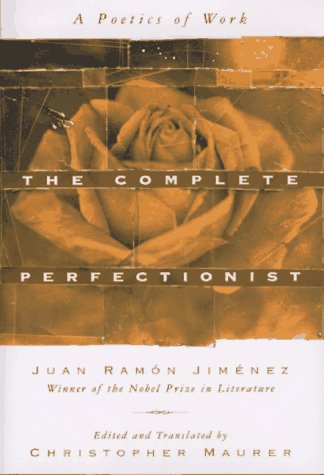
Available for the first time in English, a guide on how to achieve perfection by the Nobel Prize-winning Spanish poet presents a series of lessons in the form of aphorisms that offer insight into work, love, and any perfection-worthy pursuit.
Die Inhaltsangabe kann sich auf eine andere Ausgabe dieses Titels beziehen.
Über die Autorin bzw. den Autor
Juan Ram¾n JimÚnez (1881-1958), one of the greatest Spanish poets of the twentieth century, wrote innumerable books of lyrical verse, fine prose poems, aphorisms, and critical essays. Juan Ram¾n lived in Madrid until the Spanish Civil War, and died in exile in Puerto Rico, after receiving the Nobel Prize for Literature.
Christopher Maurer has written widely on Spanish literature, from Baltasar Gracißn (author of the New York Times bestsellers The Art of Worldly Wisdom and A Pocket Mirror for Heroes) to Federico GarcÝa Lorca. He is chairman of the Department of Spanish and Portuguese at Vanderbilt University.
Aus dem Klappentext
s an ideal that makes life worth living--the internal applause as you hit the perfect note, write the perfect piece, reach the goal you once thought unattainable. Yet many of us abandon that pursuit and settle for less than what we secretly want: perfect work, perfect love, perfect selves.
Few have courted perfection like Nobel Prize winner Juan Ram¾n JimÚnez, who felt both fear and exhilaration before his own high standards and negotiated shrewdly with his own personal best.
Drawing upon Juan Ram¾n's aphorisms, Christopher Maurer meditates upon his struggle and gives us a guide to the pursuit of life's ultimate pleasure: the dream of doing perfect work. Juan Ram¾n's relentless quest for the perfect poem leads here to an inspiring new vision of how to reach perfection in any endeavor.
Juan Ram¾n analyzes the most radical elements of perfection: how to create and revise, reconcile noise and sil
Auszug. © Genehmigter Nachdruck. Alle Rechte vorbehalten.
The Complete Perfectionist was written for those who know what it is to dream of perfect writing and perfect work. It is a book of suggestions and hints rather than of instruction or advice. Like any teacher, Juan Ram¾n liked to give advice, but in his aphorisms he often draws back from doing so: "Let no one take advice from this book; the only thing that matters is one's own experience." Because not everyone has much experience, "the only useful advice would be that given by the young to the old." Juan Ram¾n was, after all, an individualist, intent upon his own perfection, and these pages show him in dialogue more often with himself than with the reader. There are many, many "lessons" about work in this book, but they do not always come to us directly, in the second person. The you is often him, not us. Juan Ram¾n wondered whether art can "instruct" at all:
"Art is not actively didactic, no. But it is clear that the perfect fruit of the cultivated spirit--a spirit intent only upon its own perfection--can educate others through example."
How, then, to apply these aphorisms to one's own life and work? Each chapter of this book takes up a necessary element of perfect work. But within each chapter, the aphorisms--and occasionally, short poems--go off in their own directions, without following a rigid line of reasoning.
Juan Ram¾n's writing on dream and reverie throws some light on how to read this book. Part of reading lies in rational analysis. But good reading, like good work, means listening to the odd associations that arise from reverie. What is not said--what is suggested in the white space between each aphorism--matters as much as the aphorism itself: "Between idea and idea, a dream!" These aphorisms do not need to be taken by force, at one sitting: they can be returned to and read somewhat randomly and dreamily.
Dream
Dreams tempt us with their wealth. They are our imaginative endowment, the mind's unspent capital. Most of us are content to live on the interest. But many books that promise to awaken our "creativity" argue for the usefulness of dreaming. In a few easy steps, they say, we can "incubate" our dreams and learn to decipher, remember, and apply them better. We can select a problem and pose it to our dreams as a question: "How can I become more confident? "
Juan Ram¾n encourages us to do the opposite: rejoice that dreaming cannot be turned into a "productive" form of labor, of problem solving. He would agree with the French philosopher Gaston Bachelard that in dreams we are removed from ourselves:
"The night dream does not belong to us. It is not our possession. With regard to us, it is an abductor, the most disconcerting of abductors: it abducts our being from us. [In the deepest dreams] we are returned to an ante-subjective state. We become elusive to ourselves..."
Nor does Juan Ram¾n wish to "apply" his dreams to his work. He is doubtful he can capture the language of dreams in his writing, and although he speaks often of the pleasures of dreaming, few of his poems are the narration of actual dreams. He does not believe, as some psychologists do, in translating the language of dreams into that of reality, and he knows that there are dream strata "below our lives and above our deaths" that neither the psychologist nor the poet will ever get at. Following a long tradition of Spanish poets--the best known is Calder¾n de la Barca--he affirms that, when the play of life is over, what is "lived" is indistinguishable from what is "dreamt." Idealists like Juan Ram¾n can never easily decide which of these two halves of our lives is the "real" one. Some of his poems make us feel that we are flying at night, upside-down, unable to know whether those lights are coming from the stars or from an earthly city. He believes fervently in the restorative, healing power of dreams: they are the "madness" that keeps us sane; the poetry that chastens our reality; something unbalanced that gives equilibrium to the working day. They purify what happened the day before.
[Daydream]
I want to look at things, but only see through them.
Sometimes my daydreams follow one another so quickly and abundantly that I think I am bleeding to death.
There is a me who is sleeping
--buzzing fly of an idea!--
and there is a me who is staying awake
so I won't go to sleep.
Prolong your reverie past sunset into the night.
Riches of night, how many secrets taken from you, how many yet to take, though none of them is your secret or mine, night!
What unspeakable pleasure, to plunge my hand deep into you, stirring your stars!
Luminous touch of other hands searching for your treasures!
I can pluck more from dream than from life, for dream is like a better life, whose roses I would like to plant in my reality.
...In our dreams, memory makes us "sane with blackness," and this seems a natural state for us; more natural, at least, than to be "crazy with light."
Let us dream whatever we want, for when life and dream are gone, a thing lived is no different from a thing dreamt.
Dreams trap me like cobwebs in bloom. I must break free of them, because if I didn't, the nuances of things would drive me crazy.
I sing my dreams to sleep like a mother singing to her crying children.
Not to dream? But dream is the prelude, the mainspring of action; and the best, most beautiful action is the one dreamt of!
Yes, let us learn from our sleep and our dreams to look at life. That is enough.
Thought that can't climb over the fence of night...leave it in the henhouse of evening.
Dream toward the spirit, never toward reality, for reality will spring from your heart.
I dreamt I was dead and that, dead, I was dreaming that I was coming back to life and could not. And I dreamed that that dream would be eternal.
What a shame to awaken now, just as I was finding in the life of dream what I had lost in the dream of life.
„Über diesen Titel“ kann sich auf eine andere Ausgabe dieses Titels beziehen.
Suchergebnisse für The Complete Perfectionist: A Poetics of Work

Beispielbild für diese ISBN
The Complete Perfectionist
Anbieter: World of Books (was SecondSale), Montgomery, IL, USA
Verkäuferbewertung 5 von 5 Sternen

Hardback. Zustand: Fair. A Season in Granada brings together poems, essays and excerpts from letters by the great twentieth-century poet Federico Garcia Lorca, including two sequences of poems and an essay previously unpublished in English. The writings form a dazzling, elegiac celebration of the city of Granada, where Lorca grew up, where he studied, and to which he returned frequently in his life and in his imagination. And where he would die. In Christopher Maurer's words, the twenty poems in the two Suites, Poem of the Fair', and Summer Hours', draw on the structural ideas and whimsical tone of one of Lorca's favourite composers, Claude Debussy. The idea was to capture some phenomenon - the moon, the hours of evening, the ocean, wheatfields, flamenco - in a series of stylized estampas (prints) or moments.' They represent an important addition to the Lorca canon. Published to celebrate the centenary of Lorca's birth, these poems, essays and letters are remarkable for their freshness and vitality, and go right to the heart of his extraordinary and passionate vision. Federico Garcia Lorca (1898-1936) was born near Granada. His works include The Gypsy Ballads (1928), Poem of the Deep Song (1931) and Poet in New York (1940), and the three tragedies, Blood Wedding (1933), Yerma (1934) and The House of Bernarda Alba (1936). An inspiring friend and occasional collaborator of some of the great artists of his time, including Manuel de Falla, Salvador Dali and Pablo Neruda, he was also a mesmerising performer of his own work, a consummate musician and a theatrical innovator of genius. He was murdered in Granada at the height of his fame by Nationalist partisans on the eve of the Spanish Civil War. Christopher Maurer is Head of the Spanish Department at the University of Illinois, Chicago. He has published many editions and translations of Lorca's works, including Collected Poems (Farrar, Straus & Giroux, 1990) and Selected Poems (Penguin, 1995). He is the author, with Maria E. Iglesias, of Shearwater: Dreaming in Clay on the Coast of Mississippi, the story of an unusual southern family of potters, painters and writers (Doubleday, 2000). Bestandsnummer des Verkäufers 00107999831
Gebraucht kaufen
EUR 6,42
Versand gratis
Versand innerhalb von USA
Versand innerhalb von USA
Anzahl: 1 verfügbar
Beispielbild für diese ISBN
The Complete Perfectionist
Anbieter: Wonder Book, Frederick, MD, USA
Verkäuferbewertung 5 von 5 Sternen
Zustand: Very Good. Very Good condition. Good dust jacket. A copy that may have a few cosmetic defects. May also contain light spine creasing or a few markings such as an owner's name, short gifter's inscription or light stamp. Bestandsnummer des Verkäufers V09B-04663
Gebraucht kaufen
EUR 6,43
Versand gratis
Versand innerhalb von USA
Versand innerhalb von USA
Anzahl: 1 verfügbar
Beispielbild für diese ISBN
The Complete Perfectionist
Anbieter: ThriftBooks-Dallas, Dallas, TX, USA
Verkäuferbewertung 5 von 5 Sternen
Hardcover. Zustand: Very Good. No Jacket. Missing dust jacket; May have limited writing in cover pages. Pages are unmarked. ~ ThriftBooks: Read More, Spend Less. Bestandsnummer des Verkäufers G0385480229I4N01
Gebraucht kaufen
EUR 6,49
Versand gratis
Versand innerhalb von USA
Versand innerhalb von USA
Anzahl: 1 verfügbar
Beispielbild für diese ISBN
The Complete Perfectionist
Anbieter: ThriftBooks-Dallas, Dallas, TX, USA
Verkäuferbewertung 5 von 5 Sternen
Hardcover. Zustand: Good. No Jacket. Pages can have notes/highlighting. Spine may show signs of wear. ~ ThriftBooks: Read More, Spend Less. Bestandsnummer des Verkäufers G0385480229I3N00
Gebraucht kaufen
EUR 6,49
Versand gratis
Versand innerhalb von USA
Versand innerhalb von USA
Anzahl: 1 verfügbar
Beispielbild für diese ISBN
The Complete Perfectionist : A Poetics of Work
Verlag:
Knopf Doubleday Publishing Group, 1997
ISBN 10: 0385480229
ISBN 13: 9780385480222
Gebraucht
Hardcover
Erstausgabe
Anbieter: Better World Books, Mishawaka, IN, USA
Verkäuferbewertung 5 von 5 Sternen
Zustand: Good. 1st. Former library copy. Pages intact with minimal writing/highlighting. The binding may be loose and creased. Dust jackets/supplements are not included. Includes library markings. Stock photo provided. Product includes identifying sticker. Better World Books: Buy Books. Do Good. Bestandsnummer des Verkäufers 2303786-75
Gebraucht kaufen
EUR 6,57
Versand gratis
Versand innerhalb von USA
Versand innerhalb von USA
Anzahl: 1 verfügbar
Beispielbild für diese ISBN
The Complete Perfectionist : A Poetics of Work
Verlag:
Knopf Doubleday Publishing Group, 1997
ISBN 10: 0385480229
ISBN 13: 9780385480222
Gebraucht
Hardcover
Erstausgabe
Anbieter: Better World Books, Mishawaka, IN, USA
Verkäuferbewertung 5 von 5 Sternen
Zustand: Good. 1st. Pages intact with minimal writing/highlighting. The binding may be loose and creased. Dust jackets/supplements are not included. Stock photo provided. Product includes identifying sticker. Better World Books: Buy Books. Do Good. Bestandsnummer des Verkäufers 4180692-6
Gebraucht kaufen
EUR 6,57
Versand gratis
Versand innerhalb von USA
Versand innerhalb von USA
Anzahl: 2 verfügbar
Beispielbild für diese ISBN
The Complete Perfectionist
Anbieter: St Vincent de Paul of Lane County, Eugene, OR, USA
Verkäuferbewertung 5 von 5 Sternen
Zustand: Good. DUST JACKET HAS SOME MINOR SHELF WEAR BUT BOOK REMAINS IN GOOD READABLE CONDITION. hardcover This item shows wear from consistent use but remains in good readable condition. It may have marks on or in it, and may show other signs of previous use or shelf wear. May have minor creases or signs of wear on dust jacket. Packed with care, shipped promptly. Bestandsnummer des Verkäufers J-04-4496
Gebraucht kaufen
EUR 3,67
EUR 3,56 Versand
Versand innerhalb von USA
Versand innerhalb von USA
Anzahl: 1 verfügbar
Beispielbild für diese ISBN
The Complete Perfectionist
Anbieter: Half Price Books Inc., Dallas, TX, USA
Verkäuferbewertung 5 von 5 Sternen
hardcover. Zustand: Very Good. Connecting readers with great books since 1972! Used books may not include companion materials, and may have some shelf wear or limited writing. We ship orders daily and Customer Service is our top priority! Bestandsnummer des Verkäufers S_477160488
Gebraucht kaufen
EUR 5,97
EUR 3,35 Versand
Versand innerhalb von USA
Versand innerhalb von USA
Anzahl: 1 verfügbar
Beispielbild für diese ISBN
The Complete Perfectionist
Anbieter: HPB-Diamond, Dallas, TX, USA
Verkäuferbewertung 5 von 5 Sternen
hardcover. Zustand: Very Good. Connecting readers with great books since 1972! Used books may not include companion materials, and may have some shelf wear or limited writing. We ship orders daily and Customer Service is our top priority! Bestandsnummer des Verkäufers S_478122760
Gebraucht kaufen
EUR 5,97
EUR 3,35 Versand
Versand innerhalb von USA
Versand innerhalb von USA
Anzahl: 1 verfügbar
Beispielbild für diese ISBN
The Complete Perfectionist
Verlag:
Doubleday Business, 1997
ISBN 10: 0385480229
ISBN 13: 9780385480222
Gebraucht
Hardcover
Erstausgabe
Anbieter: Chaparral Books, Portland, OR, USA
Verkäuferbewertung 5 von 5 Sternen
Hardcover. Zustand: Very Good. Zustand des Schutzumschlags: Very Good. First Edition, First printing. Minor shelf wear to binding. Light wear and soiling to edges of text block. DJ lightly worn & soiled in a mylar cover. Bestandsnummer des Verkäufers SELmauCOM
Gebraucht kaufen
EUR 9,20
EUR 6,70 Versand
Versand innerhalb von USA
Versand innerhalb von USA
Anzahl: 1 verfügbar