
Verwandte Artikel zu Losing Nelson
Inhaltsangabe
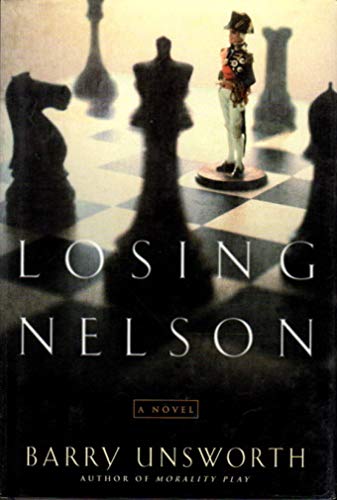
An obsessed biographer of Lord Horatio Nelson lives a kooky existence, reenacting the military exploits of the hero in his basement, but knowledge of an act of brutality committed by the Royal Navy under his command threatens to derail his carefully constructed war game.
Die Inhaltsangabe kann sich auf eine andere Ausgabe dieses Titels beziehen.
Über die Autorinnen und Autoren
Barry Unsworth won the Booker Prize in 1992 for Sacred Hunger; his next novel, Morality Play, was a Booker nominee and a bestseller in both the United States and Great Britain. His other novels include After Hannibal, The Hide, and Pascali's Island, which was also shortlisted for the Booker Prize and was made into a feature film. He lives in Umbria with his wife and recently held the position of Visiting Fellow at the University of Iowa Writers' Workshop.
Barry Unsworth recently held the position of Visiting Fellow at the University of Iowa Writers' Workshop.
Aus dem Klappentext
Barry Unsworth, author of the Booker Prize-winning Sacred Hunger and the bestselling Morality Play, has long established his genius for both historical narrative and for sharply observed, fantastically odd characters and stories. In Losing Nelson, Unsworth's most brilliantly imagined novel yet and a nominee for the Booker Prize, he has enlisted all these proven talents in a way unprecedented in his earlier work.
Every day, Charles Cleasby relives the events of Lord Horatio Nelson's life. He holds no regard for year-by-year chronology, so his life is a bustle of anniversaries: a political confrontation in 1797, for instance, might be followed immediately by a climactic sea battle in 1805. He reenacts the battles in his basement on a huge blue-glass table, moving the perfectly rendered ships that represent Nelson's Royal Navy and its enemies, thus reliving Nelson's triumphs.
Losing Nelson is a novel of obsession, the story of a man unable to see himself separately from the hero he mistakenly idolizes. Cleasby is, in fact, a Nelson biographer run amok. He is convinced that Nelson--Britain's greatest admiral, who finally defeated Napoleon, and lost his own life, in the Battle of Trafalgar--is the perfect hero, but in his research he has come upon an incident of horrifying brutality in Nelson's military career that simply stumps all attempts at glorification.
Admiral Nelson, faults and all, is a hero to many, but to Cleasby he is something more. Cleasby has come to think of himself as Nelson's dark side, the fallible human flip-side of the perfect man. And so Nelson's transgression represents more than just a chink in his thesis. Further, Cleasby's new assistant, Miss Lily of Avon Secretarial Services, insists on maintaining a running criticism of Nelson as she takes dictation, not to mention the objections she voices to the isolated, sheltered way Cleasby lives his life. Something has to give, and give it does--in the most astonishing and entertaining of ways.
Auszug. © Genehmigter Nachdruck. Alle Rechte vorbehalten.
I had a bad fright that morning. I wouldn't have left the house at all on such a special day if the man at Seldon's hadn't phoned to say they had a piece I might be interested in. It was an oval plate, bone china, frilled at the edges, slightly curved at the sides, pale cream in colour, with a central medallion enclosing his profile in dark blue. There was an inscription of the same colour in slightly worn cursive, running round the upper half of the medallion: Hero of the Nile. They had used the De Vaere profile made for Wedgwood in the summer of 1798. Nothing very remarkable about it. But of course I agreed to buy it. It bore his image. It was seldom indeed I could resist that.
I was on my way back home with it, back to Belsize Park. It was a raw day and the sky was darkly overcast. Nevertheless, I decided to walk as far as Knightsbridge for the sake of the exercise. I had time to spare--or so I thought.
As I was crossing Pont Street it started to rain, not very heavily. The platform in the Underground was crowded and became steadily more so while I waited. There was a silence among the people there, silence of waiting--they were resigned. I began to feel the first twinges of panic. Then an Asian voice on the loudspeaker: a delay on the line due to security checks at Gloucester Road station.
It was thirteen minutes to twelve. Imagine my feelings. This was February the fourteenth; it was the two hundredth anniversary of the Battle of Cape St. Vincent, Horatio's first great disobedience, the day he became an angel. On this day, at 12:50 p.m.--just over an hour's time--his ship, the Captain, went into close action. And here was I among this mute herd, sweating despite the cold, a good two miles from my table and my models. The ships were not even set out.
It mattered so much to get the time right, therein lay the whole meaning--how else could I keep my life parallel with his? Before my father died--he died last April--I fought out this battle wherever I could: on my bed, on the floor, one freezing day in the shed behind the house. We never missed, year after year we broke the line at ten minutes to one. Now I had the basement all to myself. The thought that I might fail the appointment now was unendurable, it made me feel sick.
There was no time to be lost. I struggled back to the surface along with numbers of others who had made the same decision. I was feeling distinctly unwell by now; my breath came with difficulty and there was the usual suffusion of blood at the temples, obscuring my vision, making me feel hemmed-in. It was still raining and there were no free taxis anywhere near the tube, nor outside Harrods. I had to walk some way towards Hyde Park Corner before I found one, and even then I was lucky; the previous fare was alighting as I came up.
I gave the address and sat back and concentrated on keeping my face composed and my breathing inaudible. Closing the eyes has always helped me to cope with anxiety, but now I waited two minutes by my watch before allowing myself the luxury. Timing is the key to control, and control is the key to concealment. The driver, if he glanced in his mirror, would think it strange if his passenger were dozing too soon.
My father was a master of concealment; he kept it up so well that nobody knew just when he died, nobody registered the precise moment.
We made it with twelve minutes to spare. I was still gasping a little as I went down to the basement. I did not allow myself to be sidetracked by considerations of where among the shelves and cabinets to put my new acquisition; such a decision would involve extensive rearrangement, it could easily have taken the whole afternoon, in these last months I had got steadily slower. I simply left the plate, still in its damp wrapping, on the floor and went straight through to my operations room and began setting out the ships, the Spanish first in their two loose groups, 9 in the van, 18 in the rear, these last headed by de Córdoba in his great flagship, the Santissima Trinidad, 4 decks, 136 guns, the most powerful wooden warship ever built. One of the first models I made; I was fourteen, home from school for the summer holidays. Odourless now, the ship in my hands, but still seeming to bear the spiritous, heady scents of its making--glue, paint, freshly cut shavings. The shed had a smell too, dust and hot creosote and the rank weeds that grew against the boards outside. Smells are more intense for solitude and remembered more intensely, as every lonely person knows. Sounds too. But I wasn't lonely, I had him.
Now for the English fleet, under Admiral Sir John Jervis in the Victory, Horatio's death-ship at Trafalgar eight years later--eight years, eight months, and one week. In contrast to the disorderly Spanish, our ships are sailing in impeccable close order, fifteen warships in perfect line-ahead formation, approaching from the south at right angles, making for the fatal gap in the enemy fleet, two feet wide on my table, roughly seven miles in actual fact.
The sight of them now, disposed for battle, gunports open and cannon run out, quite restored my calm. In full press of sail, with their flags and pennants and painted hulls, their figureheads picked out in gold and vermillion, they made a fine show. How much care and devotion I lavished on those models, those sloops and frigates and ships of the line, what pride I took in them. Before my father died I had to keep them in cardboard boxes in my bedroom, together with all the other Nelson memorabilia I had collected over the years. My room was full of boxes, you couldn't get the door more than half open, you had to edge your way in. Now my ships had for their manoeuvres the whole surface of the billiard table that had always been a feature of the basement. My brother Monty and I used to play on it sometimes, before he left. I had covered it with dark blue baize and had a sheet of glass fitted exactly over it. In the light of the lamp overhead--no daylight ever entered that room?the surface glinted like dark water and reflected the colours of the ships.
Eight minutes to go. Since first light these stately, deadly vessels have been slowly drawing closer together, approaching in a fashion apparently leisurely the thunder and carnage of a close encounter. Incongruous, and to me entirely fascinating, this dreamlike slowness. Consider the ferocious fire power of those ships, their capacity for destruction, more devastating than anything known before, on sea or land. Jervis is taking well over a thousand cannon into action with him. Now they are 25 miles west of the Portuguese headland of St. Vincent, 150 miles northwest of Cadiz, for which port the Spanish are running with a fair wind.
They would avoid the engagement if they could, but they cannot be allowed to, they must be intercepted. A heavy weight of responsibility lies on Jervis's shoulders today. The French Revolutionary War has reached a crucial phase. The Dutch fleet has joined with the French at Brest. One attempt to invade Ireland has already been made. Admiral Lord Bridport's Channel Fleet has been driven back to England by bad weather and forced to abandon the blockade of Brest. Only this same bad weather has so far prevented an enemy break-out and an unopposed Irish landing. If the Spanish are allowed to join them, the odds will become impossible. Not only have the English been forced to quit the Mediterranean--a vital sphere of influence--but the whole of continental Europe is now dominated by the armies of France. Drained by the subsidies she has been obliged to pay to keep her allies in the field, her trade routes curtailed, her merchantmen harassed by privateers, England is on the verge of bankruptcy. Ireland is simmering with rebellion. There are rumours of mutiny in the ships of the Royal Navy. It is indeed true, what Admiral Jervis is heard...
„Über diesen Titel“ kann sich auf eine andere Ausgabe dieses Titels beziehen.
Suchergebnisse für Losing Nelson

Beispielbild für diese ISBN
Losing Nelson
Anbieter: More Than Words, Waltham, MA, USA
Verkäuferbewertung 5 von 5 Sternen

Zustand: Good. . . All orders guaranteed and ship within 24 hours. Before placing your order for please contact us for confirmation on the book's binding. Check out our other listings to add to your order for discounted shipping. Bestandsnummer des Verkäufers WAL-D-1c-003183
Gebraucht kaufen
EUR 1,13
EUR 3,48 Versand
Versand innerhalb von USA
Versand innerhalb von USA
Anzahl: 1 verfügbar
Beispielbild für diese ISBN
Losing Nelson
Anbieter: World of Books (was SecondSale), Montgomery, IL, USA
Verkäuferbewertung 5 von 5 Sternen
Zustand: Very Good. Item in very good condition! Textbooks may not include supplemental items i.e. CDs, access codes etc. Bestandsnummer des Verkäufers 00098718034
Gebraucht kaufen
EUR 4,71
Versand gratis
Versand innerhalb von USA
Versand innerhalb von USA
Anzahl: 1 verfügbar
Beispielbild für diese ISBN
Losing Nelson
Anbieter: World of Books (was SecondSale), Montgomery, IL, USA
Verkäuferbewertung 5 von 5 Sternen
Zustand: Good. Item in good condition. Textbooks may not include supplemental items i.e. CDs, access codes etc. Bestandsnummer des Verkäufers 00101825288
Gebraucht kaufen
EUR 4,71
Versand gratis
Versand innerhalb von USA
Versand innerhalb von USA
Anzahl: 1 verfügbar
Beispielbild für diese ISBN
Losing Nelson
Verlag:
Nan A. Talese (edition First Edition), 1999
ISBN 10: 0385486529
ISBN 13: 9780385486521
Gebraucht
Hardcover
Erstausgabe
Anbieter: BooksRun, Philadelphia, PA, USA
Verkäuferbewertung 5 von 5 Sternen
Hardcover. Zustand: Fair. First Edition. With dust jacket. The item might be beaten up but readable. May contain markings or highlighting, as well as stains, bent corners, or any other major defect, but the text is not obscured in any way. Bestandsnummer des Verkäufers 0385486529-7-1-29
Gebraucht kaufen
EUR 4,81
Versand gratis
Versand innerhalb von USA
Versand innerhalb von USA
Anzahl: 1 verfügbar
Beispielbild für diese ISBN
Losing Nelson
Anbieter: BookHolders, Towson, MD, USA
Verkäuferbewertung 5 von 5 Sternen
Zustand: Good. [ No Hassle 30 Day Returns ][ Ships Daily ] [ Underlining/Highlighting: NONE ] [ Writing: NONE ] [ Edition: first ] Publisher: Nan A. Talese Pub Date: 10/19/1999 Binding: Hardcover Pages: 352 first edition. Bestandsnummer des Verkäufers 3071147
Gebraucht kaufen
EUR 5,36
Versand gratis
Versand innerhalb von USA
Versand innerhalb von USA
Anzahl: 1 verfügbar
Beispielbild für diese ISBN
Losing Nelson
Anbieter: Wonder Book, Frederick, MD, USA
Verkäuferbewertung 5 von 5 Sternen
Zustand: Very Good. Very Good condition. Very Good dust jacket. A copy that may have a few cosmetic defects. May also contain light spine creasing or a few markings such as an owner's name, short gifter's inscription or light stamp. Bestandsnummer des Verkäufers R08C-02745
Gebraucht kaufen
EUR 6,27
Versand gratis
Versand innerhalb von USA
Versand innerhalb von USA
Anzahl: 3 verfügbar
Beispielbild für diese ISBN
Losing Nelson
Verlag:
Bantam Doubleday Dell Publishing Group Inc, 1999
ISBN 10: 0385486529
ISBN 13: 9780385486521
Gebraucht
Hardcover
Anbieter: World of Books Inc, Montgomery, IL, USA
Verkäuferbewertung 2 von 5 Sternen

Hardback. Zustand: Very Good. Losing Nelson is a novel of obsession, the story of Charles Cleasby, a man unable to see himself separately from the hero--Lord Horatio Nelson--he mistakenly idolizes. He is, in fact, a Nelson biographer run amok. He is convinced that Nelson, Britain's greatest admiral, who lost his own life defeating Napoleon in the Battle of Trafalgar, is the perfect hero. However, in his research he has come upon an incident of horrifying brutality in Nelson's military career that simply stumps all attempts at glorification. Books about the sea and those who sail it are much in vogue. This seems to have been set off by the surprising and much deserved popularity of Sebastian Junger's The Perfect Storm, not to mention the Aubrey/Maturin novels of Patrick O'Brian. . . . Losing Nelson is] the best book of the lot.--Jonathan Yardley, Washington Post Book World (1999 Critic's Choice). A Publishers Weekly Best Book of 1999; A New York Times Notable Book of 1999. Reading group guide available. Bestandsnummer des Verkäufers CIN0385486529VG
Gebraucht kaufen
EUR 6,50
Versand gratis
Versand innerhalb von USA
Versand innerhalb von USA
Anzahl: 1 verfügbar
Beispielbild für diese ISBN
Losing Nelson
Verlag:
Bantam Doubleday Dell Publishing Group Inc, 1999
ISBN 10: 0385486529
ISBN 13: 9780385486521
Gebraucht
Hardcover
Anbieter: World of Books Inc, Montgomery, IL, USA
Verkäuferbewertung 2 von 5 Sternen
Hardback. Zustand: Good. Losing Nelson is a novel of obsession, the story of Charles Cleasby, a man unable to see himself separately from the hero--Lord Horatio Nelson--he mistakenly idolizes. He is, in fact, a Nelson biographer run amok. He is convinced that Nelson, Britain's greatest admiral, who lost his own life defeating Napoleon in the Battle of Trafalgar, is the perfect hero. However, in his research he has come upon an incident of horrifying brutality in Nelson's military career that simply stumps all attempts at glorification. Books about the sea and those who sail it are much in vogue. This seems to have been set off by the surprising and much deserved popularity of Sebastian Junger's The Perfect Storm, not to mention the Aubrey/Maturin novels of Patrick O'Brian. . . . Losing Nelson is] the best book of the lot.--Jonathan Yardley, Washington Post Book World (1999 Critic's Choice). A Publishers Weekly Best Book of 1999; A New York Times Notable Book of 1999. Reading group guide available. Bestandsnummer des Verkäufers CIN0385486529G
Gebraucht kaufen
EUR 6,50
Versand gratis
Versand innerhalb von USA
Versand innerhalb von USA
Anzahl: 1 verfügbar
Beispielbild für diese ISBN
Losing Nelson
Anbieter: ThriftBooks-Atlanta, AUSTELL, GA, USA
Verkäuferbewertung 5 von 5 Sternen
Hardcover. Zustand: Very Good. No Jacket. Missing dust jacket; May have limited writing in cover pages. Pages are unmarked. ~ ThriftBooks: Read More, Spend Less. Bestandsnummer des Verkäufers G0385486529I4N01
Gebraucht kaufen
EUR 6,76
Versand gratis
Versand innerhalb von USA
Versand innerhalb von USA
Anzahl: 1 verfügbar
Beispielbild für diese ISBN
Losing Nelson
Verlag:
Knopf Doubleday Publishing Group, 1999
ISBN 10: 0385486529
ISBN 13: 9780385486521
Gebraucht
Hardcover
Erstausgabe
Anbieter: Better World Books, Mishawaka, IN, USA
Verkäuferbewertung 5 von 5 Sternen
Zustand: Good. 1st. Former library copy. Pages intact with minimal writing/highlighting. The binding may be loose and creased. Dust jackets/supplements are not included. Includes library markings. Stock photo provided. Product includes identifying sticker. Better World Books: Buy Books. Do Good. Bestandsnummer des Verkäufers 3235692-6
Gebraucht kaufen
EUR 7,02
Versand gratis
Versand innerhalb von USA
Versand innerhalb von USA
Anzahl: 1 verfügbar